Updates: Recent Science Fiction Acquisitions N. CXIII (Dangerous Visions + Holdstock + Stewart + Joseph)

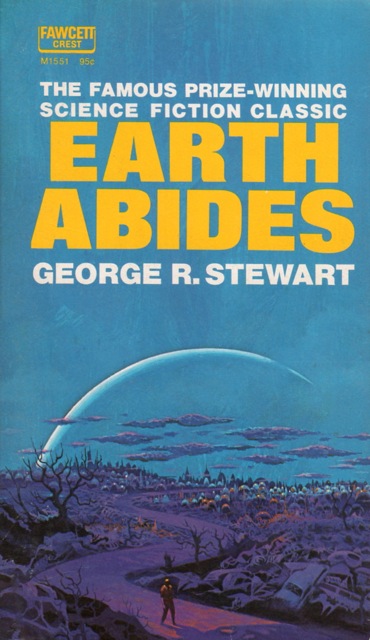
Recent travels yield wonderful SF hauls—including one of the most famous post-apocalyptical novels of all time, George R. Stewart’s Earth Abides (1949).  Thankfully my edition is graced with a gorgeous Lehr landscape—strange forms in the distances, crushed cars in the foreground.

The most famous SF anthology of all times—Ellison’s Dangerous Visions (1967).  As a proponent of the New Wave movement it’s about time that I snagged a copy (disclaimer before the cries of derision: I have already read numerous stories contained in the anthology).

An early Holdstock novel (I might get to that one soon)….

And a shot in the dark—M. K. Joseph’s The Hole in the Zero (1967).  John Clute (the noted SF critic) describes it such on SF Encyclopedia: it “begins as an apparently typical Space-Opera adventure into further dimensions at the edge of the Universe, but quickly reveals itself as a linguistically brilliant, complex exploration of the nature of the four personalities involved as they begin out of their own resources to shape the low-probability regions into which they have tumbled. Ultimately the novel takes on allegorical overtones. As an examination of the metaphorical potentials of sf language and subject matter, it is a significant contribution to the field.”  Sounds intriguing to me…

Thoughts?

1. Earth Abides, George R. Stewart (1949)

(Paul Lehr’s cover for the 1974 edition) Continue reading

Book Review: The Voices of Time and Other Stories, J. G. Ballard (1962)

(Richard Powers’ cover for the 1962 edition)

4.25/5 (collated rating: Good)

J. G. Ballard’s second short story collection, Voices of Time and Other Stories (1962), is only ever so slightly less brilliant than his first, Billenium (1962).   The stories are often linked thematically: exploring post-apocalyptical landscapes,  rituals in the face of death, urban alienation, mental fragmentation.   Scientists test whether humans can live without sleep, strange megaliths populate the volcanic landscapes of an alien planet, residual sounds are gathered in city dumps, and new ultra modern housing complexes facilitate detachment from the real world…

Highly recommended for all fans of literary, thought-provoking, and moody SF.   Ballard is one of the most routinely Continue reading

Adventures in Science Fiction Cover Art: Human Transformations + Transfigurations

LNHRZNSEB1974

(Vincent Di Fate’s cover for Alien Horizons (1974), William F. Nolan)

I have been gathering this series of SF covers for a while—the human shape contorting, manipulated, transforming into in-human forms (trees, keys, insects, etc).  Some are more metaphoric, for example Josh Kirby’s cover for the 1970 edition of A Century of Great Short Science Fiction Novels (1964).  While a few are clearly aliens which look “human”—Charles Shield’s incredibly uncanny cover for the 1979 edition of Fireflood and Other Stories (1979) by Vonda N. McIntyre….

All hint at bigger mysteries, and seduce with their uncertain Continue reading

Updates: Recent Science Fiction Acquisitions No. CXII (Spinrad + Vonnegut, Jr. + Mitchison + Anthology)

I’m a proponent of book store traveling (travel where bookstores are the first target).  Two Half Price Books and a quality independent used books store yielded what will be the first of many acquisition posts of worthy SF.

Who could resist a $5 signed copy of Spinrad’s masterpiece Bug Jack Barron (1967)?  Or a normally pricey edition of Naomi Mitchison’s Memoirs of a Spacewoman (1962) for $2?  And some Vonnegut, Jr. and a quality anthology containing the best of New Worlds….

Thoughts?

1. Bug Jack Barron, Norman Spinrad (serialized 1967)

(Alex Gnidziejko’s cover for the 1969 edition) Continue reading

Book Review: Transfigurations, Michael Bishop (1979)

(Mike Hinge’s cover for the 1979 edition)

4.25/5 (Good)

Note: A slightly shorter version of this review will appear in Big Sky, # 4 (a fanzine put together by Pete Young).

On the surface, Michael Bishop’s anthropologically inclined science fiction appears deceptively simple. In his first novel and unacknowledged masterpiece A Funeral for the Eyes of Fire (1975), the premise (moving an alien people from a planet) evolves into a vast and complex anthropological tapestry filled with stories within stories creating an almost claustrophobic doubling of characters. In Stolen Faces (1977) the biological mystery of a virulent disease grows, tumor-like, into a brilliantly nightmarish exploration of bodily and societal decay and the gravimetric forces of memory.

Bishop’s Hugo- and Nebula-nominated novella, “Death and Designation Among the Asadi” ( Continue reading

Updates: Recent Science Fiction Acquisitions No. CXI (Effinger + Farmer + Malzberg + anthology)

Two remaining books from the $1 hardback sale at my local bookstore….

A collection of Malzberg stories!

Another novel by one of my favorite SF authors, George Alec Effinger (i.e. his amazing metafictional novel What Entropy Means to Me (1972) blew me away)…

And finally an overpopulation/ecological disaster themed collection containing some great authors–Pamela Zoline, J. G. Ballard, Katherine MacLean, Kit Reed, Zelazny, etc.

Thoughts?

1. The Unreasoning Mask, Philip José Farmer (1981)

(Artifact’s cover for the 1981 edition) Continue reading

Book Review: False Dawn, Chelsea Quinn Yarbro (1978)

(Gary Friedman’s cover for the 1978 edition)

3.25/5 (Vaguely Good)

“One of the women wasn’t dead yet.  Her ravaged body hung naked from a broken billboard.  Her legs were splayed wide and anchored with ropes; legs and belly were bloody, there were heavy bruises on her face and breasts, and she had been branded with a large “M” for mutant” (1).

Before there was Mad Max (1979) dir. George Miller there was Chelsea Quinn Yarbro’s False Dawn (1978)… In 1972 she published her brutal and terrifying short story “False Dawn” in Thomas N. Scortia’s anthology Strange Bedfellows  (1972).  A few years later the work was deemed important enough to be included in Pamela Sargent’s famous anthology Women of Wonder (1975).  This story forms the first chapter of her post-apocalyptical novel False Dawn (1978).

In the 60s highly inventive post-apocalyptical stories flourished: for example, J. G. Ballard’s masterpiece The Drowned World (1962) filled with images of uterine spaces Continue reading

Updates: Recent Fantasy Acquisitions No. I (Hoban + Peake + Eddison)

Something different!

I have always had a soft sport for fantasy (mostly the non-Tolkein ripoff type) à la Mervyn Peake’s Titus Groan (1946), Stephen Donaldson’s Lord Foul’s Bane (1977), Jeff VanderMeer’s Shriek: An Afterword (2006).  Yes, as a kid I read tons of “standard fanasy” i.e. almost all those horrid Wheel of Time novels + Tad Williams’ Memory, Sorrow & Thorn  sequence, etc. etc.  And then I discovered SF and my reading parterns shifted drastically….

Over the past few months I’ve collected the two sequels to Titus Groan and a few Russell Hoban novels—my site name Joachim Boaz is  partially derived from Hoban’s remarkable The Lion of Boaz-Jachin and Jachin-Boaz (1973).

I’m not sure if I’ll review these novels here but, I might read Peake’s Gormenghast (1950) soon.

Thoughts?

1. Pilgermann, Russell Hoban (1983)

(Rowena’s cover for the 1984 edition) Continue reading

Book Review: The Worlds of Frank Herbert, Frank Herbert (1970)

(Paul Alexander’s cover for the 1977 edition)

3.25/5 (Collated rating: Vaguely Good)

I have long been a fan of Frank Herbert.   In my youth I scarfed down Dune (1965) and all its sequels and cried (metaphorically) when his son Brian Herbert made  a mockery of his vision.  I even read the more dubious novels in Herbert’s canon: from The Green Brain (1966) to the co-written (with Bill-Ransom)  novels of the Pandora sequence i.e. The Jesus Incident (1979), The Lazarus Effect (1983), and The Ascension Factor (1988).  I have found many of his non-Dune novels worth reading (Destination: Void (1966) and The Dosadi Experiment (1977), etc).

More recently I have started to read/review the handful of his novels I missed as a child—so far the solid and unexpectedly complex The Eyes of Heisenberg (1966) and the lesser Continue reading