Note: My read but “waiting to be reviewed pile” is growing. Short rumination/tangents/impressions are a way to get through the stack before my memory and will fades. My website partially serves as a record of what I have read and a memory palace for future projects. Stay tuned for more detailed and analytical reviews.
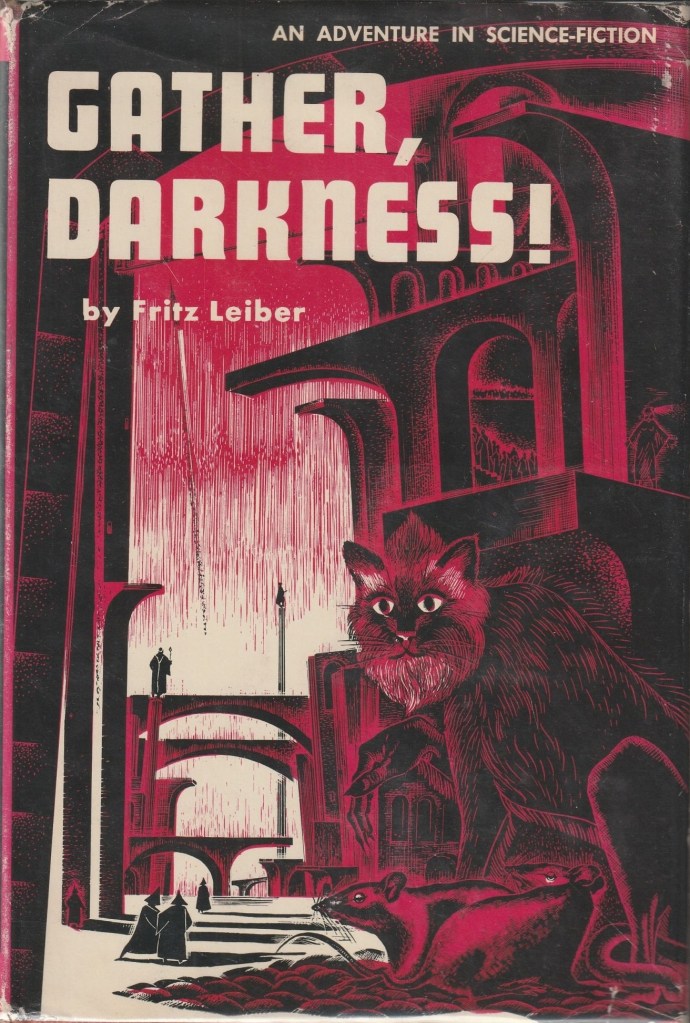
1. Fritz Leiber’s Gather, Darkness! (1943, novelized 1950)
Uncredited cover for the 1950 1st hardback edition
3.25/5 (Above Average)
Frtiz Leiber’s Gather, Darkness! first appeared across the May, June, and July 1943 issues of Astounding Science-Fiction, ed. John W. Campbell, Jr. It was novelized in 1950. Written in the midst of WWII, Gather, Darkness! is a product of an important moment in Leiber’s life. The previous year he abandoned his profession as a speech and drama instructor at Occidental College (1941-1942) and decided that “the struggle against fascism mattered more than his long-held pacifist convictions.” He joined Douglas Aircraft as a quality inspector and continued to publish science fiction.1
Which books/covers/authors intrigue you? Which have you read? Disliked? Enjoyed?
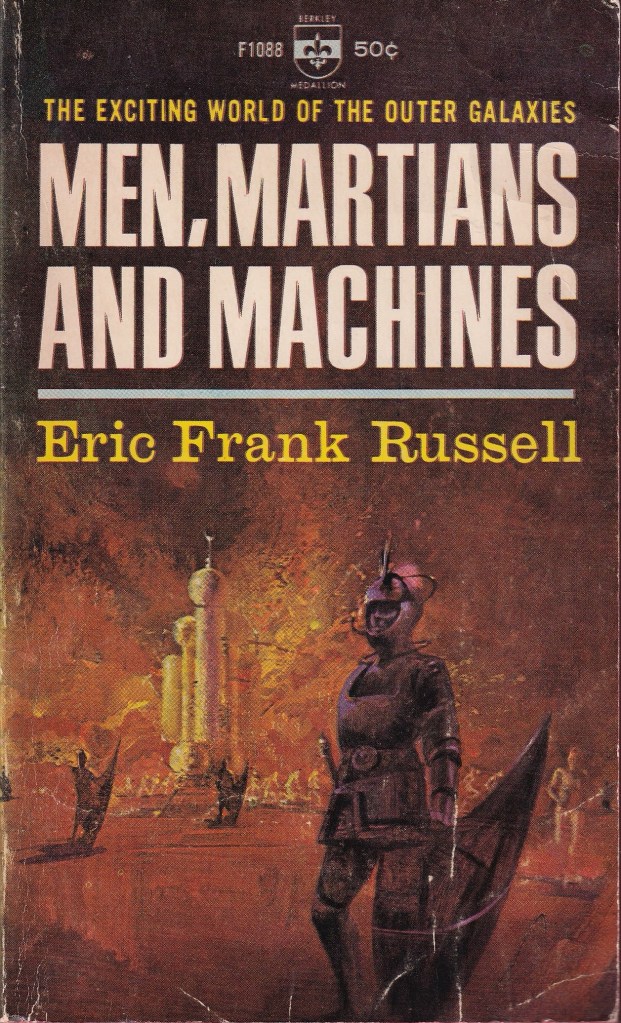
1. Men, Martians, and Machines, Eric Frank Russell (1955)
Paul Lehr’s–uncredited but certainly his style–cover for the 1965 edition
From the back cover: “VOYAGE OF THE MARATHON. Even at the time when space ships were making regular voyages across the universe, the MARATHON was a remarkable craft. Powered by the Flettner system, its speed was so great that for the first time exploration of the outer galaxies was made possible.
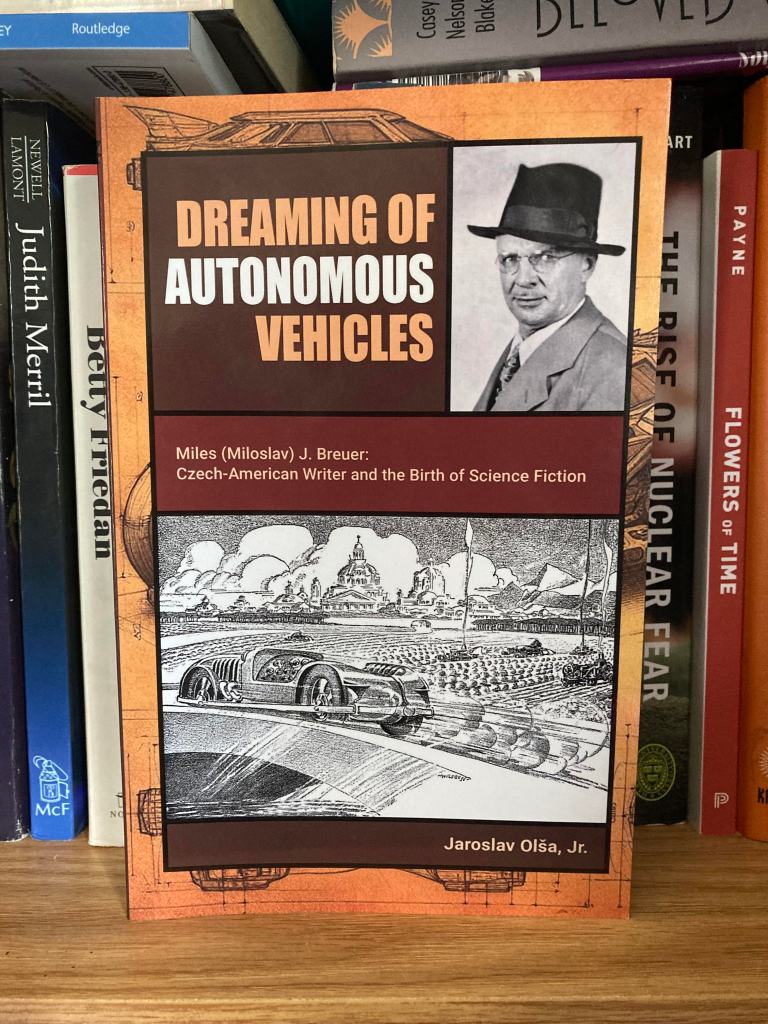
Over the last few years, I have incorporated a smattering of the vast range of spectacular scholarship on science fiction into my reviews and highlighted works with my Exploration Log series that intrigue me.1 Today I have an interview with Jaroslav Olša, Jr. about his brand-new book, Dreaming of Autonomous Vehicles: Miles (Miroslav) J. Breuer: Czech-American Writer and the Birth of Science Fiction (2025). In the book, he covers the life and career of Miles (Miroslav) J. Breuer (1889-1945), the first SF author to regularly write original stories for Hugo Gernsback’s Amazing. Breuer’s career also provides a fascinating window into the literary and cultural world of immigrants in late 19th and early 20th century America.
You can buy an inexpensive physical copy ($15.80 at last look) directly from Space Cowboy Books here (preferred) and on Amazon.
Thank you so much for agreeing to this interview. First, can you introduce yourself and your interests in science fiction?
Since childhood, I have loved reading science fiction, but — except for a short time — I have not been professionally attached to it. After studying Asian and African Studies and social sciences in Prague, Tunis and Amsterdam, I joined the Czech diplomatic three decades ago, and have served in various positions including Director of the African Dept. and the Head of the Policy Planning Dept. at the Czech Ministry of Foreign Affairs. I also served as a Czech Ambassador three times: to Zimbabwe for six years, to South Korea for another six years, and to the Philippines for four years. Since December 2020, I have served as Czech Consul General in Los Angeles in charge of the US West.
In the early 1980s, I became a part of a small but very active fandom when—in the then communist Czechoslovakia—the first science fiction club emerged. I started the SF fanzine Ikarie XB, which in 1990 turned into the first Czech-language professional SF magazine Ikarie, with monthly editions until 2024.
I have also translated many short stories and edited numerous SF anthologies, but never wrote fiction. But since the very beginning, the center of my interest in SF was to write about science fiction. I co-edited and authored entries in the only Czech SF encyclopedia, published in 1995. Thus my book about Miles (aka Miloslav) J. Breuer is somewhat of a culmination of my work on science fiction.
What drew you to the science fiction of Miles (Miloslav) J. Breuer (1889-1945)?
Over the last few years, I have attempted to incorporate a smattering of the vast range of spectacular scholarship on science fiction into my reviews and highlight works with my Exploration Log series that speak to me.1 Today I have an interview with Jordan S. Carroll about his brand-new book, Speculative Whiteness: Science Fiction and the Alt-Right (2024). In the book, he examines the ways the alt-right uses classic science fiction imagery and authors to mainstream fascism and advocate for the overthrow of the state.
You can buy an inexpensive physical copy ($10) directly from the University of Minnesota Press website or an eBook version ($3.79) on Amazon.
Thank you so much for agreeing to this interview. First, can you introduce yourself and research interests?
My article on organized labor in the 1940s and ’50s science fiction of Clifford D. Simak went live! I’d love to hear your thoughts. I’ve spent the last half year researching and reading religiously for this project–from topics such as Minnesota’s unique brand of radical politics to the work of contemporary intellectuals like C. Wright Mills (1916-1962) whom Simak most likely read.
Please check out the complete issue edited by Olav Rokne and Amanda Wakaruk over at Journey Planet. I have also embedded the PDF below.
The issue contains great work on the depiction of labor rights in a vast variety of other SF mediums. There are four articles that touch on vintage SF. The first two listed are by wonderful community members and official “Friends of the Site.”
A selection of previously read novels from my shelf
What pre-1985 science fiction are you reading or planning to read this month? Here’s July’s installment of this column.
Last month I waxed rhapsodic about a powerful interaction with a professor in graduate school… this month I’ll show you a recent obsessive territory I’ve been reading and ruminating about: 1940s and 1950s (and a few from the 60s) social commentary on American affluence, technology, and media. It all started with my media landscapes of the future series–I could not write on the topic unless I read some Marshall McLuhan. And then I had to read about C. Wright Mills to write about Clifford D. Simak and organized labor. And then I needed to track down other popular authors of social commentary published in era. It should not be surprising so much 50s SF revolved around social commentary — it was in the air. You get the idea. This pile represents some of what I now own:
I’ve finally completed my article for Journey Planet on depictions of organized labor in the 40s and 50s science fiction of Clifford D. Simak. I plan on adding to it over the next few months as I read more. After it appears for Journey, I’ll post it on my site in whatever version is current. The project lead me to read a vast range of Simak short fictions, a small slice of which I’ve reviewed on my site, including the first two stories revised for his iconic masterpiece City (1952). I’ll cover “Huddling Place” (1944) soon as well.
Enjoy!
William Timmins’ cover for Astounding Science Fiction, ed. John Campbell, Jr. (May 1944)
4.25/5 (Very Good)
“City” first appeared in Astounding Science Fiction, ed. John Campbell, Jr. (May 1944). You can read it online here.
This is a good one! I read the 1952 novelized version of the City stories in my late teens. At the time, logically, I was fascinated by the sentient dogs and the slow apocalypse of humanity that unfolds across the generations. For whatever reason, the earliest stories without dogs, for example “City” (1944) and “Huddling Place” (1944), faded from the culminative aura the novel generated all these years later. This project compelled me to break my deep-seated compulsion to read what I haven’t read before.
Which books/covers/authors in the post intrigue you? Which have you read? Disliked? Enjoyed?
1. Away From the Here and Now, Clare Winger Harris (1947)
Uncredited–JM initials but no known name–cover for the 1st edition
From the inside flap: “In this age of atomic bombs and radar to the moon, Mrs. Harris’ stories may prove closer to the “here and now” than the title would indicate. Mrs. Harris Proudly claims the distinction of being the first woman science-fiction writer in the country. Each of her stories is based upon a sound scientific fact, carried so plausibly to the nth degree that at no time does it overstain credulity. The stories possess the qualities of dealing with ideas of big importance to the human race, of presenting those ideas in a plausible form, and of appealing to emotions that exist deep within the heart of every human being whether he be scientific or not.
Today I’ve selected two early Clifford D. Simak “apprentice” stories–“Masquerade” (1941) and “Tools” (1942)–deeply critical of the American business ethic.1 Collectively they posit a future in which colonization goes hand-in-hand with the exploitation of resources, workers, and threatens the alien intelligences they encounter.2
Welcome to a future of capitalistic vastation!
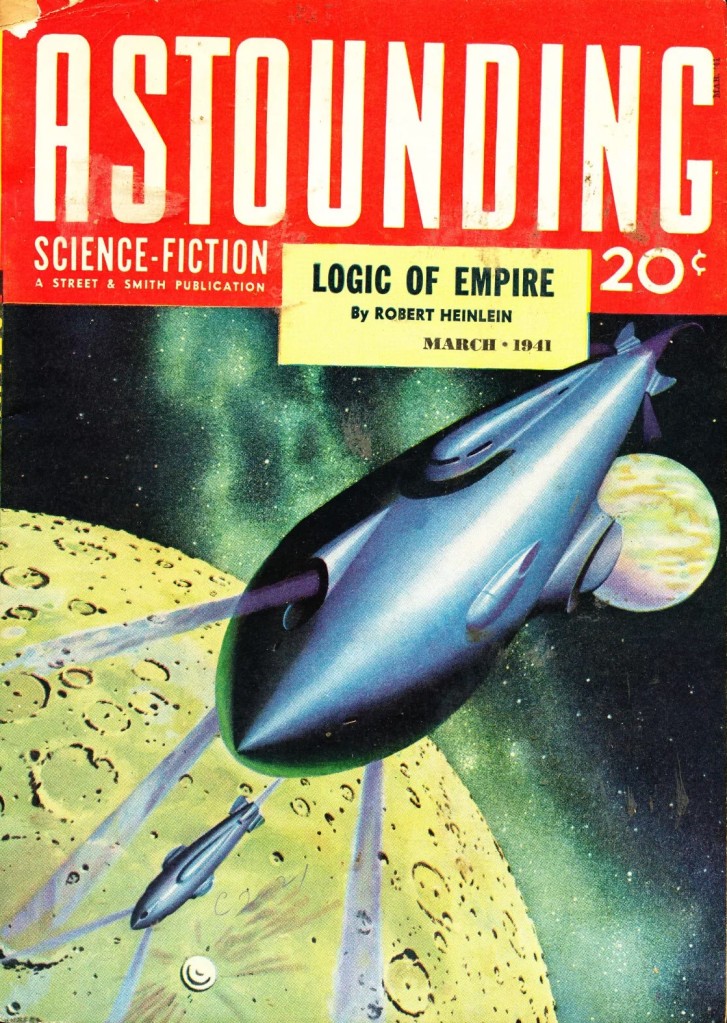
Hubert Rodger’s cover for Astounding, ed. John W. Campbell, Jr. (March 1941)
3/5 (Average)
“Masquerade” first appeared in Astounding, ed. John W. Campbell, Jr. (March 1941). You can read it online here.
In the surprisingly bleak “Masquerade” (1941), metamorphic aliens on Mercury’s radiation-blasted surface parrot human actions. Beneath their clownish behavior is a plot, a plot to takedown an Earth corporation. The story begins with a disquieting sequence in the bleak expanse outside a sunlight harvesting power station on the surface of Mercury: “the Roman candles, snatching their shapes from Creepy’s mind, had assumed the form of Terrestrial hillbillies and were cavorting the measures of a square dance” (57). The Candles, “kicking up the dust, shuffling and hopping and flapping their arms” (58), are the mysterious natives of Mercury. In classic Simak fashion, there’s a method to their apparent comic madness.3




 Science Fiction and Other Suspect Ruminations