Adventures in Science Fiction Cover Art: Imprisoned in Glass Vials (of the metaphoric + medical + experimental variety)

(Uncredited cover for the 1969 edition of The Fortec Conspiracy (1968), Richard M. Garvin and Edmond G. Addeo)

Humans and aliens in glass vials of all shapes and sizes waiting to be measured, matured, tested, analyzed, exposed to a variety of chemicals and emulsions.  The artists often combine the iconic laboratory scene filled with the tools of the trade with sci-fi speculation on human experimentation (queue babies grown in containers in Brave New World).  The result, humans in tubes.  The effect is downright terrifying and one suspects, evokes a certain moribund fascination.  As with the famous introductory sequence in Brave New World, the reader is horrified by birth entirety regulated by machines.  Or, we are simultaneously titillated Continue reading

Adventures in Science Fiction Cover Art: Nuclear Explosions + Mushroom Clouds

(Ed Valigursky’s cover for the 1957 edition of Doomsday Eve (1957). Robert Moore Williams)

The nuclear scare produced some of the best dystopic visions ever put to paper — the devastation would be utter, complete, and the radiation, oh what fun science fiction authors and filmakers had with the effects of radiation.  A red spectrum! Mutations! Hybrid bug people!  Godzilla!  Women with two heads!  An endless assortments of monsters…  I’ve selected a wide range of covers depicting the actual nuclear explosion — not the after effects.  Families gaze from caves in dispair, watching the bomb incinerate their world.  People run helter-skelter away from the explosion.  Or, artists take a more stylized approach to the explosion — figures are cast upward amongst the wreckage of buildings. Continue reading

Adventures in Science Fiction Cover Art: Spaceships Under Construction

(James B. Settles’ cover for the October 1948 issue of Amazing Stories)

A spaceship rearing from the plain, scaffolding surrounds its lithe form…  A classic image (the new Star Trek movie for example)!  Often utilizing a very traditional science fiction trope which I’ve dubbed Rocket Field Figure, cover art concerning spaceship construction is often more stylized than realistic.  My favorite is Carlo Jacono’s cover for the Italian edition of The Stars are Ours (1954).  I’m not sure that he is actually the artist due to the fact that MANY foreign editions use the work of American or British artists  modified slightly (this is not a hard fast rule, the work Continue reading

Adventures in Science Fiction Cover Art: My Top 15 Science Fiction Covers

1. Harold Bruder’s cover for the 1967 edition of Pyschogeist (1966), L. P. Davies.

Because everyone loves lists…

…I’ve selected from my collection of cover art, placed in no particular order, my fifteen favorite science fiction covers of all time.  Of course, lists being lists, and the fact that I’ve only seen a portion of all the covers ever made, it is incomplete and maleable.  Although many of the most famous sci-fi artists (Powers, Lehr, and pulp masters such as Wesso) feature, some of my favorites are by lesser known artists whose visual contributions to the field should not be forgotten (Bruder, Podwil, Foster, Schongut, etc).

A few points to consider: 1) The artist rarely had control over the font.  If the graphic designer responsible for putting together the final cover wasn’t up to snuff, the text often doesn’t Continue reading

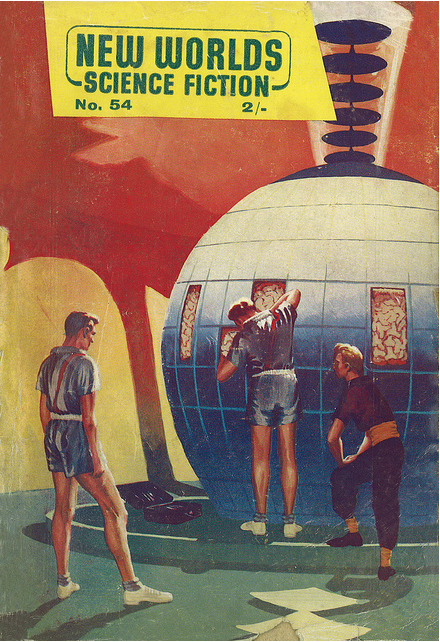
Adventures in Science Fiction Cover Art: Disembodied Brains, Part I

(Gerard Quinn’s cover for the December 1956 issue of New Worlds)

Disembodied brains — in large metal womb-like containers, floating in space or levitating in the air (you know, implying PSYCHIC POWER), pulsating in glass chambers, planets with brain-like undulations, pasted in the sky (GOD!, surprise) above the Garden of Eden replete with mechanical contrivances among the flowers and butterflies and naked people… The possibilities are endless, and more often than not, taken in rather absurd directions.

I’ve cobbled together a large variety of images from pulp magazines to covers from the late 70s.  My favorites include Valigrusky’s Continue reading

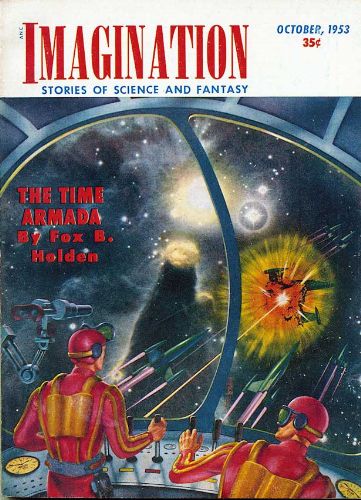
Adventures in Science Fiction Cover Art: Scenes from the Control Room

(Malcolm Smith’s cover for the October 1953 issue of Imagination)

Inspired by some of the cover art I found for my earlier post Through the View Screen, Through the Window, I decided to focus on the image of gazing from within the control room of a spaceship (either at objects within or scenes outside the view screens).  The trope is extraordinarily effective at conveying the action of a story: the unfolding canvas of an epic battle, the tension of charting a course through the stars and nefarious nebulae, the destruction of cities, the last glance at a beautiful astronaut adrift, or even, Earth within grasp!

I’ve tried not to be redundant in the covers I use — with this Continue reading

Adventures in Science Fiction Cover Art: Eye[s] in the Sky

(Ed Valigursky’s cover for the 1957 edition of Eye in the Sky (1957), Philip K. Dick)

Inspired by Ed Valigursky’s stunning cover for the 1957 edition of Philip K. Dick’s early novel Eye in the Sky (1957), I kept on the lookout for novels with similar disembodied eyes (floating, gazing with menacing presence at fearful scurrying forms arrayed below).  I discovered that it was a common theme — sci-fi artists use eyes to illustrate otherworldly (alien, spiritual) presence, big brother-esque governmental control, inhuman powers…  Few equal the true presence of Ed Valigursky’s cover but are fascinating nevertheless.

Many years ago I read Eye in the Sky but remember little.  I was intrigued but not blown away by Simak’s Way Station (below).  Dr. Futurity (below) is waiting to be read on my shelf and Continue reading

Updates: Recent Science Fiction Acquisitions No. XXV (Silverberg + Dickson + Bester + et al.)

I have a substantial backlog of purchases from my “productive” book hunting Spring Break in Texas….

I’ve read Alfred Bester’s The Demolished Man (1952), which I loved, and The Stars My Destination (1956), which I mostly enjoyed, however I’ve rarely seen his short story collections in used book stores.  I snatched up the gorgeous covered The Dark Side of the Earth (1956).  I suspect Bester is even better at short stories than his novel length works….

The Time of the Great Freeze (1964) is considered one of Robert Silverberg’s best pulp works.  On indirect advise of my friend Michael Dalke at Potpourri of Science Fiction Literature, I’ve procured more of Gordon R. Dickson’s short works…  Thankfully, he hasn’t reviewed the collection The Star Road (1973) yet (I think) — we have a “rivalry.”  Haha.

I’ve already reviewed the short story collection edited by Donald Wollheim, The End of the World (1956) (MY REVIEW), and highly recommend it. A few of the stories are duds but two are in my top 5 short work list.  Philip K. Dick’s ‘Impostor’ (1953) alone is reason enough to track down the volume.

1. The Dark Side of the Earth (1964), Alfred Bester (MY REVIEW)

(Uncredited cover for the 1964 edition) Continue reading

Book Review: The End of the World (1956), ed. Donald Wollheim

(Ed Emshwiller’s? cover for the 1956 edition)

3.75/5 (Good)

 The End of the World (1956) is a highly readable collection of short works by some of the leading figures of the 50s:  Robert Heinlein, Edmond Hamilton, Philip K. Dick,  and Arthur C. Clarke are the most notable contributors.  All the works, including the short by the virtually unknown author Amelia Reynolds Long, have appeared in other volumes but it’s nice to have them grouped according to theme with a quality Ace edition 50s Emshwiller cover.

Wollheim gathers together a fascinating range of accounts of the end of the world — seen through the eyes of aliens, humans from the present viewing the future, the last men on earth surveying the ruins, a robotic bomb who thinks it’s human and “accidentally” triggers the end of the Continue reading