Short Book Reviews: Fritz Leiber, Jr.’s Gather, Darkness! (1943, novelized 1950) and Gillian Freeman’s The Leader (1965)

Note: My read but “waiting to be reviewed pile” is growing. Short rumination/tangents/impressions are a way to get through the stack before my memory and will fades. My website partially serves as a record of what I have read and a memory palace for future projects. Stay tuned for more detailed and analytical reviews.

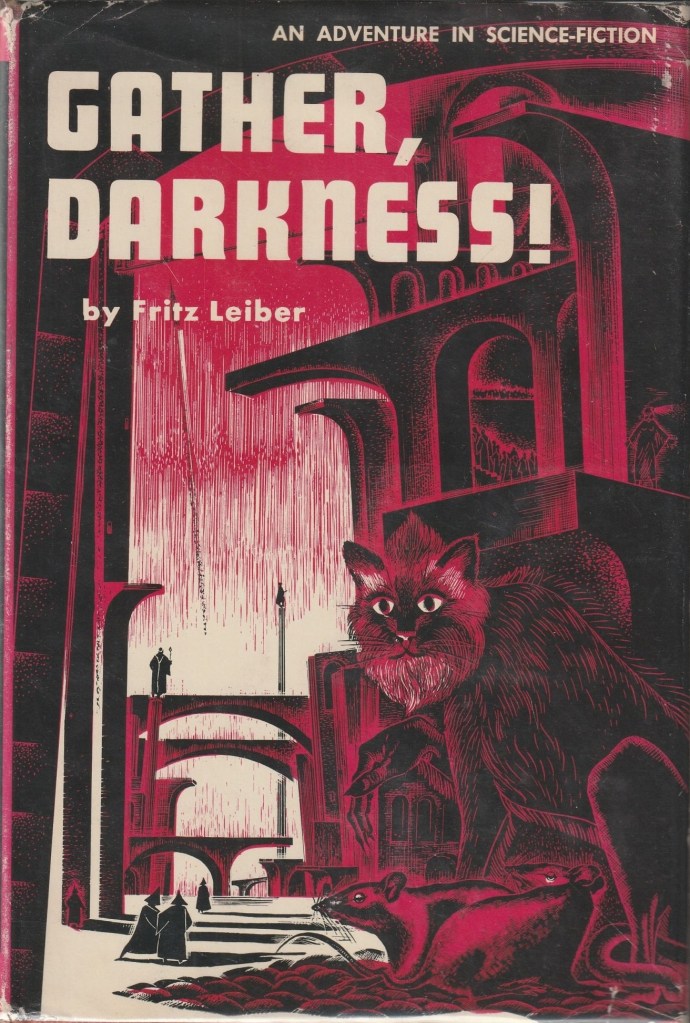
1. Fritz Leiber’s Gather, Darkness! (1943, novelized 1950)

3.25/5 (Above Average)

Frtiz Leiber’s Gather, Darkness! first appeared across the May, June, and July 1943 issues of Astounding Science-Fiction, ed. John W. Campbell, Jr. It was novelized in 1950. Written in the midst of WWII, Gather, Darkness! is a product of an important moment in Leiber’s life. The previous year he abandoned his profession as a speech and drama instructor at Occidental College (1941-1942) and decided that “the struggle against fascism mattered more than his long-held pacifist convictions.” He joined Douglas Aircraft as a quality inspector and continued to publish science fiction.1

Continue reading

Updates: Recent Science Fiction Purchases No. CCCXLVIII (Eric Frank Russell, Ben Bova, Pat Frank, and John Collier)

Which books/covers/authors intrigue you? Which have you read? Disliked? Enjoyed?

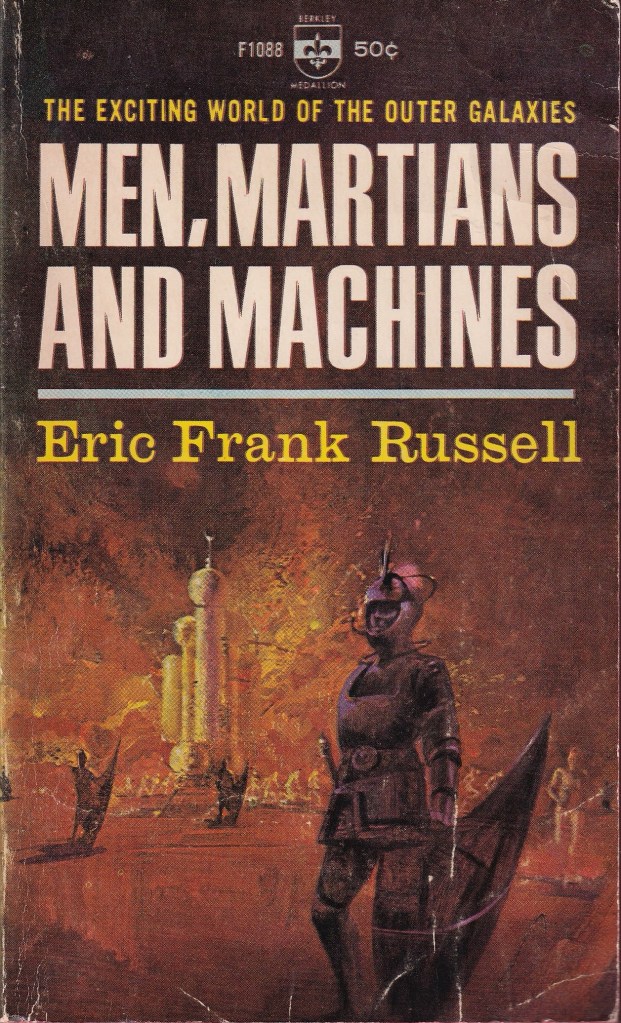
1. Men, Martians, and Machines, Eric Frank Russell (1955)

From the back cover: “VOYAGE OF THE MARATHON. Even at the time when space ships were making regular voyages across the universe, the MARATHON was a remarkable craft. Powered by the Flettner system, its speed was so great that for the first time exploration of the outer galaxies was made possible.

Continue reading

Generation Ship Short Stories: Mari Wolf’s “The First Day of Spring” (1954) and Francis G. Rayer’s “Continuity Man” (1959)

This is the 22nd post in my series of vintage generation ship short fiction reviews. While I have dabbled in the more esoteric as of late due the rapidly decreasing number of available choices, thanks go out to all who have joined some part of my read-through already. I’ve also compiled an extensive index of generation ship SF–expanded from a monograph by Simone Caroti–if you wish to track down my earlier reviews on the topic and any that you might want to read on your own.1

Previously: George Hay’s Flight of the “Hesper” (1952)

Next Up: TBD

2.75/5 (Below Average)

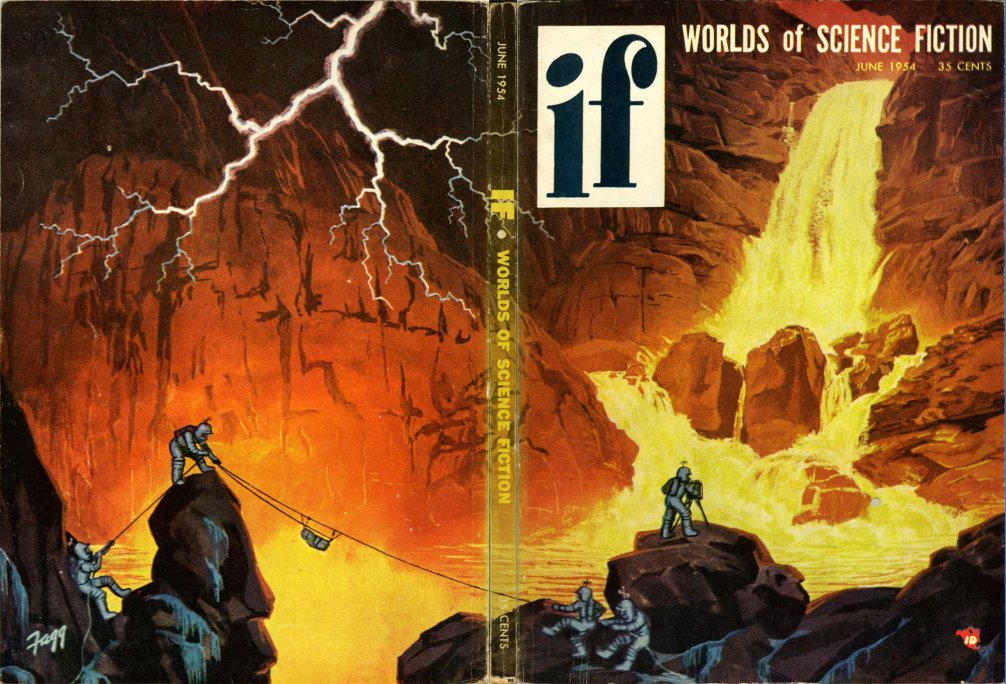
Mari Wolf’s “The First Day of Spring” first appeared in If, ed. James L. Quinn (June 1954). You can read it online here.

As I mentioned in my only other review of Mari Wolf’s work, she’s best known for her contributions to fandom including the Fandora’s Box column (1951-1956) in Imagination. In addition, Mari Wolf (1926-) published seven short stories between 1952 and 1954, six of which appeared in If. Unfortunately, after her divorce in 1955 from fellow SF author Rog Phillips (1909-1966), she stopped publishing SF. Here is a brief bibliographic blurb on her life, career, and SF endeavors. Ted White wrote an article about her in the fanzine e*I*5 (Vol. 1 No. 5) December 2002 (here). The issue also includes Wolf’s short story “Prejudice” (1953), which only received a fanzine publication.

The Nature of the Generational Voyage

Continue reading

Book Review: William Tenn’s Time in Advance (1958)

3.5/5 (collated rating: Good)

Over the years, I’ve slowly made my way through a substantial portion of William Tenn’s output: I’ve reviewed his only SF novel Of Men and Monsters (1968), two short story collections–The Human Angle (1956) and Of All Possible Worlds (1955), and three additional short stories “Bernie the Faust” (1963), “Eastward Ho!” (1958), and “Generation of Noah” (1951). I’ve found him an effective satirist with a penchant for often self-defeating twist endings. At his best, Tenn challenges grand narratives of American progress and exceptionalism, 50s consumerist culture and gender roles, and renders an absurdist spin on Cold War conflict. I imagine his reluctance to write novels relegates his often brilliant ouvre to the fringes of contemporary interest in 50s SF.

Continue reading

Updates: Recent Science Fiction Purchases No. CCCXLVII (Edgar Pangborn, Rudy Rucker, Sally Miller Gearhart, and a SF anthology)

Which books/covers/authors intrigue you? Which have you read? Disliked? Enjoyed?

The first purchases of 2026!

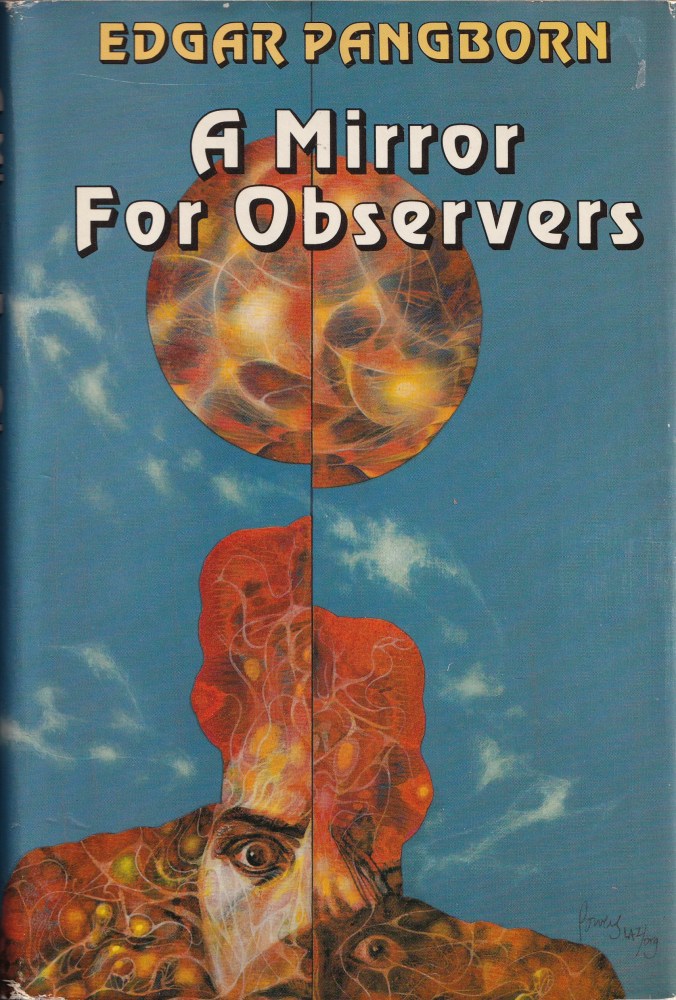
1. A Mirror For Observers, Edgar Pangborn (1954)

From the back cover: “We would call them Martians, though they refer to themselves as Salvayans. Refugees from their dying planet, they arrived on our world almost 30,000 years ago to make new lives for themselves. From their vast underground cities, hidden from discovery, the Salvayans have ben observing us with care and concern, waiting for the day when humans will be ready to meet them. The Salvayans are not many, but they are long-lived and patient….

Continue reading

My 2025 in Review (Best Science Fiction Novels and Short Fiction, Reading Initiatives, and Bonus Categories)

Here’s to happy reading in 2026! I hope you had a successful reading year. Whether you are a lurker, occasional visitor, a regular commenter, a follower on Bluesky or Mastodon, thank you for your continued support. As I say year after year, It’s hard to express how important (and encouraging) the discussions that occur in the comments, social media, and via email are to me. I’m so thankful for the lovely and supportive community of readers, writers, and discussion partners that stop by.

What were your favorite vintage SF reads–published pre-1985–of 2025? Let me know in the comments.

Throughout the later part of the year I’ve dropped hints about a research project. Perceptive readers might have parsed together the contours of the research: late 19th/early 20th century, utopian, African American, the American South, radical politics… It’s taking longer than expected. I’ve read a good ten monographs, five dissertations, countless articles. I’ve written twenty pages. I hoped to have it posted by early in this year. Alas. It’s coming together–slowly. Stay tuned.

Without further ado, here are my favorite novels (I only read a few) and short stories (I read a ton of those) I read in 2025 with bonus categories. I made sure to link my longer reviews where applicable if you want a deeper dive.

Check out my 202420232022, and 2021 rundowns if you haven’t already. I have archived all my annual rundowns on my article index page if you wanted to peruse earlier years.


My Top 5 Science Fiction Novels of 2025

1. Octavia E. Butler’s Clay’s Ark (1984), 4.5/5 (Very Good). Full review.

Continue reading

Short Book Reviews: Kim Stanley Robinson’s Icehenge (1984) and Peter Vansittart’s The Game and the Ground  (1956)

Note: My read but “waiting to be reviewed pile” is growing. Short rumination/tangents/impressions are a way to get through the stack before my memory and will fades. My website partially serves as a record of what I have read and a memory palace for future projects. Stay tuned for more detailed and analytical reviews.

You’ll soon understand why I haven’t posted regularly. There’s a substantial article (mostly complete) with original (and laborious) research on the horizon. Stay tuned!

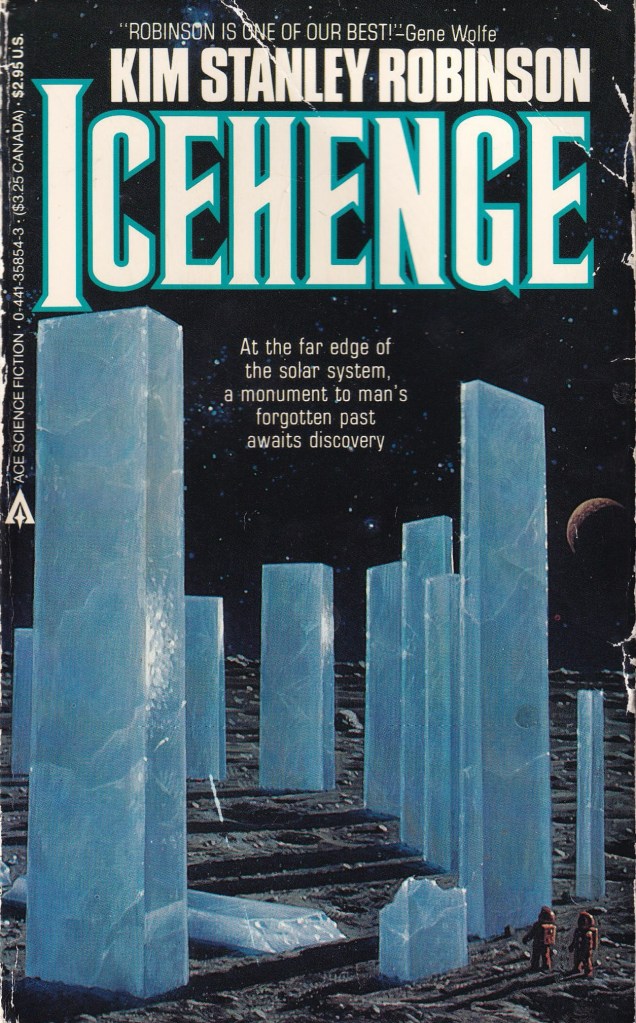
1. Kim Stanley Robinson’s Icehenge (1984)

4.5/5 (Very Good)

Kim Stanley Robinson’s Icehenge (1984), a fix-up from two previously published stories “To Leave a Mark” (1982) and “On the North Pole of Pluto” (1980), tells three interconnected tales that all connect to a mysterious monolith left on Pluto (the titular Icehenge).

In part I (2248 A.D.), hydroponics specialist Emma Weil, stationed on a mining ship in the asteroid belt, finds herself caught up in a radical act of defiance to coincide with a revolt on Mars–the creation of a spaceship for a voyage outside the solar system. She must confront the pull of home and the multitude of ways the power of the state informs and manipulates her life. In part II (2547 A.D.), historian and archaeologist Hjalmar Nederland discovers evidence of the revolt on Mars long covered up by authorities, the diary of Emma Weil, and the monolith on Pluto — a testament to the act of defiance? In so doing, he too, must reckon with Mars’ bureaucratic dictatorship and its amorphous ability to claim narratives of resistance as its own. In part III (2610 A.D.), Edmond Doya, a descendant of Nederland, spins his own conspiracy theory casting all that went before into question. As the threads intersect and split and cross, a voyage sets off, again, for Pluto and its icy pillars—a testament to our desire to find meaning in a disenchanted world.

Continue reading

What pre-1985 science fiction are you reading? + Update No. XXVII

What pre-1985 science fiction are you reading or planning to read next month? Here’s the October installment of this column.

If I’m feeling a bit unmotivated to write about science fiction, I always end up on Fanac or another online repository of fanzines/newspapers exploring all the old historical fannish debates. I especially enjoy their reports on various conventions and the community (from accepting to reactionary) that emerges. For example, the details I uncovered about a lost Philip José Farmer speech titled “SF and the Kinsey Report at the 11th World Science Fiction Convention (Philcon 2) in Philadelphia (September 1953) and Pat M. Kuras and Rob Schmieder’s article “When It Changed: Lesbians, Gay Men, and Science Fiction Fandom” (1980) on the first Worldcon panel with an openly LGBTQ topic: “The Closed Open Mind: Homophobia in Science Fiction Fantasy Stories” moderated by Jerry Jacks, one of the “early openly gay fans.” I recently edited a friend’s article for academic publication on the role of conventions in forming feminist and political activism. Conventions sound like fascinating places, at least from my historically-minded vantage point and lens.

Continue reading

Updates: Recent Science Fiction Purchases No. CCCXLVI (Kim Stanley Robinson, Miriam Allen DeFord, Keith Laumer, and Jack Dann)

Which books/covers/authors intrigue you? Which have you read? Disliked? Enjoyed?

Finally acquired a new scanner!

1. The Memory of Whiteness, Kim Stanley Robinson (1985)

From the back cover: “In the 33rd century humanity is scattered among the planets of the Solar System. Millions of lives depend on the revolutionary physics of Arthur Holywelkin; millions of hears are moved by the music created by the strange, eerie instrument he built in the last years of his life: the Orchestra. Johannes Wright is the Ninth–and youngest–Master of the Orchestra. But as he sets out on his first Grand Tour of the Solar System, unseen foes are at his heel, ready to reveal all but the meaning of their enmity. In confronting them, Wright must redefine the Universe–for himself and all humanity.”

Continue reading