Which books/covers/authors intrigue you? Which have you read? Disliked? Enjoyed?
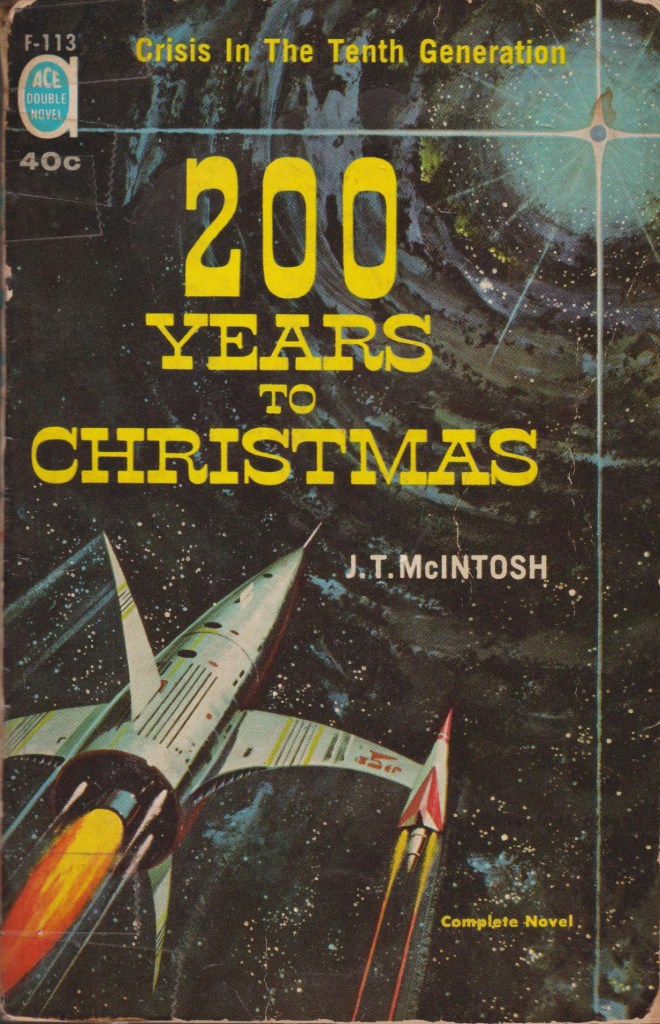
1. 200 Years to Christmas, J. T. McIntosh (1959)
Ed Valigursky’s cover for the 1961 edition
From the inside flap: “For almost two centuries the huge spaceship had speared its way through the stars, bound for another two hundred years of travel before it would put down on a new planet, a new home for the Earth people.
On board the metal-enclosed worldlet were four hundred people; the last survivors of Earth. It was up to them to start life anew, to correct the mistakes their ancestors had made.
This is the 16th post in my series of vintage generation ship short fiction reviews. Today I have an interesting formulation of the generation ship–its component parts dispersed across multiple vessels–that did not appear on Simone Caroti’s list that spurred this project.
As a reminder for anyone stopping by, all of the stories I’ll review in the series are available online via the link below in the review.
You are welcome to read and discuss along with me as I explore humanity’s visions of generational voyage. And thanks go out to all who have joined already. I also have compiled an extensive index of generation ship SF if you wish to track down my earlier reviews on the topic and any that you might want to read on your own.
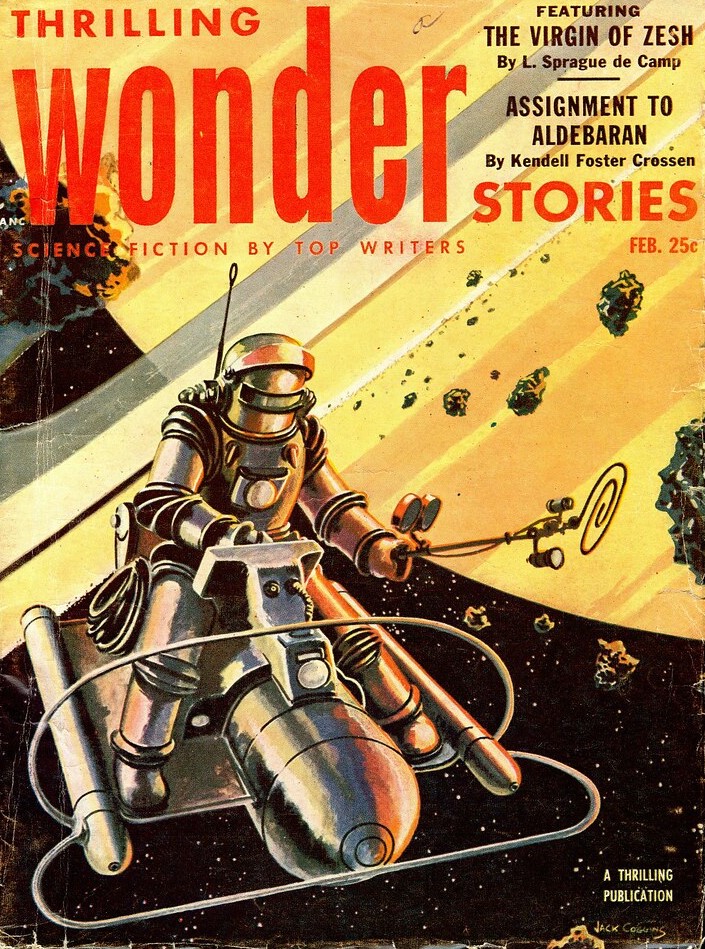
Jack Coggins’ cover for Thrilling Wonder Stories, ed. Samuel Mines (February 1953)
2/5 (Bad)
Julian May’s “Star of Wonder” first appeared in the February 1953 issue of Thrilling Wonder Stories, ed. Samuel Mines. You can read it online here.
After getting involved with SF fandom in her teens, Julian May (1931-2017) published two short stories in the 1950s before returning in the 1980s with the multi-volume Saga of the Pliocene Exile sequence (1981-1984). In between, according to Wikipedia, May worked with her husband T. E. Dikty in publishing, wrote children’s fiction and nonfiction, Buck Rogers comic strips, and even Catholic catechism for publishers affiliated with the Franciscans. Of her two 50s SF tales, “Dune Roller” in the December 1951 issue of Astounding Science Fiction remains by the best known (I suspect for good reason). It received both a TV adaptation for Tales of Tomorrow and film version.
My series on 1950s stories on sex and sexuality finds itself relentlessly drawn back to the well-trodden post-apocalyptic wasteland. New moralities are inscribed and ritualized in the wreckage. As Paul Brians points out in Nuclear Holocaust: Atomic War in Fiction, 1895-1984 (1987), authors in the 1950s and 60s demonstrate an obsession with the sex in the post-holocaust landscape as if they are “feverishly battling atomic thanatos with eros” [note 1]. Here I have paired two moments that dance around either side of the nuclear nightmare. Langdon Jones’ “I Remember, Anita…” (1964), the most controversial story from the early issues of Michael Moorcock’s New Worlds, explores an intense love affair in the moments before and after impact. Ward Moore’s shocker “Lot” (1953) charts the moments after impact as the masses flee from the city.
If any stories on 1950s stories on sex and sexuality come to mind that I haven’t read yet let me know in the comments. I have a substantial list waiting to be covered but I suspect it’s far from comprehensive.
Loretta Trezzo’s cover for the 1st edition of Beyond Armageddon: Twenty-One Sermons to the Dead, ed. Martin H. Greenberg and Walter M. Miller, Jr. (1985)
4.5/5 (Very Good)
Ward Moore’s “Lot” first appeared in The Magazine of Fantasy and Science Fiction, ed. Anthony Boucher and J. Francis McComas (May 1953). You can read it online here.
Since 2021, I’ve put together a series on the first three published short fictions by female authors who are new(ish) to me and/or whose most famous SF novels fall mostly outside the post-WWII to mid-1980s focus of my reading adventures. So far I’ve featured Josephine Saxton (1935-), Carol Emshwiller (1921-2019), Wilmar H. Shiras (1908-1990), Nancy Kress (1948-), Melisa Michaels (1946-2019), Lee Killough (1942-), Betsy Curtis (1917-2002), and Eleanor Arnason (1942-).
I do not expect transformative or brilliant things from first stories. Rather, it’s a way to get a sense of subject matter and concerns that first motivated authors to put pen to paper and to further map the territories that fascinate me.
Phyllis Gotlieb (1926-2009) was one of a legion of authors who received a debut under the influential editorship of Cele Goldsmith (1933-2002). Goldsmith fostered the early careers of Ursula K. Le Guin, Keith Laumer, Thomas M. Disch, David R. Bunch, Roger Zelazny, among many others. For a fascinating look at her years at Amazing Stories, check this later reflection article. Goldsmith writes: “My greatest pleasure was developing and publishing new, talented writers. I was not a writer and never aspired to be. But I was an editor who loved to help writers adapt their ideas and copy for the audience. My requirements: credible (or incredible), well-plotted, care- fully developed stories. My criteria for acceptance: ‘goose flesh’ while reading a submission.” For more on her contribution to the field, check out “Friend of the Site” John Boston and Cora Buhlert’s article over on Galactic Journey. Barry N. Malzberg also interviewed her in 2003.
Gotlieb, also known for her poetry, was born in Canada and received an M. A. in English from the University of Toronto. Her first novel–which I acquired recently—Sunburst appeared in 1964. Her novella “Son of the Morning” (1972) received a Nebula Award nomination. Here’s her complete bibliography. I have read none of her work until now!
Taylor Oughton’s cover art for Fantastic Science Fiction Stories, ed. Cele Goldsmith (September 1959)
Which books/covers/authors intrigue you? Which have you read? Disliked? Enjoyed?
1. From the Land of Fear, Harlan Ellison (1967)
Diane and Leo Dillon’s cover for the 1st edition
From the back cover: “SCIENCE FICTION STORIES by Award Winning Author
WHERE DID HARLAN ELLISON COME FROM?
At 13 he ran away from home in Ohio and joined a carnival. At 15 he was driving a dynamite truck in North Carolina. At 19 he was thrown out of college and at 21 had sold his first novel. Today he is 33 and is considered one of the top screenwriters in Hollywood. Fairly ordinary background? True.
But somewhere along the way, Harlan Ellison made a strange detour. He vanished into a country of the mind where time and space ceased to exist, where strange ideas and wild adventures were commonplace. He came back from that dark world, carrying away with him its richest treasures: stories unlike any ever told before. In this unusual book you will sample these “stray dreams.”
2022 was the single best year in the history of my site for visits and unique viewers!
As I mention year after year, I find reading and writing for the site—and participating in all the SF discussions generated over the year—a necessary and greatly appreciated salve. Whether you are a lurker, occasional visitor, or a regular commenter, thank you for your continued support.
Continuing a trend from 2021, I read only a handful of novels this year. Instead, I devoted my obsessive attention to various science short story review initiatives (listed below), anthologies, and histories of the science fiction genre. Without further ado, here are my favorite novels and short stories I read in 2022 with bonus categories. Descriptions are derived from my linked reviews.
Check out last year’s rundown if you haven’t already for more spectacular reads. I have archived all my annual rundowns on my article index page if you wanted to peruse earlier years.
My Top 5 Science Fiction Novels of 2022 [TITLES LINK TO FULL REVIEWS]
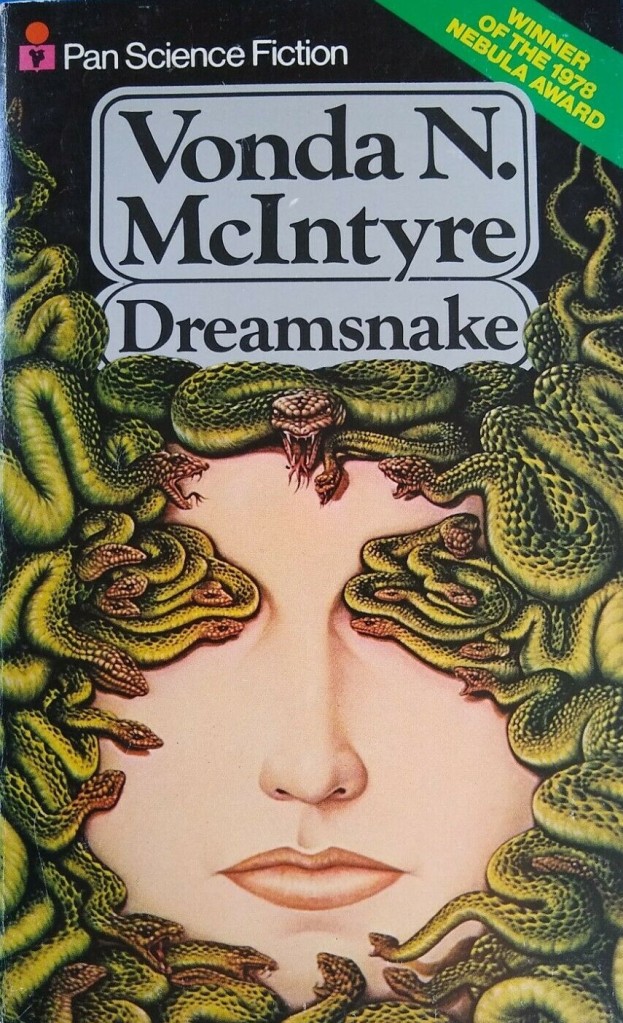
George Underwood’s cover for the 1979 edition
1. Vonda N. McIntyre’s Dreamsnake(1978), 4.75/5 (Near Masterpiece): Won the 1979 Hugo, Locus, and Nebula Award for Best Novel. Snake journeys across the post-apocalyptic wastes of a future Earth with three serpents healing the sick and caring for the dying. She is a member of the healers, who adopt orphans and rescue the oppressed and train them how to use the serpents. Mist and Sand are genetically modified vipers of terrestrial origin. But Grass comes from another alien world. Snake uses Mist and Sand’s venom to create vaccines, treat diseases, and cure tumors. Grass, the rare dreamsnake, with its alien DNA is the most important of them all–it provides therapeutic pleasure and dreams that facilitate conquering one’s fear and healing in the ill. In Snake’s voyages, she encounters prejudice and violence. A joyous sense of sexual freedom permeates the proceedings. A powerful and different take on a post-apocalyptic worldscape in every possible way.
Today I have selected two radical post-apocalyptic visions to review. Fritz Leiber (1910-1992) writes a conscientious attempt to understand the plight of a housewife trapped in a fallout shelter with an abusive husband and a mysterious man outside who whispers her deepest fantasies. I am fascinated by subversive 50s stories–especially on sex, masculinity, colonization, suburbia–and Leiber’s tale ticks many of my favorite boxes. Sonya Dorman (1924-2005), a skilled American representative of the New Wave movement, recounts a highly metaphoric flight of a woman attempting to maintain independent thought and experience in a world hurtling towards disaster.
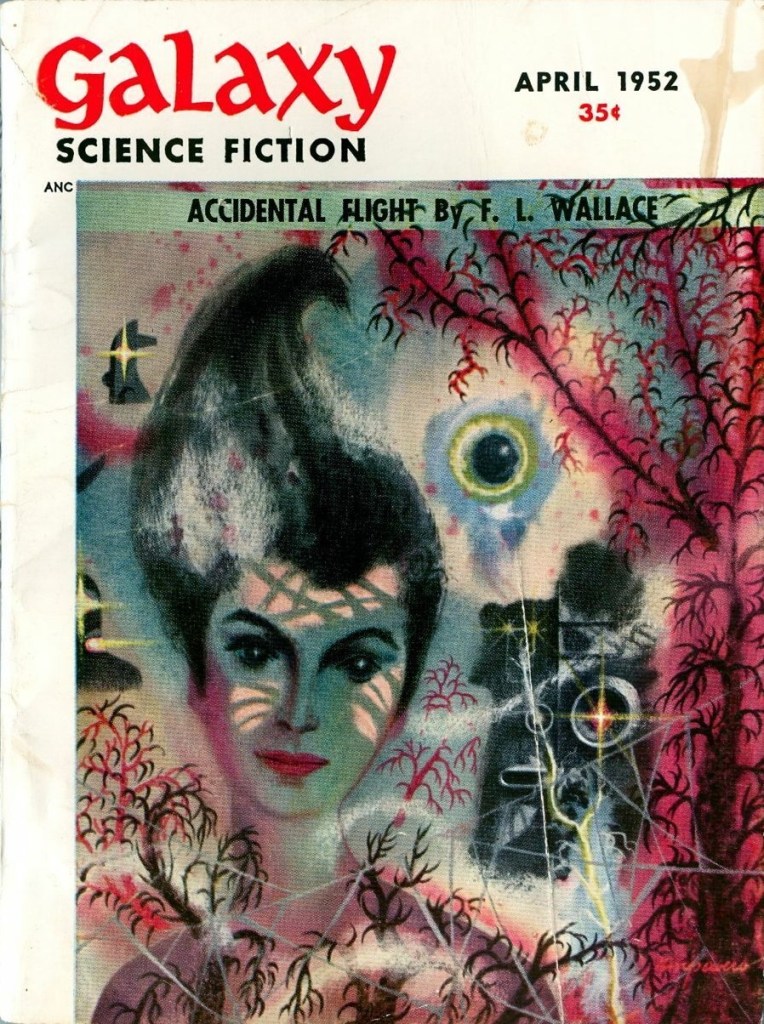
Richard Powers’ cover for Galaxy Science Fiction, ed. H. L. Gold (April 1952)
4.5/5 (Very Good)
Fritz Leiber’s “The Moon Is Green” first appeared in Galaxy Science Fiction, ed. H. L. Gold (April 1952). You can read it online here.
On January 3rd, 1950, in response to the successful 1949 Soviet test of atomic weapons, President Truman announced a crash program to develop the hydrogen bomb. It is within this moment of escalating terror after Truman’s announcement that Leiber wrote “The Moon is Green” (1952). While Leiber references hydrogen weapons, the story was published before the “Ivy Mike” Hydrogen bomb test (November 1st, 1952)–known to the public after a media blackout on January 7th, 1953–that revealed the devastating presence of fallout. The Soviets conducted their own test of a thermonuclear device–Joe-4–on August 12, 1953 (source).
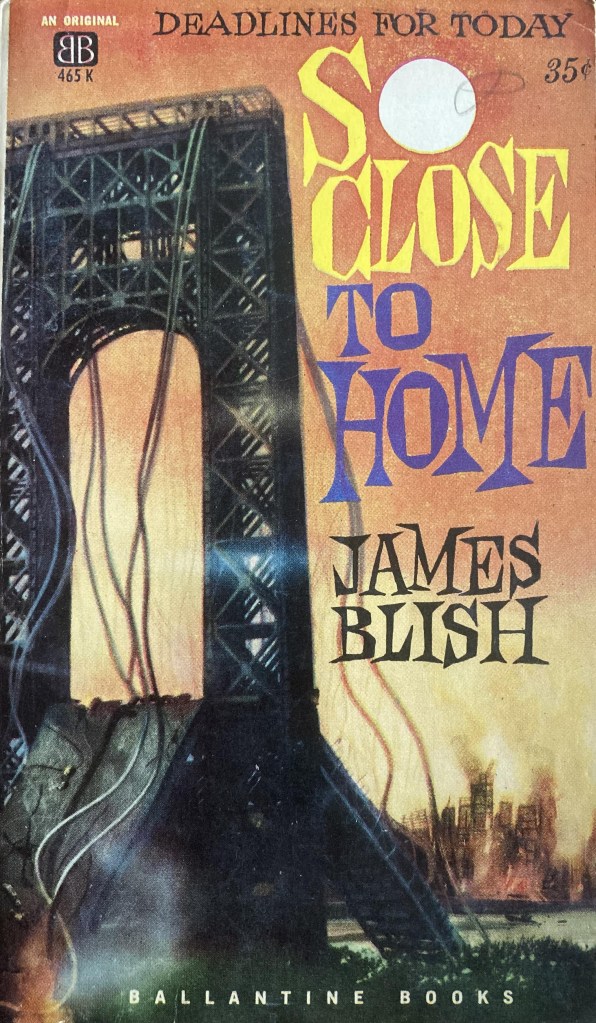
It’s been more than a decade since I’ve read James Blish. I’ve long been a fan of his Hugo-winning novel A Case of Conscience (1958) and individual stories in collections like The Seedling Stars(1957) and Galactic Cluster (1959). Unfortunately, So Close to Home (1961) is an uneven collection with more duds than hits. The three worthwhile stories–“The Oath” (1960), “Testament of Andros” (1953), and “The Masks” (1959)–can be found online at the links below. Almost all the stories in the collection are set in the near future and chart humanity’s fear of the end and how one might navigate the strange new worlds that emerge.
Which books/covers/authors intrigue you? Which have you read? Disliked? Enjoyed?
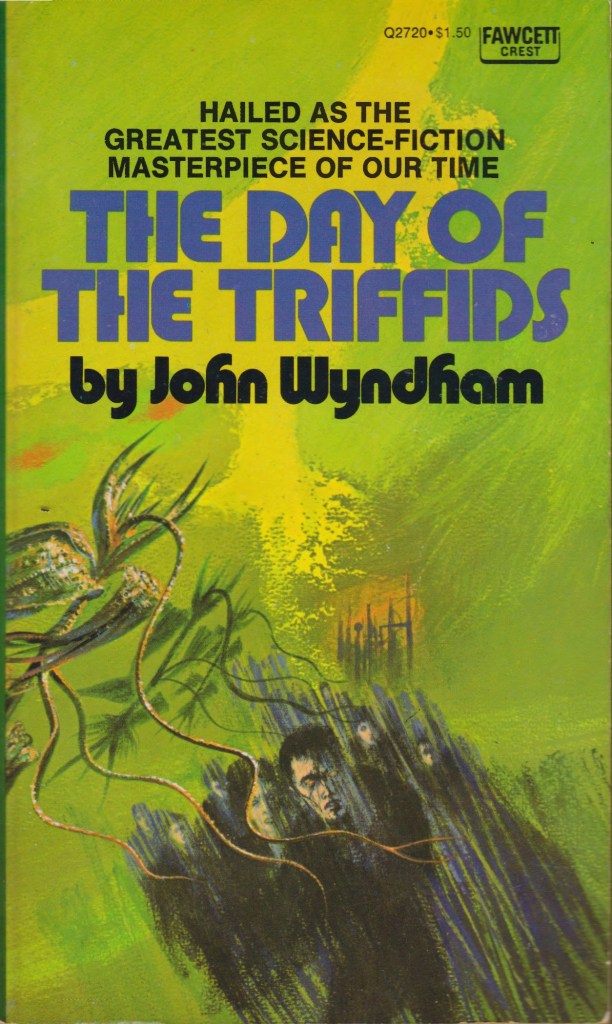
1. The Day of the Triffids, John Wyndham (1951)
Richard Powers’ cover for the 1964 edition
From the back cover: “WHAT WERE THEY–
THESE HIDEOUS TRIFFIDS ROAMING THE RUINS OF THE EARTH?
Until a few short hours ago–before the sky exploded into a shower of flaming green hell–triffids had been regarded as merely a curious and profitable form of plant life. Now these shadowy vegetable creatures became crawling, killing nightmare of pain and horror.
Madness hung in the air, fear lurked in every side street, death hovered in every doorway. Stripped of civilized veneer by terror and desperation, the handful of surviving humans began to turn on each other.