Note: My read but “waiting to be reviewed pile” is growing. Short rumination/tangents/impressions are a way to get through the stack before my memory and will fades. My website partially serves as a record of what I have read and a memory palace for future projects. Stay tuned for more detailed and analytical reviews.
1. Polly Toynbee’s Leftovers (1966)
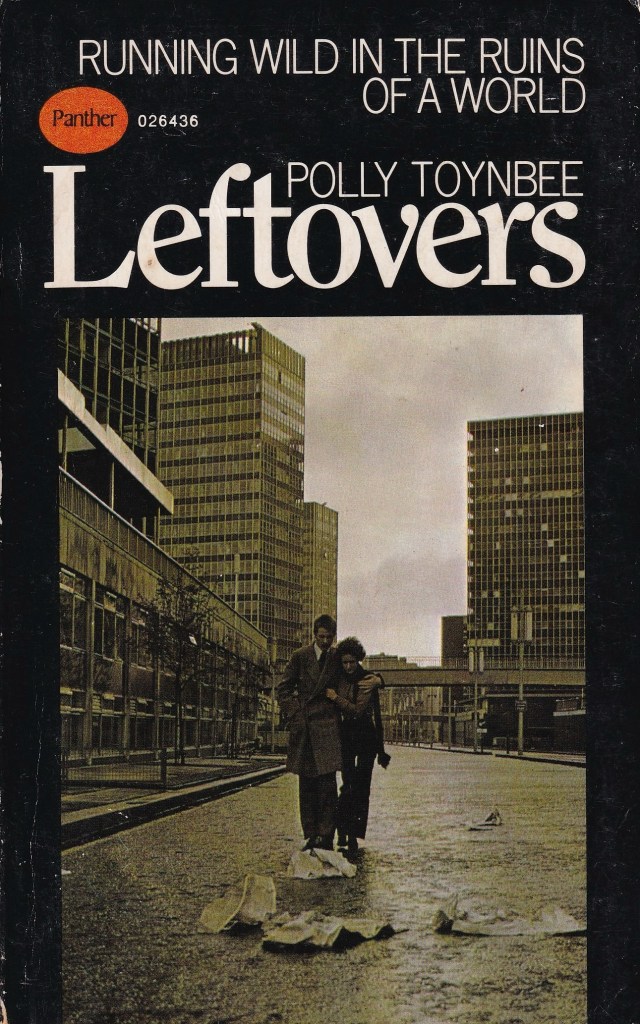
Paul May’s cover for the 1969 edition
2.5/5 (Bad)
After reading a monograph on the history of science fiction I inevitably find a handful of works that I must track down (more as an act of data collection than a quest for literary genius). Andrew Hammond’s Cold War Stories: British Dystopian Fiction, 1945-1990 (2017) contained a wealth of lesser-known works that immediately dented my pocketbook.1
Polly Toynbee’s Leftovers (1966) fits into Hammond’s analysis of a British Empire irrevocably weakened by WWII and growing US supremacy in the Cold War. Toynbee’s novel, and in even more severe terms Lewis Gibbs’ Late Final (1951) discussed below, with its focus on a handful of self-absorbed survivors of an apocalyptic event depicts a nation “irrelevant to the geopolitical present and as unrecognizable to its own past.”2 Intriguing ideas aside, debilitating flaws sink Leftovers. I found it interesting only as a lens for the moment — youth culture and rebellion in the mid-60s. As a literary and reading experience, Leftovers leaves a lot to be desired. Toynbee would soon abandon her literary career for a famous career in journalism from a leftist perspective.
Harkening back to my evocation in my review of Dave Wallis’ superior Only Lovers Left Alive (1964), imagine early 60s London. Conjure displays of cool style at local discothèques. Youthful insolence and wit. Generational strife and conflict between tradition and change. Frivolous and all-encompassing consumerism. Rebellion as little more than an alternative form of consumption. Interrupting this petulant capitalist image making comes an apocalyptic ending. A group of youth, and one middle-aged couple, taking the last London metro survive the release of a devastating poisonous gas.3
The narrative does not focus on any of the ten or so individuals in particular with the result that they become little more than indistinguishable (and deeply annoying) cyphers for the emptiness of youth rebellion. They argue with each other. They sleep with each other (in Buckingham Palace and a whole variety of famous locations). They complain about each other. One figure, Matt, tends to espouse a back-to-the-land ethos and other ideological delusions without the intelligence or planning to put them into action. The group momentarily experiments in community-building in the most illogical way possible. The experiment is doomed to failure. They rather wander the countryside eating canned food and stealing fragments of the past from museums and other important landmarks. In Toynbee’s best moments, the commercialization of the past provides a sad form of solace in the decayed contemporary moment. Even the inevitable creation of children with all the unprotected sex does not seem to pull them from their funk. There’s a deep unwillingness to say anything radical about what could be.
I found Dave Wallis’ Only Lovers Left Alive (1964) a far more satisfying take on a similar theme. He at least sees the potential of a new beginning in the vibrancy of the youth. It’s also told with a compelling beauty that Toynbee simply can’t reach with her prose. Other than the last few chapters of Leftovers, Toynbee struggles to create a memorable scene and instead revels in the fragments of sappy dialogue as the world as everyone knows it comes to the end (her point perhaps, but an exhausting one). I cannot recommend this frustrating clunker unless you have a perverse obsession with reading all pre-1985 British post-apocalyptic fictions (me!).
2. Lewis Gibbs’ Late Final (1951)
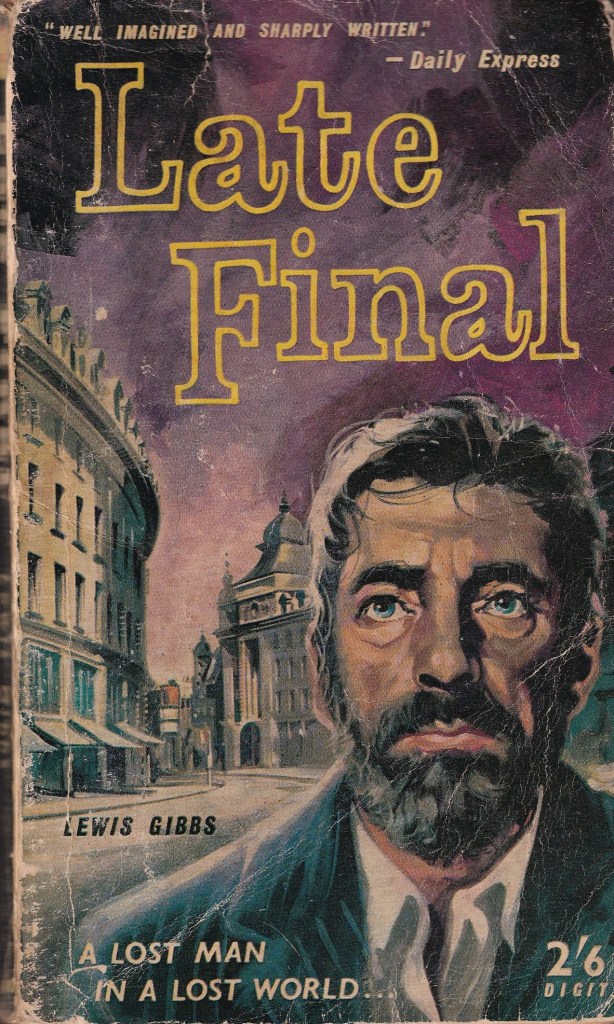
Paul Rainey’s cover for the 1961 edition
2/5 (Bad)
British author Joseph Walter Cove (1891-1972), writing as Lewis Gibbs, pens what, at first glance, appears to be a compelling scenario. A British academic spends WWIII imprisoned in the Soviet Gulag. For ten years he goes through the rituals of survival with other political prisoners in the tundra. One day without warning he’s summoned to the commandant’s office. His passport photos and surviving personal items are destroyed in front of him. He’s placed in an airplane and parachutes into a desolate England. Sheared of all his previous connections and an explanation of what specifically occurred, he wanders the countryside before joining a small community ensconced in an isolated farm. He falls–ultimately platonically although there’s an initial erotic tension–for a far younger teenager and contemplates setting off with her in some deluded version of Adam and Eve. The farm must defend itself from scattered raiders.
While the geopolitical details remain in the background, it’s implied that the Soviet Union (and the United States) were less scarred by a nuclear exchange. The bombs were instead lobbed at England. As mentioned in the previous review, Gibbs’ book fits perfectly into that British Cold War sense of an empire passing.4 For example, Gibbs quotes from George Berkeley’s Verses on the Prospect of Planting Arts and Learning in America (1728): “Westward the course of empire takes its way; The first four acts already past” (33). This also forms the eventual shift towards a focus on the Americas as that the novel, abruptly, transforms into an overt work of Catholic apology. As the Soviet Union tested their nuclear weapon in 1949, Gibbs, writing two years later, channels the initial fear of a Cold War nuclear exchange non-Hydrogen nuclear weapons.
This is an awful book which pains me to write about without a larger historical question I want to use it to answer. I enjoyed the setup and initial sense of displacement. However, the radical narrative shifts and bland rendering of the devastation weakened the impact. Thus, unless you are a scholar tracking down all available post-apocalyptic fictions or studying the intersections of Catholic apology–one gets some strong Augustinian City of God-style vibes– and SF, then there is no reason to have this taking up room on your shelf.
Notes
- Unfortunately, Hammond’s wonderful monograph is priced far beyond what it should be. Why isn’t there a paperback edition? Why is the Kindle edition $75+? My father procured it for me as a gift! ↩︎
- Hammond, 65. ↩︎
- One of many many many illogical plot points — few others survive. I find this nonsense. First, the London metro has many lines. Second there are all types of underground shelters that people could be ensconced in. ↩︎
- Hammond does not mention the novel. ↩︎
For book reviews consult the INDEX
For cover art posts consult the INDEX
For TV and film reviews consult the INDEX


Well, both of these sound absolute stinkers, so thank you for taking one (or two) for the team! I was intrigued to learn Toynbee had written fiction as I knew her name from her journalism, but obviously there’s a good reason why she made a career switch…
As she published it when she was 20, that probably means she wrote it in her late teens! I give her some slack on that front. An interesting look at youth culture from a high class insider– and an incredibly bitter take. But yes, not a great novel for sure.
That said, I’ve been writing about some far better works! I finally finished volume 2 of Knut Faldbakken’s science-fictional duology Sweetwater (1974-1976) (Norwegian SF in translation). I wish there was a new (and far cheaper) edition so more people could read it. https://sciencefictionruminations.com/2026/05/18/book-review-knut-faldbakkens-sweetwater-1976-trans-joan-tate-1994/
These sound terrible! The curse of the completist. But I appreciate your dedication to the cause.
Some interesting ideas but absolutely terrible as novels — hence the short review treatment. I just couldn’t think any longer about them….