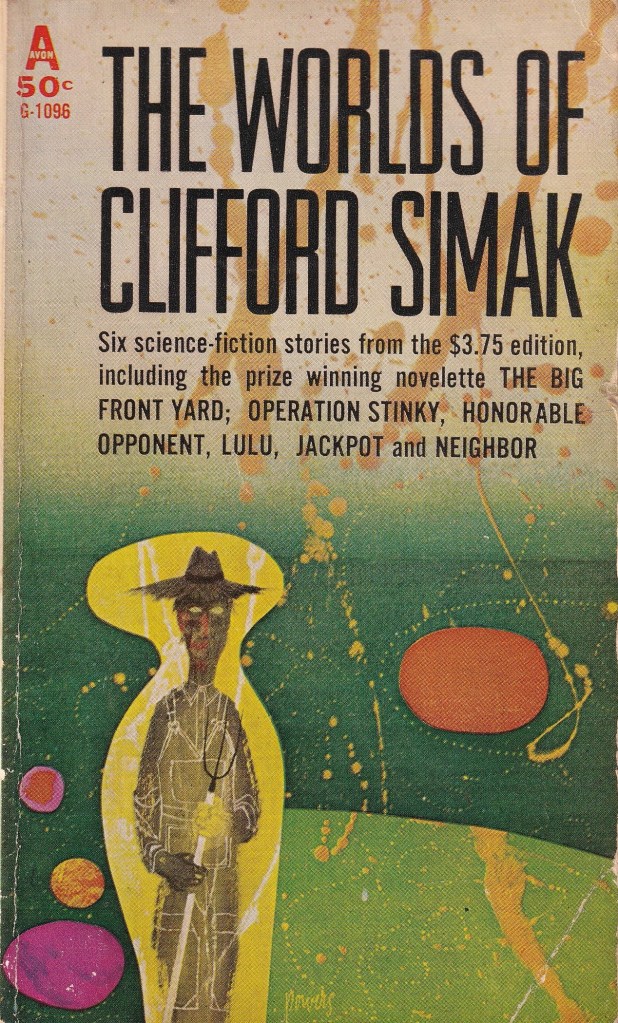
Richard Powers’ cover for the 1961 paperback edition
3.25/5 (collated rating: Above Average)
At this point in my reading adventure, I approach Clifford D. Simak’s science fiction with a clear intention to expand my understanding of his economic, political, and technological critiques of American society. This culminated in 2024 with my article “’We Must Start Over Again and Find Some Other Way of Life’: The Role of Organized Labor in the 1940s and ’50s Science Fiction of Clifford D. Simak.” Since then, albeit at a slower pace, I’ve continued to cover his science fiction, speeches, and additional interviews I’ve been able to track down. I find him a deeply fascinating author who’s often pigeonholed as “bucolic” or “pastoral” with no real attempt to read beyond his tendency to set a few of his narratives in a rural simulacrum of his childhood corner of America.
If you’re new to his work, this is a solid but unspectacular collection despite the inclusion of his best-known short story “The Big Front Yard” (1958) (winner of the 1959 Hugo Award for Best Novelette). However, with the exception of “Jackpot” (1956), I found The Worlds of Clifford Simak (1960) missing the type of ruminative and grimy moments I find most appealing about his work. It’s swings towards Simak’s more goofy and sentimental side.
And before we get to the story-by-story discussion, here’s a brief note about the publication history. This review covers the 1961 paperback edition of The Worlds of Clifford Simak (1960). It contains six less short stories than the hardback. Those six cut stories appeared in The Other Worlds of Clifford Simak (1962). I own both volumes.
Brief Plot Summary/Analysis
“Honorable Opponent” (1956), 3/5 (Average): First appeared in Galaxy Science Fiction, ed. H. L. Gold (August 1956). You can read it online here.
In the far future, the vast Galactic Confederacy centered on Earth finds itself in conflict with the alien Fivers. A meeting is scheduled on a barren planet to exchange prisoners. Why this particular planet was picked isn’t entirely clear, but the same could be said about the society/culture/and objectives of Fivers themselves. The Galactic Confederacy appears to be licked: “Earth was across the barrel. For there was nothing he could do but negotiate” (15). Earth’s war ships disappear with their crews left and right. In order to counter the Fiver threat, “thousands of researchers were working day and night in a crash-priority program to find an answer to the weapon” (8). Of course, there’s no equivalent program to understand Fiver society!
While I won’t spoil the rather silly ending, it fits into Simak’s common tendency to imagine humanity’s unwillingness to depart from traditional patterns of interaction and conflict. When the Fiver secret is revealed, Earth’s generals immediately speculate on how the new technology can be harnessed to extract new planets of their resources more effectively (18) rather than to improve lives.
I found this one a bit forgettable despite its re-emphasis of Simak’s central themes.
“The Big Front Yard” (1958), 3.75/5 (Good): First appeared in Astounding Science Fiction, ed. John W. Campbell, Jr. (October 1958): You can read it online here. Won the 1959 Hugo Award for Best Novelette.
Hiram Taine, an antique dealer and electronic repair handyman, comes home after acquiring antique furniture to resell to a mysterious substance on his basement wall. Its occupants transformed Taine’s basement. Soon a black-and-white TV set to be repaired suddenly is in color (27). Towser, his dog, comes across a spaceship buried in the woods. With Beasly at his side, a local man who seems to have an intellectual disability, Taine returns home to find his home’s exterior transformed. The porch now opens up on an entirely new, and alien, vista. As they explore the alien landscape, they come across another home that serves as a portal to another world, and more spaceships, and more aliens craftsman setting off to establish new networks. The secret gets out and soon the government and its agents come running to lay claim to new territories. Taine and Beasly will have to use their wits to understand the new world before conflict breaks out.
As with “Operation Stinky” later in the collection, Simak’s renders the rural countryside in the near future (1965) as in a state of transformation. Taine’s neighbor Henry runs a new computer factory on the outskirts of town (23). Taine fears prime pieces of land, including on where he played as a child, will be purchased to develop suburbs (22). There’s also the unavoidable sense of humanity’s relentless quest for profit. While Taine speculates on antiques and the odd job for survival, the FBI and Pentagon have something more draconian up their sleeves: “the government, of course, could exercise the right of eminent domain and start condemnation action” (52). The Russians also learn of the portal and want to lay their claim (57). Simak’s “bucolic” edges of the American countryside, often sites of contact and interaction with the alien and new, become contested spaces of Cold War conflict.
I found Taine an appealing character–he cares for Beasly, barely tolerated by the rest of the town, and his dog Towser. He wants to do good. He wants to make an honest living. He doesn’t give in to blind patriotism. He stands up for himself and others. This is a better version of the classic Simak contact story.
“Operation Stinky” (1957), 3/5 (Average): First appeared in Galaxy Science Fiction, ed. H. L. Gold (April 1957): You can read it online here.
The funniest (and silliest) story in the collection, “Operation Stinky” follows a classic Simak narrator–a “day-laborer” (75), gun-waving, drunk, shack-dwelling, good-hearted man–and his encounter with a strange type of skunk. The narrator rescues Stinky from a pack of dogs. The skunk becomes his friend and purrs like a cat. He takes it to the local bar as he doubts his friends will believe his story unless he brings evidence. And then something mysterious happens on his way home. He’s plastered. And the animal attempts to drive Old Betsy, his car… The authorities at the nearby air base catch wind of the animal and speculate that the unusual changes to Old Betsy might be the product of its handiwork.
Where “Operation Stinky” rises above its outlandish premise is Simak’s commentary on American Cold War culture. As with other stories in this collection, the alien becomes a source of exploitation for immediate gain. In this instance, rather than attempt to understand Stinky or figure out a mode of community, the military sees his skills solely as contributing to the American military-industrial complex: “We’ve got enough we actually understand to give us unquestioned air superiority. We’re a good ten years, if not a hundred, depending on how much we can use, ahead of the rest of them. They’ll never catch us now” (90). The air base interrupts the rhythms the rural experience. Simak’s countryside perches at that juncture where old ways of life are rapidly changing.
“Jackpot” (1956), 4.25/5. (Good): First appeared in Galaxy Science Fiction, ed. H. L. Gold (October 1956). You can read it online here.
A ragtag crew of intergalactic scavengers “scour the Galaxy for anything that’s loose” (97). They land on a planet. Loot ruins and resources. The dream of a jackpot that will raise them all from poverty propels them forth. Doc, the voice of conscience, spends his days blotting out their sad existence with the bottle. The captain, our narrator, justifies his actions with the lens of the past: “Back on Earth, in the early days […] it was folks like us who went into new lands and blazed the trails and found rivers and climbed the mountains and bought back word to those who stayed home. […] They didn’t worry much about the law or the ethics of it and no one blamed them for it” (100). And, most egregiously, he posits a defense of colonial violence: “If they killed a native or two or burned a village or some other minor thing like that, why, it was just too bad” (101). Clashing ideologies will come to fore with the discovery of a new alien technology.
On a desert planet, the crew encounters an immense silo–“quiet and solemn inside” (99)–with what look like endless rows of filing cabinets and strange chair-like contraptions. The crew, sans experts like the better equipped explorers, putter around with the alien tech in a sad scene of trial an error. Are the sticks in the cabinets dynamite? Is it an alien library? One will have to draw the short straw and find out. But there’s profit for sure whatever the discovery might be, right? The occupants of the building soon discover the interlopers.
This is absolutely the best story in the collection! We got some grime and intriguing rumination! “Jackpot” posits a series of historical parallels between the crew of scavengers and the famous expeditions to explore Earth. This serves two primary rhetorical purposes: 1) the ways people use the past to justify exploitation 2) to further Simak’s contention that humanity, despite its vast intergalactic empire, cannot escape its innate tendency towards brutal capitalistic exploitation. Profit remains the goal. Understanding the alien is only important if it leads to profit. There’s a bleak desperation to all that transpires.
Recommended.
“Lulu” (1957), 2.5/5 (Bad): First appeared in Galaxy Magazine, H. L. Gold (June 1957). You can read it online here. I previously reviewed this short story here.
My least-favorite story in the collection is a humorous trifle about a sentient “female” robotic spaceship falling in love with her three human male crewmen and setting off on her own grand romance. Riffing off of the tradition of naming airplanes and ships after women, Simak imagines that a Planet Exploration Robot–“a combination spaceship/base of operations/synthesizer/analyzer/communicator” (132)–would be programmed with a female persona in order to keep the crewmen company on a long voyage (as Simak is rarely more than G rated other implications are not discussed). In retrospect, the narrator suggests that Jimmy Robins’ bad romantic poetry caused Lulu to connect with them far more than intended. The three crew attempt–never picking up after themselves, refusing to move for days at a time, etc.–to make her fall out of love. Eventually she lands on a planet and finds a long lost alien robot. But there’s a hitch. Lulu’s new “man” means that she abandons the three crewmen outside on an alien planet. They need to get her to fall back in love if they’re ever to return to Earth.
It’s Simak at his least ruminative and moody–a strange inclusion for a best of collection. The concept of the robot programmed with a particular character to keep the crew sane on a long voyage is only touched upon. The rest is straight, often sexist in a 50s manner, sap. Forgettable.
“Neighbor” (1960), 3/5 (Average): First appeared in Astounding Science Fiction, ed. John W. Campbell, Jr. (June 1954). You can read it online here. I previously reviewed this short story here.
The inhabitants of Coon Valley, a ubiquitous rural farming community of the “kind of people you meet all over these United States” (170), barely survives on farming the bottomlands and pasturing the hillsides.1 The story follows an “old-timer” who would feel strange living anywhere else and the arrival of an unusual neighbor. Unlike many who buy up an old farm and leave as the work gets hard, Reginald Heath transforms an abandoned farm into a veritable rural utopia–highly productive crops, repaired fences, a gorgeous garden filled with unusual vegetables, etc. The narrator slowly realizes that not is all that it seems.
While I’m not convinced of the merits of the actual story, “Neighbor” posits a utopian possibility that I’d suggest helps us formulate the world the Simak yearned for after the devastation of WWII and the emergence of a strong capitalist state. Here a small number of families, with the assistance of a humanoid alien that represents what humans could be if technology was not controlled by “our commercial-industrial society,” radically improve their own lives. As in many of Simak’s stories of corporate nightmare, farmers are not forced from their lands.2 Decentralization of technology prevents profit from becoming the sole objective. As Simak retrospectively spells out in various interviews, the problem is with technology’s implementation and control: “[it] should be used for the betterment of mankind and to make life more meaningful.”
There’s a mournful sadness in Simak’s stories as humanity rarely seems to change, without outside assistance, its own destructive urges.3
Somewhat recommended.
Notes
- Simak includes one of his few direct references to the political parties of his day: “I imagine you’d call us [the valley old-timers] conservative, for most of us vote Republican without even wondering why and there’s none of us who has much time for all this government interference in the farming business.” ↩︎
- As in “City” (1944), revised as the first installment of the 1952 fix-up. In this iconic Simak story, farmers are forced to flee their lands for the abandoned urban centers due to the growth of the hydroponics industry and cheap transportation. In “Full Cycle” (1954), check page 38 of my article rather than my review as I dived into far more detail with helpful context, characters ruminate on the impact of more sophisticated farm equipment that forced farmers sell land to monolithic corporate holdings. ↩︎
- This tendency makes “Full Cycle” (1955) an unusual anomaly as humans, via roving unions, are able to discover their own innate potential. We don’t learn from aliens. We don’t encounter robots transformed by hyperspace. We change from realizing the importance of community, the land, and standing up against oppressive societal forces. ↩︎
For book reviews consult the INDEX
For cover art posts consult the INDEX
For TV and film reviews consult the INDEX


I first read “Neighbor” in an anthology I found in the public library when I was 13 or 14. It stuck with me long after I forgotten the title or author. I ran into it again 30 or 40 years later and loved it again. I reread it last year in the Collected Short Stories of Clifford D. Simak and found that it still holds up. Given the effect it had on me, I would rated it higher than you do.
Hello Paul,
Have you read “Jackpot” in this collection or something like “Conditions of Employment” (1960) or “Immigrant” (1954)? I think you’ll understand the type of Simak that I tend to gravitate towards. That said, I write religiously about Simak and find most of his work through-provoking — and “Neighbor” certainly fits into my larger thesis of his work (and various criticisms of American society) and the role of the rural. As a story, I think it is far from his best.
I’ve actually read both “Conditions of Employment” (1960) and “Immigrant”. “Conditions of Employment” stirred store memories of when I served aboard a submarine, when I was in the Navy, There were times, when you had been under water for a month and you still had another month to go, that seemed interminable. “Immigrant” reminded me of ‘Special Deliverance’ where you had aliens who were willing to help if you asked nicely. I think “Neighbor” had such a great affect on me because I grew up in a rural community in Michigan where the way of life was being changed by people from Detroit moving in and turning it into a bedroom community. In “Neighbor” you had a quiet person keeping the good parts going.
I assumed you had but I never know unless I ask. But yes, that more grimy, disturbed, frustrated brand of SF with a good dose of existential dread (which, as you point out, would definitely be something I would feel if I were on a submarine!) is what I find most appealing from a literary standpoint. When Simak verges into more goofy and sentimental territory I recoil a bit. BUT, you have to realize that I am partially reading Simak to write about Simak and even stories that do not sync up with my personal taste are still throught-provoking and add to various arguments that I am formulating.
I’m currently working on a 27-page paper (at the moment, could be close to 35 when I’m done) about a SF novel from the turn of the 20th century which is pretty amateur as a literary experience but goodness me, I could say something about it due to its historical moment, political content, and contemporary scholarship with substantial holes.
I get all of that — I grew up in rural Appalachian Virginia with access to thousands of acres of woods. I then moved to a quickly “suburbanizing” area of Texas right before I started high school. I despise returning home to visit my parents due to the extreme transformation/destruction of the physical landscape.
Always enjoy more Simak content! I actually don’t think I’ve read any of the stories in this collection, my track record with his short fiction is spotty and generally consists of a few random stories from different anthologies. I know he’s got one of those multi-volume complete stories collections published but I sorta wanted to pick a peak era rather than try to plow through them all (there are a lot). “Neighbor” and “The Big Front Yard” both sound great, don’t think I’ve come across those before.
Thank you. Considering how widely its anthologized, I can’t help but imagine you’ve actually read “The Big Back Yard”! As always, I look forward to your thoughts if you get around to them. As I mentioned to Paul above (he helps run a Simak fan forum online), I do gravitate towards Simak’s more despairing visions.
Simak apparently liked the name “Towser” for a dog – I think that’s the name of the dog in “Desertion?
I’d have to go back and check. It sounds familiar for sure! Have you read any of the stories in this collection?
I don’t think so. I’ve read City and some other of his stories (“No Life of Their Own”) and novels (“Way Station,” “Special Delivery”) but there’s more for me to read, clearly.
Other than “City” and its various sequels, here are my favorite short stories of his so far (as you know, I gravitate towards his more despairing visions):
“Conditions of Employment” (1960)
“Founding Father” (1957)
“Jackpot” (1956) (in this collection)
“Full Cycle” (1955) (mostly due to its very interesting take on unions as I explored in my article)
“New Folks’ Home” (1963)
“All the Traps of Earth” (1960)
“You’ll Never Go Home Again!” (variant title: “Beachhead”) (1951)