What pre-1985 science fiction adventures have you finished this summer? Any great reads? Disappointing ones? Intriguing discoveries? Here’s the June installment of this column. I know, it’s been a while…
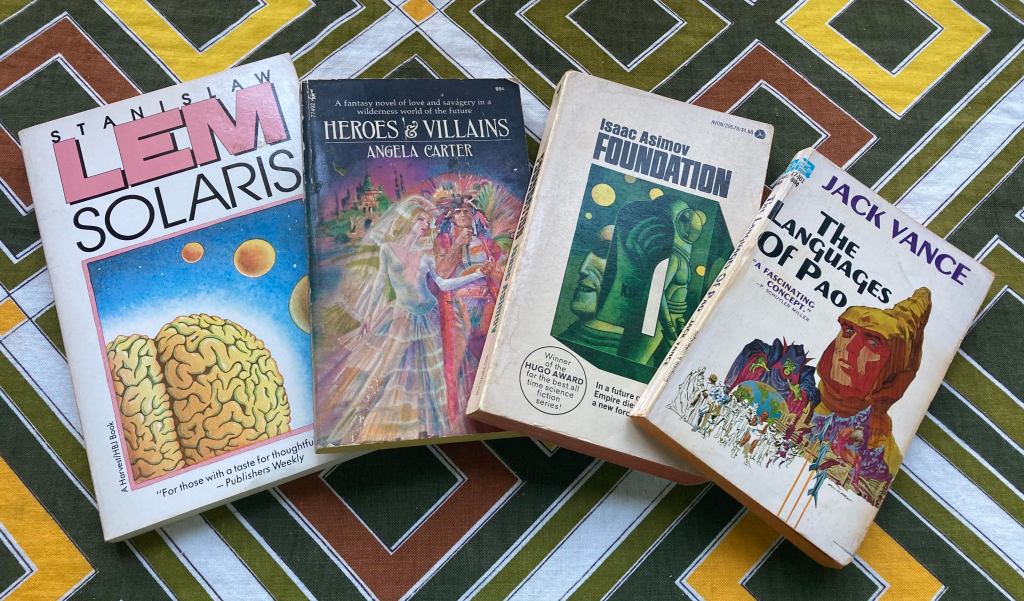
A selection of read volumes from my shelves
On Bluesky, a Youtube channel that I follow sought to collate a list influential cyberpunk novels for a future video or review series from the first generation of the subgenre’s practitioners. Other than Pat Cadigan’s multiple contributions, the list was entirely male. Knowing me, I suggested a few works by female authors that engaged with similar ideas that might be considered either important predecessors–for example Joan Vinge’s “Fireship” (1978) and Chelsea Quinn Yarbro’s Hyacinths (1983) (I think the proto-internet isn’t that central so it tends to be dismissed)–or works by the second generation right around the original poster’s cutoff date of 1990: Lisa Mason’s Arachne (1990), late 80s short fiction by Candas Jane Dorsey, Melissa Scott’s Trouble and Her Friends (1994), Gwyneth Jones’ Escape Plans (1986) and White Queen (1991), Misha’s Red Spider White Web (1990), and Nisi Shaw’s “I Was a Teenage Genetic Engineer” (1989).
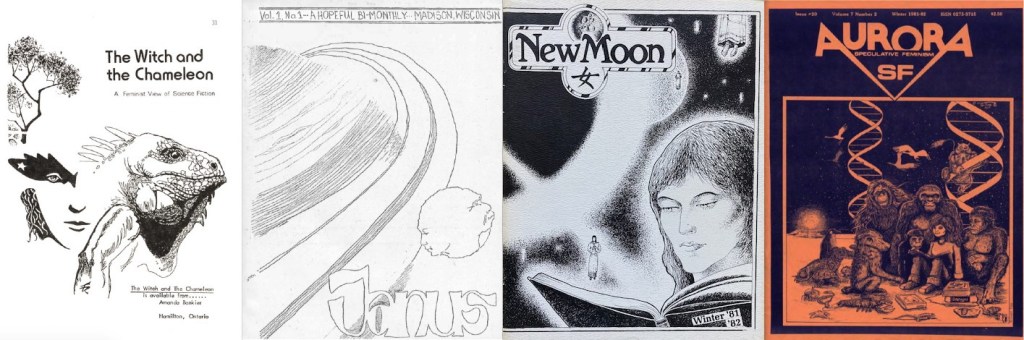
From L to R: The Witch and the Chameleon, no. 5/6 (1976), cover by Amanda Bankier; Janus, no. 1 (1975), cover by Jennifer Wilson, Jeanne Gomoll, and Janice Bogstad; New Moon (Winter 1981, 1982), cover by Robert Kellough; Aurora (Winter 1981), cover by Steven Fox
Over the last few years, I have curated a few pieces of science fiction scholarship in my Exploration Log series that I’ve found memorable, historically important, and worth sharing.1 Today I have an interview with SF scholar (and friend) Loïg J. F. Pascual, author of the recently published article “The Collective Memory of 1970s-1980s Feminist Science Fiction Fandoms: A Case in Reflexivity and Historiography for fan Studies Practices” (2026). The article appeared in Transformative Works and Cultures, Vol. 49 (2026) You can read a translated version in English and in the original French. The French version includes multiple Youtube video interviews with important figures in the movement.
More than just an interview about his specific area of research, Loïg dives into the larger history of feminist fanzines and the vital role of fan culture in the creation and memorialization of genre. Enjoy!
Graphic created by my father
1. Thank you so much for agreeing to this interview. Please introduce yourself and your interest in feminist SF fandoms in the 70s and 80s.
My name is Loïg J.F. Pascual, and I am a Ph.D. student at the Université du Québec À Montréal. I started reading science fiction (SF) with the books my father bought—collections of Philip K. Dick stories, Hard to Be a God (1964) by the Strugatsky brothers, and Robert Charles Wilson’s Spin (2005), Axis (2007), and Vortex (2007) series. We would spend hours looking for new SF reads in used bookstores.
Which books/covers/authors intrigue you? Which have you read? Disliked? Enjoyed?
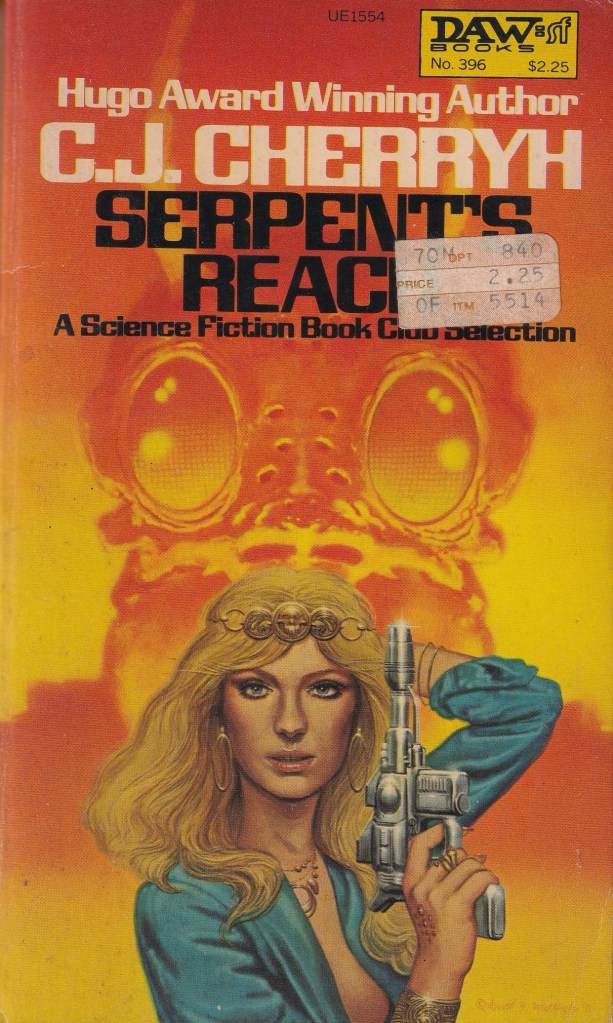
1. C. J. Cherryh’s Serpent’s Reach (1980)
David Mattingly’s cover for the 1980 paperback edition
From the back cover: “The constellation of Hydrus, known as the Serpent, is compact and obscure as seen from Earth’s sky. Even in the great era of interstellar colonization it remained obscure. For it was under strict quarantine – harboring an intelligent race, powerful, alien, and inhuman.
Yet there were human colonies within the Serpent’s Reach, cut off from the galaxy beyond, with their own inbred culture, their Families and traditions, and their special relationships to the inhuman majat.
This is the strange and brilliant novel of Raen, the last of the massacred Sul Family, and of her lifetime pledge to find vengeance. It was to take her across the worlds of the Reach into the very center of the alien webwork, into the strands of thought and counter-thought that knit the forbidden constellation into a complex of interbred cultures that no outsider could hope to unravel.”
Which books/covers/authors intrigue you? Which have you read? Disliked? Enjoyed?
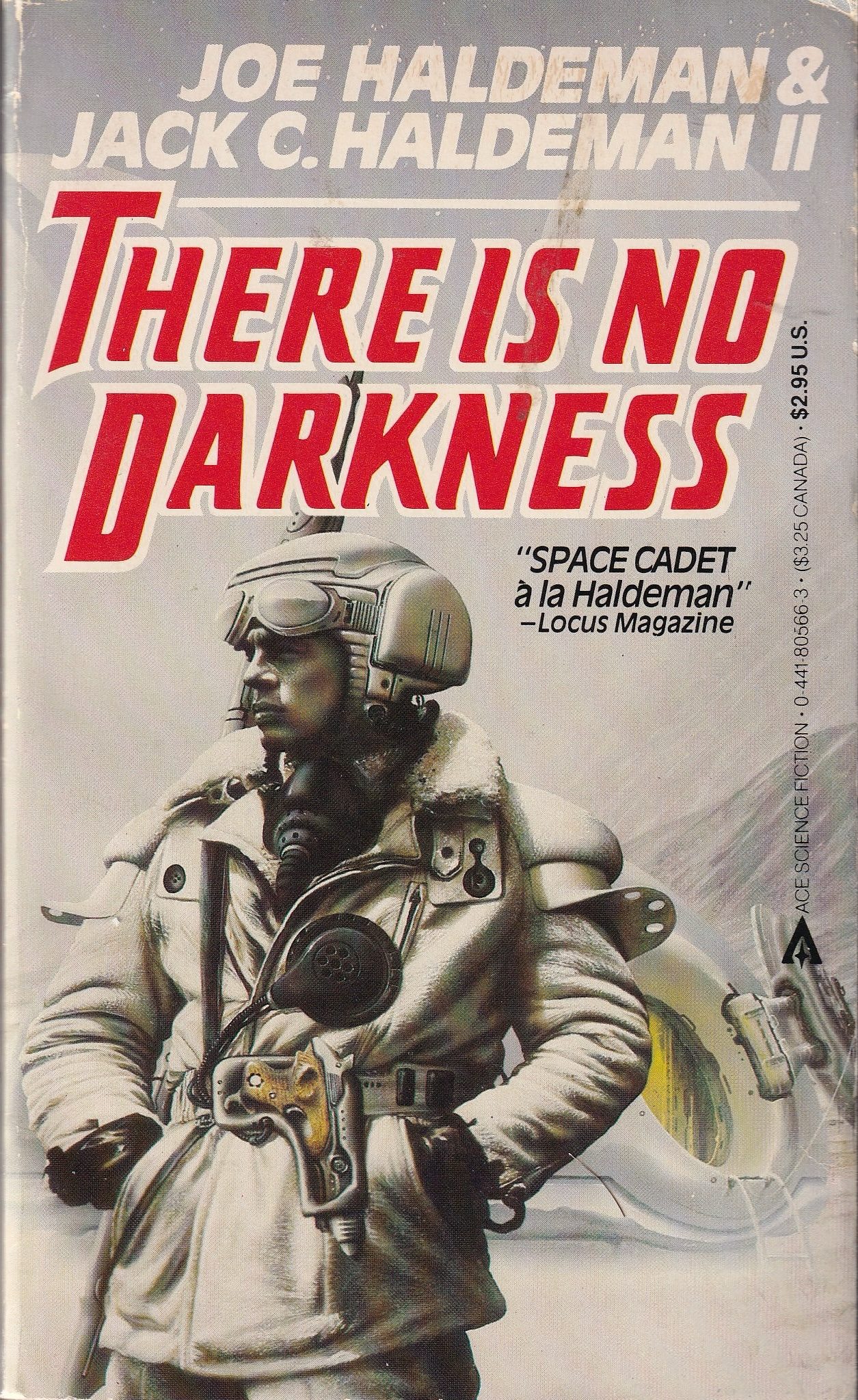
1. Joe Haldeman and Jack C. Haldeman II’s There is No Darkness (1983)
Jim Burns’ cover for the 1st edition
From the back cover: “The universe is not interested in fair play. The universe is interested in survival. That is lesson number one aboard the giant advance-training ship called ‘Starschool.’ Those who fail to learn lesson one very rarely have cause to worry about what comes next…”
Initial Thoughts: Even at his worst, I find Joe Haldeman a polished author. I’ve only read a few of his brother’s short stories. I’ve hear this volume is a bit on the juvenile SF side of things. We shall see.
Clifford D. Simak’s speech “The Face of Science Fiction” appeared in Minnesota Libraries, vol. XVII, no. 7. (September 1953). He originally gave it to the Minneapolis Branch Library staff. I have not found evidence that the speech appeared elsewhere or is anywhere online. I requested the article through the university library I’m affiliated with. I’ve included a transcription below. I hope with the easy access of important primary sources related to Simak’s fan activities and views on SF, we can see more scholarship on his fiction in the future vs. empty repetition of time-worn designators of his brand of SF.1 As with other posts on Simak’s interviews, speeches, and fan articles, I’ll provide a few words of summary first.
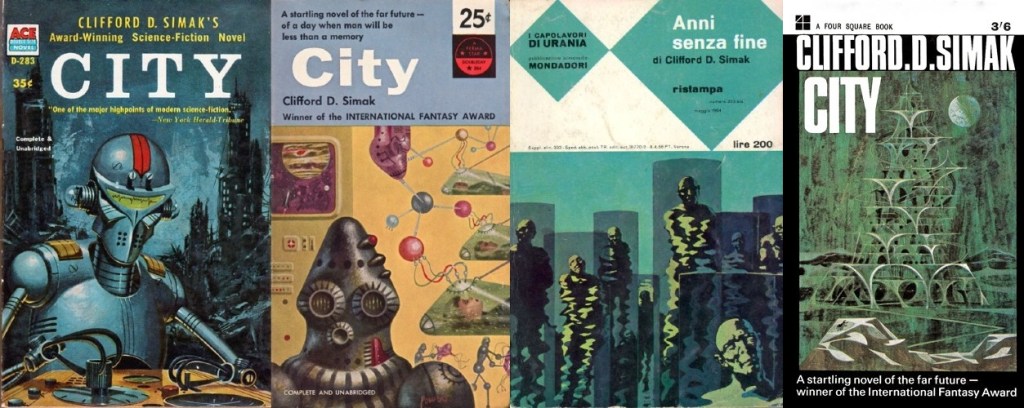
Four editions of Clifford D. Simak’s City (1952): Artists and publication date from L to R, Ed Valigursky (1958), Richard Powers (1954), Karel Thole (1964), uncredited (1965)
“The Face of Science Fiction” articulates the intersection of Simak’s own interest in the genre (and hope for its future), its larger history, with observations about the growing contemporary interest. He highlights the exploding popularity (and commercialism) the genre underwent in the 50s in the aftermath of WWII, for example the sheer quantity of magazines, toys, games, gadgets, and scientific gadgets designed with “science fiction motif” for teenagers. He charts his own exposure to the genre through authors like Jules Verne.
And echoing later arguments by Darko Suvin, posits an incredible “long and honorable lineage” of the genre with works like the Greek Legend of Icarus, Plato’s Republic, Thomas Moore’s Utopia, and Jonathan Swift’s Gulliver’s Travels that detach its origins from the influence of Hugo Gernsback (he does not mention his name but does acknowledge the “first science fiction magazines” that appeared in 1926).2 Arguments like this one partially serve as a rhetorical flourish meant to legitimize the genre and to self-justify your own brand of writing. And like those classics of old, 50s SF seems to re-manifest some of that ancient maturity (“fewer and fewer of them think of it in terms of Buck Rogers and rocket guns”) with increasing quality of writing. While acknowledging the fix-up novels still hitting print culled from the old pulps, he hopes the “backlog of old stories” is coming to its end.3 He admits that modern science fiction is still a young genre with growing to do!
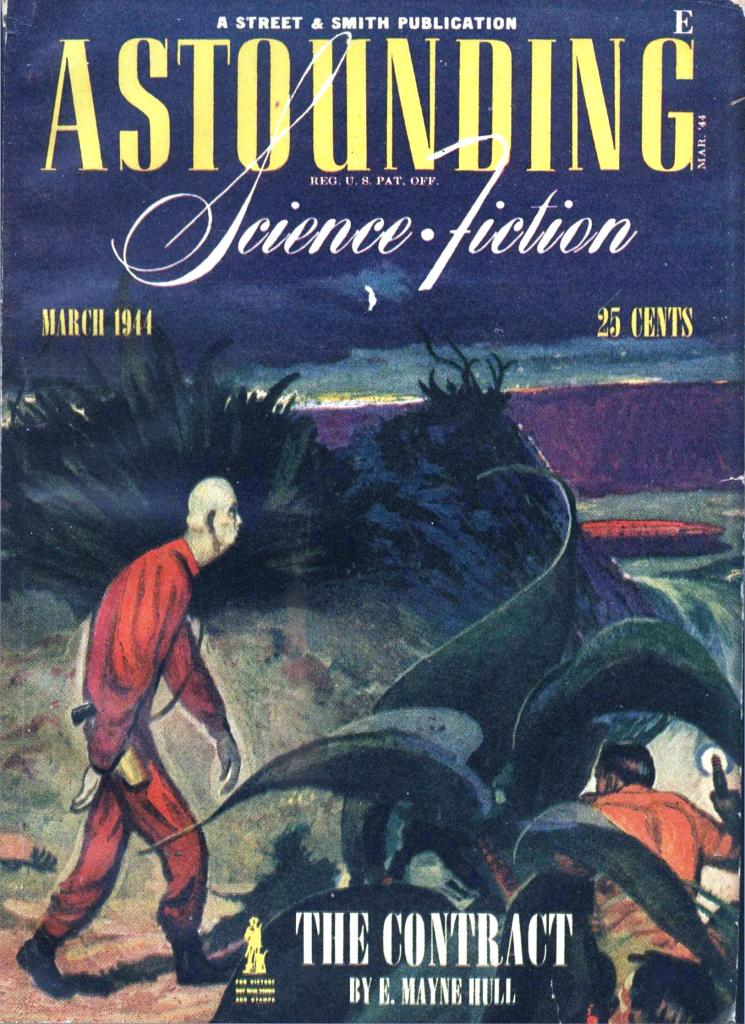
William Timmins’ cover art for Astounding Science Fiction, ed. John W. Cambell, Jr. (March 1944). Contains Cleve Cartmill’s “Deadline” (1944)
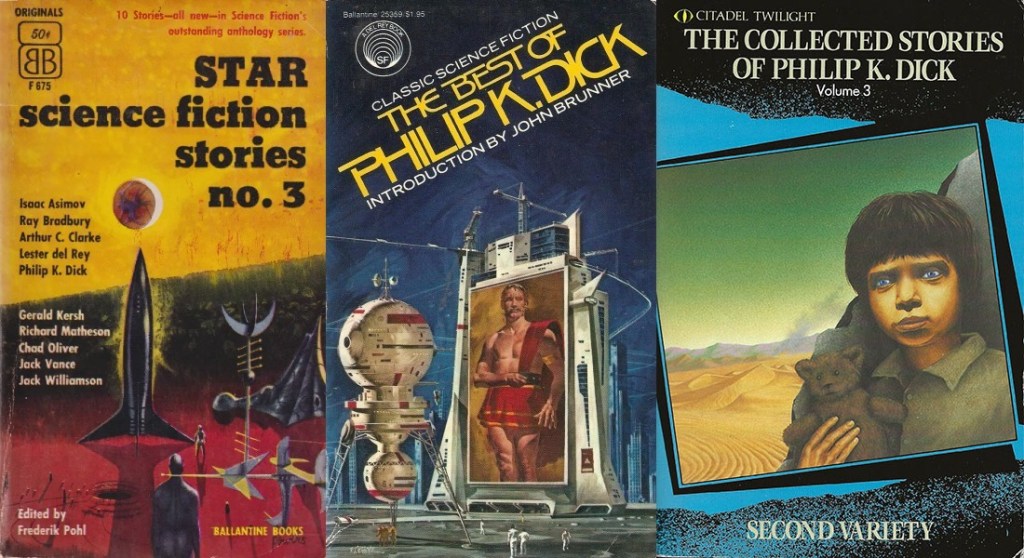
Three locations where Philip K. Dick’s “Foster, You’re Dead” (1955) appeared: L to R. Star Science Fiction No. 3 (1955), The Best Of Philip K. Dick (1977), and Second Variety (1991)
I appeared on the podcast DickHeads (i.e. Philip K. Dick fans) to discuss one of his most underrated (in my opinion) short fictions: “Foster, You’re Dead” (1955). If you want to read the short story before you listen to the quite detailed discussion, it’s available online here. I’m a sucker for science fiction satires of 50s American defense policy, commercialism, and the idiocracy of fallout shelters. As I am allergic to listening to myself, I’ve not given it a re-listen! Hopefully it went as well as I thought it did at the time.
Also, here is my short review of the story–part of my larger review of the entire original anthology Star Science Fiction No. 3, ed. Frederik Pohl (1955)–from last year if you don’t have time to listen to the podcast at the moment.
The following reviews serve as the 38th installment of my series searching for “SF short stories that are critical in some capacity of space agencies, astronauts, and the culture which produced them.” Some stories I’ll review in this series might not fit or are poor quality. And that is okay. I relish the act of literary archaeology. I’ve previously covered two Harlan Ellison short stories for this series: “Psycho at Mid-Point” (1956) and “The Discarded” (variant title: “The Abnormals”) (1959). As always, if you know of any others that might fit, let me know. I’ve compiled an extensive list but like all lists it’s incomplete.
Thank you Richard, “Friend of the Site,” for these recommendations all the way back in 2022. I didn’t forget.
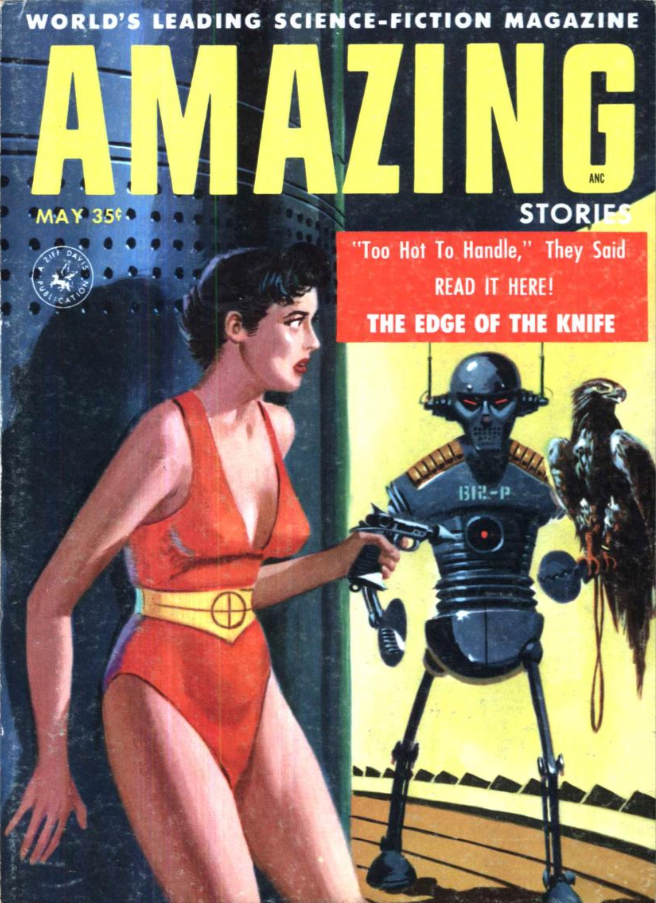
Ed Valigursky’s cover for the Amazing Stories, ed. Paul W. Fairman (May 1957)
3/5 (Average)
Harlan Ellison’s “Night Vigil” (variant title: “Yellow Streak Hero”) first appeared in the fanzine Peon, ed. Charles Lee Riddle (May 1955). It was reprinted in Amazing Stories, ed. Paul W. Fairman (May 1957). You can read it online here in Peon and here in Amazing Stories.
Which books/covers/authors intrigue you? Which have you read? Disliked? Enjoyed?
1. Arkady and Boris Strugatsky’s Roadside Picnic (1972, trans. Olena Bormashenko, 2012)
Dominic Harman’s cover for the 2012 edition
From the back cover: “Red Schuhart is a stalker, one of those misfits who are compelled, in spite of the extreme danger, to venture illegally into the Zone to collect the mysterious artefacts that the alien visitors left scattered around. His life is dominated by the place and the thriving black market in the the alien products. Even the nature of his mutant daughter has been determined by the Zone. And it is for her that he makes his last, tragic foray into the hazardous and hostile territory.”
Initial Thoughts: One of those obvious holes in my SF knowledge… I certainly have read about the writing pair but I’ve only read a story here and there–for example “Wanderers and Travellers” (1963, trans. 1966)–and one novel that I never managed to review. My father has been pushing me to read more of their work. And yes, Andrei Tarkovsky’s adaptation Stalker (1979) remains one of my favorite movies. I took a History of Russian Film class in college and wrote my term paper on Tarkovsky’s use of color.
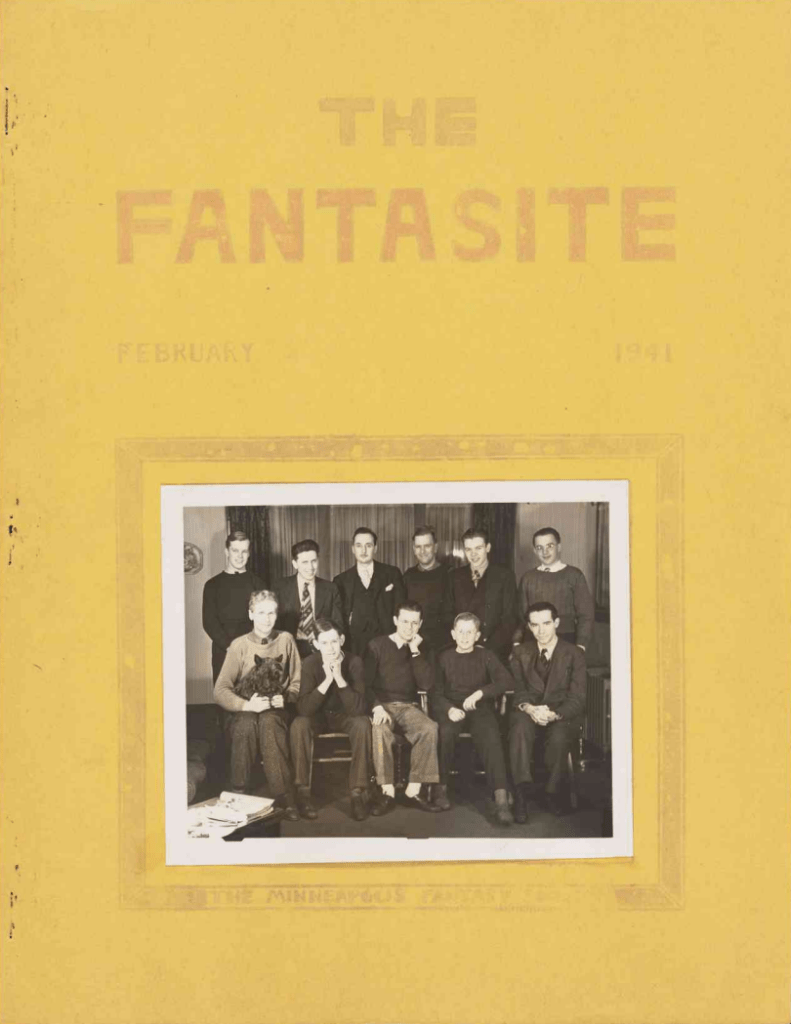
Cover image from The FANAC Fan History Project. Clifford D. Simak is the second from the left in the back
Clifford D. Simak’s “The Future of Science Fiction” appeared in the fanzine Fantasite, No. 2, ed. Phil Bronson (February 1941). You can read it online here. As the quality of the scan at the link is quite poor and close to unreadable in spots, I’ve transcribed the entire article below. In a few instances I have guessed based on vague letter shapes. If you spot an error, let me know!
The fanzine Fantasite, comprised of twelve issues between 1940 and 1944, was the official organ of the Minneapolis Fantasy Society. For more on the fanzine and its creator, consult the Fancyclopedia entries. The MFS was formed when when Simak arrived in Minneapolis and joined with the old Minneapolis Science Fiction League (Hugo Gernsback’s SF clubs). The second meeting happened at Simak’s house. As members went off to WWII, the group became less formal and eventually dissipated. Simak helped briefly resurrect the club after WWII, joined by Poul Anderson and others. Other SF authors who were members included Theodore R. Cogswell, Noel Loomis, Oliver Saari, and Gordon R. Dickson. For a fan history of the organization, check out Jim Young’s fanzine Rune 17issue.
This is a fascinating, if a bit vague and imprecise, look at Simak’s early views on the evolution and potentiality of science fiction. Unfortunately, as his professional life as a newspaper reporter ramped up he paired back his fan activities. These three points stood out: 1) Simak believes that the science fiction of the 1930s (in particular 1933 and 1934) transformed the genre by departing from “wooden men” who stalk through “wooden plots.” 2) he speculates that science fiction will diversify even further with “new ideas and new ways of presenting them” 3) he emphasizes the importance of “careful delineation in character” with “superb plotting.” Even from Simak’s earliest fannish writings, he shows an interest in a genre without clear boundaries — a genre that grows and expands and explores new things. For a more overt statement on his toleration for a diverse genre, check out his 1971 Worldcon Guest of Honor Speech given in the middle of the New Wave movement.