Clifford D. Simak’s speech “The Face of Science Fiction” appeared in Minnesota Libraries, vol. XVII, no. 7. (September 1953). He originally gave it to the Minneapolis Branch Library staff. I have not found evidence that the speech appeared elsewhere or is anywhere online. I requested the article through the university library I’m affiliated with. I’ve included a transcription below. I hope with the easy access of important primary sources related to Simak’s fan activities and views on SF, we can see more scholarship on his fiction in the future vs. empty repetition of time-worn designators of his brand of SF.1 As with other posts on Simak’s interviews, speeches, and fan articles, I’ll provide a few words of summary first.
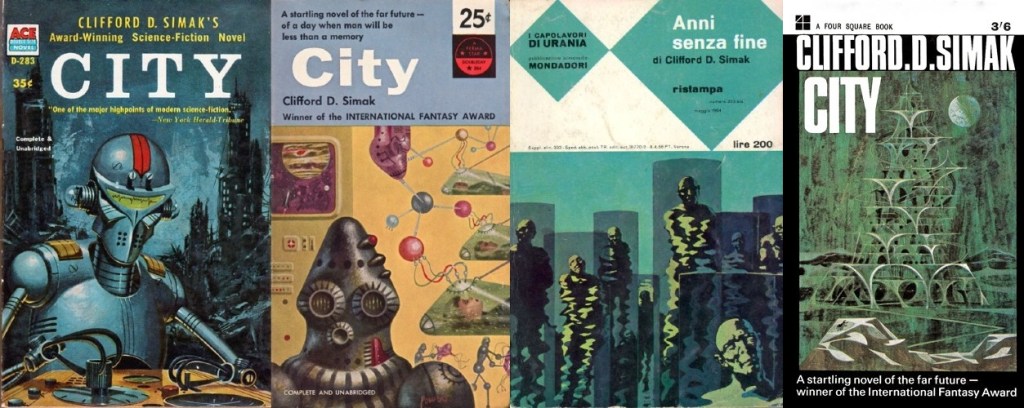
Four editions of Clifford D. Simak’s City (1952): Artists and publication date from L to R, Ed Valigursky (1958), Richard Powers (1954), Karel Thole (1964), uncredited (1965)
“The Face of Science Fiction” articulates the intersection of Simak’s own interest in the genre (and hope for its future), its larger history, with observations about the growing contemporary interest. He highlights the exploding popularity (and commercialism) the genre underwent in the 50s in the aftermath of WWII, for example the sheer quantity of magazines, toys, games, gadgets, and scientific gadgets designed with “science fiction motif” for teenagers. He charts his own exposure to the genre through authors like Jules Verne.
And echoing later arguments by Darko Suvin, posits an incredible “long and honorable lineage” of the genre with works like the Greek Legend of Icarus, Plato’s Republic, Thomas Moore’s Utopia, and Jonathan Swift’s Gulliver’s Travels that detach its origins from the influence of Hugo Gernsback (he does not mention his name but does acknowledge the “first science fiction magazines” that appeared in 1926).2 Arguments like this one partially serve as a rhetorical flourish meant to legitimize the genre and to self-justify your own brand of writing. And like those classics of old, 50s SF seems to re-manifest some of that ancient maturity (“fewer and fewer of them think of it in terms of Buck Rogers and rocket guns”) with increasing quality of writing. While acknowledging the fix-up novels still hitting print culled from the old pulps, he hopes the “backlog of old stories” is coming to its end.3 He admits that modern science fiction is still a young genre with growing to do!
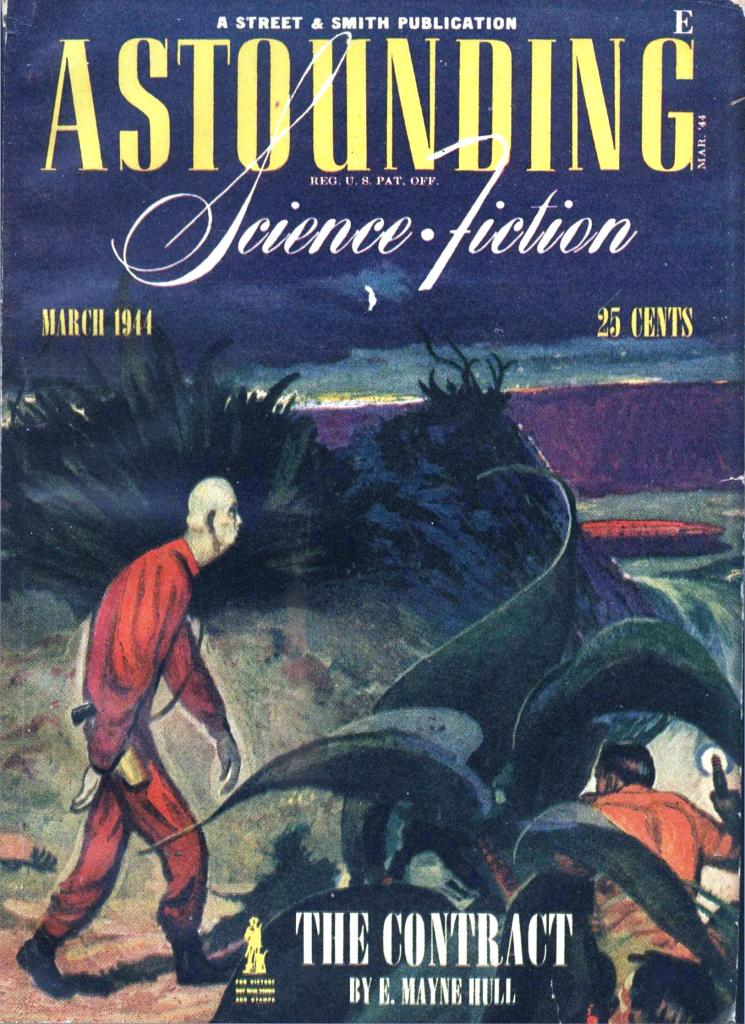
William Timmins’ cover art for Astounding Science Fiction, ed. John W. Cambell, Jr. (March 1944). Contains Cleve Cartmill’s “Deadline” (1944)
Simak also attempts to categorize the nature of the genre: 1) the prophesy story 2) the fictionalized essay on some matter of ethics 3) the adventure science fiction story. He’s thankful that the final category of stories—in particular space opera and a few of the more “juvenile” magazines—is less and less popular. He attempts to rebut arguments that science fiction is not literature and that it is overly reliant on science: “the plain and simple truth is that science fiction, for many years, has not been vitally concerned with science.”
He concludes by repeating a few of the popular talking points about the value of science fiction—especially its apparently predictive qualities—especially Cleve Cartmill’s short story “Deadline” (1944). Ultimately, Simak believes that science fiction is more than escapism, he argues that there is a “subsidiary purpose which may be of lasting value.” Science fiction helps humanity realize “our problems and their dangers.” Possibly such science fictional brain work might allow the “correct courses to be followed.”

Graphic created by my father
Clifford D. Simak’s speech “The Face of Science Fiction” (1953)
I am glad to be with you today because I feel at home with library people–and likewise feel a great debt to them. In innumerable instances libraries have been extremely valuable to me, and I have always found their personnel charming, helpful and courteous.
You have asked me to talk about science fiction and that is something I am always happy to do because I have lived with science fiction, man and boy, for almost my entire life. I became acquainted with it first by way of Jules Verne, graduating from him to Haggard and Wells, and thus was well equipped, both in reading habit and inclination, to go along with the first science fiction magazines when they appeared on the market about 1926.
I have never lost faith in science fiction. I have watched it grow and I believe it will grow still more. I am convinced that it is here to stay.
I am convinced, not because there are some thirty magazines on the stands, not because a hundred books or more of it are published each year, nor simply because it has invaded the movies, radio and television. What convinces me far more is that, outside of the written and the spoken medium, it has expanded into what even now is a comparatively large industry. Toys, games, gadgets, scientific instruments of all kinds for the teen agers and wearing apparel for youngsters are now on sale – all with the science fiction motif. You have space helmets, space guns, space suits, spaceships, and dozens of other items selling at the dime store level. When a way of life reaches the dime store level it is my contention that it finally has arrived and has arrived to stay. At the moment, the science fiction toys and gadgets are on a par with the western paraphernalia which is offered the younger set, while science fiction itself, both in quantity published and, I would like to think, in quality of writing as well, has forged ahead of the western story and the whodunit.
More and more people are reading science fiction and liking it. It used to be that you never mentioned science fiction because people would look at you either in blank amazement ( since they did not know what you were talking about) or in pity ( since they did know).
But today, while more and more people read science fiction; fewer and fewer of them think of it in terms of Buck Rogers and rocket guns.
There was a time, of course, when science fiction was largely Buck Rogers and rocket guns, but that day is long past. God grant it may never come again.
I suppose you would like me to define science fiction for you. If you do, I’m afraid I shall have to disappoint you. It simply does not lend itself to definition.
Science fiction has a long and honorable lineage, although many of its roots border so closely on fantasy that it is difficult to separate the two. There is a school of thought, notably supported by August Derleth, the Wisconsin author, lumping science fiction under the general heading of fantasy. Most of us who are in the field feel however that science fiction has earned the right to stand on its own-that it occupies a position distinctly its own.
There is a good deal of discussion and dispute in trying to peg the first science fiction story. I won’t attempt to go into that, for its details are of no more than academic interest. My own nomination is the Greek legend of Icarus, who wished to Ry, and accordingly fastened the wings of a huge bird to his shoulder blades with wax. He did fly exceedingly well for such a clumsy device, Being filled with pride he flew too high into the sky and too close to the sun, with the result that the sun melted the wax, the wings dropped off and he fell into the sea and drowned. This is a fable, a “pride goeth before the fall” sort of story-but even by present standards, it is still fairly good and acceptable science fiction.
Plato’s Republic comes close to science fiction. More’s Utopia is in many parts straight science fiction. Gulliver’s Travels is a fair piece of science fiction. Bishop John Wilkins in 1641 predicted the airplane in a tract entitled Mercury, or the Secret and Swift Messenger. The literature of the 17th and 18th century is sprinkled with imaginative tales of voyages to the moon.
It is not until we get into the twentieth century, however, that science fiction begins to take definite form.
Jules Verne wrote good science fiction, of course, and Poe came close, but it remained for H. G. Wells to cast it into its modern form. After a couple of tries, Wells settled down to writing science fiction with social overtones and today fifty per cent of our science fiction has to do with our social structure, pointing out its weak spots, speculating on the direction of its course, envisioning utopias, or erecting speculative civilizations of the future.
The science fiction books that are on your shelves today had, for the most part, their origin in pulp magazines, which started out as rather shaky ventures in the middle twenties and today have largely replaced the westerns and whodunits on the news stands.
I would say that ninety per cent of the current science fiction books have been culled from previous serialized publication in the magazines during the past twenty or twenty-five years and, to tell the bitter truth, some of them are pretty awful. With the backlog of old stories swiftly coming to an end, I am sure that henceforth we can expect considerable improvement in the thinking, the writing, and the tone of science fiction books.
Now, a while back J told you that I could not give you a definition of science fiction, I can tell you, in large part, what it is, and can, if necessary, tell you what it is not, but I can’t draw a single, bold line and say that it encircles a body of ideas or rules which constitute science fiction, and that nothing outside the circle can be considered science fiction. I think that this is because science fiction is still in a state of flux, that it is still too young to be pegged down.
As a rather clumsy and loose approach to the whole question I might say that science fiction is the business of prediction, with speculation based upon those predictions.
Briefly, and again rather clumsily, science fiction can be split into three main groups, but I plead with you to remember my qualifications-that the approach is clumsy and not all-inclusive.
First, we have the prophesy story, which predicts the effects of a new invention or trend-and that trend may be philosophical political, sociological, economic, or mechanical.
Second, we have the fictionalized essay in which the author chooses some matter of ethics, let us say, and drapes his proposition in fictional garments as an attractive way of making his point.
Third, we have the adventure science fiction story, in which the action and the plot are the main thing. It seems to me, quite happily, that we are seeing less and less of these. Except in a few of the more juvenile magazines, the space opera, in which we have a spaceman instead of a cowboy, riding a spaceship instead of a cow pony, is coming into disfavor. The seasoned science fiction reader will not waste his time on pure adventure, and that is one of several hopeful signs that the science fiction writer and publisher are alive to the possibilities and responsibilities of this form of writing.
Another hopeful sign is the steady advance in the quality of the writing. Science fiction at one time was pure pulp, and at times poor pulp.
A year or so ago the Saturday Review of Literature published an article concluding that science fiction was not literature. You will observe that I have very carefully and conscientiously refrained from using that word in connection with it. A short time later the New York Times Book Review section likewise concluded that science fiction was not literature and said that until a science fiction writer produced a book which could be read a second time and a third and fourth for the pure excellence of its writing, it could not be said to be literary in any sense.
I believe that, in a large sense, I agree with both of these evaluations. I might add, however, that science fiction is being· arraigned at the bar of literary judgment at too tender an age. It is like saying that a boy of ten cannot be considered to be a man. It is my belief that in time science fiction may well come to a point where it can be considered literature. After all, science fiction in the modern sense is little more than a quarter century old. Fully half of that quarter century was spent in groping and fumbling as its authors attempted to find out what they had. It turned out they had a bear by the tail-something entirely too big for a group of youngsters to handle, for the most of them were youngsters. Cut off from other writing fields by overcrowding, circumstance, and inclination, caused them to gravitate to a fairly uncrowded, non-competitive field and make the most of it. Those youngsters are men in their forties and fifties today. While young writers are continually coming into the field, the hardcore of writers there are these youngsters of the late twenties and early thirties, more mature of judgment now, more sure of their medium, better trained in their writing skills.
But before you condemn science fiction too harshly for not being literature, let us consider some of the special problems which a science fiction author faces. Most science fiction stories do not deal with the here and now, but with otherwhere and otherwhen -in time from any point within the next twenty-five years and on into the future to the last tick of eternity, in space from our familiar earth to the farthest planet of the final galaxy in the universe.
The writer who deals with the contemporary scene or with the historic past has set for him, within an immovable framework, a background of situation and manners. That is, when he writes about an automobile, he does not have to explain what an automobile is. When he writes of colonial days in early America he knows that in his own mind the reader will automatically supply a fairly accurate background of the dress, the customs, and the thinking of that period. And what is more, he is certain that his reader will believe there is such a thing as an automobile and will not question that people dressed and talked and thought as he says they did in colonial America.
The science fiction writer has no such ready-made, tailored-to -order background. He must supply, must build from the ground up whatever background he uses, and he must write that background so well that his reader will believe him. Nor is it merely a matter of physical background; it is also a matter of philosophic, economic, ethical, and social background.
And again, more often than not, he must deal with alien peoples and alien concepts, and he must make these people and these concepts sufficiently non-human to be acceptable as aliens.
Faced with this task of taking unfamiliar material and writing of it so well that he banishes skepticism, the science fiction author has little room left to write in what the Saturday Review and the New York Times consider the manner. By the time he has sold the reader on his alien concepts and his unfamiliar background, he has exhausted whatever room, time, and ability he may have to create literature.
People often ask me what it takes to write science fiction, how one goes about writing science fiction – where one gets all those screwy ideas? The classic and flippant answer, of course, is that being slightly crazy helps enormously.
It is a question that can’t be answered too intelligently or too concretely.
First, I would say, you have to be interested in science fiction for itself. You can’t sit down and say, “Now I am going to write a science fiction story.” There is no formula which will enable you to do it, for, say whatever else you may wish of science fiction, it is the least formula-ridden of any form of writing. It does fall into trends, of which I will have something to say later, but it does not fall into a formula.
Another requirement is the inquiring mind, the speculative mind, the willingness and the ability to see beyond tomorrow-to say that if this is so and that is so and something else is so then certain specific results may obtain.
It also requires a break with orthodox thinking. As an example, many science fiction stories deal with immortality, with physical immortality, with the ability of a person to live on and on forever and forever, in his present body. At first glance such a concept might be a pleasing one, for in all of us there is a certain unreasoning fear of death.
But suppose we were to achieve immortality. What then do we have? What problems do we face? The science fiction writer can tell you, for he has explored· the problem fully. First of all, we would have terrific overcrowding with its accompanying problems of lack of food and other resources. Before we achieve immortality we had better be sure that we have living space far beyond what earth itself affords us.
Immortality would deprive us of the boon of growing old. While it might not be considered so in many cases, the last years of life often are the most splendid and fulfilling of all the years one lives. And above all, it would deprive us of the promise of a hereafter, which is the most precious thing that many of us hold.
Can you imagine the complex family relationships which would result if everyone lived forever-if no one ever died? Or the complex family property and financial structures which might be built up?
There are many other problems, and most of them have been explored by the science fiction writer, with the almost unanimous conclusion that in the physical sense, personally and racially, immortality would be a curse rather than a blessing.
And, above all else, science fiction requires a writing craftsmanship which enables the author to force down the throat of a skeptical reader the propositions and the ideas which he puts forth. Good writing must sugar-coat the ideas for easy swallowing.
Many people say to me, “How do you keep up with the scientific ideas? Where do you get the scientific knowledge to write the things you do?”
The plain and simple truth is that science fiction, for many years, has not been as vitally concerned with science as many people think. There was a day when a knowledge of the physical sciences was necessary, when gigantic and tricky machines, strange chemical goings-on and other ideas of such a caliber, went into the science fiction story.
Today however few writers use strange and tricky machines. It’s been a long time since I’ve read a story based on chemistry. Today we speculate on the ethics of time travel, the mechanics of setting up a galactic government, the establishment of relations between humans and aliens, the picturization of a culture or a civilization based upon some premise other than the premise upon which our own culture and civilization has been reared.
I said a few minutes ago that, while science fiction did not subscribe to formula, it did show trends. I would like to tell you something of these, for in these trends are the signposts of the development of the shape of science fiction.
To start with, back in the late twenties and early thirties, science fiction did a great deal of floundering around. The writers were not sure of themselves, were not sure just how much the reading public would swallow, and most of them were just a little blinded by the shining glory of this thing upon which they had stumbled.
But gradually, out of this chaos, sorne shape began to take form. First one writer and then another would explore different directions and different areas of speculations; other writers would follow these leaders to develop the fields which they had opened up. For you must understand that no one story or group of stories can or ever will fully explore or utilize any one area of science fiction possibilities, Each new lode that is struck gives room for a lot of work.
One writer wrote a story about the paradox of time travel-of a man going back in time and killing his remote ancestor, thus establishing the impossibility of his own existence. Since that time literally dozens of time paradox stories have been written, each one dealing with a new facet of the many conflicts and contradictions which would result from time travel, Then someone wrote a story about time travelers coming from the future into the present, which was their past, and once again this opened up a field which is still rich digging for the resourceful craftsman.
The same thing has happened with robot stories, with the first contact of aliens and humans, with the idea of immortality. In each case one writer has opened up the field, and others have come in to develop it. Because of this opening of new and fascinating fields, because of topical interests, because of world conditions; trends have developed.
In the early forties the trend was toward the picturing of civilizations in which war had been made impossible, or the picturing of worlds destroyed by war, for at that time the actuality of war hung heavily over the earth. When this wore out, we had the galactic empire trend, in which men had established dominion over a great part of the galaxy and were absorbed with the problems of government and of economic processes. At war’s end we had the atomic bomb trend in which the science fiction writer, always a step beyond public thinking, wrote of what the world would be like after an atomic war. Today you would have a hard time selling an atomic bomb story, for the trend utterly exhausted itself. Now we have a rather wistful groping toward shadowy utopias, with many writers hugely concerned with the problem of peace and brotherhood, of true understanding among men.
By this I do not mean that all the stories written followed the trend, but that there was a heavier proportion of the trend type of story than of any other type of story.
I am asked where science fiction is going and my answer must of necessity be that I don’t know. I have no doubt that it will continue to anticipate and react to public concern and world problems, that it will in many cases be ahead of public opinion and alert to new dangers before the general public is. But never believe for a moment that in science fiction you are dealing only with the glamor boys of the imaginative. The men and women who write science fiction are mainly substantial citizens who might scoff at you if you accused them of being preoccupied with world conditions.
That brings us to the question of who writes science fiction. Curiously enough, only a small percentage of the authors are authors as such. There are a few, of course, but not many. The stories are written by men in many walks of life. An astonishingly large number of them are men who are in a position close to the pulse of today’s problems. There are engineers, scientists, medical technicians, advertising agency, men, anthropologists, and newspapermen, to name a few professions. They write because they feel the need to write.
I said that prediction was the business of science fiction, and I know you wonder how accurate this prediction may be. To illustrate how deadly accurate it may be, I’d like to tell you a story.
Sometime in 1943 a writer by the name of Cleve Cartmill wrote a story entitled Deadline. It was a story about the use of an atom bomb in wartime. It pinpointed the then secret American weapon on many details, including the method of detonation. The story was published in the March, 1944, issue of the magazine, Astounding Science Fiction. This was more than a year, mind you, before an American bomb exploded over Hiroshima. Within a few days the . FBI and Military Intelligence descended upon Editor John W. Campbell. “Who,” they wanted to know, “had been talking?” “How did Cartmill know about the Manhattan project?” At the same time other agents descended upon an unsuspecting Cartmill, who now learned for the first time, that he had used an American war secret as the plot for a fiction story. In due time the agents were convinced that no one had talked. Cartmill said he’d just figured it out – that was all. Campbell, the editor, pointed out that Cartmill was just a bit off the track, that the bomb, as he portrayed it, wouldn’t work, although it would come mighty close to working. He told them what to do to make it work. The Military Intelligence agents and FBI men went away, slightly groggy and slack-jawed.
That is exactly how close science fiction can come in the business of prediction.
Not all science fiction comes that close, probably because of the limitations of time and space. But science fiction predicted the atom bomb years before Cartmill almost told how it would work. Science fiction predicted the bazooka used in World War II. It predicted television years before it became an actuality. Jules Verne predicted the submarine. For years science fiction writers have written about going to the moon and the stars beyond. Today, as a matter of sober fact, we could send a rocket to the moon. Several years ago a two stage rocket, fired from the White Sands proving grounds, reached a height of two hundred and fifty miles above the surface of the Earth. Two hundred and fifty miles above the earth is space! The atmosphere at that point is a very good vacuum, much better than we can achieve in our laboratories, A two-stage rocket reached that height. A three-stage rocket would hit the moon. That’s how close we are.
I would like to close with an affirmation of faith. Science fiction has lived through its infancy, is entering adolescence. It will take it some time to reach mature stature. I think it is being written by sincere men and women for a sincere purpose. It has developed a medium of expression by which certain truths and certain ethical concepts can be carried to the reading public. It is, first of all, of necessity, fiction – escape fiction if you wish to call it that. The enjoyment which it affords is its stock in trade. And yet underneath this enjoyment and this escapism I sense some subsidiary purpose which may be of lasting value. If it can aid even slightly in bringing about a realization of our problems and their dangers, if it can point, even by indirection, to correct courses to be followed, it has then served a purpose above and beyond the mere matter of entertainment.
Notes
- Other relevant Exploration Log posts if you’re in the Simak mood: Exploration Log 4: Six Interviews with Clifford D. Simak (1904-1988), Exploration Log 5: “We Must Start Over Again and Find Some Other Way of Life”: The Role of Organized Labor in the 1940s and ’50s Science Fiction of Clifford D. Simak, Exploration Log 6: Clifford D. Simak’s 1971 Worldcon Guest of Honor Speech, Exploration Log 9: Three More Interviews with Clifford D. Simak (1904-1988), Exploration Log 15: Clifford D. Simak’s fanzine article “The Future of Science Fiction” (1941). For the full list of Exploration Logs, consult the index here. ↩︎
- For the erasure of Hugo Gernsback as influential figure in pre-2000 scholarship on the genre, see Gary Westfahl’s remarkably combative (yet interesting) The Mechanics of Wonder: The Creation of the Idea of Science Fiction (1999). Westfahl focuses on Darko Suvin and Brian W. Aldiss’ scholarship and their often ahistorical attempts to re-conceptualize the history of the genre. ↩︎
- His own famous fix-up City appeared in the previous year (1952). ↩︎
For book reviews consult the INDEX
For cover art posts consult the INDEX
For TV and film reviews consult the INDEX


Fascinating and far-sighted Simak essay, considering when it was written! Thanks for that. The Manhattan story reminded me of a similar one from this side of the pond, where the secret services were alarmed when several of the code-names for the D-Day landing beaches appeared as answers in the Daily Telegraph cryptic crossword: investigations proved it was coincidence!
And the photo of a novel by Polly Toynbee intrigues me – she’s an old and much-respected political commentator at The Guardian newspaper and has been for many years. I shall have to explore.
All the images on the right column are hyperlinked to reviews. Unfortunately, the Toynbee novel is very flawed and clearly the work of an author trying to find a voice. My review: https://sciencefictionruminations.com/2026/05/25/short-book-reviews-polly-toynbees-leftovers-1966-and-lewis-gibbs-late-final-1951/
Glad you enjoyed it! I’ve not read the “Deadline” story yet. I should, for historical reasons.
In a way, the KSR of his time – or is that too far a stretch?
Other than Icehenge that I read recently and a short story here and there, it’s been almost 20 years since I read a lot of his work. What is the parallel you see?
Both recognize SF as useful, meaningful genre, and not escapism.
I imagine, due to the dates, the easier comparison is between Gernsback/Campbell, Jr. and Simak. Both of those editors (and occasional authors) made a similar argument. Although, Simak is eager to distance himself from the technophilia of Gernsback (without saying his name).
And Cartmill’s “Deadline” (1944) story was one Campbell, Jr.’s talking points about the value of SF.
It would be interesting to read the Saturday Review and the New York Times articles he mentions. NYT published that science fiction “is not literature” as late as 2004, in their Oryx and Crake review.
When I have a minute, I’ll try to track it down. But yes, I definitely agree!
If you didn’t know, Simak was a professional newspaper man. It’s not surprising that he’s keeping up with reviews and articles. This is why we actually don’t have a ton of fan writing or speeches until he was nearing retirement — he had an entire career in addition to writing SF.
I’m not in a position to determine whether it’s “more scholarship on his fiction in the future vs. empty repetition of time-worn designators of his brand” but Cy Chauvin has an essay on Simak in the new SF COMMENTARY
https://efanzines.com/SFC/SFC125L.pdf
Ah, about Why Call Them Back from Heaven? (1967) I really enjoyed that novel when I read it more than a decade ago. I have a review on the site. Thank you for the link. I assume you’ve read my article about his work as well? If you haven’t (or anyone looking through the comments), here’s the link.
Pingback: Pixel Scroll 8/18/26 A Circle Of Ent Leaves Made Into A Gateway | File 770