Note: My read but “waiting to be reviewed pile” is growing. Short rumination/tangents/impressions are a way to get through the stack before my memory and will fades. My website partially serves as a record of what I have read and a memory palace for future projects. Stay tuned for more detailed and analytical reviews.
1. Tanith Lee’s Drinking Sapphire Wine (1977)

Don Maitz’ cover for the 1st edition
3.5/5 (Good)
In 2019, I read and mostly enjoyed Tanith Lee’s Don’t Bite the Sun (1976). The sequel Drinking Sapphire Wine (1977) follows the same nameless narrator of the first volume. It’s set in the same post-scarcity future replete with advanced technology where youth, the Jang, are encouraged (and “taught” via hypno-schools) to engage in all forms of excess. The narrator, sometimes female and other times male, attempts to find life’s purpose in a society without need. In cities surrounded by desert sand and the hidden ruins of ancient habitation, humans deploy technology to satiate all their whims. Society falls into three groups: The Jang, or the youth. In Limbo, new bodies are made for the Jang who commit suicide and others who want a change in costume or gender. Old People, the post-Jang state, are allowed to have children and pursue simple jobs (of course, backed up entirely by machines!). They too are able to change gender and create new bodies… The third and final “human” state are Quasi-Robots, who are humanoid androids and care for every human need.
Drinking Sapphire Wine follows the maturation of N (the nameless narrator). While in mournful male poet form, N spends their days in the History Tower reading old records. They learn about duels and soon a rival named Zirk challenges them to one. With almost all the city’s Jang watching, N kills Zirk (albeit, in self-defense), the first intended murder in six thousand years (I find this hard to believe) (30). N enters new territory as the city’s QR guardians conduct the first trial in centuries. N, now in female form, is sentenced to exile with as many supplies as she might need. Severed from the guaranteed immortality promised by life in the city, N must figure out how to make the life she always wanted. She grows plants with a water reclaimer and eats the first food grown by hand in generations. And others from the cities soon leave their urban cocoons and join her.
Beneath all the Jang jargon (which I found unnecessary and distracting) and silly excess, Drinking Sapphire Wine (1977) and Don’t Bite the Sun (1976) successfully channel the dark undercurrents of youth dissatisfaction and struggle. The youth in this world yearn for connection and meaning. This is a book about navigating depression and suicide. This is a book about the small choices that keep you alive in hard times. This is a book about love and community. I’m just not sure I bought into the talking swans and baboon bodies and the sheen of it all. I should also note that there’s a ton of material on gender and sexuality in both these volumes for serious study.
If you’re new to Tanith Lee’s brand of science fiction, I recommend the superior Electric Forest (1979) first.
2. Edmund Cooper’s All Fool’s Day (variant title: All Fools’ Day) (1966)
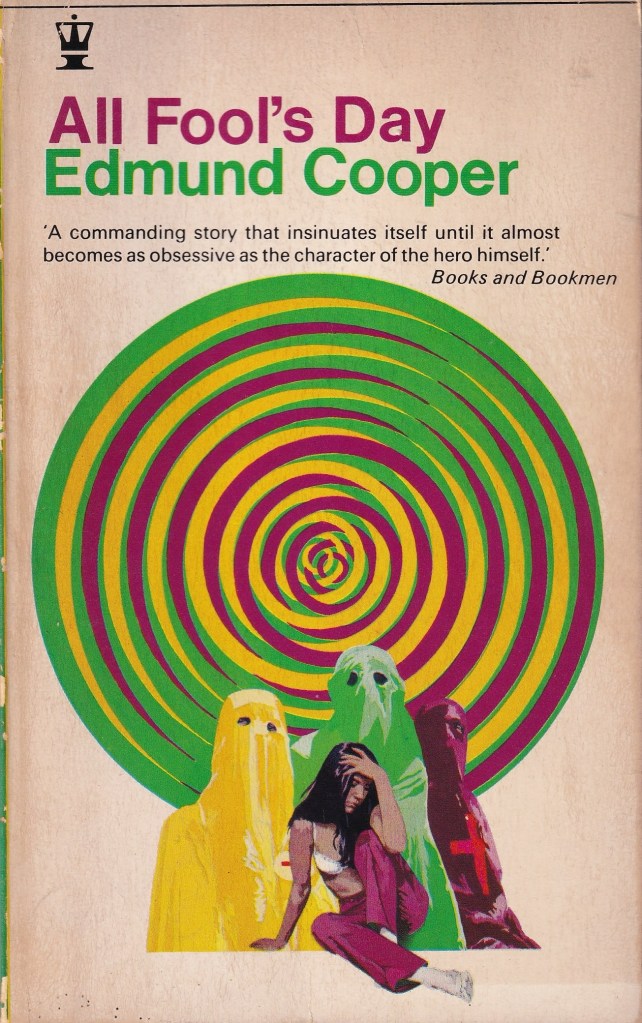
Uncredited cover for the 1967 edition
2.75/5 (Below Average)
As readers of the site should know by now, I am relentlessly entranced by the post-apocalyptic, especially in the post-WWII British mode (shaped in part by the psychological impact of an empire irrevocably weakened).1 I’ll happily suffer through the jarring Catholic apology of Lewis Gibbs’ dismal Late Final (1951) or the comical and grotesque adventures of a one-time Playboy bunny in Emma Tennant’s The Time of the Crack (1973) on my misguided quest to chart the lay of the charred and denuded landscape. And thus, this volume by Edmund Cooper (1926-1982) came into my possession. Cooper contributed quite a few angry and “dyspeptic” novels to the subgenre–Deadly Image (1958), Seed of Light (1959), The Overman Culture (1971), Slaves of Heaven (1974), The Cloud Walker (1973), etc. He also infamously known for his anti-Feminist streak.2
All Fool’s Day (1966) imagines an UK grappling with the profound suicide-causing effects of solar radiation. The story follows Matthew Greville, a wannabe novelist roped into a life as an adman. Greville, already depressed due to his cheating wife and failed career goals, attempts to drive his car off Chelsea Bridge. After serving his sentence for manslaughter and dangerous driving, Greville exits prison to find a UK transformed. Soon even local governments collapse as “Radiant Suicide” spreads. An unusual pattern emerges, those of a creative persuasion (“transnormals”) and those classified as sociopathic or psychotic seem to be spared Omega radiation’s wrath (21).
In a classic dystopic landscape with packs of wild dogs, polyamorous collectives, hordes of rats, bands of religious fanatics, and insane British nobles seeking to resurrect feudalism, Greville spends his days reading novels in an almost Gothic locale–a house of some mournful long-dead poet on an island replete with graveyard. On one of his scrounging expeditions, Greville comes rescues Liz, an escaped sex slave for one of the many deranged cults wrecking havoc, from a pack of animals. While Cooper deliberately renders Greville a violent man willing to kill his wife, it’s hard to escape the sense that Cooper revels in Liz’s suffering. There are numerous unnerving scenes of domestic violence. He falls in love. As forces gather strength, will it be possible to escape cycles of violence?
Why did I keep reading? Despite the novel’s profound problems, Cooper has his moments. He often effectively renders humanity’s earthy, drunk, grimy, and disturbed tendencies. It’s angry. It veers into dark comedy at the oddest moments. In one instance, Liz and Greville are rescued by a criminal who pretends to be a priest (with all the rituals of benediction) and takes over a convent and trains all the nuns to wield weapons. Cooper’s pen lashes out at all the traditional targets: nobility, boarding school boys, priests, etc. A bit of praise seeps into his description of a community of radical acceptance: “We don’t give a damn whether people are homosexual or Hungarian. We don’t give a damn whether they are sex-crazed or schizophrenic. So long as they do their whack and don’t bust up the furniture” (166). Unfortunately, the narrative swings wildly and the story doesn’t ponder what new form of social order might counter ingrained cycles of violence.
If you’re hankering for more satisfying British post-WWII dystopias, check out Dave Wallis’ Only Lovers Left Alive (1964), John Christopher’s A Wrinkle in the Skin (variant title: The Ragged Edge) (1965), M. John Harrison’s The Committed Men (1971), Richard Cowper’s The Road to Corlay (1978), Anna Kavan’s Ice (1967), J. G. Ballard’s oeuvre, and Martin Bax’s experimental The Hospital Ship (1976). I can only recommend Cooper’s All Fool’s Day (1966) for unusual people like myself.
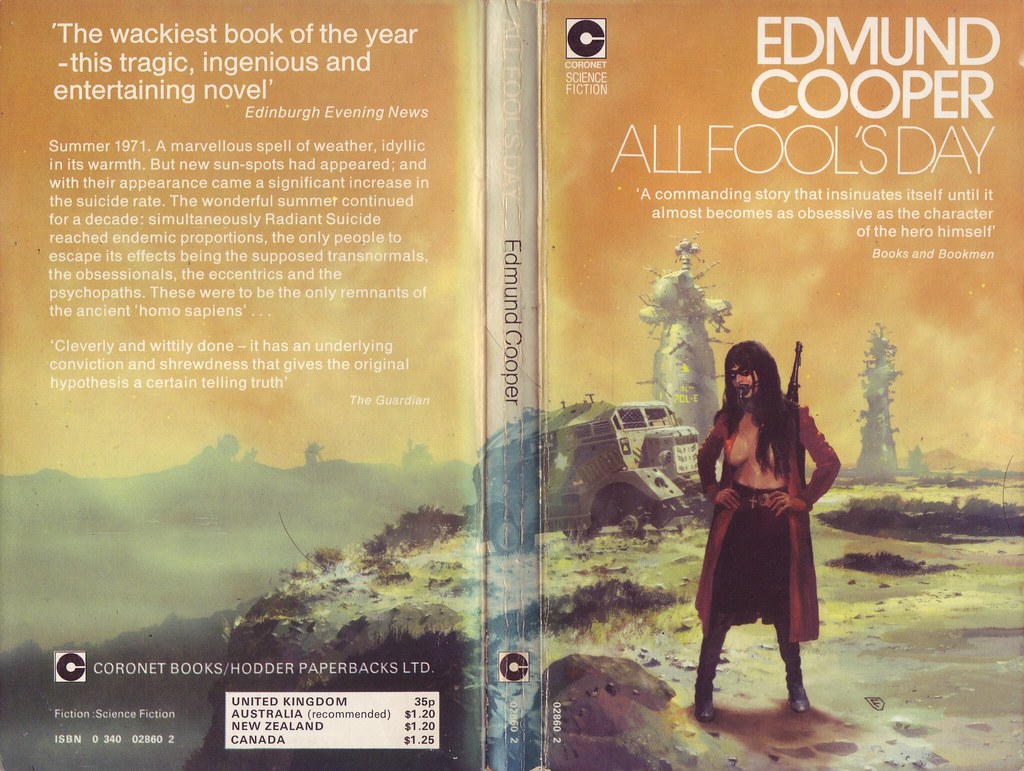
Chris Foss’ cover for the 1973 edition
Notes
- Check out Andrew Hammond’s Cold War Stories: British Dystopian Fiction, 1945-1990 (2017). ↩︎
- The adjective and description of his work comes from the SF Encyclopedia entry. ↩︎
For book reviews consult the INDEX
For cover art posts consult the INDEX
For TV and film reviews consult the INDEX


Pretty much every Cooper I read as a teen was dreadful. His career must have given hope to millions of aspiring authors.
Yeah, not very good for sure… As I point out, I actually find some of his prose solid. He’s okay at rendering the grime, alcoholism, gothic depression, etc. Unfortunately, he’s wedded to a rather aimless plot that masquerades as an adventure story. None of it works.
The only Cooper I’ve read is the first book of the Expendables, The Deathworms of Kratos, originally published as by Richard Avery, and A Far Sunset. The Cooper family decided to fight out who owned the rights to the literary estate in the comments on my review of A Far Sunset…
I remember the drama!
I’ve picked A Far Sunset up as a few times but never finished it. The post-apocalyptic theme often adds the necessary impetus to finish poor novels. Hah.
…I do wonder if they ever resolved their differences! I hope so. Although, I doubt there’s too much money to be made in his estate.
Most of his books seem to be available now through SF Gateway, so I’m guessing they came to some sort of agreement.
Ah, that’s good.
What are your thoughts on Tanith Lee?
I always thought of her as a fantasy writer, so I’ve read very little – only Don’t Bite the Sun, Drinking Sapphire Wine and the collection Women as Demons. I reviewed Don’t Bite the Sun and Women as Demons for SF Mistressworks.
I also did not care for the slang. I compiled a list of her SF above. She wrote quite a few early novels that can be classified as at least SF(ish). I recommend Electric Forest (1979). It’s really not to be missed. https://sciencefictionruminations.com/2020/03/15/book-review-electric-forest-tanith-lee-1979/
Apparently I was not impressed with the Jang slang 🙂
I’ve had the two Tanith Lee books in that cycle on my radar for awhile but haven’t taken the plunge, when I’ve thumbed through them I’ve found myself hesitating to wade into that type of prose, with that dense invented jargon. I was certainly enamored of that style of writing in my younger days but I seem to have less patience with it now. You make it sound worth it though!
I can’t remember if you told me whether you had read some of her other work?
I have not – bit of a blind spot for me.
I recommend Electric Forest (1979) first! It’s far superior to both of these. No invented slang! Lots of gothic sheen and SF nightmare.
I still have a bunch of her early SF works to read.
The Birthgrave (1975) — apparently feels fantasy but set in SF venue.
Sabella or the Blood Stone (1980) — less interested in this one. A vampire on Mars… still a SF venue though. Maybe after I read the rest of this list. The only one on this list I don’t own yet.
The Silver Metal Lover (1981)
Day by Night (1980)
Days of Grass (1985)
I’m probably missing a few more.