Note: My read but “waiting to be reviewed pile” is growing. Short rumination/tangents/impressions are a way to get through the stack before my memory and will fades. My website partially serves as a record of what I have read and a memory palace for future projects. Stay tuned for more detailed and analytical reviews.
1. George Alec Effinger’s The Wolves of Memory (1981)

Norman Walker’s cover for the 1st edition
4.75/5 (Near Masterpiece)
I read almost 150 pages of George Alec Effinger’s masterful The Wolves of Memory (1981) before setting it down almost two years ago. As is often the case, I do not have a single reason why. It certainly had nothing to do with its quality. Perhaps Effinger’s uncanny evocation of dementia (through a SF lens) felt a bit too real. Perhaps his ability to render deeply affective interactions hurt in a way I rarely feel in science fiction. The volume sat on my desk waiting to be completed. I picked it up a few days days ago and finished in one sitting. I’m glad I did.
The Wolves of Memory follows, in a non-linear manner, the story of the bumbling but kind Sandor Courane. After three failed jobs (pro basketball, science fiction author, and factory worker in Tokyo), TECT, a supercomputer who rules Earth, assigns him to a backwater planet. The planet exerts unusual properties on its inhabitants. A viral disease afflicts all who come with a debilitating memory loss. The handful of colonists, all sent to the planet by TECT, spend their days caring for the sick and dying, eking out a substance lifestyle, and explaining to the new arrivals the nature of the planet. It’s an existence filled with brittle, uncomfortable, conversations filled with loss and trauma. New friendships are made. New friendships inevitably unravel as memories fragment and fade away. The compressed timeline makes it all more harrowing. Sandor is selected by the community as the liaison to TECT in order to learn more about the disease. Inevitably, it, too, will afflict him.
It’s shocking The Wolves of Memory only received a handful of printings. Where is the Gollancz masterwork volume? At least Golden Gryphon Press published a collection with all the Sandor Courane tales in 2009. The two earlier US editions received forgettable art. I imagine it didn’t help sales. If you ask me for a list of criminally underrated SF novels that deserve more readers, Effinger’s The Wolves of Memory (1981) would be close to the top.
Highly recommended. It’s bleak. It’s funny. It hurts in a way that’s all too human. Thank you Mark Pontin and Rich Horton for recommending this one back in early 2024.
For more sustained reviews of his work, check out my review of What Entropy Means to Me (1972) and the collection What Entropy Means to Me (1972). There are also a handful of other Effinger reviews which you can access at the general index.
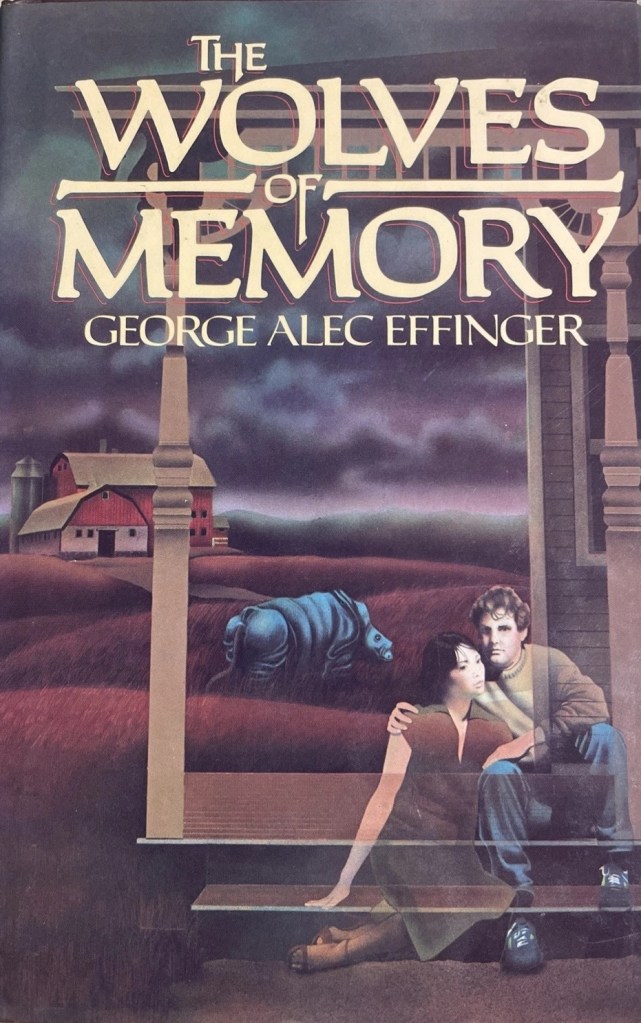
Norman Walker’s cover for the 1st edition
2. J. J. Connington’s Nordenholt’s Million (1923)
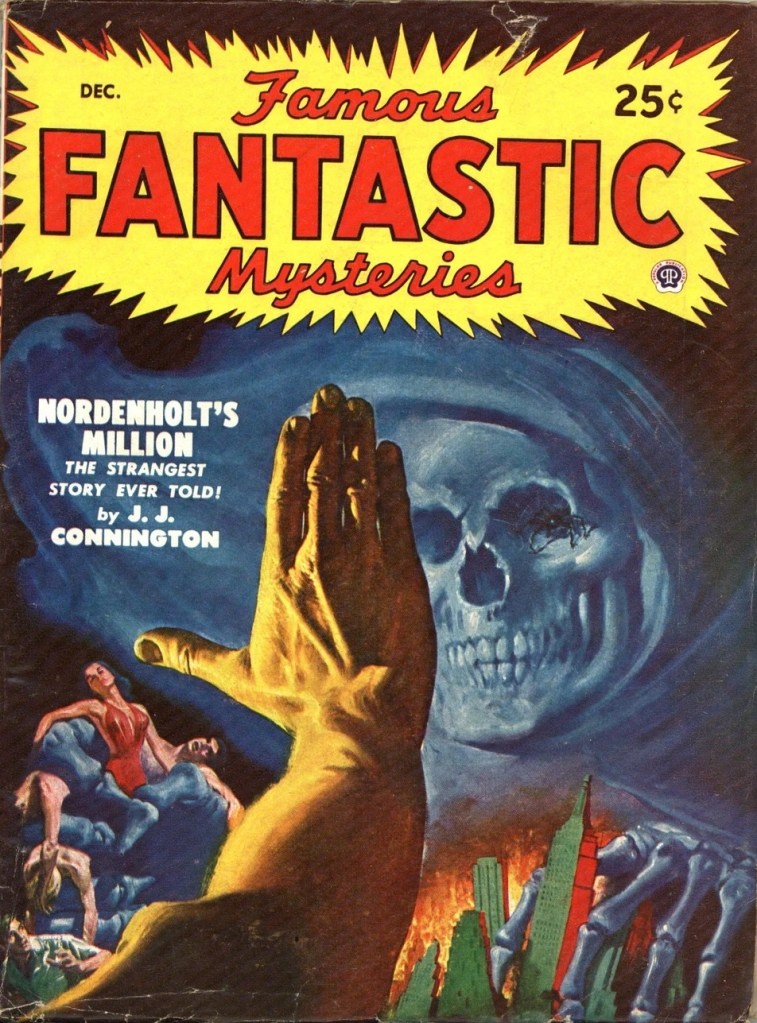
Lawrence’s cover for Famous Fantastic Mysteries, ed. Mary Gnaedinger (December 1948)
3.25/5 (Above Average)
In attempt to understand more of the threads that make up the pre-WWII history of science fiction, I’ve been researching (and occasionally reading) a range of utopian and dystopian works. Sometimes, like E. A. Johnson’s utopian Light Ahead for the Negro (1904), they spawn a year-long research project (still working on it!), and other times I struggle to finish them. J. J. Connington’s Nordenholt’s Million (1923) falls into the latter camp. Alfred Walter Steward, under the name J. J. Connington, was a Scottish chemist and part-time novelist, who wrote mostly detective novels (wikipedia).
Steward’s first novel, Nordenholt’s Million (1923), traces the catastrophic impact of a denitrifying bacteria on the environment. While initially little more than an irritant as swathes of London’s lovely parks die, soon the true impact of the bacteria bears nightmarish and dystopic fruit as the food producing countries of the world horde their own produce and retreat inward. The story follows the narrator (and businessman) Flint who’s drafted to assist a secretive survival project funded by the mysterious plutocrat Nordenholt, who maneuvers the British government into using its vast resources (and force) to procure large swatch of the Scottish industrial Clyde valley: the “Nitrogen Area.” Along with Nordenholt’s adopted daughter (sheltered from the true reality of life outside the Nitrogen area), Flint is tasked with planning the contours of the new utopia that is bound to emerge from the ecological catastrophe.
Not sure what to make of this one. While its implied that a utopian solution may emerge from the wreckage, that manner that it comes about wreaks of dictatorial horror. This certainly feels like a novel written in the aftermath of the Great War. A few sections that transpire outside of the Nitrogen area, are filled with scenes of visceral horror, like coming across a trench filled with the victims of a gas attack. Like many of the era, Steward resorts to a romantic narrative in which the formulation and design of a future society feels secondary. This isn’t a happy story, however. It’s an interesting revision to the normal utopian fiction narrative so popular before WWI.
Somewhat recommended for those interested in the history of the genre. There’s a recent edition out via MIT Press.
For book reviews consult the INDEX
For cover art posts consult the INDEX
For TV and film reviews consult the INDEX


As soon as I saw the Effinger title I thought of Philip Larkin’s poem Sad Steps, which includes the same expression. Does the poem get acknowledged?
Good eye. Neither of the two texts quoted in the beginning of the novel are Larkin’s poem. But yes, the reference seems overt — both explore the sense of loss and disillusionment.
Have you read any of Effinger’s works? He’s one of the lesser known greats.
Have you read any of Effinger’s works? He’s one of the lesser known greats.
I have not, but your review (and the borrowed quote) makes me want to correct. that.
“The vilest deeds like poison weeds
Bloom well in prison air:
It is only what is good in man
That wastes and withers there.”
–Oscar Wilde, “The Ballard of Reading Gaol”
“I have come to die for your sins,” Jesus told a stopped figure passing him on the road.
“Then what am I to die for?” the old man asked.
Jesus took a small notebook from his pocket and copied the question. “If I may have your name and address,” he said, “the answer will be sent to you.”
–A. J. Langguth, Jesus Christs
His short fiction is also great.
I really enjoyed “Biting Down Hard on Truth” (1974). My short review: The best of the collection—worth the price of the book. Deserved an award nod in 1975…. Mac, Willie, and Willie’s wife Sam are members of a highly regimented cult with Mithraic undertones and iconographies. The cult leader Jennings has them take endless notes on bombs and armaments, notes that mysteriously disappear from the page. Evenings are spent watching old adventure films à la Slaves of Blood. And their lives seem to parallel the films they watch! As escape from the laws and regulations seems possible sheer panic sets in. Cyclicality elicits a hopeless feeling that its is all a figment, a psychotic extravaganza, an obsession seemingly concrete… Mac proclaims to himself, “It’s a very interesting psychological experiment” as Jennings provides “a rigid life, and now he’s removing the laws that we’ve always used as props. It’s pathetic, when you realize how simple he is. And these poor people! They’re helpless” (158).
And “25 Crunch Split Right on Two” (1975): A beautiful and affective story with a slightly unorthodox (at least for SF) plot–a NFL player named Eldon MacDay discovers that the most severe blows of his opponents trigger lucid memories of his wife. Physical pain allows him to relive his past. And of course, it takes a profound toll on his body and mind. Devastating, emotional.
Link to the full review of the collection Irrational Numbers: https://sciencefictionruminations.com/2016/01/26/book-review-irrational-numbers-george-alec-effinger-1976/
As for novels, I assume he’s best known for his Marîd Audran sequence: When Gravity Fails (1987), A Fire in the Sun (1989), and The Exile Kiss (1991). They’re a few years outside of this site’s current focus (pre-1985).
However I really really enjoyed his Nebula nominated novel What Entropy Means to Me (1972). One of the better New Wave works in my view. https://sciencefictionruminations.com/2012/12/13/book-review-what-entropy-means-to-me-george-alec-effinger-1972/
Many thanks!
No problem. Let me know your thoughts if you get to any of his work.
Great to read about another Effinger book I’ve never heard of! Definitely an interesting/underrated voice, I’ll keep an eye out for this one. Agreed that that cover art isn’t doing him any favors. Still looking for a copy of “What Entropy Means to Me”.
Yeah, it’s a good one! See Matthew’s comment below for even more reasons why its been forgotten. He’s worth the hunt.
Can’t add much other than The Wolves of Memory is a great melacholic book about the sense of ones’ self dwinding – even as he employs to more serious effect some of the recurring cast and ideas he used in his comic or absurdist stories. As to some degree it draws on Effinger’s own harrowing experiences of terrible health and lengthy hospitalisation in the 70s, he’s made something far beond the expectations of the most generic sf – hence selling so poorly. Effinger thought it was also orphaned when a new editor came in replacing his commisioning editor, who therefore had no reason to push the book to reviewers or promote it. Effinger claimed it sold so badly publishers refused to look at When Gravity Fails
Also, the 14 chapters are to match the Stations of the Cross.
What rating would you give it? It’s really really good — and deserves a new edition.
I’m really not a person for starred ratings – but 4+ out of five.
I just thought: “Piranesi” touches some of the matter of this book, encroaching sickness, confusion, acceptance of inescapable valetudinarianism and diminishment. And that found an audience.
It wholly stands on its own without the incorporation of Effinger’s habitual self-references to other works by him.
Me neither but… I was at one point. And very often I end up writing so much about books I dislike as literary products but are fascinating historically. I sometimes think about two ratings: literary quality + historical interest.
Maybe Piranesi found an audience due to the surprising success of her first novel?
Maybe the backlash to the New Wave was in force and Effinger’s book felt–with its experimental structure and unconventional, for SF, plot– a bit 1972.