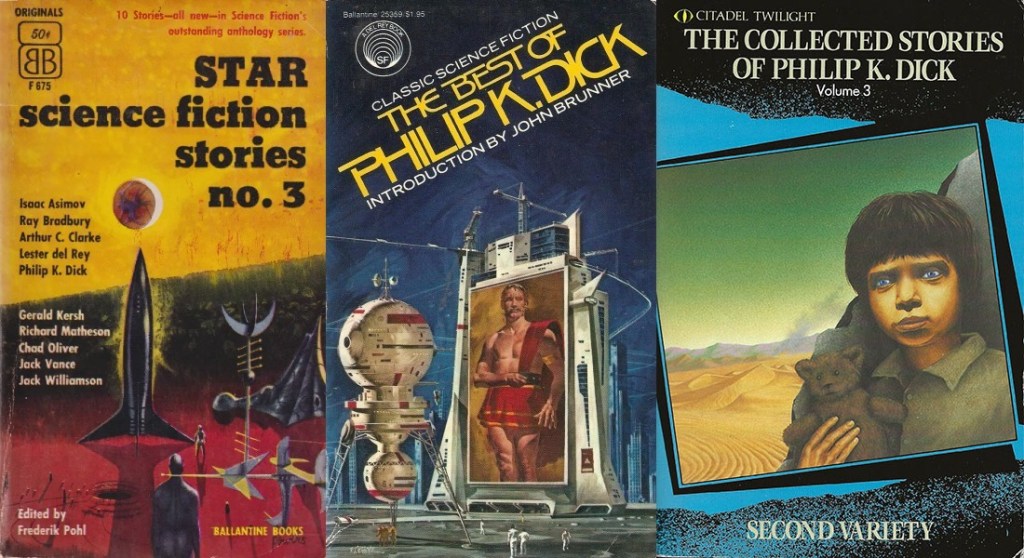
Three locations where Philip K. Dick’s “Foster, You’re Dead” (1955) appeared: L to R. Star Science Fiction No. 3 (1955), The Best Of Philip K. Dick (1977), and Second Variety (1991)
I appeared on the podcast DickHeads (i.e. Philip K. Dick fans) to discuss one of his most underrated (in my opinion) short fictions: “Foster, You’re Dead” (1955). If you want to read the short story before you listen to the quite detailed discussion, it’s available online here. I’m a sucker for science fiction satires of 50s American defense policy, commercialism, and the idiocracy of fallout shelters. As I am allergic to listening to myself, I’ve not given it a re-listen! Hopefully it went as well as I thought it did at the time.
Also, here is my short review of the story–part of my larger review of the entire original anthology Star Science Fiction No. 3, ed. Frederik Pohl (1955)–from last year if you don’t have time to listen to the podcast at the moment.
“Foster, You’re Dead” (1955), Philip K. Dick, 5/5 (Masterpiece): Mike Foster spends his school days practicing survival skills–digging, making knives, weaving baskets–in case of a nuclear attack. The kids snicker at him as he walks past. They don’t own a fallout shelter at home. His father refuses to pay into the NATS (National Security fund). If a bomb hit, Mike wouldn’t even be granted access to the school shelter. He’s possessed by a deep, perpetual, encompassing trauma.4 His walk home is nightmarish. Mechanical newspaper machines shout excitedly about “war, death, amazing new weapons” (67). The public shelter beckons with its neon lights but he has no money in his pocket for entry. And the store with the new shelter model mocks with its advertisements: “a powered heating and refrigeration system” and “self-servicing air-purification network” with “three decontamination stages for food and water” (68). Reluctant to yet again confront his father about their lack of shelter, he gazes at the new model and talks to the salesmen. He imagines that every evening he’d sleep in its encapsulating embrace, womb-like.
One of the absolute best fallout shelter themed SF stories I’ve ever read. It’s a fascinating collision of crisp prose, commentary on the arms race, and an evisceration of the complicity of commercialism in Cold War terror. Joins William Tenn’s “Generation of Noah” (1951), Daniel Galouye’s Dark Universe (1961), Modecai Roshwald’s Level 7 (1959), and Fritz Leiber’s “The Moon Is Green” (1952) amongst the best on the theme.
For cover art posts consult the INDEX
For book reviews consult the INDEX
For TV and film reviews consult the INDEX


This is one of my favorite PK Dick stories. Thanks for covering it.
Glad you enjoyed it! But yes, one of mine as well.