In 2019, I reviewed and adored David Ely’s science fiction thriller Seconds (1963), the source material for John Frankenheimer’s similarly brilliant 1966 film. I did not know that Ely got his start in genre magazines under the editorship of Cele Goldsmith Lalli (1933-2002), known for “discovering” SF luminaries like Ursula K. Le Guin, Thomas M. Disch, Keith Laumer, Sonya Dorman, and Roger Zelazny (among others).1 Before his writing career, Ely served in the Navy (1945-1946) and Army (1950-1952) and as a reporter in St. Louis (until 1956) before entering the corporate world as an “administrative assistant” for the nebulously named Cold War organization Development and Resources Corporation in New York (1956-1959).2
After a handful of short stories in genre magazines, Ely moved to far more lucrative venues like Playboy and Cosmopolitan. I’ve had my eyes on his collection–containing additional SF tales–Time Out (1968) for years. Unfortunately, prices rarely drop below $70 with shipping. Science fiction seems to have been close to his heart as he returned to the genre with his novel Journal of the Flood Year (1992).
Let’s get to the stories!
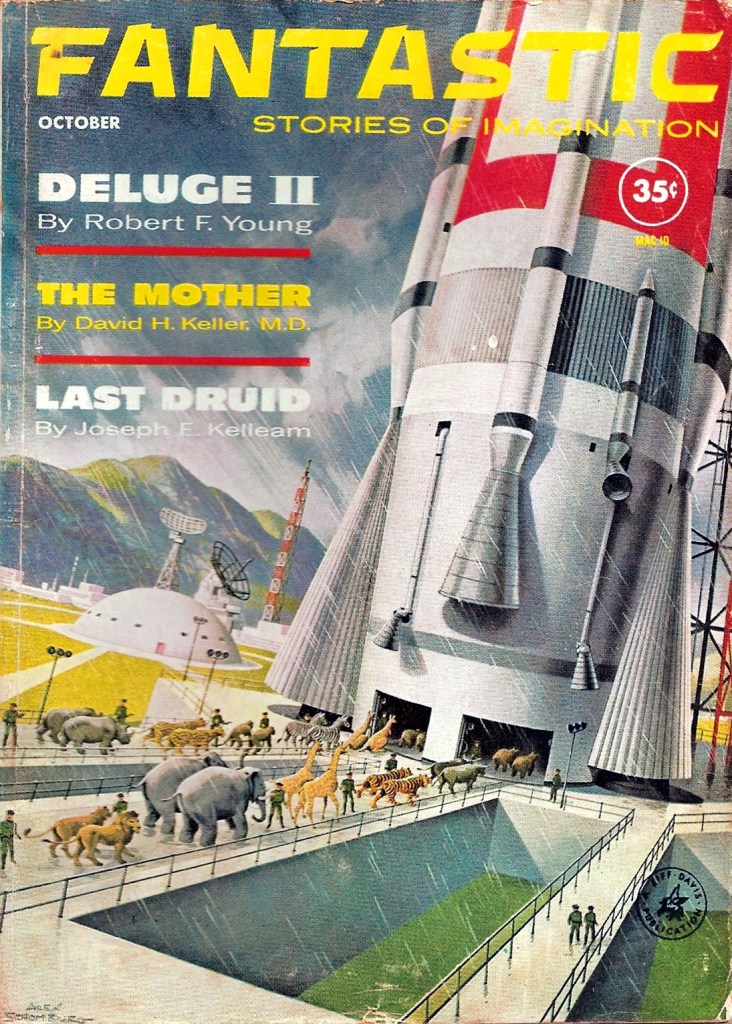
Alex Schomburg’s cover for Fantastic Stories of Imagination, ed. Cele Goldsmith (October 1961)
3/5 (Average)
“Court of Judgment” (1961) first appeared in Fantastic Stories of Imagination, ed. Cele Goldsmith (October 1961). You can read it online here. Received an Honorable Mention at the 1962 Hugo Award for Best Short Fiction.
In the perpetual rain and murk of the London winter, Major Dance slowly sells off the important objects he’d accumulated in his service. He’s sick. He’s desperate. His pension’s insufficient. His doctor wants him to spend “the winter in a more congenial climate” (113). Checking in with Mr. Carstairs, who runs an antique store, he discovers that the “Indian niello pipe” presented to him by the Maharajah still has not sold. Carstairs, utterly blind without his glasses, shows Major Dance his new discovery — a mysterious lost painting of Reutenwald (an artist invented by Ely) called “Court of Judgement.” Lost in the siege of Paris in 1870, the painting imagines a “gloomy scene in grays and reds and heavy greens” with low clouds that seemed to “weight upon the painted human figures” (114). More important than the creepy contents of the painting to Major Dance is the value! And he’s willing to go to great lengths to procure the painting from Carstairs without paying its full price.
Ely’s first story is a slight fantasy horror trifle. Yes, the descriptions of the painting tantalize—I wanted to know more about its composition and secret history. Yes, there’s a morally ambiguous noir feel to the proceedings. Ely’s minimalist evocation of dread and obsession with morally conflicted men in works like Seconds (1963) certainly have their origin in visions like this one. But it’s all a bit careful and tentative.
I can’t strongly recommend this one unless, like me, you are interested in Ely’s pre-Seconds (1963) genre explorations.
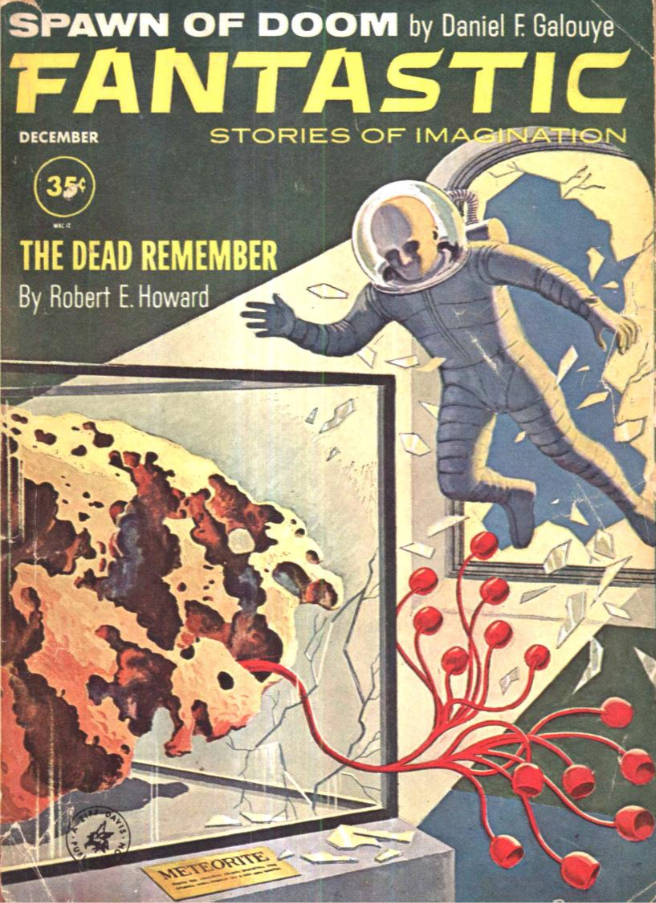
Lloyd Birmingham’s cover for Fantastic Stories of Imagination, ed. Cele Goldsmith (December 1961)
3.5/5 (Good)
“The Last Friday in August” (1961) first appeared in Fantastic Stories of Imagination, ed. Cele Goldsmith (December 1961). You can read it online here.
The best of the three stories, “The Last Friday in August” follows Williams, a senior engineering draftsman, and his descent into fanaticism. A fastidious and sociopathic man, Williams “loathed” and “hated” the mass of humanity crowded into public transit on his commute home (44). Silently, he demeans the women who look at him with “their dark little goat eyes” that “rove up an down his slender neatness like fingers” (44). He’s overwhelmed by the smells, the proximity, and the accidental touch of other people. At home he slips into his meditative system in an attempt to purge the built up angst and hate accumulated daily in his interactions with his fellow humans. He folds his clothes. He squats naked on the carpet with his head arched back. Soon the sounds of the street and the occupants of nearby apartments fades.
But he has ambitions! Rather than a personal ritual to navigate his sociopathic hate, Williams wants others to learn his technique. However, he doesn’t want to be a teacher. That would require interaction with other humans: “it would mean contact with other people, it would mean misunderstanding; ridicule, perhaps even persecution and public denunciation” (46). But something inside of him suggests that a moment approaches in which he can reach the masses.
What is the SFF element? Williams somehow, it’s not entirely clear, takes his personal meditative practice and forces it on others. Or is it entirely in his head? Seconds (1963) similarly explored the emptiness of modern man. However, in this instance, Williams is clearly a sociopath rather than a successful suburban organization man. I sort of liked this one. It’s a short, concise, and dark little story about fanaticism and disturbed rendering of a sociopathic inability to connect and understand your fellow humans.

Lloyd Birmingham’s cover for Amazing Stories, ed. Cele Goldsmith (March 1962)
2.75/5 (Below Average)
“The Wizard of Light” (1962) first appeared in Amazing Stories, ed. Cele Goldsmith (March 1962). You can read it online here.
Dr. Browl, the titular Wizard of Light, a classic mad-scientist sort who amassed a fortune “with his remarkable inventions in the field of optics” (69), spends his days traveling from esteemed art collection to art collection with a strange technological device. His apparent objective? Poor slapdash copies of famous paintings. But not all the machine’s capabilities are entirely clear. Almost magically within two years, Dr. Browl and his machine went through the collections of “every significant art repository in the Western world” (70). And then “one bright June morning” a perfect Manet–“Boy With Drum”(an invented Manet?)–appears in a place where it’s not supposed to be. The problem? It’s an exact copy–down to the historical paint and style–of the original. It’s impossible to tell the difference. And then other copies appear. And soon the nature of Dr. Browl’s plot to sabotage the entire art world becomes manifest.
Clearly Ely aims his gentle ire on the underpinnings of the art world—the insular circle of wealthy collectors and museums who buy and sell to each other. And, of course, the incredible value placed on a handful of artists and works. That said, Dr. Browl clearly is an agent-provocateur who uses his accumulated wealth in arbitrary ways. He’s no mouthpiece of Ely’s take on the art world. He’s more a maniacal manifestation of the pulp “Tech Bro.” This clash between social commentary and the nature of the agent that forces a reckoning means the meanings gets lost in the silly jumble that emerges before all the ends get tied in the neatest of all possible ways. A forgettable attempt at social commentary that doesn’t actually have much to say at all. Not recommended.
Taken as a group, Ely’s first three published genre short stories illustrate a tentative start to his writing career with a few moments of interest. While they contain hints of his later ability to create unease and an interest in social commentary (on the art world, fanaticism, modern ennui, etc.), all the parts do not mesh entirely successfully. I find it all the more impressive that Seconds (1963), a work of an author fully formed, appeared in print the following year.3 Track down a copy of the novel!
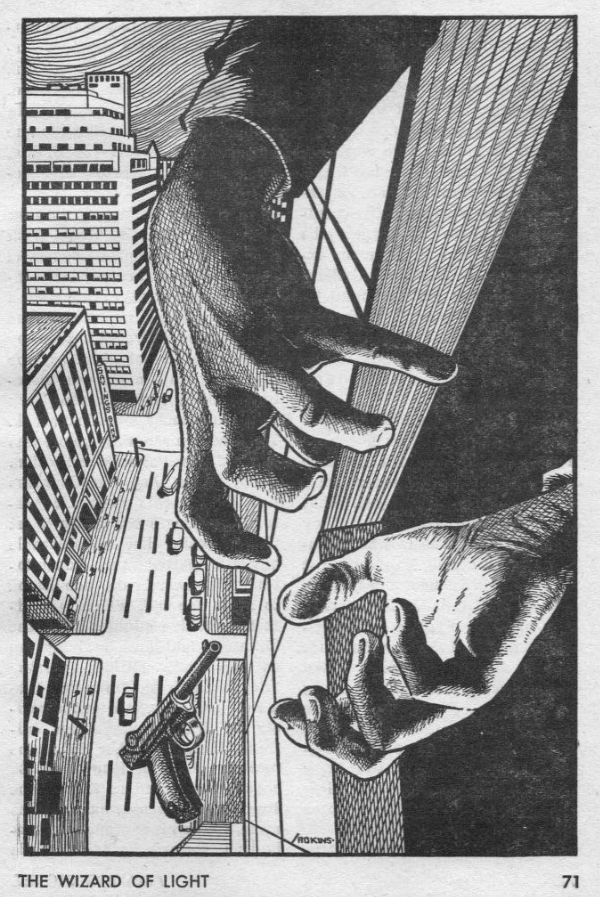
Dan Adkins’ interior art for David Ely’s “The Wizard of Light” (1962)
Notes
- I don’t know whether he appeared in print earlier in non-genre magazine. The bibliography linked below does not include his first two SFF stories and thus is incomplete. For more on Goldsmith’s editorial contribution, check out this article by Cora Buhlert. ↩︎
- The bibliographic details come from here. According to Wikipedia, the Development and Resources Corporation “aimed to develop rural areas in foreign” countries in order to gain support for the United States during the Cold War. ↩︎
- Seconds (1963) is Ely’s second novel. The first, Trot: A Novel of Suspense (1963), appeared earlier in the year. I do not know if it contained any speculative elements. I am eager to read Ely’s third novel The Tour (1967). ↩︎
For book reviews consult the INDEX
For cover art posts consult the INDEX
For TV and film reviews consult the INDEX


“[…] a mysterious lost painting of Reutenwald (an artist invented by Ely) called “Court of Judgement.” Lost in the siege of Paris in 1870 […]”
This made me think of Isidore Ducasse, author of “Les Chants de Maldoror” (written under the moniker “Comte de Lautréamont”). Ducasse died during the siege of Paris in late 1870 and his work fell into obscurity for almost 50 years before the Surrealists rediscovered it in the wake of the First World War.
I should check out Ely.
I hope you are well.
Hello Anthony,
Definitely check out Seconds before any of these short stories. I have a copy of Chants but haven’t read it!
I’m doing okay. Rough starts to the semester seem to be the norm in this current American educational dystopia.
Maldoror is quite the experience. Highly recommended.
I enjoyed the John Frankenheimer film adaptation so I might just track down a copy of the book.
The film is quite similar to the book. For example, that creepy scene they film in the building as collateral without the main character’s knowledge is identical. If I remember correctly, there’s more of a difference in narrative flow. The middle section of the film (the grape scene, etc.) is a VERY short part of the book.