The following reviews serve as the 38th installment of my series searching for “SF short stories that are critical in some capacity of space agencies, astronauts, and the culture which produced them.” Some stories I’ll review in this series might not fit or are poor quality. And that is okay. I relish the act of literary archaeology. I’ve previously covered two Harlan Ellison short stories for this series: “Psycho at Mid-Point” (1956) and “The Discarded” (variant title: “The Abnormals”) (1959). As always, if you know of any others that might fit, let me know. I’ve compiled an extensive list but like all lists it’s incomplete.
Thank you Richard, “Friend of the Site,” for these recommendations all the way back in 2022. I didn’t forget.
Previously: Clifford D. Simak’s “Madness from Mars” (1939)
Up Next: TBD
Let’s get to the stories!
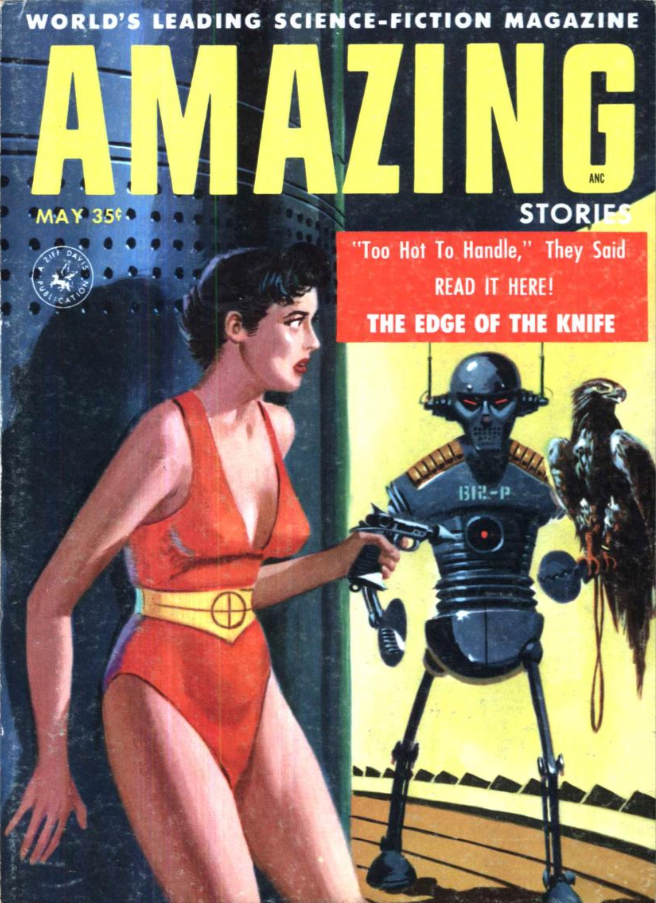
Ed Valigursky’s cover for the Amazing Stories, ed. Paul W. Fairman (May 1957)
3/5 (Average)
Harlan Ellison’s “Night Vigil” (variant title: “Yellow Streak Hero”) first appeared in the fanzine Peon, ed. Charles Lee Riddle (May 1955). It was reprinted in Amazing Stories, ed. Paul W. Fairman (May 1957). You can read it online here in Peon and here in Amazing Stories.
Futuristic Press Gangs
The computer told the space military of the future to “Get Charles Jackson Ferreno only!” (117). So they grabbed him while he was lounging on his porch with his arms around his girlfriend. Pressed into service, Charles, then only nineteen, is sent to a little quonset hut on a small bleak planetary body to wait for an invasion. Why Charles? The computer brain said he wouldn’t go insane in solitary confinement for decades and decades if necessary. The enemy? It’s not entirely clear. But the authorities knew “the enemy would come, for they had found the remnants of those the enemy had destroyed” (114). So he sits in his futuristic cell. Listening to the same music. Reading the same books. Watching the same blinking red machine eye. Cycling through periods of self-loathing, despair, dislocating depression until….
This is a bleak distillation of a classic moral dilemma: do you sacrifice the life of an individual for the greater good of humanity? Charles possesses unique skills of mental self-preservation. In the almost dystopian logic of this future he must be sacrificed. Of course, Ellison harnesses the bleak solitude of space to make his point even more punchy. I do think the ending undercuts a more complex moral argument. While Ellison’s still figuring out his voice, the story does possess elements of polemical aggression and unflinching style that characterizes so much of his work.
The premise is remarkably similar to Tom Godwin’s “The Nothing Equation” published in the same magazine Amazing Stories, ed. Paul W. Fairman (December 1957) later that year. Godwin far more realistically depicts the effects and result of solitary isolation (in a far shorter timespan). I imagine he read the Ellison reprinted story and decided to enter into a dialogue. Authors published in genre magazines were consumers of said magazines. This cluster of human sacrificed for the “greater good” stories feel like the 50s take on the moral issues so adeptly raised by Le Guin’s “The Ones Who Walk Away from Omelas” (1973).
Somewhat recommended if you’re interested in the theme or Ellison’s earliest fictions.
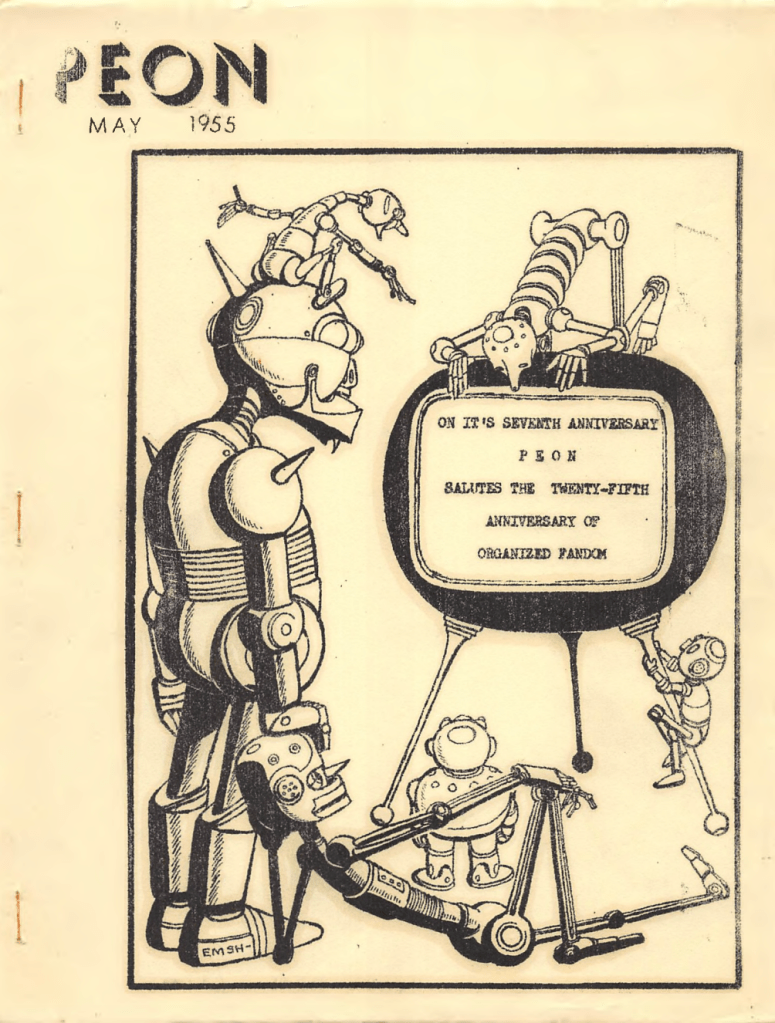
Ed Emshwiller’s cover for Peon, ed. Charles Lee Riddle (May 1955)
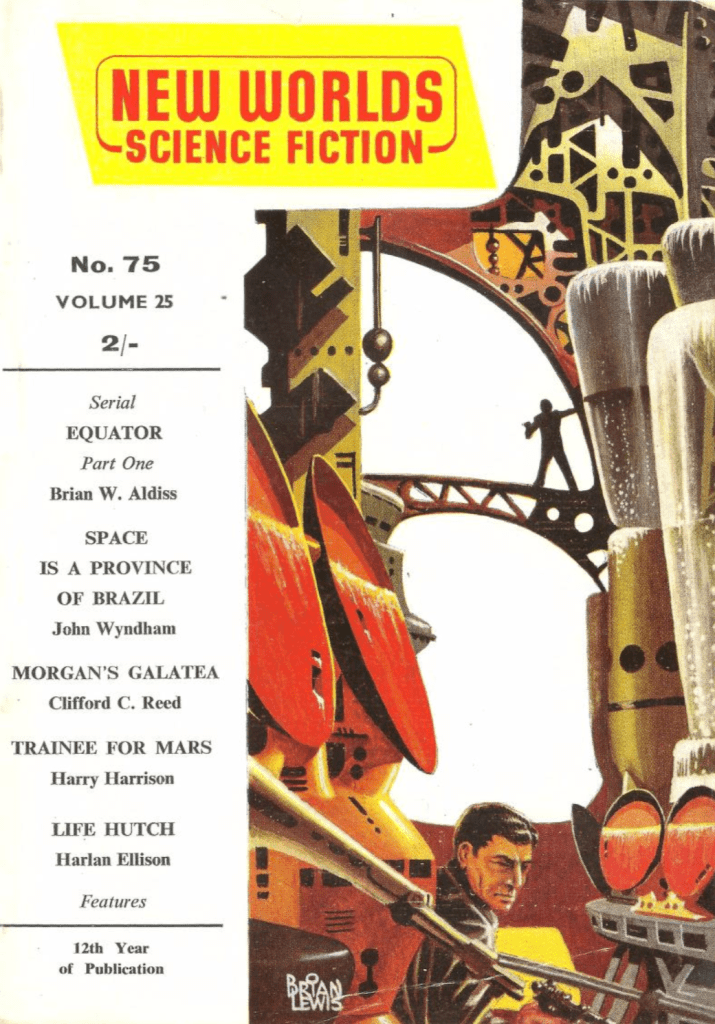
Brian Lewis’ cover for New Worlds Science Fiction, ed. John Carnell (September 1958)
3.25/5 (Above Average)
Harlan Ellison’s “Life Hutch” first appeared in If, ed. James L. Quinn (April 1956). You can read it online in the September 1958 issue of New Worlds here.
Like “Night Vigil,” “Life Hutch” transpires within a limited locale — the titular rescue station wedged on a pebble spinning somewhere in space. There’s a cataclysmic war with the alien Kyben transpiring in the distance. Terrence, in the life hutch, imagines the “sounds of war, across the gulf of space” (84). He had crash landed on the planetoid and attempted to utilize the equipment and supplies in the life hutch. However, the hyper violence of the galactic conflict becomes an entirely different struggle within the metaphoric womb meant to preserve the injured. Something happened to the robotic mind meant to care for the occupant. Terrence is immediately attacked by the robot upon entry. Wired to notice movement, Terrence must avoid the sensors of the robot and figure out how to survive. Interspersed with his terror-filled attempts to avoid the robotic instrument of violence, Terrence thinks back on humanity’s utter ignorance of the alien Kyben,
Ellison sets up a series of narrative parallels. Terrence remembers how his commander told him “for the next thousand we’ll be trying to figure out how [the Kyben] think, why they fight, what it takes to get along with them, what motivates them” (90). Of course, in order to survive, humans must confront the seemingly robotic Kyben with violence. This is a war without a clear understanding of the nature of the enemy. “Does it matter?” asks the commander (90). In both instances, Terrence’s fight with the robot and with the Kyben, “survival never matters until you have to survive” (90). Both parallels present only one possible choice.
I’m not sure what to make of the message of this one. Without doubt Ellison depicts humanity’s future in space as a constant struggle for survival that inevitably yields violence. Figures like Terrance and Charles (in “Night Vigil”) are caught up in vast mechanisms they cannot control. It’s unclear whether knowing more about the Kyben would have prevented conflict just like there was no time for Terrence to respond to the robot before he’s attacked. The paralleled action represents an attempt to add complexity to the narrative. It’s more effectively rendered than “Night Watch” but remains the work of a new writer trying to find his voice.
Somewhat recommended.
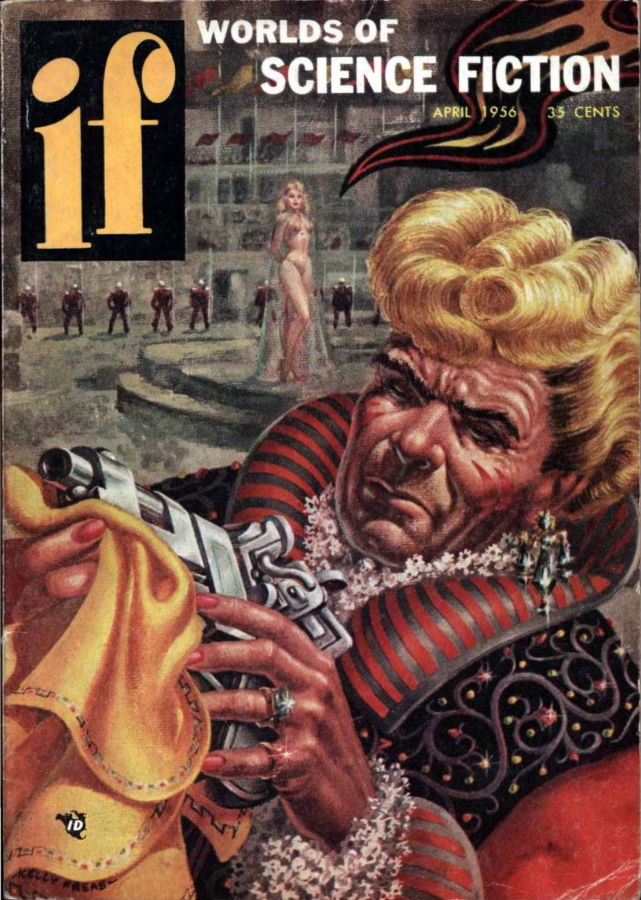
Frank Kelly Freas’ cover for If, ed. James L. Quinn (April 1956)
For book reviews consult the INDEX
For cover art posts consult the INDEX
For TV and film reviews consult the INDEX


As I said before, the theme of “Night Vigil”, is about totalitarianism. A world where someone can be torn from the arms of their girlfriend, is one where you haven’t any life of your own. The theme’s been taken to it’s most extreme. Life itself serves the state. The second one seems to be about isolation, but I don’t recall much about it. Both were written before his “new wave” apoplexy.
Hello Richard,
Yup — I made sure to point out “Figures like Terrance and Charles (in “Night Vigil”) are caught up in vast mechanisms they cannot control.”
I did enjoy how both stories use the isolated locale to emphasize each theme’s extreme.
Thank you again for the recommendation. I, unfortunately, did not care for either story enough to really find myself eager to write about them other than brief comments about how they fit the series. Hence my analysis is threadbare at best.
Yes…well…I chose them because you wanted short stories by him that fitted your themed critique about space agencies and the culture that founded them. They’re probably quite good considering the period in which they were written, and showed his future “new wave” potential.
I know! No worries!
It’s okay. I knew what you wanted.
Keep the recommendations coming. Also know that I’m the one with the perverse desire to read all of Ellison’s short stories that appeared in Super-Science Fiction magazine — most of them have not been anthologized.
Do mean Harlan Ellison on the same theme?
Ellison or others — as long as it’s pre-1985. I have quite a long list but it’s obviously incomplete.
I sent you Philip K. Dick’s “Precious Artefact”. Another one by him, “If There Were No Benny Cemoli?”, is only remotely connected to your obsessive theme, by the intervention of aliens after devastation on Earth, but It’s also about what might be called mechanical bureaucracy. Have you read it?
Yup, I reviewed “Precious Artifact.” I don’t think you’ve recommended “If There Were No Benny Cemoli?” in the past. If I read it, it was before I started my site. I have no memory of it.
The plot blurb for “If There Were No Benny Cemoli?” certainly sounds interesting.
I remember your review of “Precious Artefact”. I haven’t recommended “If There Were No Benny Cemoli”. I don’t know how flexible your criteria is for inclusion of this one.
As I mention in the intro blurb, a large part of the fun is the exploration — if it’s an excuse to read a story I haven’t read yet, the potential possibility of an interesting theme might push me to actually get to it!
I see.
Just posted a podcast that might be of interest to you! PKD related.
I’m sure that “Explorers We” you discussed on the podcast, was written in 1957/58. He wrote it after a two year gap when he wrote no science fiction, and has I said on your post about it, it showed a greater maturity of thought, that was cultivated during the period he wrote mainstream novels. It dealt with the themes of identity and a definition of being human.
Yeah, I enjoyed that one.
The cover of the Amazing Stories magazine caused me to actually laugh out loud.
Haha, yeah. Ed Valigursky has a style that screams pulp stereotypes. To be honest, the most confusing element is the falcon! I haven’t read the story it illustrates.
I am going to have to make time to read that, if anything to see what passes for too hot to handle in a 1955 SF magazine.
I hope to see the point of the falcon, because I am unsure why a robot, even a villainous one, would need a falcon. Now, a Persian cat with a diamond studded collar I could see…
It’s an H. Beam Piper story. I doubt there’s much that’s too hot to handle in one of his stories. If it was Farmer or even Ellison (he at least implies that characters have passions), I’d believe it.
Looking at the magazine’s contents page makes this more complicated. The Piper story is reiterated as “too hot” and “too dangerous,” but the contents page says that the cover illustrates a scene from “Winged Planet” by Adam Chase. I think I have an evening’s reading ahead of me to satisfy my curiosity.
Ah, let me know how to goes.
I just finished “Winged Planet.” It is not good. The fact that the woman on the cover is the protagonist of the story is a plus, but that is tempered by the plot that eventually contrives to have her naked through a third of the story (the first third has her encountering perils that mange to strip away the few layers she is wearing at the outset). Also, traditional gender roles are reinforced in a way that is definitely “cringe.” The presence of birds is explained unsatisfactorily, as is most of the ideas in the story. I don’t think this qualifies as camp, but might be more accurately described as kitschy.
I did not recognize the author at first glance. It’s a pseudonym of Milton Lesser. He too must have thought it was for a paycheck only. hah.
I actually liked a Lesser story recently: “Do It Yourself” (1957) https://sciencefictionruminations.com/2024/10/13/short-story-reviews-phillip-k-dicks-stand-by-variant-title-top-stand-by-job-1963-milton-lessers-do-it-yourself-1957-and-h-beam-piper-and-john-j-mcguires-hunter-patrol/
I perseverated through the Piper story. I am at a loss as to what would make it so outrageous. Nuclear threat stories were a common thing by the time this was published. Maybe the depiction of tenure being wielded like a club by a college administrator against instructional staff was supposed to be provocative.
While you’re at it, you might as well read the Ellison! haha.
Hmmmm… I think I prefer Ellison’s new wave apoplexy.
That said, “Do It Yourself” is much better that “Winged Planet.” Reading it I started comparing it to Brackett’s “The Long Tomorrow” (published two years earlier than DIY).
Yeah, it’s notable, as I explain in my review, for its straight-laced no-strings attached positive depiction of unions.
There’s a review of Brackett’s The Long Tomorrow on the site. My favorite of her works.
I think it is one of the great SF novels of that era. It’s startlingly good from the Queen of Space Operas (though I enjoy her crime fiction, too).
I agree. I enjoyed her reluctance to give easy answers or settle on some simplistic morality: https://sciencefictionruminations.com/2020/07/04/book-review-the-long-tomorrow-leigh-brackett-1955/
Ellison is my second favourite science fiction writer (after PKD). I feel like I should have somethingbto say about these stories, but as mentioned, they are so early in his career, it is hard to get too excited about either story. I know I read both stories, but it would have been many years ago now (2001), as Ellison was the first science fiction writer I made a sustained attempt to read all of their available work. It required quite a bit of ordering used items from Amazon back then, as I believe only one book by Ellison was currently in-print back in those dark days, and Ellison was not an easy name to find at most local used book stores.
Which is a very long, and roundabout, method to recommend a story for your list. I’m sorry if this was already on your list, but I cannot seem to find the list for this particular topic.
Anyway, I read “The MacBeth Expiations” by M. John Harrison in the John Carnell edited New Writings in SF #9 anthology recently, and it would fit the theme. I believe it was Harrison’s first weitten story. It reads more like Barry Malzberg than the style Harrison would quickly perfect, but “reads like Malzberg” isn’t exactly a negative. It tells a story of exploring another planet bringing madness to the astronauts.
I should have searched better. I see you have already read and reviewed New Writings in SF #9, including the Harrison story. I should have searched for “Macbeth” rather than looking for the list.
No worries. I had completely forgotten that I’d reviewed it. I have little memory of it.
But yes, the list is more a list of stories that I’ve uncovered that might relate to the theme. It’s in a notebook next to my desk rather than on my site.
Thank you for the recommendation! I’ll put it on my list. But yes, I’ve read a few of Ellison’s earliest fictions and they have some grit and grime and intensity but not much else. As for his 50s tales, I did enjoy “The Discarded” (variant title: “The Abnormals”) (1959). I linked the review in the intro to the post.
I do enjoy some of Ellison’s earlier science fiction work. Looking at the ISFDB site, it looks as if “The Sky is Burning” from 1958 stands out as the earliest Ellison science fiction story that made an impression on me.
”The Very Last Day of a Good Woman” and “In Lonely Lands” are two other early stories that I remember enjoying.
He certainly was prolific in the late 50s. He was a big contributor to the generally dismal Super-Science Fiction magazine. There’s probably a reason so few of his stories that appeared in that magazine were collected or anthologized!
I have another one by Dick, that definitely does fit your criteria for short stories that are critical of space agencies, astronauts and the powers behind them. It’s called “Chains of Air, Web of Aether”, that’s about two planetary colonists, a man and a woman, living in singly occupied domes, and the relationship that develops between the woman, who’s ill, and the man’s capacity to care for her. It’s one of his much later pieces and one of his very best I think, being done with great depth and feeling.
Thank you for the recommendation.