Preliminary note: This review originally appeared in the second issue of Rachel S. Cordasco’s new magazine Small Planet: The SF in Translation Magazine. You can read the entire issue for free here! I plan on contributing one review of pre-1985 SFF in translation for each issue. In the first issue, I reviewed Knut Faldbakken’s harrowing dystopia Sweetwater (1976, trans. Joan Tate, 1994).

Jane R. Wattenberg’s cover for the 1980 edition
3.5/5 (Good)
Czech author Luděk Pešek (1919-1999), also a painter of space landscapes and photographer, emigrated to Switzerland with his wife in 1968. Due to his political beliefs and penchant to criticize the state in his early literary works, the Union of Czechoslovak Visual Artists expelled Pešek from its ranks. In Switzerland, he focused on painting space landscapes and providing illustrations for foreign publishing houses like Penguin Books and the National Geographic Society.1 He also wrote three science fiction novels in Czech, his native language: The Earth is Near (1970, trans. Anthea Bell, 1973), Flight into the World of Tomorrow (1975), and Trap for Perseus (1976, trans. Anthea Bell, 1980). All three first appeared in print in German translations.2 Anthea Bell translated two of the novels, The Earth is Near and Trap for Perseus, from German to English.3 I am unsure if the Czech manuscripts still exist. In the safety of exile, Pešek’s Trap for Perseus re-imagines the generation ship, so often a symbol of humanity’s technological triumph, as an isolated microcosm of Stalinist extremes detached entirely from its original purpose to colonize the stars.
The Lay of the Halls and Plantations and Other More Conceptual Places
The deep space exploration vessel Perseus III, under the command of Commander Steven D. Clair, celebrates the third anniversary of its voyage to investigate Tartarus, the tenth planet of the solar system. The multi-ethnic crew of scientific experts spend their time debating the merits of contemporary scholarship and theory. The tentative filaments of the crisis first fray in a crew debate over Collaborate of Perish, a controversial work by Dr. Larry S. Hogan. Hogan claims that “man’s efforts to adapt the environment to its own needs were mistaken” and went against “the biological laws of evolution” (3). Blair, laying the conceptual groundwork of all that comes to pass, suggests that Hogan’s argument “concerned man as a whole” and “if man changes, what he calls laws must change too” (3). Linda Ramsay, the crew exobiologist and voice of reason, “protested that this would lead to moral apathy” and would infect men without any backbone, leading them “to a position of responsibility, given the right environment!” (3). While on the surface a scene of petty bickering, Pešek uses this offhanded discussion to introduce the conceptual crux of the novel: the dangers of moral relativism. If there is no prescriptive moral compass guiding our behavior towards others, the totalitarian state will forever exist and bend us to its will.
As they approach Tartarus, the crew picks up a strange radio signal, as if someone were monitoring the flight of Perseus III. The two previous Perseus deep space exploration vessels lost radio contact with Earth. Is the signal coming from one of the lost ships? The Perseus II contained all the requirements for 30-40 years of survival (meaningful work growing food, vast collections of literature and music, drugs in the case of psychological emergency, etc.). Is the source of the signal extraterrestrial?
The crew discover the long lost Argo, a vast prototype interstellar spaceship built in the 2050s and 60s, more than 200 years in the past (21). Was it possible that the descendants of the original 120,000 pioneers were alive? What society exists within? The records indicate nebulous “differences of opinion among the commanding officers of the ship” before it cut off radio contact (23). As they approach the Argo, they notice the Perseus II docked with the larger vessel. Commander Blair decides to lead an away mission in order to discern the fate of its crew. Beyond all belief, the commander of the Perseus II sits in his chair waiting for their arrival. In the dead silence of space, he leads them through the hatch into the hallways of the vast Argo. Soon communication from the Argo to the remaining crew on the Perseus III dictates the draconian terms: “They will live with us. And so will you” (48).
The narrative radically shifts into far more disturbing waters. Separated from his crew, Blair awakes in a “globular room” with a man wearing a “blue equilateral triangle with a small black circle in the middle” (51). The man, the Tutor, intones: “Sit down, brother, and forget the past” (54). The leaders of the Argo, isolated from the rest of the universe, detach the vessel from its voyage and purpose. There is no destination. The hallways and plantations and technological splendor becomes a Stalinist dystopia. And as the Tutor guides Blair through endless dehumanizing rituals, psychological torture, drugged sleep, Kafkaesque tasks, he’s sheared from all his moral anchors and ideals. And, as Linda Ramsay foretold, Blair bends sinister into the arms of the state.
The Generation Ship as Arena of Authoritarian Speculation
Trap for Perseus joins a legion of stories in which a generation ship becomes an isolated laboratory to explore the impact and implementation of authoritarian schemata.4 Authors frequently imagine draconian rituals to control the restless generations trapped between departure and arrival. As a Machiavellian character spells out in Frank M. Robinson’s “The Oceans Are Wide” (1954) to a youth destined to wear the mantle of dictator, the generation ship cannot be “a democracy under any conditions. Democracies are run by men who agree among themselves as to their course of collective action. The colonists weren’t free agents” (170). Often authors, deliberately or accidentally, end up endorsing extreme totalitarianism in an effort to get the ship—by hook or by crook—to its planet of destination: E. C. Tubb’s The Space-Born (1956), with its offhanded endorsement of Stalinist purges of non-conformists and the elderly as a necessary evil to achieve the goal, is a particularly egregious example.
However, in my quest to read all pre-1985 examples of generation ships in science fiction, most authors I’ve covered so far tend to couch the generation ship (and the society within) in a grand narrative of future conquest and colonization of alien worlds. Even if disaster besets the ship, for example in Fred Saberhagen’s “The Long Way Home” (1961), the crew still inch towards the ultimate destination. Occasionally the architects of colonization create deliberate stasis—Poul Anderson’s “The Troublemakers” (1952)—in order to maintain the stability necessary to achieve the grand objective. In instances where accidental decadence or institutional authoritarianism seize control, intrepid youth discover the true nature of things and force the narrative forward. Chad Oliver’s “The Wind Blows Free” (1957) and Robert Heinlein’s influential “Orphans of the Sky” (1941) are exemplars of this narrative pattern. Pešek’s formulation of the generation ship does not fit neatly with other exemplars of the subgenre. As the Tutor explains to Blair, “nothing outside our world is of any interest to us unless it is a threat” (59). The Tutor even implies that the Argo can no longer even move from its position. Blair cannot even keep record of time in his cell (77). The past and future collapse into each other. There is no beginning. There is no end. Stasis.]
Pešek detaches the Argo entirely from its purpose to explore and colonize in order to serve as a condemnation (and analog) of the Soviet state: a state hurtling towards collapse; a state trapped in a self-justifying manifesto of transformative life yet diseased, corrupt, and immoral to the core. The Tutor proclaims “there are no lower or higher classes here. We are all brothers” (89). The state here is supported and encouraged by a legion of brainwashed supporters, willing to look the other way as their colleagues are sent to the gulags. While outnumbering the Black Shirt enforcers of the regime, the workers, brainwashed and traumatized, avoid even looking at the police for fear of punishment.
In the novel’s most successful moments, Pešek conveys how the totalitarian state transforms the physical space of the generation ship and the psychological workings of the minds within. A “plantation room” with a “solitary, dark green banana tree” (67) becomes the site of psychological torment as Blair shifts soil from one side to the other until he truly believes “the basis of human happiness is work” (69). Blair, shifted from his cell to a larger dormitory of workers, watches how his companions, “whom he had taken for stupid near-morons with very few emotions,” become swept up and moved by a whole series of seemingly nonsensical fairy tales piped through the ship’s speakers (97). In another instance, he realizes that the “way the workers were organized” and the machines they used were “deliberately primitive” in order to create the work needed to pacify the masses (97). And soon Blair, too, yearns for the “present, the timeless, unbounded present” (111). The fate of the world, the nature of the world, the connection formed by the past, the desire formed by the future, are unraveled and rewoven into the superstructure of the totalitarian present.
Recommended for fans of science fictional allegories of totalitarianism.
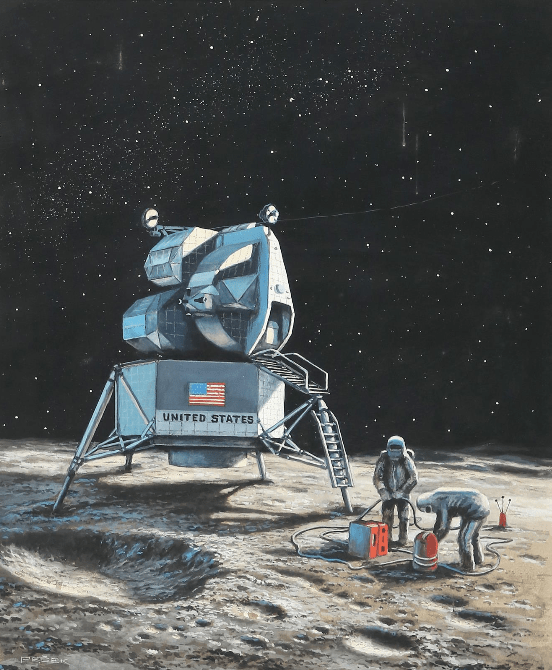
Luděk Pešek’s “The Moon Expedition” (1966)
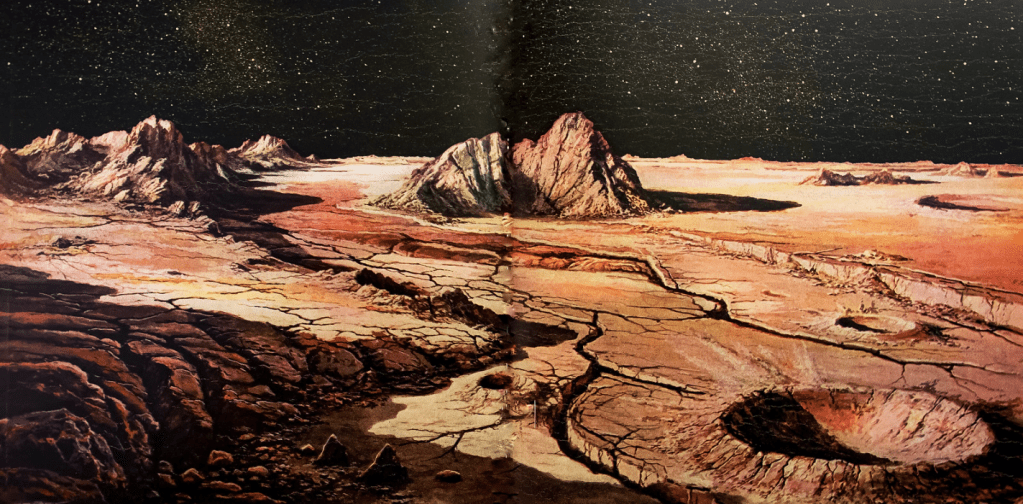
Luděk Pešek ‘s “Mercury’s Cliffs and Deserts” in The Moon and the Planets (1963)
Notes
- For Luděk Pešek’s influence as a space artist, see N. Cramer’s “Ludek Pesek’s Role as Space Artist” in Organizations and Strategies in Astronomy 5, ed. A. Heck (2004), 259-272. ↩︎
- As Pešek was in exile, I assume they did not appear in Czech originally but rather it was the language he was most comfortable writing in. ↩︎
- Biographical info from the Czech entry on Wikipedia. ↩︎
- For a survey of the science fiction on generation ships, see Simone Caroti’s The Generation Starship in Science Fiction: A Critical History, 1934-2001 (2011). In my own explorations, I’ve added to Caroti’s list on my site. Caroti does not include Pešek’s novel. ↩︎
For book reviews consult the INDEX
For cover art posts consult the INDEX
For TV and film reviews consult the INDEX


On the one hand, I think the overall idea sounds pretty interesting, while on the other, I somehow get the impression that it’s also rather heavy handed, so I’m not really shure if this is something I’d like to check out. Perhaps if I stumble upon it by chance (and cheap) at some point…
I actually did encounter a Persek in the wild once – The Earth is Near, which is translated to Danish for some reason -, but I didn’t buy it because as far as I could assess it seemed to be very standard hard SF.
It is heavy handed. But…. as I point out in the review, he’s participating in a rich tradition of generation ships as arenas for authoritarian speculation. I think it is hard to avoid. You have to talk about the political systems that would govern such a ship.
I own a copy of The Earth is Near. I chose this one because it wasn’t hard SF. I really bounce off science-driven SF….
Yes, it makes sense that authoritarian speculation should come up in generation ship stories. I’m all for it, and I fully understand if someone coming from the eastern block want’s to depict the horrors of a stalinist system. I suppose the impression I get here is that he’s making it all too demonstratively evil, which can really diminish the effect – though I could be wrong of course.
I really love some science driven SF, when the science is used as a loose catalyst for really wild and bizarre speculations. Probably mostly thinking of Lem here I guess. SF that is all about realistic depictions of existing science seems very boring to me.
I imagine he’s channeling the post-Prague Spring (1968) crackdown despair. He left for Switzerland around then.
Due to my rather minimal scientific knowledge (I took history of math and history of science courses as an undergrad to dodge the math and science requirements — haha), I often cannot distinguish between bizarre speculation and “existing science.”
Never heard of this one – sounds promising! Putting it on my “want” list
It’s an odd one. I upped the rating from a 3/5 –> 3.5/5 while writing the review. Take that as you may! I think it is interesting in dialogue with other gen ship stories.
…and by dialogue I don’t necessarily mean he is aware of other gen ship stories. It reads as if in an utterly distinct register.