Which books/covers/authors intrigue you? Which have you read? Disliked? Enjoyed?
1. C. J. Cherryh’s Serpent’s Reach (1980)
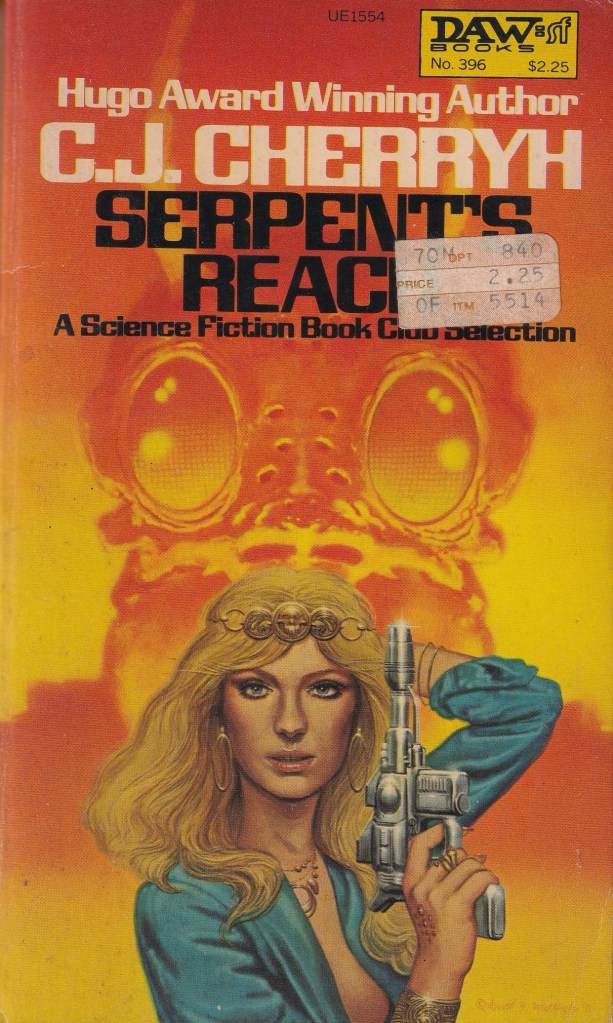
David Mattingly’s cover for the 1980 paperback edition
From the back cover: “The constellation of Hydrus, known as the Serpent, is compact and obscure as seen from Earth’s sky. Even in the great era of interstellar colonization it remained obscure. For it was under strict quarantine – harboring an intelligent race, powerful, alien, and inhuman.
Yet there were human colonies within the Serpent’s Reach, cut off from the galaxy beyond, with their own inbred culture, their Families and traditions, and their special relationships to the inhuman majat.
This is the strange and brilliant novel of Raen, the last of the massacred Sul Family, and of her lifetime pledge to find vengeance. It was to take her across the worlds of the Reach into the very center of the alien webwork, into the strands of thought and counter-thought that knit the forbidden constellation into a complex of interbred cultures that no outsider could hope to unravel.”
Initial Thoughts: My collection of Cherryh’s pre-1985 SF grows slowly. I still have a few of her pre-1985 SF novels (and short story collections) to track down. I do not know that much about this particular novel other than its place in her sprawling Alliance-Union universe.
2. Alan Burns’ Europe After the Rain: A Novel (1965)
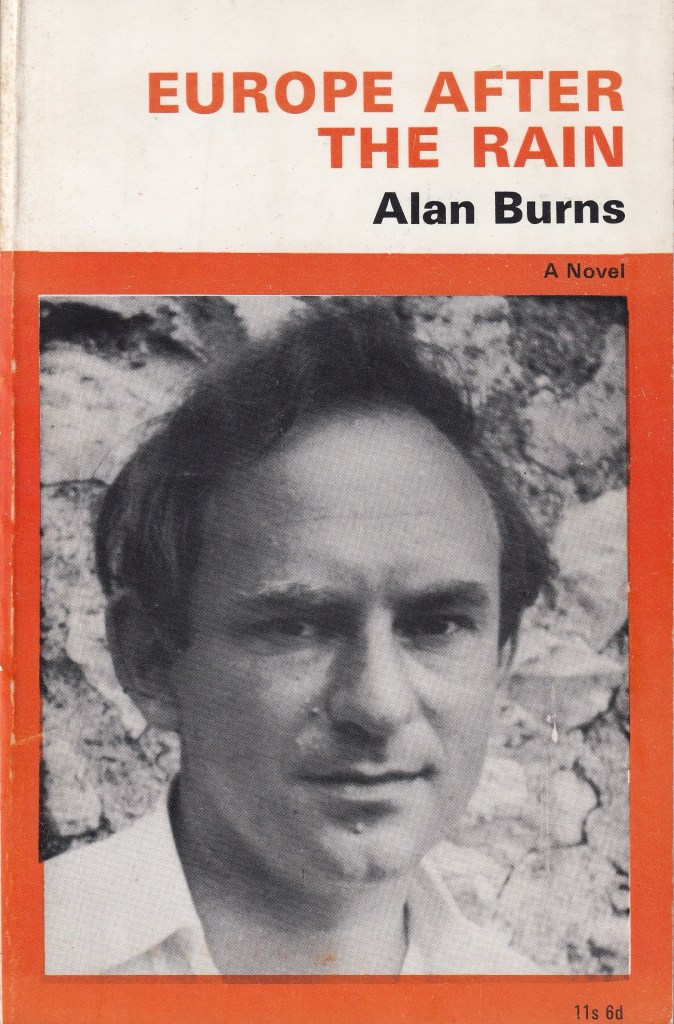
Cover for the 1st edition
From the back cover: “Europe After The Rain is a disturbing book, a creation and, no doubt for many people, a re-creation of the nightmare of utter devastation, of hope, of complete disillusionment and of re-affirmation. The author has taken his title from a painting by Max Ernst but the connection between the two works is far more complex. The painting prophetically depicts a vision of rampant destruction close to that which has become a terrifying reality in modern times. Alan Burns, taking the theme to its logical conclusion, shows man not merely trying to come to terms with desolation but combating human cruelty with that resilience of spirit without which survival, both physical and moral, would be impossible.
The narrator is engaged in an arduous search for a girl. The ‘Europe’ through which he travels is a devastated world, twisted and misshapen both geographically and morally. Life and death are curiously intermingled with fear the motive force of men and women expressed through a cupidity and violence which takes on much more than a physical significance. The narrator brings an interested apathy to the horrific events he is forced to witness but never succumbs to complete despair or an easy cynicism. The book ends with a profound experience in love but the initial vision, original and deeply personal, is never marred by sentimentality.
Alan Burns has succeeded in presenting a picture of his age, has captured with disturbing realism what well may be the ‘collective unconscious’ of the twentieth century. And he has done this in a language that can have few rivals for economy, beauty and rhythm. His austere sentences glow with intelligence, colour and force.”
Initial Thoughts: Burns strikes me as a very J. G. Ballard-esque writer. I’m basing my assessment on Babel (1969) and Dreamerika!: A Surrealist Fantasy (1972), both of which I read but never managed to review. Both utilize collage and post-modern experimentation. At least there’s a new edition of Dreamerika!. When I read it more than a decade ago prices hovered around $150. I managed to ILL a copy through my university. As I’ve said many times before, I endlessly fall victim to British post-apocalyptic visions, especially those like Anna Kavan’s Ice (1967), where the physical landscape manifests the psychological afflictions of humanity.
3. Brian M. Stableford’s The Mind-Riders (1976)
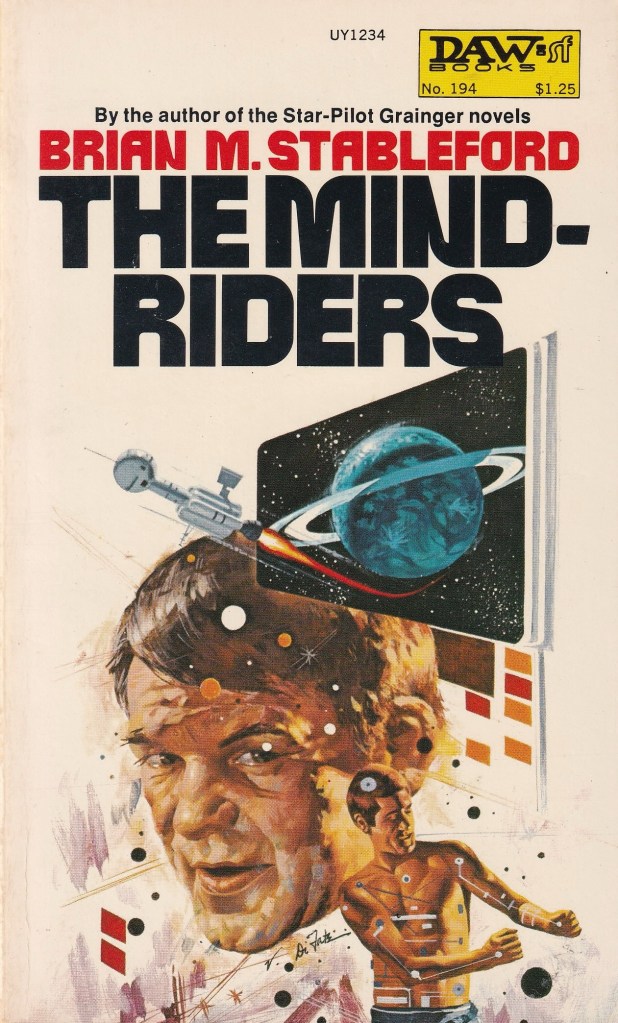
Vincent Di Fate’s cover for the 1st edition
From the back cover: “If millions pay today just to watch two men fight for a champion’s crown, tens of millions will pay for the additional thrill of being actually within the mind and body of the boxers themselves, to experience in person the tension and combat, to throw themselves into punch and counter-punch without having to feel the pain.
This is the story of Ryan Hart’s final fight. His was not the publicized name of the boxer. Nobody knew him but the insiders, because he was the man who operated the challenger, whose mind handled the boxer’s muscles, whose agonies were never felt by the E-linked millions, but who would be for a few dozen minutes the embodiment of half the human race!
It’s a novel of two unforgettable battles one the seen and obvious, the other the fight of a single solitary man to regain honor and self-respect in a world he had ceased to believe in.
Initial Thoughts: I’ve had little success with Stableford’s works. However, the plot of this one — sports as a SF vehicle for social commentary on commercialism, trauma, alienation, the media, and violence — is right up my alley. Check out reviews of William Harrison’s “Roller Ball Murder” (1973) and Gary K. Wolf’s Killerbowl (1975) for other 70s exemplars.
4. Irene Clyde’s Beatrice the Sixteenth (1909)
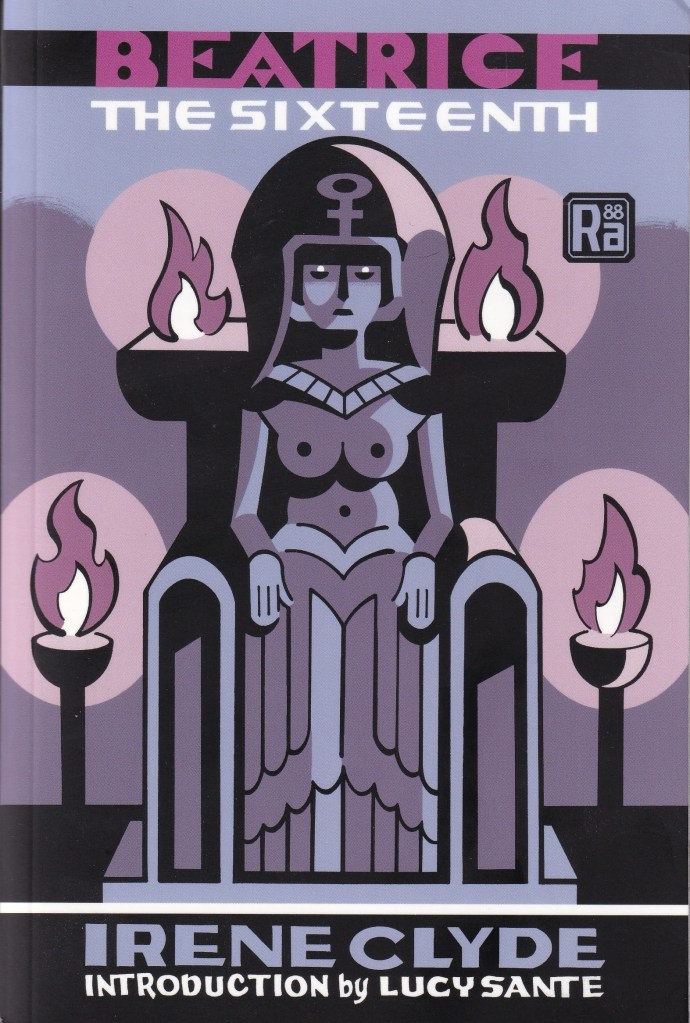
Seth’s cover for the 2026 edition
From the back cover: Beatrice the Sixteenth (1909) is “a pioneering 1909 feminist utopia. Mary Hatherley, an intrepid British explorer, finds herself transported to an alternate version of Earth. Arriving in Armeria, she discovers a society in which the very concept of gender is unknown. By avoiding the use of gendered pronouns, the story’s author–herself a genderfluid activist–challenges our assumptions about gendered social paradigms.”
Initial Thoughts: I’m a huge fan of the MIT Press Radium Age series. I’m all for bringing back more esoteric utopias and dystopia. For a great recent article on this book, check out Elizabeth A. Allen’s review over at Strange Horizons.
For book reviews consult the INDEX
For cover art posts consult the INDEX
For TV and film reviews consult the INDEX


Ah, remembering long lost days of my youth, working at B. Dalton. I know the codes on that price sticker on the Cherryh. 70M refers to the section of the store this goes in, in this case “science fiction,“ obviously. M denotes it’s mass market. 0F indicates the receiving date wth a single numerical digit for the year and a letter for the month, in this case June 1980. The 7-digit code above and below the price is the SKU assigned by the store’s system, since scanning a UPC barcode wasn’t a thing yet. All of this had to be typed in by hand while ringing up. There! You now know some meaningless trivia about a defunct (but still very much loved by those of us who lived through those days) bookstore chain.
Haha. While I know there are ways to remove a sticker with ease, I am worried — due to how old and how “one-with-the-cover” it has become — about removing it.
Remember this particular Cherryh book?
It’s been a while – well, a few decades – since I read Serpent’s Reach, but I remember liking it a great deal. In fact, it’s one of her books I’m dying to reread, but I’ve yet to find a cheap secondhand copy here. Having said that, all of her sf, pre-1985, is worth reading, although some more than others.
On Bluesky people mentioned that there was a giant bundle of her work going on sale — if you’re okay with eBooks. https://www.humblebundle.com/books/best-cj-cherryh-daw-books-books
It contains Serpent’s Reach.
Only in the US, I think.
Alas.
Nice to see some love for that Radium Age series! Haven’t read that one specifically but I’ve been making my way through most of the imprint. Been meaning to get to this one and also “Herland”. Really enjoyed “Goslings” (aka World of Women) by J.D. Beresford, which was in a similar vein, albeit with added pandemic backdrop.
Stableford and Cherryh generally not for me (actually I don’t think I’ve read anything I liked by Cherryh since some of those Thieves’ World books back when I was a teenager). The Burns sounds kind of interesting, never heard of him.
Cherryh was one of my pre-site top-5 authors. I read quite a few of her novels. In my 2019 review of Port Eternity (1982), I list everything of hers I think I read. Some are a bit hazy. That said, I have not read anything by her since 2019. Not sure what I would think of Downbelow Station (1982) now, which I remember being one of my favorites.
As for Stableford, I agree! Only the premise convinced me to acquire the copy. It was also probably in the local bookstore bargain bin. Some times elapses between when I acquired the book and what I post it on the site.
Here’s the blurb for the recent (needed) edition of Dreamerika! (1972):
”
Dreamerika!, Alan Burns’s fourth novel, first published in 1972, provides a satirical look at the Kennedy political dynasty, serving up an idiosyncratic hotch-potch of history that gives an old tragedy new meaning. For this book, Burns collected newspaper clippings, headlines, cartoons and photographs, cut them up, filed them and then interspersed them throughout his text to create a collage of contrasting effects.
Presented in a fragmented form that reflects society’s disintegration, Dreamerika! fuses fact and dream, resulting in a surreal biography, an alternate history which lays bare the corruption and excesses of capitalism just as the heady idealism of the 1960s has begun to fade.”
https://almabooks.com/product/dreamerika/
Here’s the 1st edition that I wish I could acquire for far less than $150. Love the graphics!

wow, that’s wild
I wish the new edition got the rights to the cover. I often wonder why they don’t reissue earlier art. As for the novel, very very New Wave… as you can tell from that description.
I’m a total sucker for science fiction written by literary fiction novelists, so I’d be interested in Europe After the Rain. Even if the novel doesn’t turn out well, it’ll probably be written well and the main characters will be reasonably well-developed. Plus, literary fiction novelists can take science fiction in unusual directions.
Yeah, he seems to be in the UK orbit of authors like Ballard and Christine Brooke-Rose (she wrote similarly experimental SF novels in the 60s and some random YA SF in the 80s apparently).