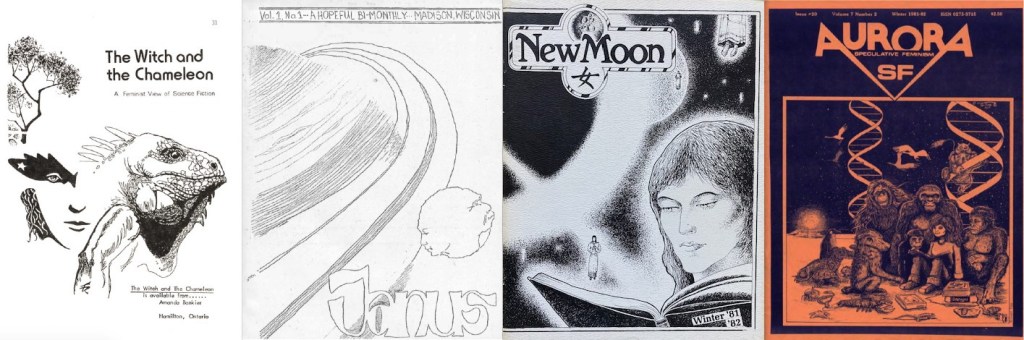
From L to R: The Witch and the Chameleon, no. 5/6 (1976), cover by Amanda Bankier; Janus, no. 1 (1975), cover by Jennifer Wilson, Jeanne Gomoll, and Janice Bogstad; New Moon (Winter 1981, 1982), cover by Robert Kellough; Aurora (Winter 1981), cover by Steven Fox
Over the last few years, I have curated a few pieces of science fiction scholarship in my Exploration Log series that I’ve found memorable, historically important, and worth sharing.1 Today I have an interview with SF scholar (and friend) Loïg J. F. Pascual, author of the recently published article “The Collective Memory of 1970s-1980s Feminist Science Fiction Fandoms: A Case in Reflexivity and Historiography for fan Studies Practices” (2026). The article appeared in Transformative Works and Cultures, Vol. 49 (2026) You can read a translated version in English and in the original French. The French version includes multiple Youtube video interviews with important figures in the movement.
More than just an interview about his specific area of research, Loïg dives into the larger history of feminist fanzines and the vital role of fan culture in the creation and memorialization of genre. Enjoy!

Graphic created by my father
1. Thank you so much for agreeing to this interview. Please introduce yourself and your interest in feminist SF fandoms in the 70s and 80s.
My name is Loïg J.F. Pascual, and I am a Ph.D. student at the Université du Québec À Montréal. I started reading science fiction (SF) with the books my father bought—collections of Philip K. Dick stories, Hard to Be a God (1964) by the Strugatsky brothers, and Robert Charles Wilson’s Spin (2005), Axis (2007), and Vortex (2007) series. We would spend hours looking for new SF reads in used bookstores.
When I attended university, I launched the Gravof Corp channel with my friend GovanifY, where I talked about science fiction. My first videos were about Philip K. Dick’s Ubik (1969) and William Gibson’s Neuromancer (1984). I had stopped reading regularly then and did not know how to write consistently outside of my coursework; the quality of those first commentaries was bad. One day, I stumbled upon a book that belonged to my father—probably a gift from his father: A. E. Van Vogt’s The World of Ā (1948), translated into French by Boris Vian. That was the first time I really tried to conduct my own research, reading about Golden Age SF fandoms and general semantics.
After a period of depression, I started reading again, borrowing Ursula Le Guin’s The Left Hand of Darkness (1969) and Kurt Vonnegut’s The Sirens of Titan (1959) at the library in Chicoutimi, Canada. Martin Nadeau, the instructor for a course titled “Cyberculture,” asked me to present Donna Haraway’s article “Cyborg Manifesto” (1985). It was through her list of cyborg writers (Monique Wittig, Joanna Russ, Samuel Delany, Vonda McIntyre, Suzy McKee Charnas, etc.) that I discovered (the academic canon of) feminist SF.
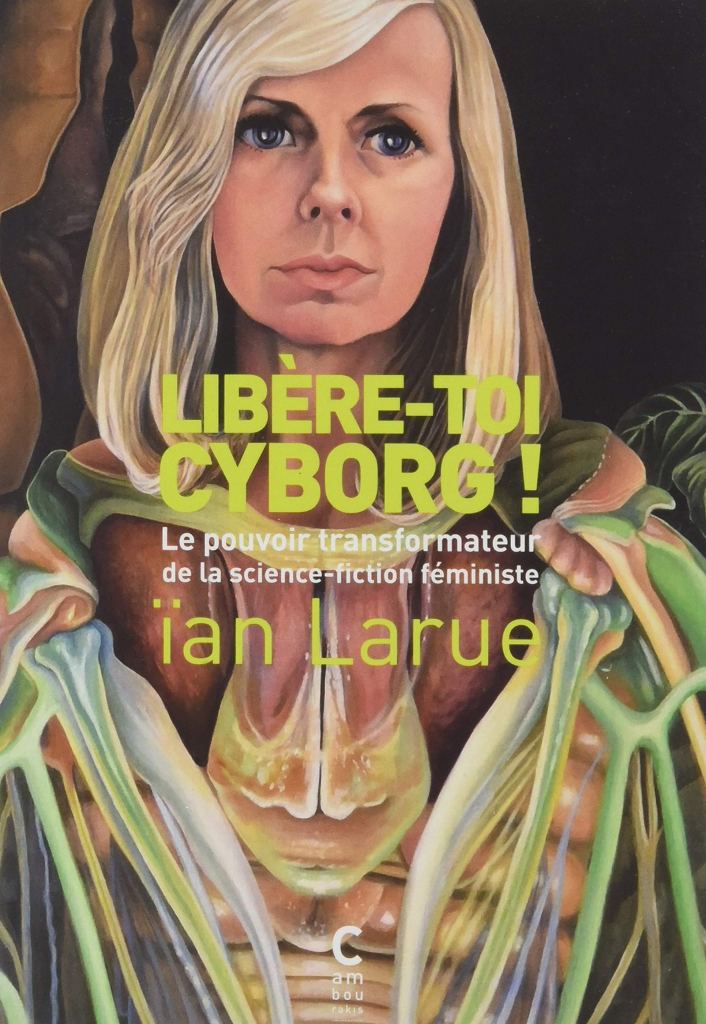
In 2021, I read an essay by ïan Larue titled Libère-toi Cyborg! (Free yourself cyborg!) (2018). She mentioned Jeanne Gomoll’s 1986 Open Letter.2 Gomoll, a feminist fan, denounced the way conventions and books—primarily by male fans and authors—rewrote SF history by omitting the role of women and feminists (or reducing them to marginal “mother earth” ramblings). Not only were authors like Alice Bradley Sheldon (James Tiptree, Jr.) omitted, but also the role of feminist readers—those who invented new ways of reading, who politicized conventions, and who created zines and awards—was erased. It was a sense of rebellion that drove my research: the feeling that I had helped perpetuate a simplistic narrative of SF centred on authors.
I decided to read these fanzines: Janus (1975-1980) by the Madison group, edited by Jeanne Gomoll and Janice Bostad; New Moon (1981-1987) by Bogstad; Aurora (1980-1990) by the Madison group, mainly edited by Diane Martin; and the Canadian fanzine The Witch and the Chameleon (1974-1976) by Amanda Bankier. I started with a naive student question: “Where does feminist science fiction come from?” Then, I found myself in the middle of a complex and rich universe.3
2. For any readers interested in exploring feminist fanzine communities from this era, is there a specific issue/article that’s a must read?
I think everyone should read Jeanne Gomoll’s “An Open Letter to Joanna Russ”4 and Susan Wood’s “People’s Programming,”5 both of which cover the creation of the first feminist spaces leading up to the feminist convention WisCon. After that, I would browse through any fanzine on Fanac, the Fan History project, to grasp the diversity of the (historical) SF fanzine community. I suggest the readers check out the July 1977 issue of Janus because it features an academic review by Marleen Barr, a call to support Suzy McKee Charnas by Gomoll, and a major debate surrounding Marion Zimmer Bradley’s so-called feminism; the 1978 issue 2-3 to read the letters addressed to Harlan Ellison because this is a significant case in the reception of a mainstream feminist topic, the Equal Rights Amendment, within the fandom (Ellison’s position is explained in the 1977 issue 4, pp. 32–33).
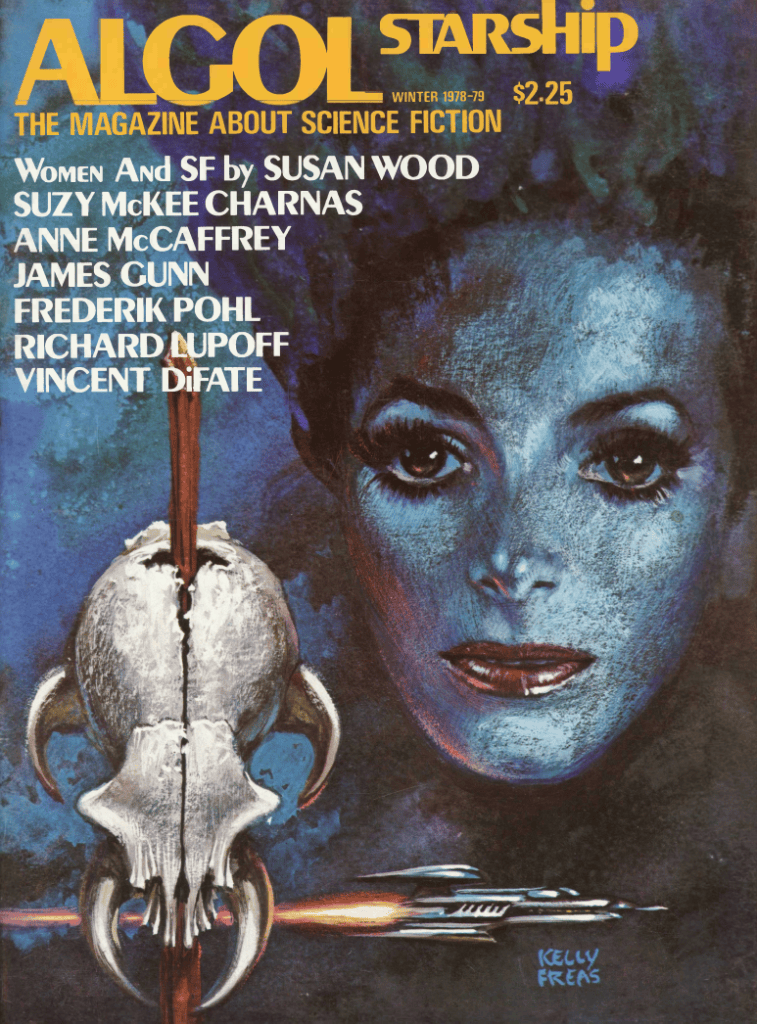
Frank Kelly Freas’ cover for Algol, ed. Andrew Porter (Winter 1978-79)
From an academic perspective, I recommend reading the first feminist critiques of SF published in the 1970s: “The Image of Women in Science Fiction” by Joanna Russ,6 “Virgin Territory: Women and Sex in Science Fiction” by Beverly Friend,7 “Women and Science Fiction” by Susan Wood,8 and “A Feminist Critique of Science Fiction” by Mary Kenny Badam.9 It’s very important to take a step back to appreciate the monumental work these writings accomplish: female readers—from various academic and/or fan communities—introduced feminist concepts into the realm of science fiction. It’s also worth reading the early anthologies by women writers or feminists, such as Aurora: Beyond Equality (1976), Women of Wonder (1975), and especially Amazons! (1979) (more heroic fantasy, but one that sparked a great deal of debate).
3. Before we examine the various arguments you make in your article, two concepts come to the fore in your analysis: “collective narrative” and “memory activism.” How are they related? How are they useful?
Why talk about a collective narrative? The central idea of my work is that we underestimate the role of fans and readers in general. We often look for a founding figure or a seminal book (a pioneer among writers or a Big Name Fan), especially once feminist SF becomes an autonomous, almost-mainstream narrative that transcends its fandom. In doing so, we engage in the reinterpretation of its collective narrative and reinforce the literary illusion—the idea that literary genres are “natural” and that distinctions between genres are a pure reflection of readers’ interests. A genre is the product of a continuous, discrete work of indexation, of selecting its shelf in a library or a bookstore, of teaching literary history in school and university and, most of all, in learning how to write any specific genre. Samuel Delany,10 Mark Angenot,11 and Richard Saint-Gelais12 show that SF requires its readers to learn to postulate a form of background scientific realism supporting all of the authors’ inventions. The New Wave and Hollywood movies played a major role in spreading this way of reading to a mass audience. We also tend to forget that the division between genres is also the product of political struggles, which is why we must pay attention to the political work of fans.
Being a fan of a genre, a series, or a fiction universe is, first and foremost, a labor of memory. Fan memory cements the fandom, consolidates the specificity of the fan experience (“fans are slans,” after all), builds common interpretations of cultural products, and generates a proper vocabulary for that fandom. It requires what sociologist Camille Bacon-Smith13 called an attention to the most insignificant details of stories—details that nonetheless matter for discussions among fans—as well as ongoing archival work. This labor of attention and archiving is the fundamental condition for the existence of an autonomous space, a subculture if you want to call it that. That labor is also an act of resistance that enables future generations of fans to have a history at their disposal, to claim it, and, doing that, to claim a place for themselves in SF as both a genre and a fandom. Researcher Abigail de Kosnik14 goes further and claims that this continuous memory work, especially the archiving practices, is a space where fandoms and queer subcultures converge, insofar as these communities are sensitive to the fragility of their collective memory, to the lack of institutions to transmit it, and to the social forces of erasure that surround them. This memory work is therefore inherently activist, as it is part of the struggle to gain recognition for the ongoing presence of minorities in SF—a constant fight against social norms that identify the technological and scientific themes as hard, and therefore, naturally masculine (naturalized as places exclusively for men).
4. At first glance, for the uninitiated, fanzines can be a bit daunting. There’s an entire invented vocabulary. Readers often respond to each other, and larger genre scandals and debates, over the course of many issues. In addition to reviews, artwork from the amateur to professional, and news, fanzines often include poetry and stories that might not be publishable elsewhere. What is the role of a fanzine?
Fanzines are complex objects. The word “fanzine” encompasses a wide range of cultural productions: trekzines (Star Trek fanfiction), personal zines, comics fanzines, poetry fanzines, online zines, and letterzines (consisting solely of letters between fans). The Corflu convention, for example, has historically been dedicated to SF fanzines. What sets Janus—one of the first feminist fanzines—apart is that it was originally a “clubzine” (since it was the fanzine of the Madison SF club) and a “genzine” (meaning “general”). It features essays along with fiction, poetry, drawings, letters, and more… This is a rarer form, as the majority of zines are primarily vehicles for fictions and poetry, although their content is rarely uniform.15
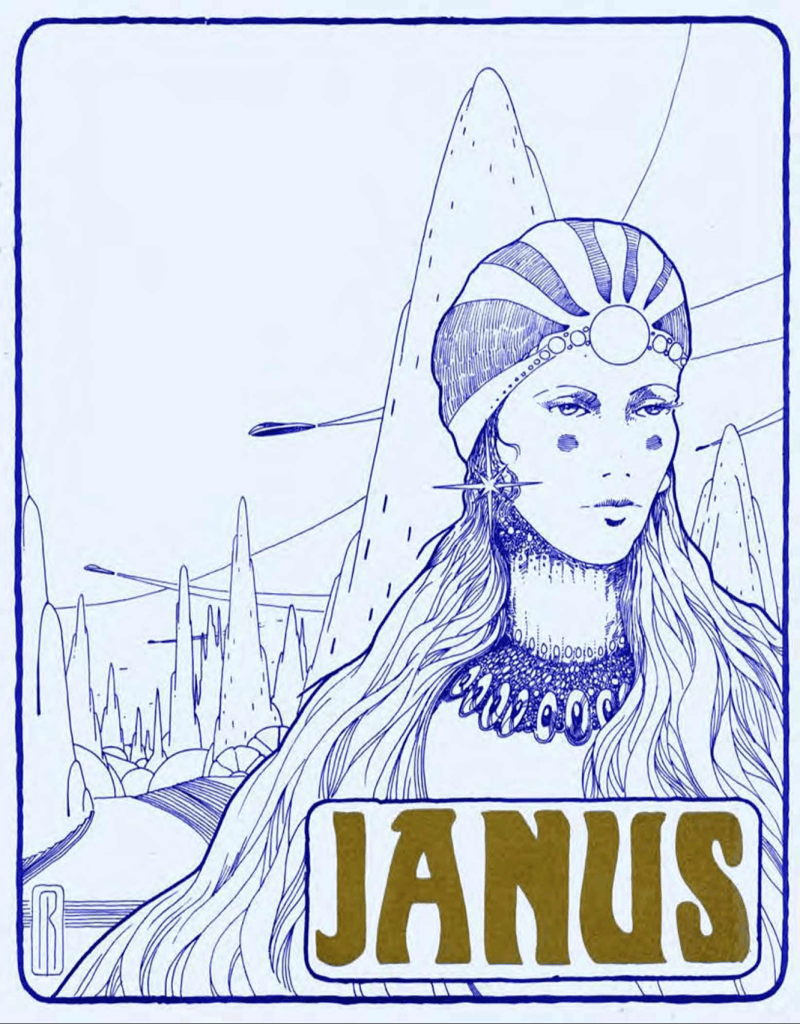
Robert Kellough’s cover art for Janus #9 (1977)
The French philosopher Michel de Certeau16 used the metaphor of “poaching” to talk about reading—a metaphor taken up in one of the founding works of fan studies, Henry Jenkins’s Textual Poachers. De Certeau criticizes the formalist (and dominant) definition of reading, which treats texts as deterministic machines, as if we all read attentively, mechanically, line by line, sitting at a desk. Reading is an activity with an extremely diverse range of functions, and most of the time, it is oblique and subverts the author’s intent. The same is true of a fanzine: it can serve to convey stories, create a work of art, reinterpret a canon, suggest an interpretation, preserve memories, secure a booth at a convention, win an award, and so on. Fanzines are living entities, the active memory of fandom, and feminist fanzines are laboratories for experimenting with feminist critiques of SF, for chronicling the history of women writers, and for creating a space at the intersection of fandom, literature, and the feminist movement.
Journals such as 13th Moon, Frontiers, Pandora Feminary, and Chrysalis—which sit at the intersection of literature, poetry, academia, and the feminist movement—are referenced by the authors of the fanzines Janus and Aurora. Author Samuel Delany17 proposed to distinguish between the formal criticism found in academic journals and the older tradition of informal criticism that emerged in the fanzine. For the feminist fans, academic journals, magazines, and fanzines formed a continuum; along with novels and anthologies, they were all part of the same countercultural space.
5. What were the most important feminist SF fanzines (and their editors) that helped shape the community and form the narrative in the 70s and 80s?
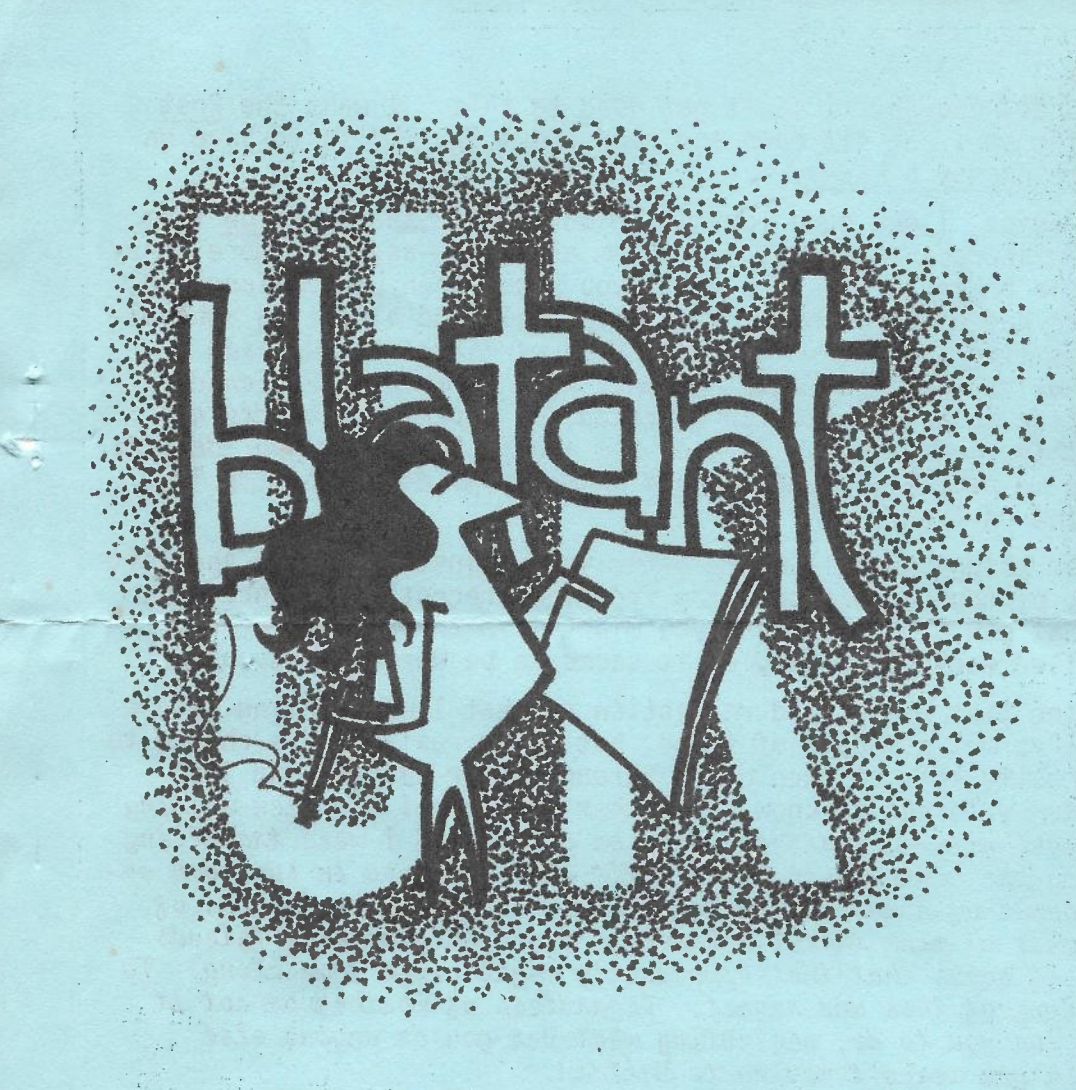
It can be said that feminist fanzines, as such, emerged in the 1970s, since it was at that time that the word “feminist” took on the meaning given to it by the “second wave” in North America: the personal is political, and gender inequalities are not exclusive to the public sphere. Sexism structures all social relations, and the feminist struggle must especially include the realm of cultural productions. There seems to be a consensus that the first SF fiction fanzines to identify as feminist appeared in the mid-1970s. The first was the Canadian The Witch and the Chameleon by Amanda Bankier, and soon after appeared Janus by Wisconsin fans Janice Bogstad and Jeanne Gomoll, supported by the Madison club. We can also point to the special issue of Khatru published in 1975, the fanzines Aurora and New Moon from the 1980s, and Susan Wood’s short-lived Room of One’s Own (1981). There were other fanzines addressing feminist or queer themes at the time: Blatant (1980-1989) by Avedon Carol, Harlot (1981-1983) by Carol and AnneLaurie Logan, Windhaven (1977-1979) by Jessica Amanda Salmonson, the Australian zine WeberWoman’s Wrevenge (1981-2001), Suzette Haden Elgin’s The Lonesome Node (1980-1990), and perhaps also Denys Howard’s fanzines, among others. The list is long; we could also include the reviews written by Elisabeth Vornarburg in the Quebec fanzine Requiem/Solaris.
6. What was the historical genesis of feminist fanzines?
That’s the impossible question, isn’t it? Feminist fanzines appeared at the intersection of the SF New Wave, the success of SF TV series Star Trek, the spread of roneographs and other printing machines—fueling the exponential growth of activist magazines—and, of course, the social movements shaking up North America: civil rights and Black Power, feminism, environmentalism, pacifism, anti-ableism… When writing history, it is important not only to remember the material conditions but also to recognize how events present themselves as contingent to the people whose writings we study—it is important not to erase the feeling of uncertainty. The first feminist fanzines were tentative and experimental; they initially referred to “fem-fans,” then “feminist fans,” and the expression “feminist SF” appeared rarely at the beginning.
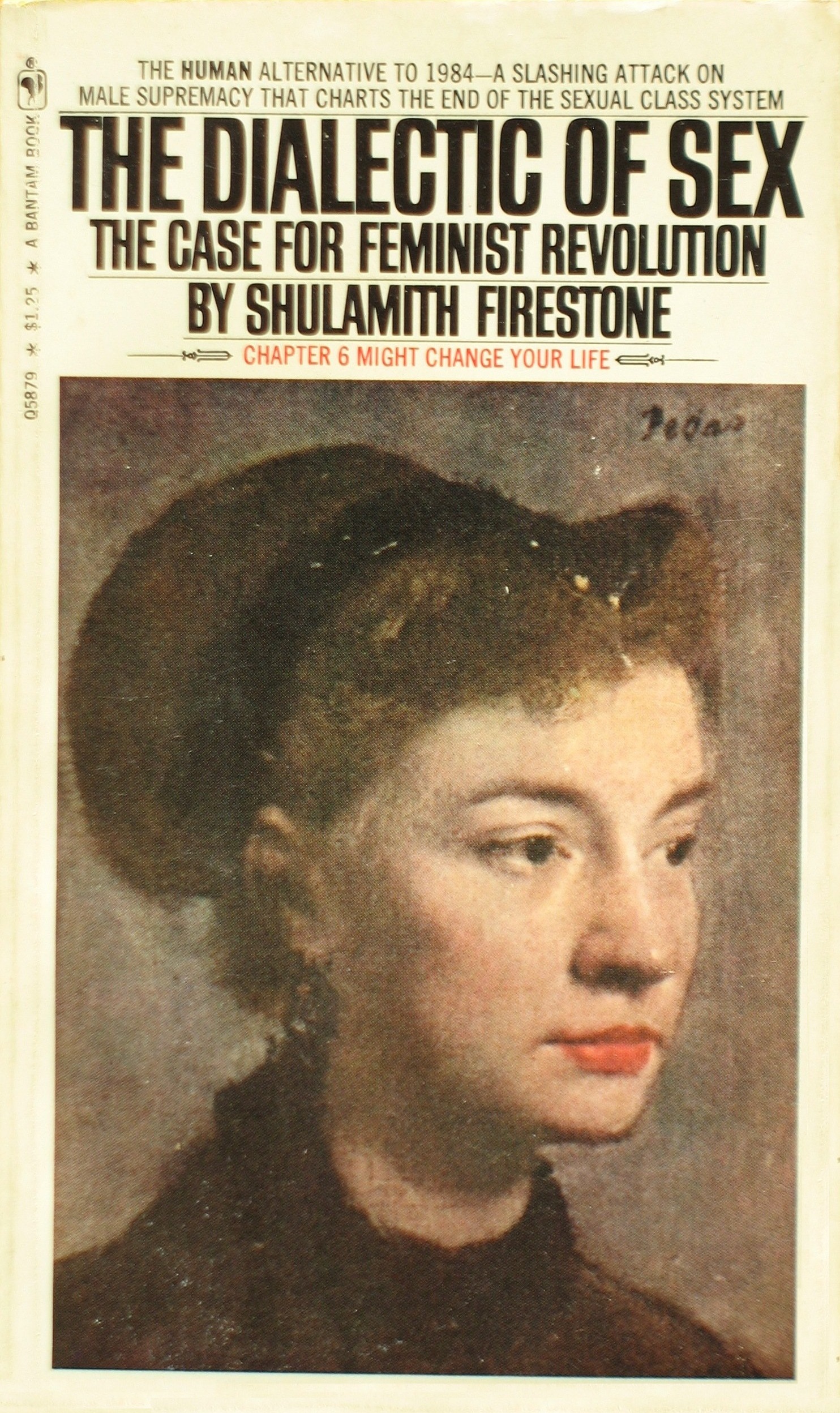
I will quickly identify four historical origins of feminist fanzines: the democratization of universities, the student movements, the popularity of SF after the New Wave, and the spread of feminist essays. First, it is important to remember that those are the early decades of women’s widespread access to higher education. The editors of Janus, Jeanne Gomoll and Janice Bogstad, mention the influence of Professor Fannie LeMoine, who decided to organize a seminar on science fiction in 1973 at UW-Madison. Next, feminist and student movements played an important role; Students for a Democratic Society (SDS) is regularly mentioned in the interviews. Furthermore, SF was becoming more mainstream as a literary genre in the 1960s. Those fanzines would not have existed without the numerous local reading groups, which provided them with material to print and connections within the fandom. Finally, it is important to consider the spread of feminist essays: Kate Millett’s Sexual Politics (1970), Shulamith Firestone’s The Dialectic of Sex (1970), and, later, writings of Adrienne Rich, Marilyn Frye, and others.
7. What were the defining social and political issues debated within their pages?
My article shows a gradual evolution of themes in feminist fanzines. The early issues are dominated by texts primarily focused on fandom, sometimes with a feminist “ethical angle.” They feature letters from fans and authors, essays on current events in science and technology, convention reports, and so on. It is easy to fall into the teleological trap and focus solely on feminist content, forgetting that the fanzine is first and foremost a publication intended for the fandom, one that allows readers to engage in it.
However, I noted the presence of a few essays on feminist anthropology and critiques of sociobiology, lively discussions about the Equal Rights Amendment, and numerous comments on sexism in fandom and lesbophobia within the feminist movement. I also found it interesting that fans used the fanzine to support feminist authors, for example, by helping Suzy McKee Charnas publish Motherlines (1978) or by self-publishing the first version of the Làadan dictionary—a language devised by linguist Suzette Haden Elgin to better express women’s experiences.
8. Your analysis focuses on “memory activism” within Janus and Aurora. One of the common types of acts of memory activism are “epiphany” accounts. How do these stories allow “fans [to] inscribe their individual stories in the ‘grand history’ of fandom”?
Epiphany stories are an excellent way to understand why collective memory is a vital issue for feminist SF. An epiphany is a story of discovery: “The book or the author that made me an SF fan” (I just gave my own version in the first answer of this interview). These stories serve as gateways into fandom, allowing people to present themselves as “true” fans by recounting their individual memories in accordance with fandom conventions. This is how collective memory works: it provides frameworks through which one reinterprets their experience, demonstrates their belonging, and, in doing so, forges a fan identity and, in turn, reinforces the identity of the fandom itself.
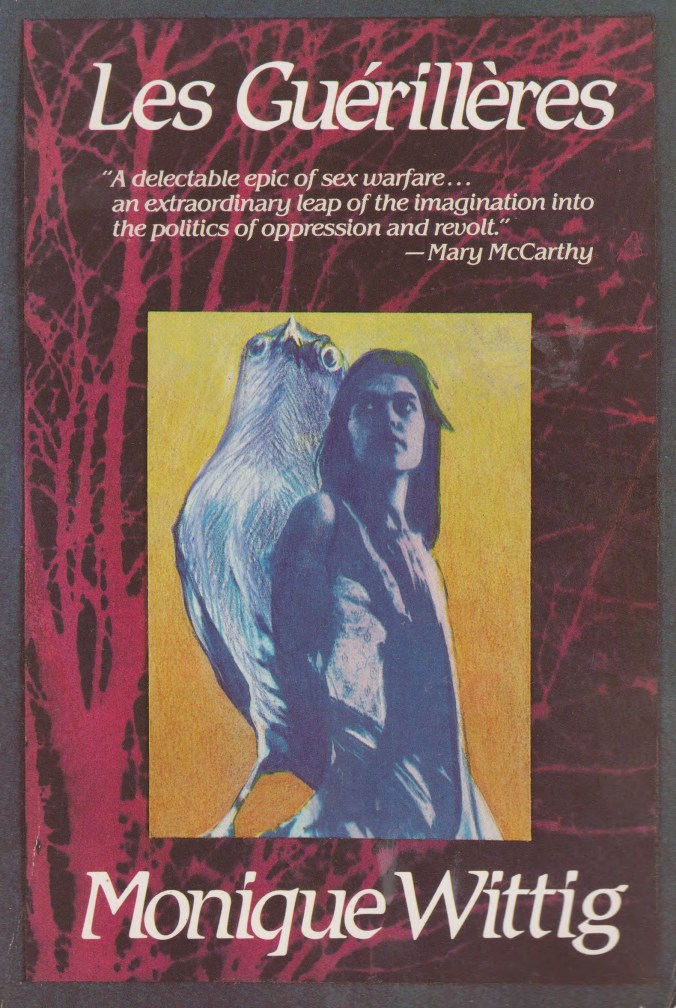
Uncredited cover for the 1985 edition
For example, Jeanne Gomoll recounts how Monique Wittig’s Les Guerillères (1969) was a turning point for her. Jessica Amanda Salmonson mentions Elgin’s At the Seventh Level (1972) as “one of the earliest feminist SF” because it contained strong female characters despite having a male protagonist.18 Epiphany stories show how the self-narratives and collective memory of feminist fans both sustain their presence in fandom (as other SF fans) and their presence as feminist SF fans. The existence of a specific SF feminist fandom depends on their ability to sustain a collective memory of the continuous presence of strong female characters, the exploration of gender relations in SF novels, known female fans, and female authors. This memory is stronger when it is institutionalized, with women/LGBTQ+ spaces in conventions, feminist conventions, and awards. Reciprocally, the disappearance of this memory would be, to borrow L. Timmel Duchamp’s words, a “sentence of exile”19 from one of the few places where these fans can feel welcomed as feminists and as readers of SF.
9. Part of your analysis explores the tensions between fan communities and academic analysis of genre. What were the points of contention?
It has been suggested that I was pitting female authors—primarily academic feminists—against fans. The truth is, many of them occupy multiple roles at the same time. Yet it is at the heart of the literary illusion to believe that female SF authors were the vanguard of feminist SF because they had a natural inclination to create feminist SF. To be honest, at that time, Ursula Le Guin clearly did not identify as feminist, and writers such as Anne McCaffrey, Andre Norton, and Katherine McLean were explicitly wary of the label. The few to claim this label did so primarily as fans and activists; I am thinking of Vonda McIntyre, Joanna Russ, Jessica Amanda Salmonson, and Suzy McKee Charnas. There is always a tension between readers as fans, as academics, and as writers. In the 1970s and 1980s, female authors were reluctant to call themselves feminists, for fear that their fiction would be reduced to politics, and academics disliked science fiction—a genre perceived as masculine—and did not want to risk their institutional standing for such a secondary interest. It continues today; most authors do not like political labels for fear that they would negate their craft of worldbuilding. Academics sometimes use the label “feminist SF,” but the majority of them do so while replacing the fan-driven history of feminist SF with a literary, author-driven—in a word, legitimate—canon. Fans (sometimes also being authors or academics) are the only ones with a clear incentive to champion feminist SF because it is their history, their place in SF conventions, their panels, and so on, that are at risk of being canceled when the history of women/feminists in SF is overlooked.
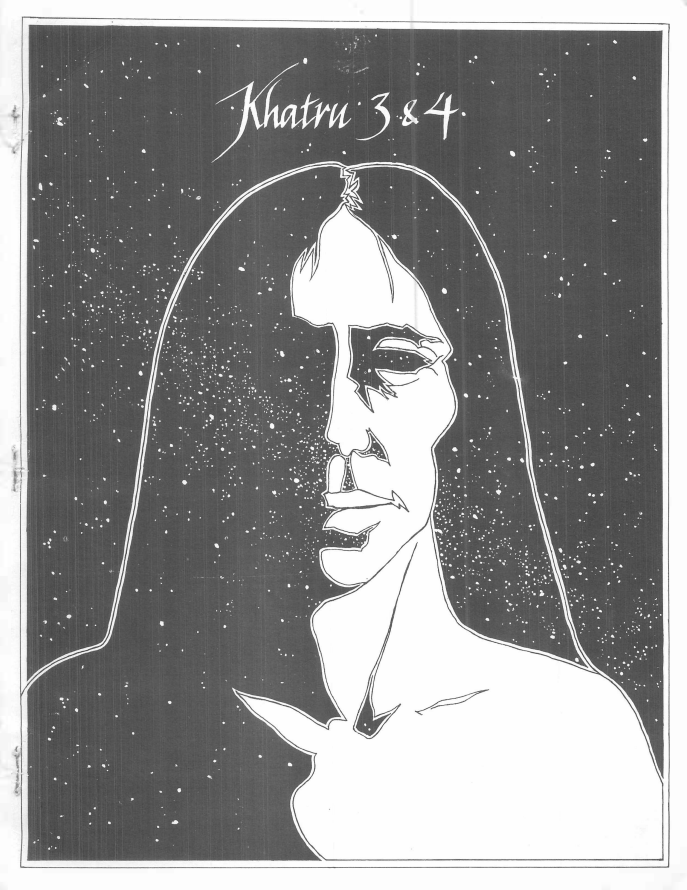
Judith Weiss’ cover for Khatru #3 and #4, ed. Jeffrey D. Smith (1975)
10. In your rendering, the 1975 “Women in Science Fiction” special issue of Khatru takes on almost mythic community status. What was the issue about? How was it interpreted later?
Khatru is a fascinating archive. It was a fanzine published by Jeffrey Smith. In 1975, he sent letters to writers (not exclusively women—he included Samuel Delany and James Tiptree Jr., the latter known at the time as a man). Joanna Russ and Vonda McIntyre turned the issue into a symposium reflecting on women and feminist issues in science fiction. There were also writers Chelsea Quinn Yarbro and Suzy McKee Charnas, who identified as feminists but were pessimistic about the movement’s future; Kate Wilhelm, whose stance was ambiguous and whose analysis seems closer to a pessimistic marxism; Raylyn Moore and Ursula Le Guin, who denied being feminists or belonging to any particular camp.
This 1975 issue, titled “Women in SF,” predates the appearance of The Witch and the Chameleon and Janus and could, in a sense, lay claim to the status of the first “issue” of a feminist SF fanzine. And indeed, while it did not enjoy a wide diffusion at first print, it has achieved cult status within feminist SF fandom and has been reprinted several times by the Madison group (which published Janus and Aurora). It is viewed in retrospect as a defining moment in the collective memory of feminist fandom: a gathering and discussion on gender, sexuality, and the place of women led by women science fiction writers. The 1993 edition includes commentary from fans and authors. This clearly illustrates the fluidity of roles and positions (authors, fans, scholars, editors, readers): they have all contributed to carving out a space for women in science fiction and for feminist issues, and feminist science fiction is their story. As one of them puts it, the reissue of the fanzine “is a re-claiming of history.”20
11. What struck me the most in your analysis is the role of the fanzine (and the larger feminist fan movement connected to them) in “periods of backlash.” For example, the political and social backlash in the 1980s to earlier 70s activism. Simultaneously within science fiction, cyberpunk and its proponents attempted to define themselves in relation to the past. How did it challenge the collective memory of the feminist fanzine? How did they respond?
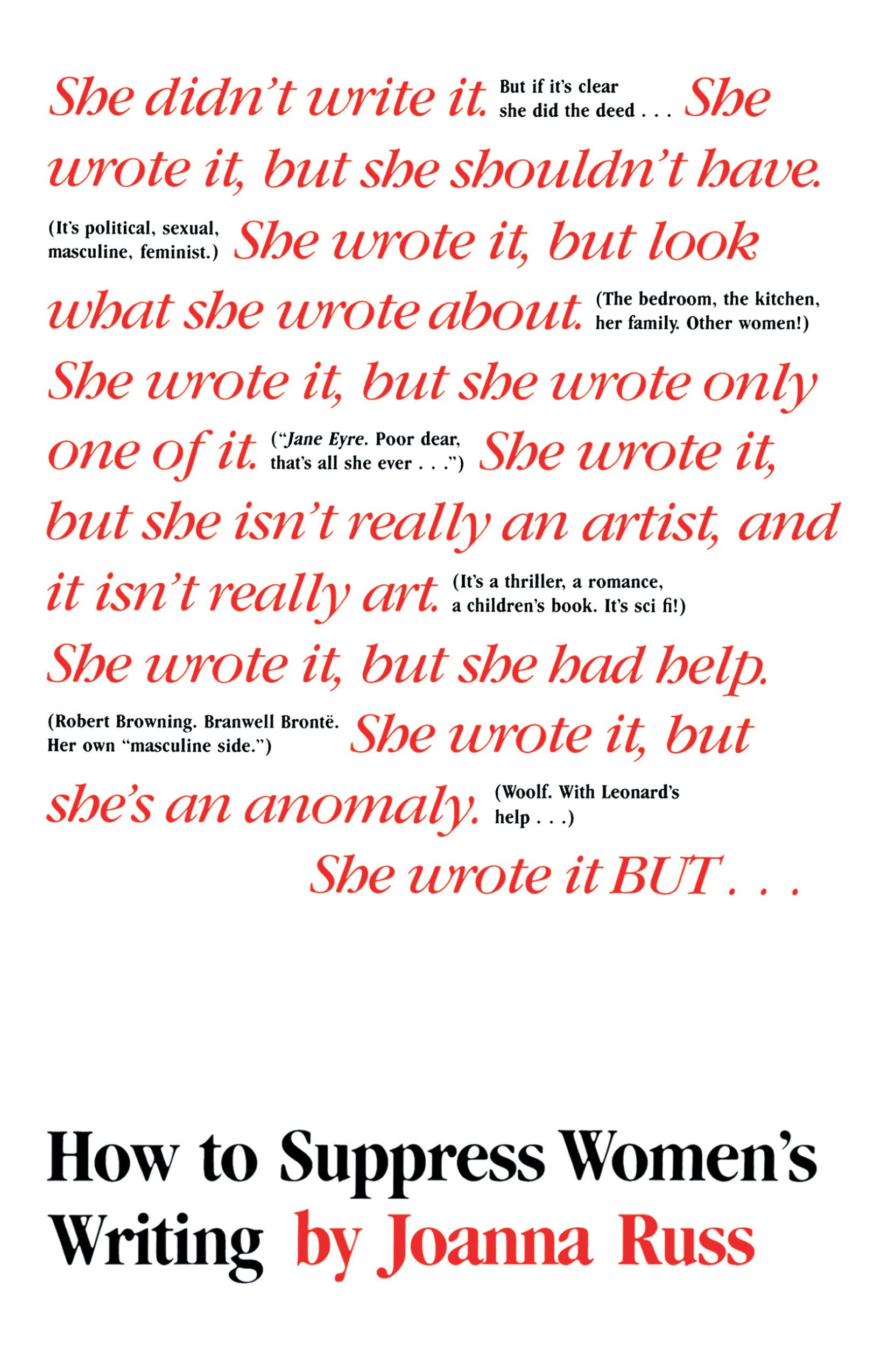
In her Open Letter, Gomoll cites Joanna Russ’ How to Suppress Women’s Writing (1983), which lists common strategies for downplaying the role of women writers (their originality, contributions, and presence). Gomoll draws a parallel with the way Cyberpunk authors, with their glorified history of SF, reproduced these omissions by claiming an exclusively male lineage of SF authors and by opposing “soft” and feminine SF. Her observation goes further: these mechanisms of omission are institutionalized within the SF fandom, and she notes how some retrospective panels always seem to overlook the existence of feminists (and downplay the presence of women fans and authors).
The main lesson taught by the feminist fans is the power of narratives. Some categorizations act as drawers; you can store “second-wave feminism” in the “1960s–1970s” drawer or feminist SF in the “short period of 1970s extreme activism” drawer. Then, it is possible to close them off: feminists played a small role in the past, for problems now solved and outdated. However, what the paper is arguing, and what other researchers have shown, is that it did not take a lot of feminists in fandom. Their very presence sent shockwaves that affected the entire SF community. Feminist fans were the driving force of the feminist revolution in the SF community, one instance of a social revolution that affected all aspects of gender practices, whose full impact on our lifestyles and social relationships is still unraveling.
Thus, I use Verta Taylor’s concept of “abeyance structures.”21 The feminist SF fandom—like other feminist organizations during periods of backlash—continues to operate within the interstices of the patriarchal order, preserving a network of readers, authors, and publishers; a repertoire of tactics and goals; all cemented by a collective memory and a continuous work of archiving.
13. What are your next projects?
In 2022, I submitted a thesis proposal to be admitted to the Ph.D. program at the University of Ottawa. This involved expanding my research on feminist fanzines and magazines from the 1980s in North America and more interviews. However, I decided not to pursue the PhD and took a break from SF studies in 2024. I was affected by the passing in 2023 of Suzy McKee Charnas, a central figure in the feminist SF fandom, and by that of Darrah Chavey in 2024, who had built an extraordinary collection of fanzines edited by women. Furthermore, rising tuition costs at the University of Ottawa forced me to leave. Finally, the political climate surrounding the co-optation of historical radical feminism by reactionary, transphobic groups made me reluctant to continue in that field. This does not mean that the work on feminist SF is done. On the contrary, it is an ongoing effort that extends to all minority voices in SF to underline their contribution to the development of new ways of reading and to the exploration of “gender-bending themes” (to use the Otherwise Awards presentation). There is a vast field ahead for ethnographic and archival research, and I hope that new generations of SF students will include readers and fans, as well as conventions and literary institutions, in their study of SF history.
14. Thank you so much for your answers. I look forward to your future work on science fiction–in whatever form it might take–and discussions!
Notes
- Relevant previous posts: Interview with Matthew I. Thompson, author of On Life Support: Eco-Dystopian Cinema in the Long 1970s (2026); Interview with Chukwunonso Ezeiyoke, author of Nigerian Speculative Fiction: The Evolution (2025); Interview with Jaroslav Olša, Jr., author of Dreaming of Autonomous Vehicles: Miles (Miroslav) J. Breuer: Czech-American Writer and the Birth of Science Fiction (2025); Interview with Jordan S. Carroll, author of Speculative Whiteness: Science Fiction and the Alt-Right (2024); Interview with Adam Rowe, author of Worlds Beyond Time: Sci-Fi Art of the 70s (2023); Al Thomas’ “Sex in Space: A Brief Survey of Gay Themes in Science Fiction” (1976); and Sonja Fritzsche’s “Publishing Ursula K. Le Guin in East Germany” (2006). ↩︎
- ïan Larue (2018). Libère-toi Cyborg ! Le pouvoir transformateur de la science-fiction féministe, Éditions Cambourakis. ↩︎
- I recommend two essays that specifically dig into this fan history in more detail: Helen Merrick (2009). The Secret Feminist Cabal: A Cultural History of Science Fiction Feminisms. Aqueduct Press; and Rox Samer. (2022). Lesbian Potentiality and Feminist Media in the 1970s. Duke University Press. ↩︎
- Jeanne Gomoll. (1986). An Open Letter to Joanna. Aurora 10(1), p. 7-10. ↩︎
- Susan Wood. (1978). People’s Programming. Janus 4(1), 1978, p. 4-7 et 14. ↩︎
- The Image of Women in Science Fiction was first published in 1970. It can be found in Joanna Russ (2007). The Country You Have Never Seen. Essays and Reviews, Liverpool University Press, p. 205-218. ↩︎
- Beverly Friend. (1972). Virgin Territories. Women and Sex in Science Fiction. Extrapolation 14, p. 49-58. ↩︎
- Susan Wood. (1978). Women and Science Fiction. Algol 16(1), p. 9-18. ↩︎
- Mary Kenny Badami. (1976). A Feminist Critique of Science Fiction. Extrapolation, 18 (1), p. 6-19. ↩︎
- Samuel R. Delany. (1969). About Five Thousand One Hundred and Seventy Five Words. Extrapolation 10 (2), p. 52-66. ↩︎
- Marc Angenot. (1979). The Absent Paradigm: An Introduction to the Semiotics of Science Fiction. Science Fiction Studies 6(1), p. 9-19. ↩︎
- Richard Saint-Gelais. (1999). L’empire du pseudo : modernités de la science-fiction. Éditions Nota bene. ↩︎
- Camille Bacon-Smith. (1992). Enterprising Women: Television Fandom and the Creation of Popular Myth. University of Pennsylvania Press. See section p. 130-138. ↩︎
- Abigail De Kosnik. (2016). Rogue Archives. Digital Cultural Memory and Media Fandom. The MIT Press. ↩︎
- As Orange Mike Lowrey notes on File 770 and in the comments below, it would be false to claim that the dominant form of fanzines was fanfiction, especially before the era of “mass” media fandom after the 1990s (although a quantitative analysis of the diffusion of fanzines may show that “purely” fanfiction zines such as Trekzines, may have been dominant before). What clearly sets the mentioned fanzines apart (The Witch and the Chameleon, Janus, Aurora, and New Moon) is that they were initially more closely tied to feminist magazines and academic journals; therefore, fiction and poetry occupied only a marginal place, sometimes absent.” ↩︎
- Michel De Certeau. (1990). L’invention du quotidien I. Arts de faire, édité par Luce Giard, Gallimard. ↩︎
- Samuel R. Delany and Takayuki Tatsumi. (1986). Interview: Samuel R. Delany. Diacritics 16(3), p. 33. ↩︎
- Jessica Amanda Salmonson. (1981). Letters of comment. Aurora 7(2), p. 8. ↩︎
- L. Timmel. Duchamp. (2004). The Grand Conversation. Aqueduct Press, p. 19. ↩︎
- Jane Hawkins in Jeanne Gomoll and Jeffrey D. Smith (eds). (2009) [1993, 1975]. Khatru Symposium: Women in Science Fiction, Third edition, The James Tiptree Jr. Literary Award Council, p. 118. ↩︎
- Verta Taylor. (1989). Social Movement Continuity: The Women’s Movement in Abeyance. American Sociological Review 54(5), p. 761-775. ↩︎
For book reviews consult the INDEX
For cover art posts consult the INDEX
For TV and film reviews consult the INDEX


This is a tremendously interesting interview. I learned a lot.
Thanks for stopping by Mike! I’m glad you enjoyed it.
I will have to reread this to absorb it all the way it deserves. But it’s funny that I thought just a week or so ago how The Left Hand of Darkness was more relevant than ever.
Glad the interview was worthwhile food for thought. It’s been a long long time since I’ve read The Left Hand of Darkness… in my late teens (half my life ago hah).
Pingback: Pixel Scroll 9/17/26 If You Can’t Scroll Anything Nice, Come Pixel Next To Me | File 770
Reading the interview is sort of like a WisCon retrospective/reunion, although too tragically many of the people named are no longer among the living. I hope that you, Joachim, and Loïg both intend to come to WisCon 49 in 2027, when we will be back in full: four-day weekend, at the Concourse, in Madison, with four GoHs. I think Loïg , though, betrays their youth, in making the false assertion that fanzines are/were primarily a venue for fanfiction. The all-fiction fanzine was a phenomenon primarily of media fandom, and even media zines are by no means fiction-only. Historically, the mixed-content zine filled with essays and criticism, reviews, poetry, fiction, artwork, humor, letters and whatever else the editor(s) fancied, was the joyous tradition rather than the exception, be it clubzine or perzine or apazine.
I look forward to seeing one or both of you in the future, and to discussing these matters at further length.
Hello Orange Mike,
Thanks for stopping by. I’m glad you enjoyed the interview. I will point out that he emphasizes how mixed fanzines were and are: “the word “fanzine” encompasses a wide range of cultural productions.”
As for conventions, I’ve never attended one (other than for board games). I am primarily interested in the historical analysis of science fiction (the trained historian in me). I know that they have panels on older SF depending on the convention. I am slightly interested in attending the WorldCon in Montreal. We shall see. I find it very hard to take time off from my job at certain times of the year (the beginning of the school year in the fall is the worst). But… WisCon is in the Spring… and unfortunately as I would need to take a few extra days off during final exams which I’ll have to proctor.
Hello Mike, I wanted to point out that Loïg revised that sentence and added a footnote in response to your comment. Thanks again for the discussion!