Preliminary note: This review originally appeared in the second issue of Rachel S. Cordasco’s new magazine Small Planet: The SF in Translation Magazine. You can read the entire issue for free here! I plan on contributing one review of pre-1985 SFF in translation for each issue. In the first issue, I reviewed Knut Faldbakken’s harrowing dystopia Sweetwater (1976, trans. Joan Tate, 1994).
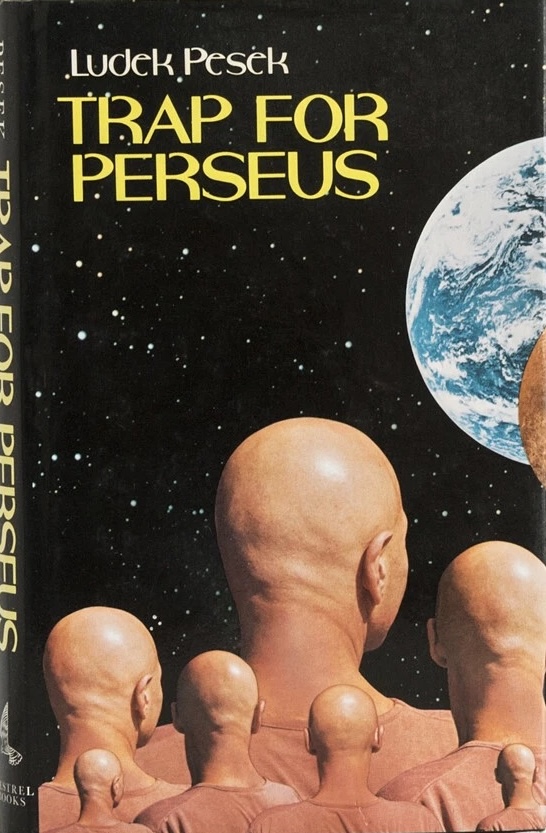
Jane R. Wattenberg’s cover for the 1980 edition
3.5/5 (Good)
Czech author Luděk Pešek (1919-1999), also a painter of space landscapes and photographer, emigrated to Switzerland with his wife in 1968. Due to his political beliefs and penchant to criticize the state in his early literary works, the Union of Czechoslovak Visual Artists expelled Pešek from its ranks. In Switzerland, he focused on painting space landscapes and providing illustrations for foreign publishing houses like Penguin Books and the National Geographic Society.1 He also wrote three science fiction novels in Czech, his native language: The Earth is Near (1970, trans. Anthea Bell, 1973), Flight into the World of Tomorrow (1975), and Trap for Perseus (1976, trans. Anthea Bell, 1980). All three first appeared in print in German translations.2 Anthea Bell translated two of the novels, The Earth is Near and Trap for Perseus, from German to English.3 I am unsure if the Czech manuscripts still exist. In the safety of exile, Pešek’s Trap for Perseus re-imagines the generation ship, so often a symbol of humanity’s technological triumph, as an isolated microcosm of Stalinist extremes detached entirely from its original purpose to colonize the stars.
The Lay of the Halls and Plantations and Other More Conceptual Places
Continue reading
