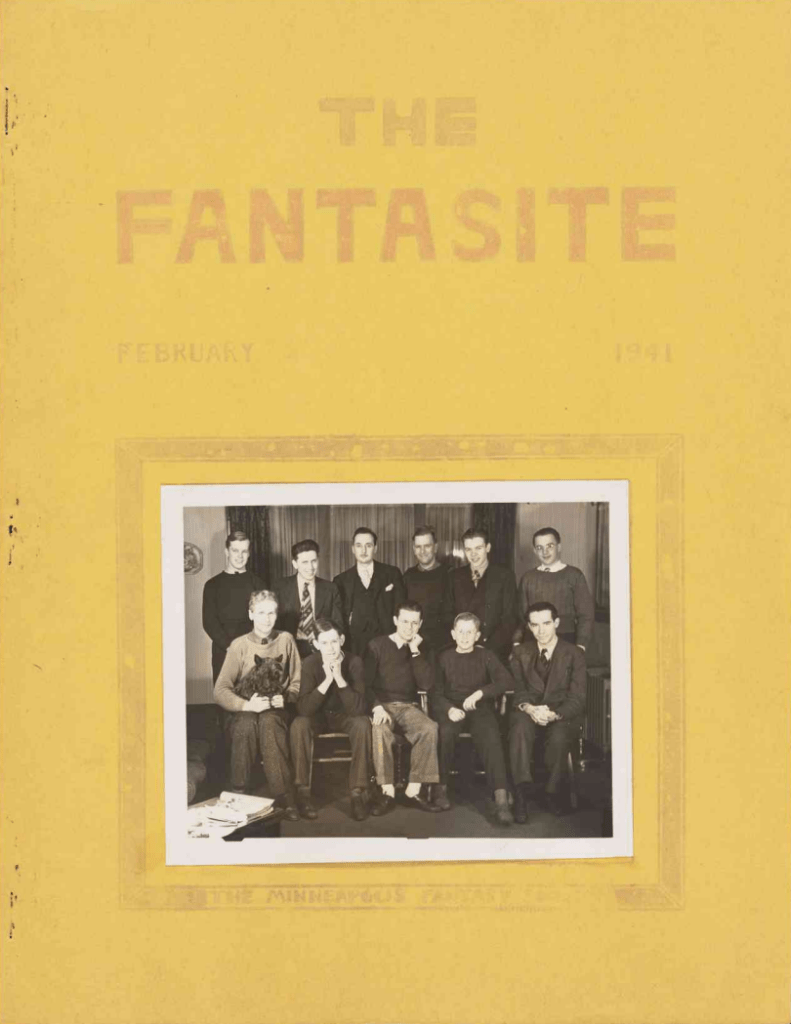
Cover image from The FANAC Fan History Project. Clifford D. Simak is the second from the left in the back
Clifford D. Simak’s “The Future of Science Fiction” appeared in the fanzine Fantasite, No. 2, ed. Phil Bronson (February 1941). You can read it online here. As the quality of the scan at the link is quite poor and close to unreadable in spots, I’ve transcribed the entire article below. In a few instances I have guessed based on vague letter shapes. If you spot an error, let me know!
The fanzine Fantasite, comprised of twelve issues between 1940 and 1944, was the official organ of the Minneapolis Fantasy Society. For more on the fanzine and its creator, consult the Fancyclopedia entries. The MFS was formed when when Simak arrived in Minneapolis and joined with the old Minneapolis Science Fiction League (Hugo Gernsback’s SF clubs). The second meeting happened at Simak’s house. As members went off to WWII, the group became less formal and eventually dissipated. Simak helped briefly resurrect the club after WWII, joined by Poul Anderson and others. Other SF authors who were members included Theodore R. Cogswell, Noel Loomis, Oliver Saari, and Gordon R. Dickson. For a fan history of the organization, check out Jim Young’s fanzine Rune 17 issue.
This is a fascinating, if a bit vague and imprecise, look at Simak’s early views on the evolution and potentiality of science fiction. Unfortunately, as his professional life as a newspaper reporter ramped up he paired back his fan activities. These three points stood out: 1) Simak believes that the science fiction of the 1930s (in particular 1933 and 1934) transformed the genre by departing from “wooden men” who stalk through “wooden plots.” 2) he speculates that science fiction will diversify even further with “new ideas and new ways of presenting them” 3) he emphasizes the importance of “careful delineation in character” with “superb plotting.” Even from Simak’s earliest fannish writings, he shows an interest in a genre without clear boundaries — a genre that grows and expands and explores new things. For a more overt statement on his toleration for a diverse genre, check out his 1971 Worldcon Guest of Honor Speech given in the middle of the New Wave movement.
Of the handful of stories Simak lists, I’ve only read Stanley G. Weinbaum’s “A Martian Odyssey” (1934). Nat Schachner’s “Ancestral Voices” (1934) comes up frequently in SF scholarship as an original early SF story with a rather radical (for the era) implication. I should give it a go!1
Let me know your thoughts.

Graphic created by my father
Clifford D. Simak’s “The Future of Science Fiction” (1941)
For a long time science fiction was formula. Then, suddenly, something happened. Stanley Weinbaum wrote “[A] Martian Odyssey.” Jack Williamson wrote “Born of the Sun.” Nat Schachner wrote “Ancestral Voices.” Murray Leinster wrote “Sidewise in Time.” 2 Don Wandrei strolled onto the scene.3
Other things happened, too. But those few examples give you an idea.
Science fiction shook off the old beliefs that the saga of a man going to another planet and making the acquaintance of the three-legged, seven-eyed, 18-fingered resident of that planet constituted a story. Science fiction started to go places. It’s been going places since.
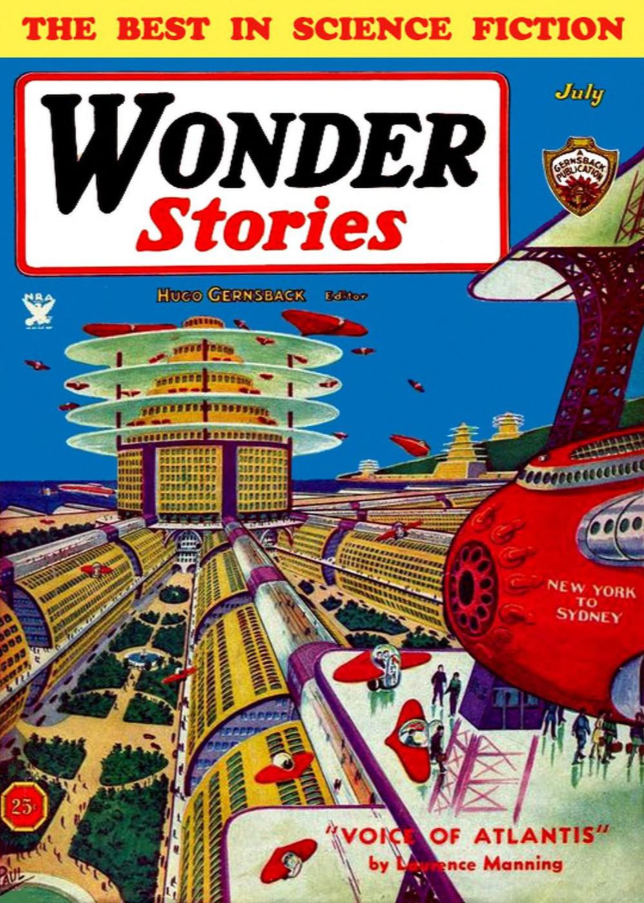
Frank R. Paul’s cover for Wonder Stories, ed. Hugo Gernsback (July 1934) — the publication location of Weinbaum’s “A Martian Odyssey”
Just where it is going is hard, perhaps impossible, to say.
I know that after reading the first paragraph of this article a bunch of you fellows are going to rear up on your hind legs and let ouf a few bellows: “What about the early Skylark stories? What about Wade and Morey? What about some of Lovecraft’s first work? What, above all, about Hawk Carso?”
I’ll admit you have something there. I would be the first to deny that all of the pre-Weinbaum stories were lousy. I wasn’t even trying to say that. What was meant is that they all followed pretty much the same pattern… and that doesn’t mean they weren’t good. But they were pretty much the same.
But in trying to trace the trends of any type of literature, one must generalize. Comparisons and deductions must be made of a broad basis, ignoring the occasional exceptions which arise in almost every phase under consideration.
From necessarily crude beginnings, when the pioneers of science fiction were laying what has proven to be a firm and solid basis for a new type of literature. We have advanced up to the present day of science fiction story which is well rounded in almost every respect. We have achieved realism, an elusive sort of modern-day fantasy, humor, characterization, in some cases satire, and when satire arrived one may be fairly certain that type of literature is out of its swaddling clothes. We have even come to regard psychology as a legitimate field upon which a science fictioneer may base a thrilling, thought-provocative story.
No more do wooden men stalk through wooden plots. Your typical science fictioneer character of today seems to be alive. Plot is given equal consideration with the scientific basis of the story. Some stories are frankly (and actually) humorous. In many of the tales the science does not arise unshriven and smack you in the face… you have to sit and think about it. Seldom do heroes gallop around the red sands of Mars without oxygen helmets or protective armor… seldom do they rescue Martian princesses. Because science fiction writers now know that Mars is mighty cold and has little atmosphere and that a Martian princess probably would look like something that skittered out from under a rock only more so.
Just what science fiction is going to do next is harder to say today than it would have been so a few months ago. The advent of new magazines, all of which show heartening promise of making real contributions to science fiction, and a radiant flurry of story types, serve to confuse any analysis of the situation.
A few months ago I would have guesses the trend would be toward ever increasing realism. Now is appears there may be a decided swing back to the modern-day fantasy. The best solution to the whole problem is to say one doesn’t know.
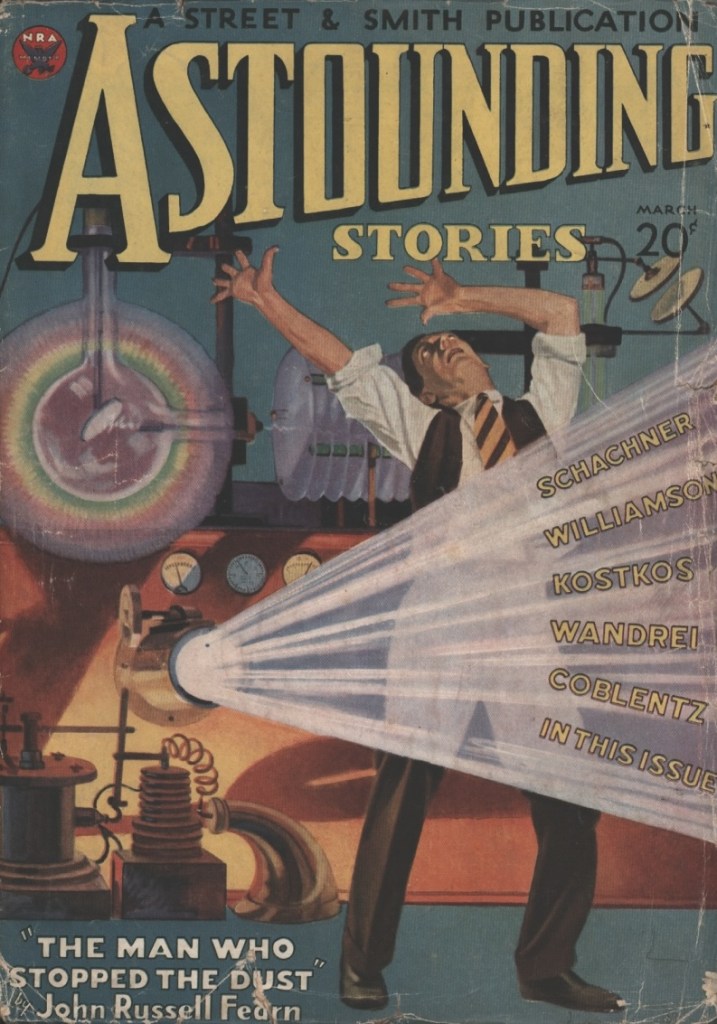
Howard V. Brown’s cover for Astounding Stories, ed. F. Orlin Tremaine (March 1934) — the publication location of Jack Williamson’s “Born of the Sun”
The editors themselves probably don’t worry a great deal about trends. They are in the market for good stories. A sudden outpouring of certain types of stories perhaps is the unconscious imitation of one or more highly successful stories, the writers following, for the moments, the dictates of the fans. As the fans tire of one kind of story, the writers gradually forsake it, turn to something else. One or two of them hit a jackpot and bingo! a new trend has started.
With more magazines in the field, the trend is going to be increasingly harder to follow. One of the magazines at the moment is publishing stories which are almost impossible to define as to type, all of them realistic, many of them based on concepts which a few years ago would not have been regarded as scientific. Another magazine has returned to the simpler type of story, calling for substantial science, swift action, good characterization. Still another relies upon the old popular romantics (not a love story) with science added to provide motive, throwing in some real humor as a pace breaker. And yet another seems to be re-setting the stage for the “big idea” yarn of a few short years ago.
We may be sure of this, however all literature follows certain broad trends and science fiction will be no exception. The direction in which science fiction is moving may be obscured by the number of magazines and the correspondingly large number of writers in the field, but the direction will be there, although it probably will spread over wider ground. Henceforward we probably will get more of every kind of story and the development of any particular type will be slower as a result.
Most of us can remember the time when the hero invariably carried a ray [gun]. More of us can remember when an author who didn’t bust a solar system or two wide open was a panty-waist, too. There was the time when the future was the future and not a future. And Venus was always a jungle and the only thing the asteroids were good for were to hunt gems on or harbor outlaws. The hero usually was a scientists.
Today few ray guns are packet, mighty few solar systems are busted up. Characters are now rampant through many futures instead of a single future. Venus needn’t be a jungle (probably isn’t) and asteroids can be used for lots of things. As well as scientists, heroes can be handy men, newspapermen, farmers, football players, old soldiers, deep-sea divers, historians, librarians… almost anything.
But we’ll come back to them because we liked them and don’t want to get along without them. the ray gun probably won’t come back because, as a weapon, it was a sort of silly think to lug around.
And in the meantime we’ll go ahead to new ideas and new ways of presenting them. We’ll eventually have so many different types of stories that we can afford to wee out the ones we don’t like, keep the ones we do. The fans will take care of that.
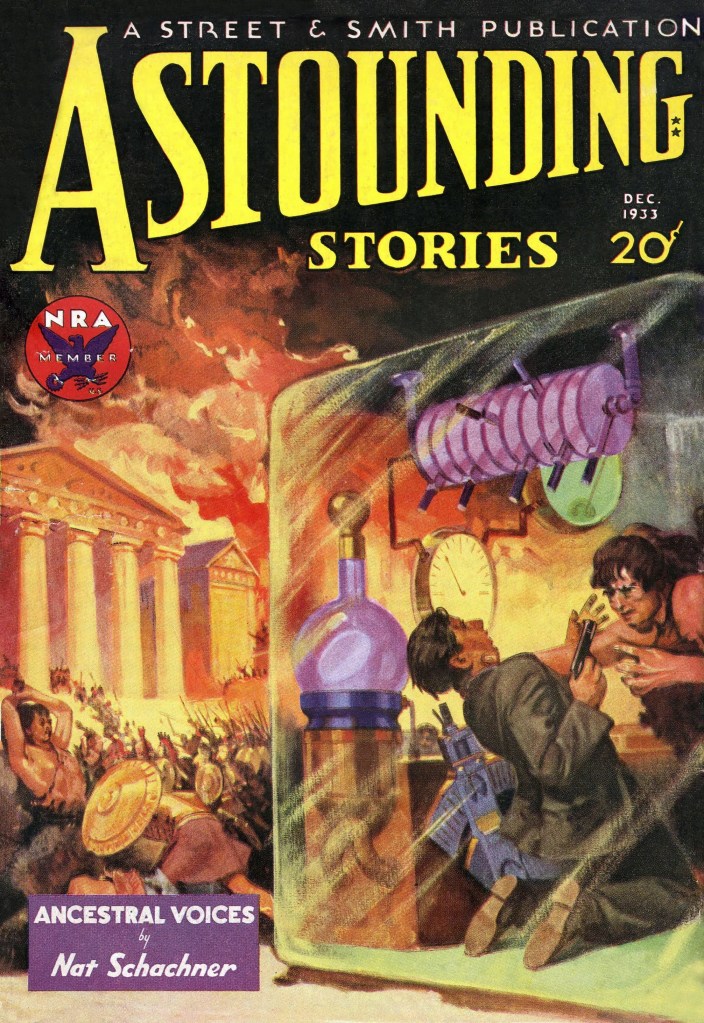
Howard V. Brown’s cover for Astounding Stories, ed. F. Orlin Tremaine (December 1933) — the publication location for Nat Schachner’s “Ancestral Voices”
Unquestionably science fiction has developed. Throughout this article I have referred to it as a literature, which probably isn’t correct, but seemed a handy term to use. Excellence in writing, careful delineation in character, superb plotting and definite story value, however, have put some of the science fiction yarns of the last few years very close to literature. Probably no accredited critic would recognize them as such… but what do we care for critics.
I think that we can expect it to continue its development. it seems to have won a secure place with the American reader. It is no longer on the totary [tertiary?] basis which almost enabled the Depression of the early 30’s to virtually knock it out. each year that goes will see itself winning itself even a more secure place.
Many great stories have been written, but I believe the greatest still are to be written. The horizon grows broader as time goes on. Each new idea is a springboard for a dozen other ideas, all derivatives of the first, but each a separate theme in its own right. If this be true, how can we help but have the greatest stories yet to come?
Notes
- For example in Mike Ashley’s The Time Machines: The Story of the Science-Fiction Pulp Magazines from the beginning to 1950 (2000), 84: “With the December 1933 issue Tremaine announced his new policy for stories of total originality and scope. He called them ‘thought variants’, and the first example was “Ancestral Voices” by none other than Wonder Stories’ leading writer Nathan Schachner. […] The twist Schachner added was that these people were amongst every race and creed. The story is not among Schachner’s best, and did not create the stir that Tremaine expected but it had some degree of originality.” ↩︎
- Stanley Weinbaum’s “A Martian Odyssey” first appeared in Wonder Stories, ed. Hugo Gernsback (July 1934). You can read it online here. Jack Williamson’s “Born of the Sun” first appeared in Astounding Stories, ed. F. Orlin Tremaine (March 1934). You can read it online here. Nat Schachner’s “Ancestral Voices” first appeared in Astounding Stories, ed. F. Orlin Tremaine (December 1933). You can read it online here. Murray Leinster’s “Sidewise in Time” first appeared in Astounding Stories, ed. F. Orlin Tremaine (June 1934). You can read it online here. ↩︎
- Donald Wandrei also published a few stories in Astounding Stories, although he might be best known for his work in Weird Tales, etc. As all the stories Simak lists appeared in Astounding and Wonder Stories in late 1933 and 1934, he might be referencing any of the following Wandrei tales: “A Race Through Time” (October 1933), “Farewell to Earth” (December 1933), “Colossus” (January 1934), “The Man Who Never Lived” (March 1934), “The Atom-Smasher” (April 1934), “The Blinding Shadows” (May 1934), “The Nerveless Man” (July 1934), “A Scientist Divides” (September 1934), and “Colossus Eternal” (December 1934). I have not read any of his work. ↩︎
For book reviews consult the INDEX
For cover art posts consult the INDEX
For TV and film reviews consult the INDEX


Thanks for posting this. It is interesting to see Clifford D. Simak, the youthful fanboy instead of the stately SF Eminence we are used to. It is also interesting to see him talking about the changes in Science Fiction, circa 1940. In other words we are witnessing the New Ripple, 30 years before the New Wave.
Hello Paul,
I get the general sense that everything about science fiction at the moment felt youthful and new. But yes, I take your point. I wish there were more fan writings (or nonfiction) by Simak before the profusion of interviews and speeches that appear in late 60s and 70s. I do see his modesty about his own fiction — certainly published in the same decade — that could be grouped with the authors he mentions in the beginning. I’m thinking Simak’s “The Creator” (1935) and its discussion of religion.
I should point out that I have another Exploration Log on his 1953 speech “Face of Science Fiction” lined up as well. Although, I’m going to space it out a bit with some other posts as people sour on a single author focus over too long of a span (i.e. 3 of my last 5 posts).
I posted about Simak’s speech “The Face of Science Fiction” (1953)” moments ago! 🙂
The irony here being that Simak is chiefly remembered as a writer of bucolic science fiction, more concerned with documenting rural America in stories light on sf tropes.
Yes, authors are often pigeonholed. I don’t think that is very surprising. I certainly — in everything I’ve written about him over the last few years — have tried to take a more sophisticated analytical lens to his “pastoral” and “bucolic” fictions. Those words tend to dismiss his stridently anti-capitalist takes on the modern American business ethic by wrapping it up in some hilly-billy conservatism and simplistic nostalgic for what was. I’ve of course made the case at length by arguing something quite different about his rural focus. And, of course, his early fiction covers far more territory that the handful of stories that people remember him for.
I recently read his A Heritage of Stars – review to appear on Thursday 9 July – and while he was in his seventies when it was published, it struck me as pretty low on invention. A couple of standard sf tropes and a US slowly returning to nature – with a timeline that didn’t add up. I wasn’t impressed. He was a better writer than Asimov, but that’s a really low bar to clear.
I’ve never been a fan of his later works. I’ve focused far more on his early work on my site.
I bought the book by accident, and decided I might as well (re-)read it – especially since I had no memory of it from the last time I’d read it. Which was sometime in the late 1970s, I think.
I have a copy hanging around somewhere. I’ve not made any moves to pick it up.
Did you ever read my article on Simak’s early anti-capitalist fictions and labor rights? https://sciencefictionruminations.com/2024/09/13/exploration-log-5-we-must-start-over-again-and-find-some-other-way-of-life-the-role-of-organized-labor-in-the-1940s-and-50s-science-fiction-of-clifford-d-simak/
It is through the lens of my arguments in this article that I engage with his work. I am trying to expand my argument a bit and include additional works. As I’ve mentioned before, so much of my interest in genre is as a source for historical arguments.
And, because of my research interests in that article, I will eventually read all his pre-1960/1965 short fictions — regardless of their quality. It’s why I reviewed Simak’s “Madness from Mars” (1939) and “Hermit of Mars” (1939) recently. And I know I’ll find some hidden gems and great reads along the way!
In Asimov’s autobiography (vol 1, “In Memory Yet Green”) Asimov talks about giving Simak’s “World of the Red Sun” a low rating (Asimov, like many fans, wrote letters to the mags, rating each story in the most recent issue, and editors published them, because filling a page with text they didn’t have to pay for was a great deal) – because Simak’s method of transitioning from one scene to another was confusing, which probably tells us something about how structurally simple the other stories that Asimov had seen up to then were.
Characteristically, Simak wrote a humble letter* asking how he could improve, and Asimov (by then a few months older) reread the story, understood it, and apologized (and I think Simak later sent Asimov a congratulatory postcard when Asimov’s first story appeared in print).
*letter column letters included addresses.
Just checked my memory – it was “Rule 18” not “World of the Red Sun” per this https://www.panshin.com/higher/simak.html
Yup, I came across Asimov’s interactions as a mention in Muriel R. Becker’s Clifford Simak: A Primary and Secondary Bibliography (1980) while I was writing my article on his early fiction and tracking down all available interviews: https://archive.org/details/clifforddsimakpr0000beck
Asimov talks about it in his intro to Simak’s story “The Big Front Yard” in The Hugo Winners: https://www.isfdb.org/cgi-bin/pl.cgi?216017
Becker explains that the story about “Rule 18” mentioned in that 1962 anthology is the first of many that Asimov told about Simak.
@sciencefictionruminations.com
Very interesting. Thank you.
I read the "totary" in the next-to-last paragraph as "tottery". Calling the basis unsteady makes sense to me.
Remote Reply
Original Comment URL
Your Profile
Why do I need to enter my profile?
This site is part of the ⁂ open social web, a network of interconnected social platforms (like Mastodon, Pixelfed, Friendica, and others). Unlike centralized social media, your account lives on a platform of your choice, and you can interact with people across different platforms.
By entering your profile, we can send you to your account where you can complete this action.
Ah, I missed this comment. Thanks for stopping by. Yes, that makes more sense. I went ahead and edited it. I also just posted another early speech containing some SF criticism by Simak — “The Face of Science Fiction” (1953)