Which books/covers/authors intrigue you? Which have you read? Disliked? Enjoyed?
1. The Best from Fantasy and Science Fiction, 8th Series, ed. Anthony Boucher (1959)
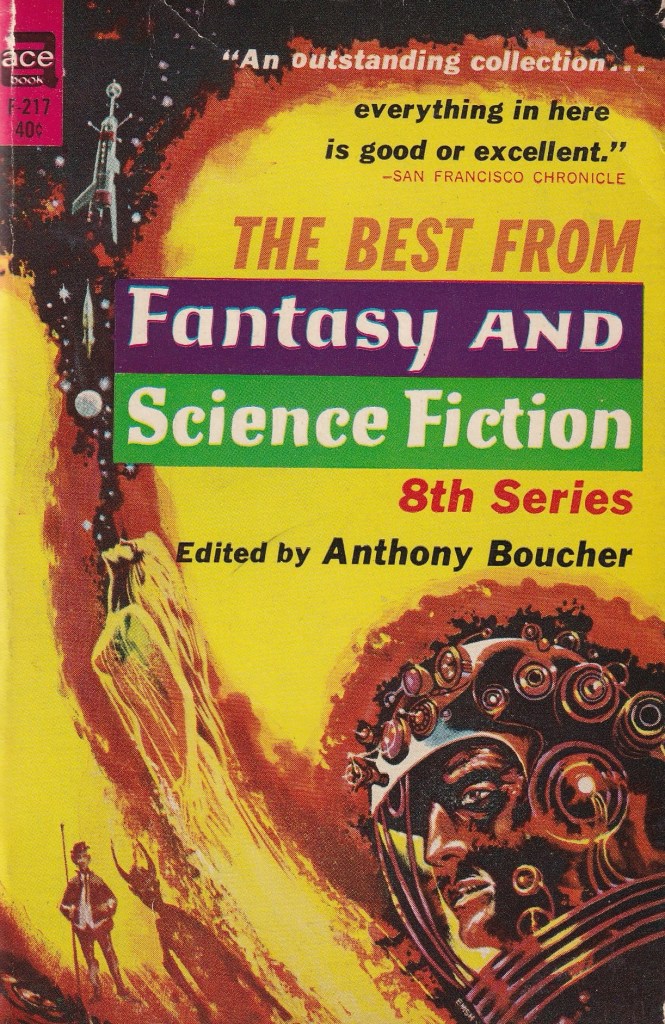
Ed Emshwiller’s cover for the 1963 edition
From the back cover: No summary blurb.
Contents: C. S. Lewis’ “Ministering Angels” (1955), Poul Anderson’s “Backwardness” (1958), Kit Reed’s “The Wait” (1958), Isaac Asimov’s “The Up-to-Date Sorcerer” (1958), Fritz Leiber’s “A Deskful of Girls” (1958), Damon Knight’s “Eripmav” (1958), Brian W. Aldiss’ “Poor Little Warrior!’ (1958), Shirley Jackson’s “The Omen” (1958), Jules Verne’s “Gilt Braltar” (1887), Avram Davidson’s “The Grantha Sighting” (1958), C. M. Kornbluth’s “Theory of Rocketry” (1958), John Shepley’s “Gorilla Suit” (1958), Zenna Henderson’s “Captivity” (1958), and Alfred Bester’s “The Men Who Murdered Mohammed” (1958)
Initial Thoughts: I love anthologies. I need to finally tackle a Zenna Henderson story!
2. Aldous Huxley’s Island (1962)
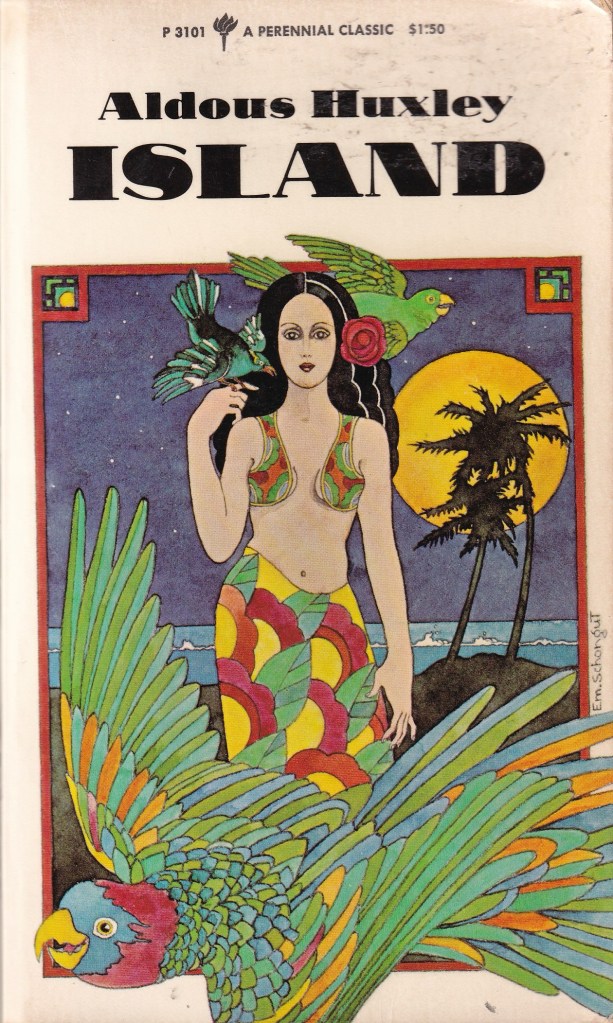
Emanuel Schongut’s cover for the 1972 edition
From the back cover: Contains no clear blurb about the book. I’ve quoted the blurb from SF Encyclopedia: “Island (1962) presents a utopian alternative to the previous books, though without much energy. Pala and Rendang – the primary Islands in question – are set safely in the Indonesian Archipelago, and Pala in particular has long enjoyed a mildly euphoric existence, sustained spiritually by religious practices derived from Tantric Buddhism, and physically by moksha, a sort of benign soma, whose psychedelic effects – as shared by the island’s inhabitants in unison – smooth the rough edges of the world. But the book itself is powerless to convince.”
Initial Thoughts: I’ve read, and enjoyed, Huxley’s Brave New World (1932) and the bizarre Ape and Essence (1948) (which I never managed to review). When I saw Islands (1962) in the bargain bin at my local used book store foe $1, I couldn’t resist.
3. Joyce Thompson’s Conscience Place (1984)
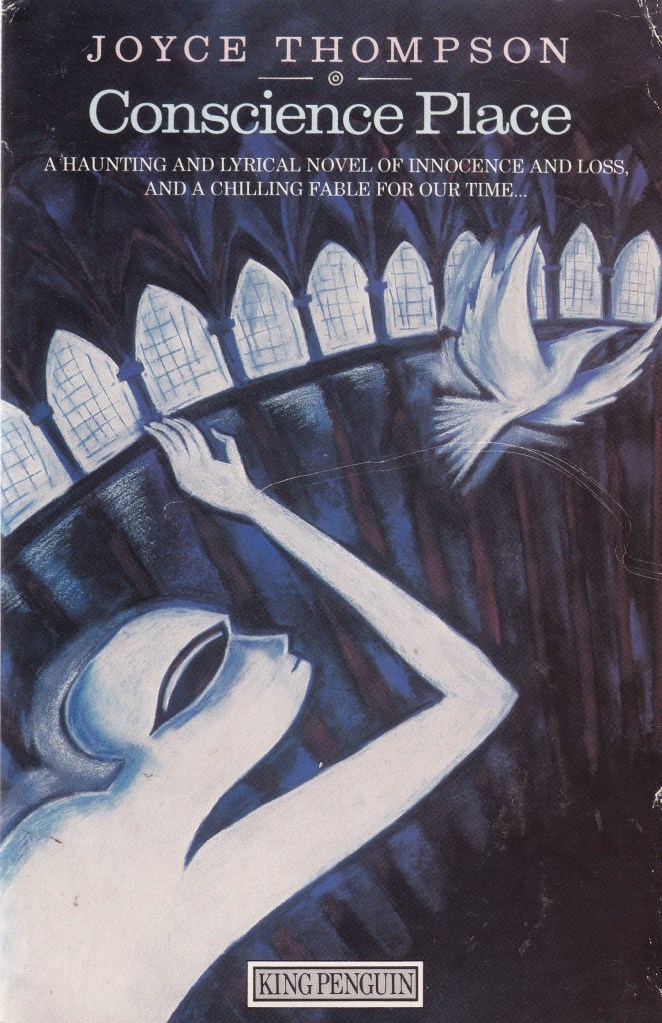
Jackie Morris’ cover for the 1986 edition
From the back cover: “The People of the Place are the victims of progress, although they are unaware of their physical deformities, and their existence, in a community somewhere in America, is a closed guarded secret from a guilty world.
For the People are the mutant offspring of nuclear plant workers. Loved and cherished by the Fathers, they are allowed to live out their brief lives in dignity and harmony and in something approaching joy. Until their miniature civilization is threatened by the very ones who nurture them.
In the ensuring struggle to survive, the People learned the bitter truth of who they are and the lessons of their history.”
Initial Thoughts: Not sure where I learned of this one. SF Encyclopedia, in its limited fashion, aims a kind description its way.
4. John Collier’s Tom’s A-Cold (1933)
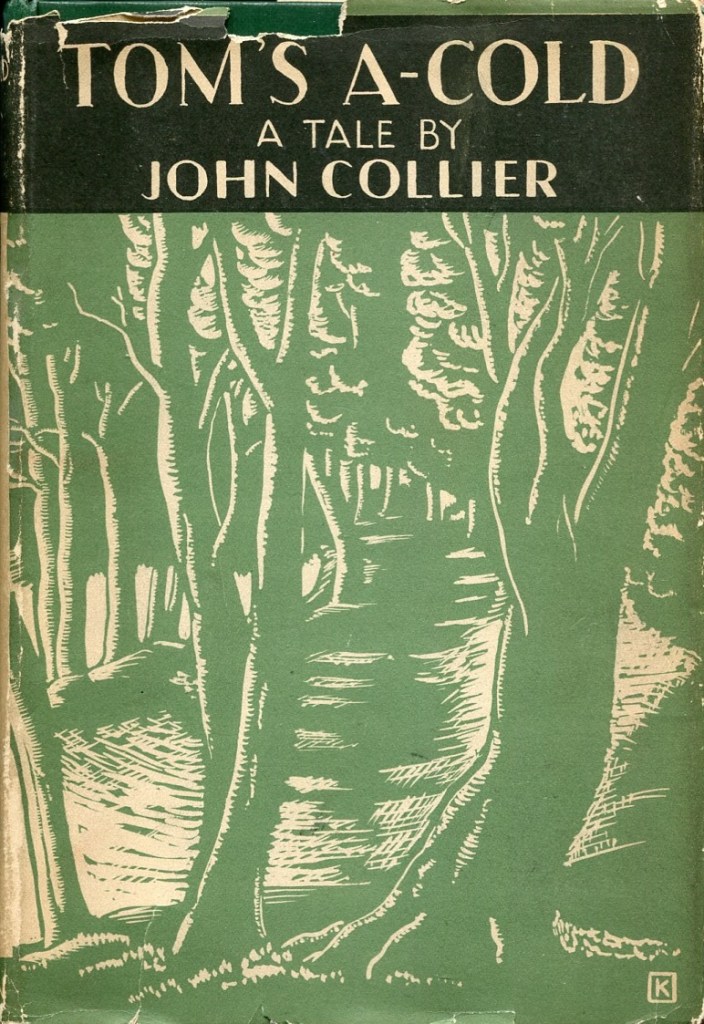
Uncredited (“K” initial) cover for the 1st edition
From the inside flap: Unfortunately, copies with dust jackets are FAR too expensive for me to purchase. Here’s the blurb from SF Encyclopedia: “Radically dissimilar to his most familiar work is Tom’s A-Cold (1933; vt Full Circle 1933), a remarkably effective Scientific Romance set in a 1990s Ruined Earth, long after an unexplained Disaster has decimated England’s (and presumably the world’s) population and thrust mankind back into rural barbarism, a condition out of which the eldest survivors, who remember civilization, are trying to educate the young third generation. The simple plot plays no tricks on the reader: the young protagonist, a born leader, rises through raids and conflict to the chieftainship, undergoes a tragedy, and reconciles himself at the novel’s close to the burdens of a government which will improve the lot of his people. Throughout the novel, very movingly, Collier renders the reborn, circumambient natural world with a hallucinatory visual intensity found nowhere else in his work. Along with Alun Llewellyn’s The Strange Invaders (1934), Tom’s A-Cold can be seen, in its atmosphere of almost loving conviction, as a genuine successor to Richard Jefferies’s After London (1885).”
Initial Thoughts: I encountered a few mentions of this one in Andrew Hammond’s monograph Cold War Stories: British Dystopian Fiction, 1945-1990 (2018). Clute’s blurb above makes it out to be a real winner. Can’t wait to read this one.
For book reviews consult the INDEX
For cover art posts consult the INDEX
For TV and film reviews consult the INDEX


I’ve read a lot of the stories from the F&SF collection (not positive which ones, but some for sure). The Leiber is part of the Change War series, but doesn’t involve the war directly; instead there’s someone using technology that the Change Warriors generally use. You’ll recognize who the main character is based on, I suspect (though I’m old enough that I can’t expect that pop culture references that I get will be recognized by everyone)
That’s one of the stories that caught my eye. I read The Big Time in the years before my website. I haven’t returned to his Change War tales since then. I also need an excuse to finally read a Zenna Henderson story!
This F&SF anthology is one of the very best of the series, exceeded only by the next year’s volume. But be sure to take your blood pressure medication or tranquilizer, if you have such a prescription, before reading C.S. Lewis’s “Ministering Angels.”
I’ve read Lewis’ Cosmic Trilogy (not for me) but have not read any of his SF short stories. Can’t say I’m really looking forward to that one!
You should definitely read “Ministering Angels.” You should also read “The Shoddy Lands,” which is in the sixth Best from F&SF volume and no doubt several other places, as a fine specimen of a certain kind of intellectual snobbery–class-based intellectual snobbery, I should add.
Curious about “Tom’s-a-Cold”, it sounds familiar but not sure where I would have come across a mention of it before.
I read the Huxley a couple years ago when I was exploring utopian fiction a bit more in depth, sorry to say my recollection is pretty negative and the SF Encyclopedia’s judgment feels accurate. The plot seemed tortured and the didactic points belabored. At least it was only a dollar haha.
So… After your comment I realized that I already posted about the book in March! I forgot to move it from my substantial pile of acquisitions that I hadn’t featured on the site yet. Well, I might go ahead and replace it with another book. Considering this is the 349th purchase post in the history of my site, I’m surprised I haven’t posted a duplicate before!
ha well that explains it!
I think I’ll just leave it as other comments have touched on the book too. It’s on the shortlist of things I want to read this year.
The dust jacket for TOM’S A-COLD can be found here:
https://www.dustjackets.com/pages/books/7235/john-collier/toms-a-cold
Nice! It is a lovely cover. Not sure I’m invested enough in the book or collecting to acquire a facsimile.
Agreed. But that operation is a place to find the jacket text to quote it where you don’t have the jacket of a book you’re describing.
I had read Island once years ago, in college. I remember it being very chatty with not much in the way of a plot. I do more vividly remember reading Huxley’s “The Doors of Perception” around the same time, which while not SF certainly had an influence on New Wave SF, among other things.
Yeah, I gad a group of friends in high school that were obsessed with Huxley’s Brave New World. I vaguely remember one of them went and tracked down his other work and pointed out how different it was, and its chatty nature, as you said. The kid was also into drugs and adored The Doors of Perception.
I read that particular F &SF anthology a few years back; from memory, my reaction to the contents ranged from “Excellent – a classic” through to “_This_ was one of the best stories they published that year?” Admittedly I have that reaction to a lot of old “Best of” anthologies, as well as to some more recent ones.
The Anderson story sticks in my mind not because it’s great (it’s not) but because it seems to have wandered in from an issue of Campbell’s “Astounding” of that period – which isn’t meant as a compliment.