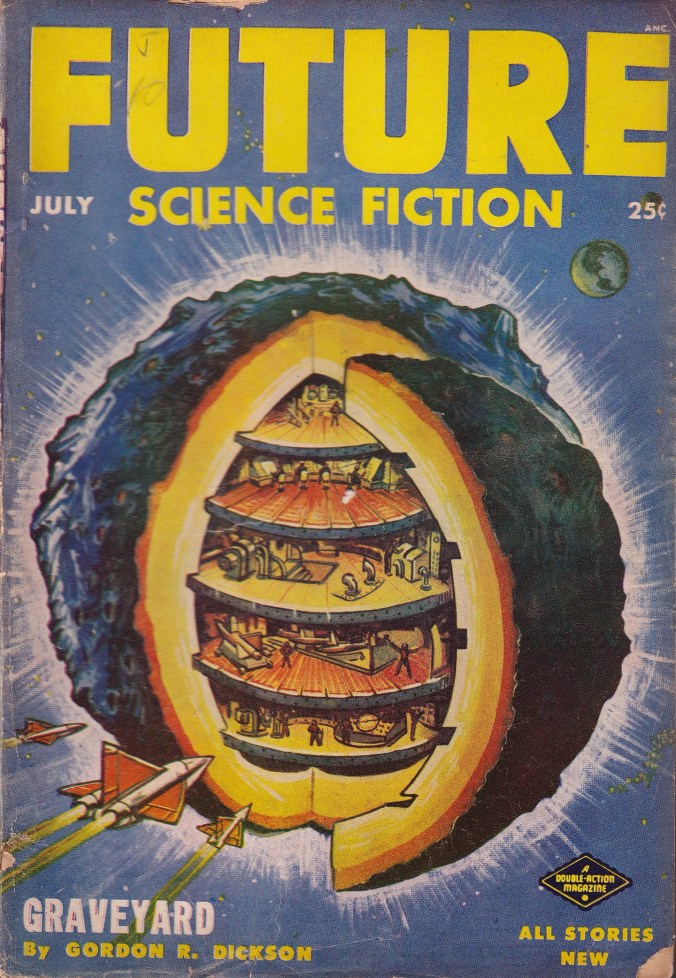
Milton Luros’ cover for Future Science Fiction, ed. Robert W. Lowndes (July 1953)
3.25/5 (Above Average)
“One by one the cargo-liners blew up, most conveniently for I.C. in its squabble with the union. In fact, these accidents were too convenient…”
Richard Wilson’s “Strike” (1953) first appeared in Future Science Fiction, ed. Robert W. Lowndes (July 1953). You can read it online here.
“Strike” is the third story in the “Dateline Mars” sequence by Richard Wilson (1920-1987). To the best of my knowledge, this sequence follows the investigative career of Reporter Scott Warren, chief of the Iopa bureau of the Galactic News Service on Mars.1 I am unsure how many stories appeared in this sequence as they have not yet been grouped as a unit on The Internet Speculative Fiction Database.2 Regardless, there’s an appealing simplicity to the general framework of the series — how news agencies attempt to provide objective reporting in a future in which humanity has settled Mars. “Strike” also clocks in as an unabashedly pro-labor union tale. From the stories I’ve gathered so far, this is somewhat rare for the 1950s.
The Nature of the Union
The crisis? After the Interplanetary Spacemen’s Union goes on strike for “higher pay and better retirement benefits” (35), two cargo-liners on the dangerous route between Earth and Mars explode, leaving no survivors. The I. S. Union, comprised not only “pilots but crewman, mechanics and maintenance workers at the spaceports” (25), blame Interstellar Carriers’ use of scabs, in particular “supervisory personnel” long retired from spaceflight (41). The company, predictably, blames the Union for sabotage. The Union holds a powerful card as the cargo-ships supply Mars with luxury goods, medicine, and passenger service. Interstellar Carriers does what all big businesses do when threatened–pour resources into a PR campaign and attempt to influence the Martian Parliament to change the law to permit “union-busting” (38). But labor “hasn’t got a lobby, much less influence” to fight the long political game (39). The World Government does nothing but encourage mediation. Only with the truth of the explosions revealed will the crises be averted. In steps the necessary independent press!
The story follows Scott Warren’s journalistic investigation and write-up of the story as the events unfold. He manufactures a personal emergency as cover to send a reporter, Art Roper, on one of the limited cargo runs crewed by scabs back to Earth. Roper discovers a strange pattern of insurance claims. And his careful questions, and lubricating lips with alcohol, soon reveals the true nature of things.
Final Thoughts
Wilson’s straightforwardly positive take on organized labor clashes with many other 50s authors — who swing mostly between social satire and criticism of unions and their leaders to outright ridicule. I will cover stories in both camps later in this project. Wilson even imagines a future in which unions were legally able to conduct a strike without restrictions. This isn’t a future with a Taft-Hartley Act (1947). In addition, he equates anti-union mentality with anti-democratic actions. The journalistic investigation of Interstellar Carriers’ Sargin, the chief agent of political and PR campaign against the union, reveals his previous history as a “silent partner of the old Rockhead dictatorship on Mars” (43). Sargin used his political influence and connections to be cleared of political wrongdoing after a new, more democratic, government came to power.
According to Wilson’s story, unions protect workers and a free press, invested in reporting the truth, can challenge the anti-democratic machinations of big business. At its heart, “Strike” is a functional, not terribly riveting, thriller with a surprising stance. Recommended for fans of science fiction that addresses labor issues.
Notes
- The sequence was inaugurated with the story “Dateline: Mars” (1951). I’ve identified a few more including “Incident in Iopa” (1953), and “New Weapon” (1953). “Mary Hell’s” (1954) takes place on Iopa but doesn’t seem to be part of the sequence. ↩︎
- Wilson’s listing. ↩︎
For book reviews consult the INDEX
For cover art posts consult the INDEX
For TV and film reviews consult the INDEX


This sounds so cool. Are you going to track down the other Dateline Mars stories?
I wrote this before I read your footnote. I am very tempted to track these down and read them. Some of the other stories on his isfdb listing sound like they could be related, e.g. “Press Conference” (1953).
No worries. You’re good. But yes, I only looked through a small portion of his bibliography. I also assume the stories that are in Future Science Fiction are more likely to be in the sequence. It doesn’t seem to be the project that got him published in the top tier magazines at the time.
I am certainly intrigued. I suspect there are more than the handful I found. I really like the set-up — although, when you read this story, it’s all a bit too functional.
The Fictionmags Index lists the following as the series including “Strike”:
[]Galactic News Service (Scott Warren)
http://www.philsp.com/homeville/FMI/l00/l00046.htm#A19
Thank you John! Read any of them?
Nope. I have only rarely found anything by Wilson to be more than mildly clever. I recall describing AND THEN THE TOWN TOOK OFF as a “limp and dispirited farce.” His award-winning “Mother to the World” was more impressive, though I believe the disability community would like a word with him. But in general he’s gone into the “life’s too short to bother” bin.
Yeah, I covered “Mother to the World” as well. A legitimate shocker — and certainly a conundrum, and a disturbing one as you imply.