Which books/covers/authors intrigue you? Which have you read? Disliked? Enjoyed?
1. Jack Vance’s Galactic Effectuator (1980)
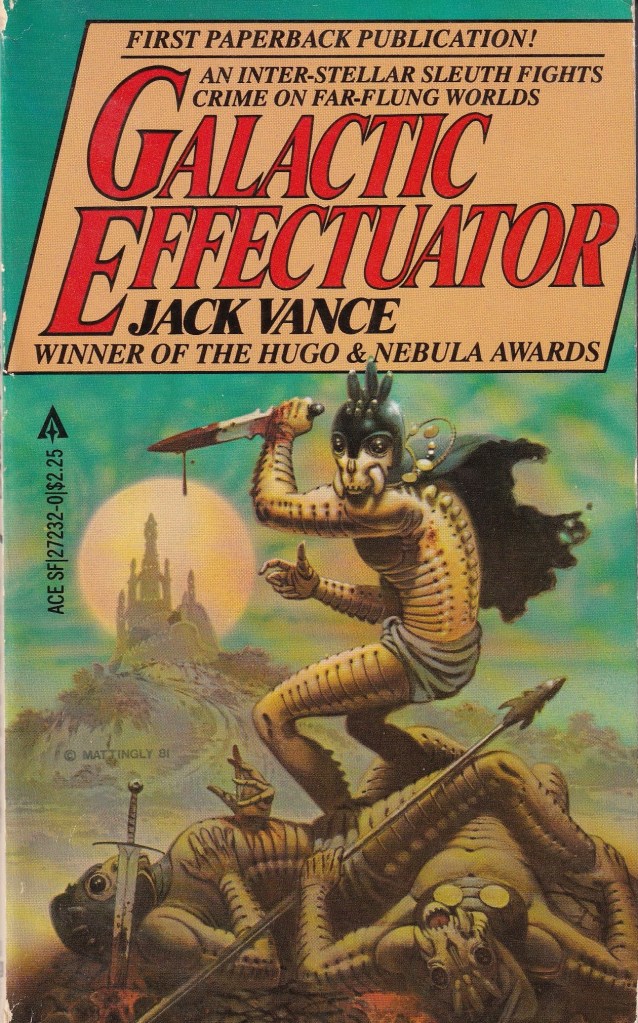
David Mattingly’s cover for the 1981 edition
From the back cover: “Meet Miro Hetzel, Galactic Effectuator. He’s part gentlemen, part detective, part fraud, and his trail of exploits cuts through some of the more improbably civilizations in the universe. Join him in a trip to the planet Maz, whose natives are so fierce that they’ll fight three battle before lunch and then dine on the enemy–a planet that only a man with Miro Hetzel’s steely nerve would dare to visit at all.”
Initial Thoughts: This is a fix-up novel containing “The Dogtown Tourist Agency” (1975) and “Freitzke’s Turn” (1977). I previously reviewed “Freitzke’s Turn” (1977) and did not classify it amongst Vance’s best. As many know, I’ve soured a bit on Vance in the last decade. That said, I still think novels like Wyst: Alastor, 1716 (1978) and Emphyrio (1969) are worth the read.
2. Adolfo Dioy Casares’ Diary of the War of the Pig (1969, trans. Gregory Woodruff and Donald A. Yates, 1972)
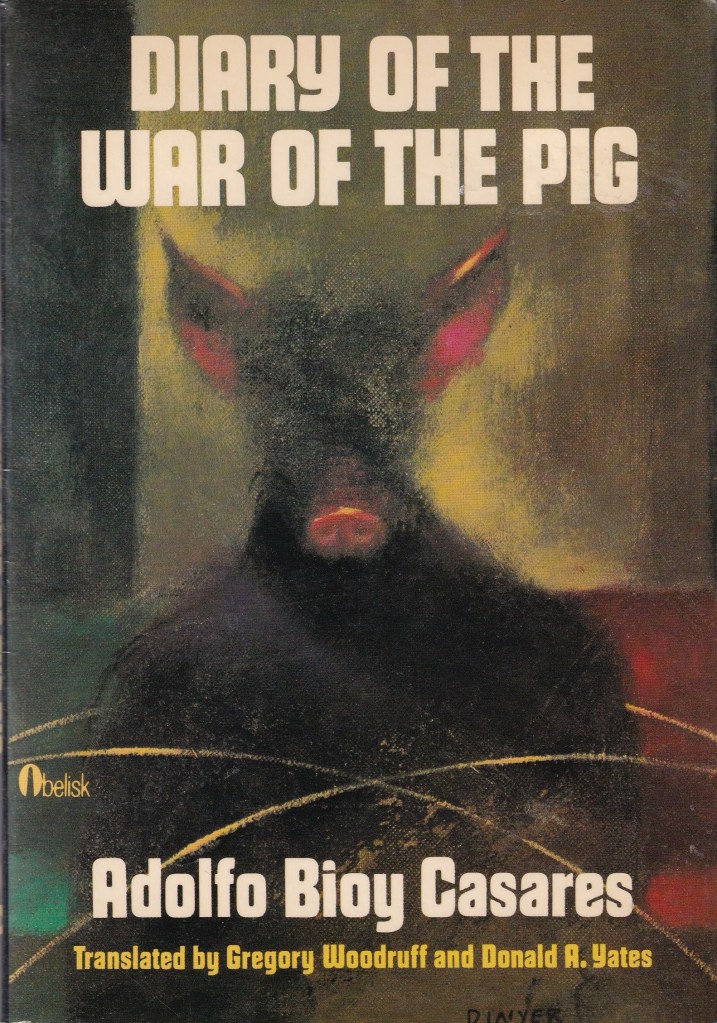
Eric Dinyer’s cover for the 1988 edition
From the back cover: “The Obelisk edition of Diary of the War of the Pig marks the first time in paperback for this fictional chronicle about street terror and disappearance by the greatest living Argentine author. Written almost a decade before the death squads disrupted Argentinea, it is the gripping first-person narrative of an old man caught in a wave of persecutions against all old people, and might well stand as a metaphor for the murkier currents of Latin American society today. Adolfo Bioy Casares relates the day-to-day life of Isidro Vidal, the “old boys” from the corner cafe, and the women, young and old, who offer temporary redemption from madness and mob terror. Part allegory and part irreducible dream this story of courage, cowardice, and love is disquieting testimony on the human conditions of our southern neighbors.”
Initial Thoughts: As issue one of Rachel Cordasco’s new online magazine Small Planet: The SF in Translation Magazine (with one of my reviews) recently went live, I’ve acquired a bunch of SF and SF adjacent works for my review column. She suggested I track down Casares’ near-future dystopia Diary of the War of the Pig (1969). In college I read (and adored) his masterpiece The Invention of Morel (1940, trans. 1964) (one of many tantalizing books deliberately visible and in dialogue with the narrative of Lost).
3. Thom Keyes’ The Battle of Disneyland (1974)
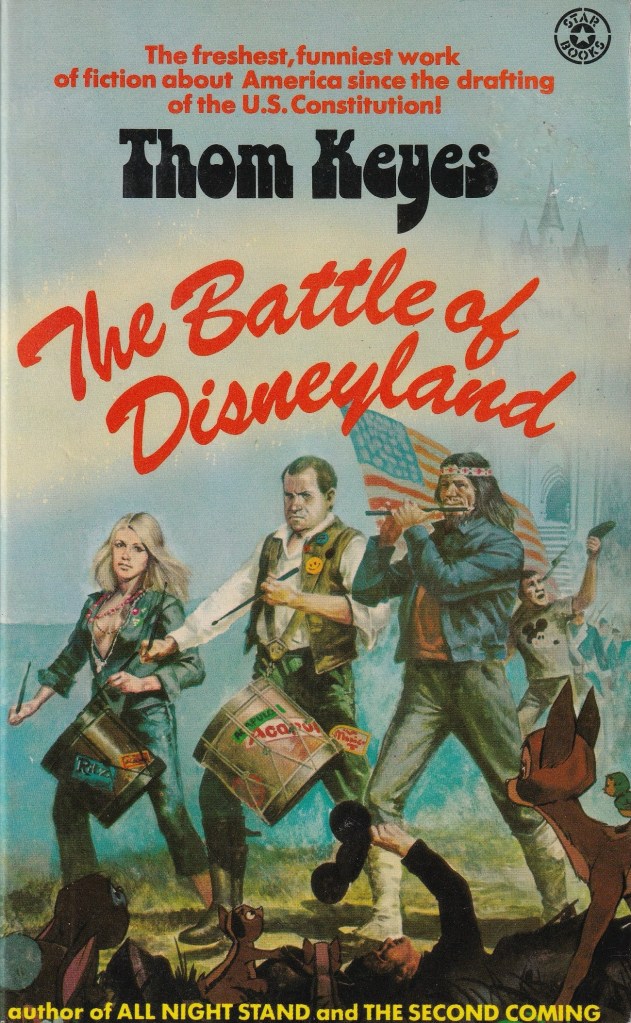
Uncredited cover for the 1st edition
From the back cover: “A hilarious post-Vonnegut trip. Prophets of doom, harbingers of the coming self-destruction of the U.S.A., fasten your forlorns. Exiled Californian sci-fi writer, Thom Keyes, has the answers to it all.
Disregard what Gerneral Jastrzab is doing to the playboy bunnies with his wooden lef. Look down into the streets… There’s a whole lot fighting going on! And when the riot spills into the Sleeping Beauty’s Castle and the Magic Kingdom in Disneyland you’ll see where things are really at.”
Initial Thoughts: All I know is what SF Encyclopedia blurbs: “The Battle of Disneyland (1974) also hyperbolic, depicts a Post-Holocaust Los Angeles, and the calving of California from the continent.”
4. Kenneth Bulmer’s The Insane City (1971)
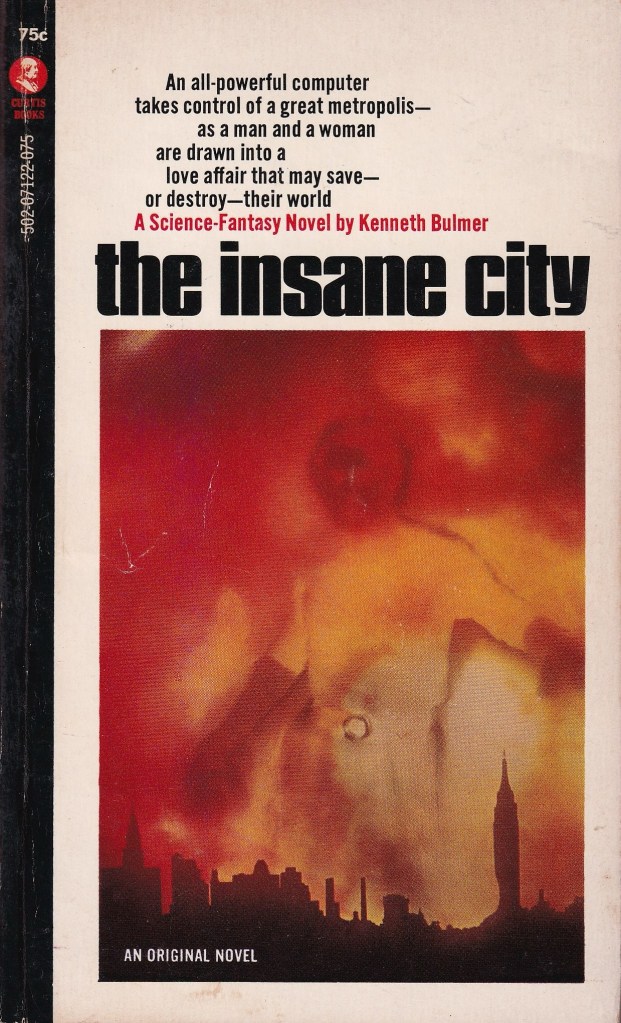
Uncredited cover for the 1st edition
From the back cover: “In a city of tomorrow–the master-machine turns upon the people who created it.
A clicking sounded up the tunnel. A robex on three wheels rolled steadily toward them. Ridgeway swallowed. He knew they were safe, but he felt jittery just the same. The thing looked so calm and unemotional, so mechanical and precise. Moving closer, it glittered at them. Then a box on its body opened with a squeal. A long screwdriver appeared on one tenacle, a hammed on another.
“Oh, No!” screamed Carrit. “It can’t be!” But it was…
In a single lethal rush the robex charged toward them, brandishing its tenacles like weapons of final destruction.”
Initial Thoughts: Kris Vyas-Myall over at Galactic Journey wrote nice things about this one. Kris described it as “told in a beautifully alienated style” and that “it is unfortunate this book has been put out by Curtis, known primarily as the venue for reprinting the back catalogue of people like the Binders or Robert Moore Williams. I think if this had been published as an Ace special, it would be a shoe-in for a Hugo nod.” Count me intrigued. Despite the fact that Kris and I rarely see eye-to-eye on science fiction (which is fine of course)!
For book reviews consult the INDEX
For cover art posts consult the INDEX
For TV and film reviews consult the INDEX


Wow! I’d never heard of “…War of the Pig”!!
Yeah, I hadn’t either. The only Casares I knew was The Invention of Morel (1940) — really really otherworldly and fascinating.
Yes, that one I’ve read and loved but this one is completely new to me!
Rachel’s magazine comes out four times a year. The first issue just went live at the beginning of May. That means I’ll probably review this one in the next two or three issues. I have my next one already lined up and nearly finished (reading). This is all to say that I’ll have it reviewed in about 3/4rs of a year! haha. Maybe you’ll get to it first. If so, let me know.
LOL, well I’d need to find a copy first!!
Wasn’t the cheapest book out there. I apparently spent $40 with shipping on this volume… eek.
😱😱😱
I know. Not good. But then again, books are my main expense/drug/self-care/obsession — haha.
Snap! 🤣
Is that Nixon on the drums?
Looks like it!
Coincidentally, I’m just home from buying Bioy Casares’ The Dream of Heroes at the used bookstore around the corner.
Hello Michel,
As I mentioned to Kaggsy above, the only Bio Casares I had read is The Invention of Morel (1940). I have firm memories of adoring that one. Have you read any of his work?
That is that one about?
Joachim,
Adolfo Dioy Casares’ Diary of the War of the Pig is available on archive.org, for those that have an account.
Andrew
Unless it’s a short story, I simply can’t read things in depth that aren’t physical copies. But yes, good to know if a paper copy is too expensive or people are fine reading longer things online!
The Vance ‘Dogtown Tourist Agency’ is a rewrite of one of his 1950s-era Magnus Riddolph stories — ‘The Kokod Warriors’, IIRC — but done in the mode of later Vance and at greater length.
It first appeared in a mid-1970sCarr, Elwood, or Silverberg anthology — I’m not going to look up which now as I’m on the move — and I assume Vance rewrote the earlier story because he needed to fulfill a commission and the Riddolph story had a workable plot he could recycle.
I’ve a lot more time for Vance than you at this point, in that I’d argue that he was one of the best writers that American SF has produced as a writer — though simultaneously he’s a terrible influence for other writers to try to imitate. That said, this is fourth-rate Vance and the original Riddolph story had the virtue of brevity.
Now I think about it, ‘Freitzke’s Turn’ also recycles elements of one of Vance’s 1950s-era Jean Parlier stories in his Monsters In Orbit.
Don’t worry I can answer this question (it’s “Epoch”, ed by Silverberg and Elwood) because by some strange coincidence I just started reading that very entry a couple days ago. Although funnily enough it is advertised as a “new full-length novel” on the jacket, not to be confused with the other novellettes, novellas and short stories contained therein. I am relatively new to Vance, having only previously read a bit of a “Dying Earth” collection, which charmed me enough to give “Dogtown Tourist Agency” a look. Several chapters in I would say the prose is fun but the content is a bit too heavy on set-up/exposition to be that engaging.
“I’ve a lot more time for Vance than you at this point, in that I’d argue that he was one of the best writers that American SF has produced as a writer” — I have never been struck by his prose. I find him descriptive to a fault. And his use of footnotes almost seems like some rote action vs. a useful choice. He often abandons footnotes a few pages into his novels. I’m unsure why they’re even there.
And like you, I think The Invention of Morel is an important work. Also, if you didn’t know, the basis for Alan Resnais’s film, Last Year at Marienbad by some accounts.
https://brightlightsfilm.com/the-invention-of-marienbad-resnais-robbe-grilletmorel-and-adolfo-bioy-casares-on-the-left-bank/
Like you, again, Ive never read anything else by Bioy Casares. So I’m curious what your opinion might be. Borges, who was usually a very sound critic and judge of literature, thought the world of his friend’s work.
I took a History of French Film class — and Last Year at Marienbad blew my young mind and caused me to spend many an afternoon in the audiovisual library watching every Resnais film I could get my hands on. I quite enjoyed Resnais’ Muriel ou le Temps d’un retour (1963) as well. And, of course, Hiroshima mon amour (1959).