Which books/covers/authors intrigue you? Which have you read? Disliked? Enjoyed?
1. They’d Rather Be Right, Mark Clifton and Frank Riley (1954)
Michael Carroll’s cover for the 1981 edition
Inside page blurb: “They’d rather be right!
They tried to smash ‘Bossy’ the super-computer. Joe Carter and his strange friends saved the machine–but that really wasn’t necessary. You can’t smash an idea–and the idea was bound to grow again anyway. But people can hate an idea….
Which books/covers/authors intrigue you? Which have you read? Disliked? Enjoyed?
1. Not Without Sorcery, Theodore Sturgeon (1961)
Uncredited cover for the 1st edition
Back cover blurb: “In 1948, Theodore Sturgeon published his first collection of short stories, titled, either from modesty or irony, WITHOUT SORCERY. Mr. Sturgeon’s firm conviction that, in his own world at least, absolutely anything is possible (and therefore whatever happens does so ‘without sorcery’) is an obviously specious argument and certainly no excuse. The fact is that anything which Theodore Sturgeon writes is the result of an extraordinary alchemy–the sorcery of his own talent, a talent that is peculiar to himself, unidentifiable but unmistakable, elusive yet always there. This is sorcery, and there is no point boggling it.
Which books/covers/authors intrigue you? Which have you read? Disliked? Enjoyed?
1. The Synthetic Man (variant title: The Dream Jewels), Theodore Sturgeon (1950)
Gray Morrow’s cover for the 1974 edition
From the back cover: “SUPERKIDDO! He ran away from home into the carny world. Noname “Kiddo,” disguised as a little girl in a freak show. What he didn’t know didn’t exist. What he couldn’t do was unimaginable. What he hadn’t asked was obvious: ‘Who am I and where did I come from?'”
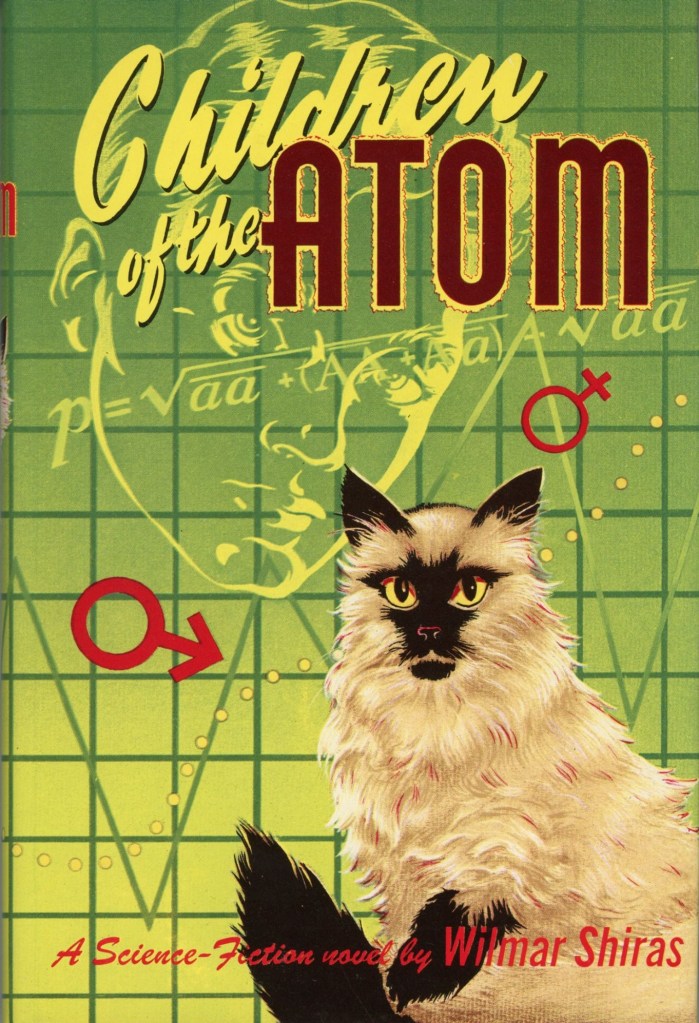
Frank Kelly Freas’ cover for the 1st edition of Children of the Atom (1953)
Wilmar H. Shiras (1908-1990) is best known for her short stories in the Children of the Atom sequence–starting with “In Hiding” (1948)–about hyper-intelligent mutant children and a well-meaning psychiatrist who brings them together. In 1953, she added two additional stories and expanded it into a novel. Here’s her bibliography and SF Encyclopedia entry. I’ve decided to read the three short stories published before the novelization. I might at some later point tackle the complete Children of the Atom (1953). I’ll also review the only other story she published before her brief 1970s comeback.
First, here’s a bit of historical context that helps place the Children of the Atom stories. In The Dragon’s Tail: Americans Face the Atomic Age(2013), Robert A. Jacobs analyzes radiation’s “paradoxical iconography” that dominated early Cold War media. Jacobs describes the paradox as follows: “its abstract nature (invisible, odorless, tasteless), when combined with its true dangers (genetic mutation, cancer, death), allows it to evoke impossible worlds emerging from the ordinary one” (12). In film and fiction, “radiation came to symbolize a break in the normal structure of everyday reality” (13). The mere reference to its presence served as a “narrative marker” to indicate that “from this moment on anything was possible” (13). Modern readers might scoff at a nuclear logic (if it’s described at all) more alchemical rather than scientific but it went with the territory. Think of the B-film with a Geiger counter ominously signally some gigantic mutant about to appear… No informational deluge required. The author’s certainty about the audiences’ terrified/fascinated uncertainty is enough to justify whatever transpires.
Shiras’ stories in the Children of the Atom sequence fit Jacobs’ formulation perfectly. She provides no explanation for the hyper-intelligent mutant children other than vague references to a nuclear accident and radiation exposure. I’m not entirely sure what to think of these short stories. She avoids many of the pitfalls of other mutant children tales (A. E. van Vogt’s Slan and John Wyndham’s The Chrysalids come to mind) by the inclusion of caring normal adults who empathize with them and attempt to provide them a better life. Ultimately, the historian in me kicks into gear–they are fascinating relics of the earliest Cold War years and that adds another level of appeal.
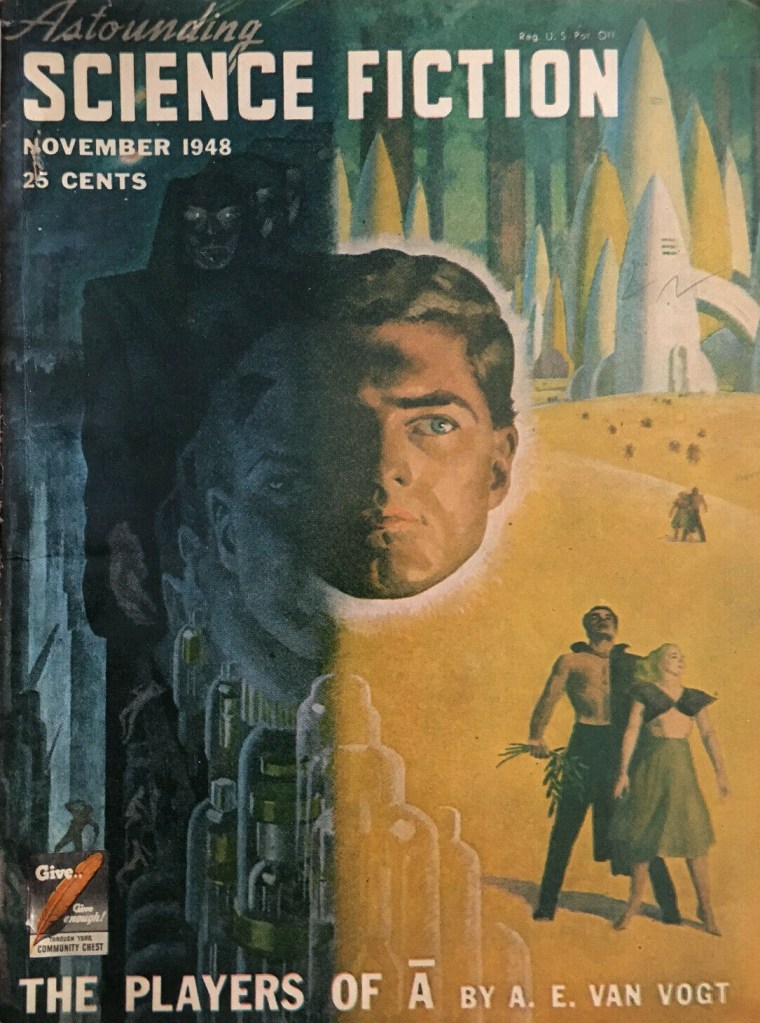
Hubert Roger’s cover for Astounding Science Fiction, ed. John W. Campbell, Jr. (November 1948)
3.75/5 (Good)
“In Hiding” (1948) first appeared in Astounding Science Fiction, ed. John W. Campbell, Jr. (November 1948). You can read it online here.
“In Hiding” introduces Peter Welles, a thoughtful psychiatrist, and Tim, a boy who seems different despite his average grades and normal child-like behavior. Tim is referred to Dr. Welles by his kind teacher Miss Page. Dr. Welles’ believes one should always trust a teacher, especially a veteran who taught him as a child (meaningful observations like this one add an air of realism to the proceedings), a proceeds with an array of tests. The results? Welles believes Tim is hiding something from his teachers and family. Over time, Tim opens up to Welles and grows to trust him. And the secret is immense…. Tim pretends to be normal as he is really a hyper-intelligent mutant created by a nuclear accident. And he’s far more than simply precocious–at reads all the books in the library, corresponds with luminaries across the globe, writes under various pseudonyms, and conducts cat breeding experiments in his own workshop.
Which books/covers/authors intrigue you? Which have you read? Disliked? Enjoyed?
1. The Darfsteller and Other Stories, Walter M. Miller, Jr. (1982)
Peter Jones’ cover for the 1st edition
From the back cover: “Walter M. Miller, Jr., wrote A CANTICLE FOR LEIBOWITZ, and changed the nature of science fiction, forever. Now, collected together for the first time are some of his most gripping masterpieces, including the Hugo Award-winning ‘The Darfsteller’ and ‘Crucifixius Etiam.'”
Today I’ve reviewed the eleventh story in my series on the science fictional media landscape of the future! Ann Warren Griffith spins a nightmarish dystopia where advertisements are illegal to block out.
Ed Emswhiller’s cover for the 1960 edition of The Best from Fantasy and Science Fiction, Third Series, ed. Anthony Boucher and J. Francis McComas (1954)
4/5 (Good)
Ann Warren Griffith’s “Captive Audience” (1953) first appeared in The Magazine of Fantasy and Science Fiction, ed. Anthony Boucher and J. Francis McComas (August 1953). You can read it online here.
In the 1950s, Americans depicted Communism as denying inherent human freedoms of choice and enslaving the mind. Over the course of the decade, the terror of Communist brainwashing collided with fears of the detrimental effects of consumer culture and advertising. Perhaps the evil Communist was so successful due to a new softness within the American family (Dunne, 123). Anne Warren Griffith’s “Captive Audience” imagines a dystopic future in which the American mind is turned into malleable putty by an entropic (and sonic) inundation of advertisements. According to the story’s relentless logic, the last bastions of independent thought will cease to exist in a capitalist world where the right of every product to receive “its share of the consumer dollar” is the only right that matters (57).
Which books/covers/authors intrigue you? Which have you read? Disliked? Enjoyed?
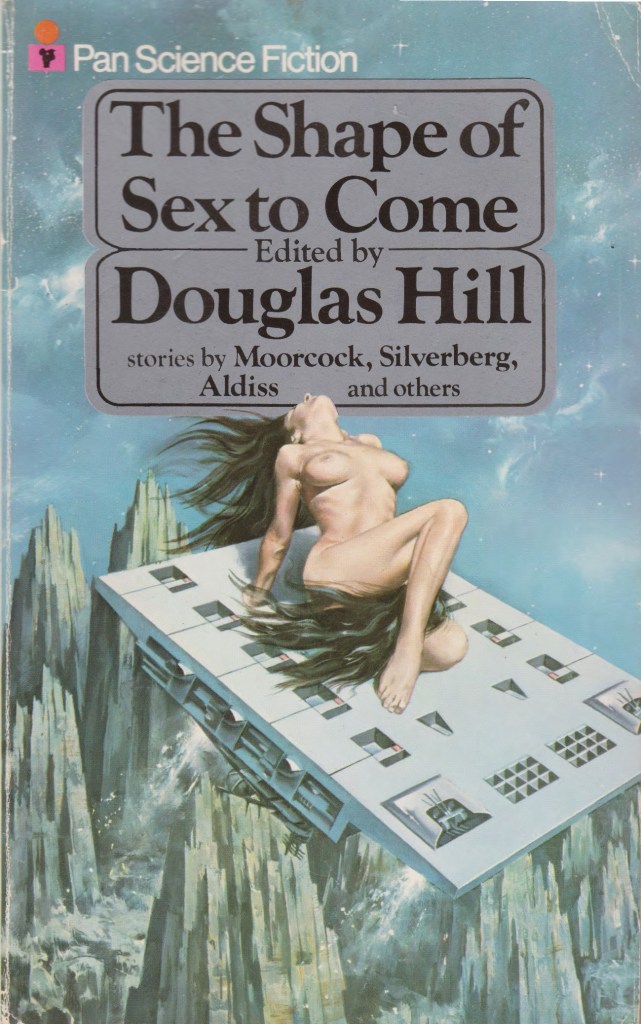
1. The Shape of Sex to Come, ed. Douglas Hill (1978)
Uncredited cover for the 1st edition
From the back cover: “Eight stories from SF names as highly-respected as Aldiss, Moorcock and Silverberg explore the strange and bizarre possibilities for sexuality in the furthest reaches of tomorrow.”
Contents: Robert Silverberg’s “In the Group” (1973), Thomas M. Disch’s “Planet of the Rapes” (1977), A. K. Jorgensson’s “Coming-of-Age Day” (1965), Anne McCaffrey’s “The Thorns of Barevi” (1970), Brian W. Aldiss’ “A One-Man Expedition Through Life” (1974), Brian W. Aldiss’ “The Taste of Shrapnel” (1974), Brian W. Aldiss’ “Forty Million Miles from the Nearest Blonde” (1974), Hilary Bailey’s “Sisters” (1976), John Sladek’s “Machine Screw” (1975), and Michael Moorcock’s “Pale Roses” (1974).
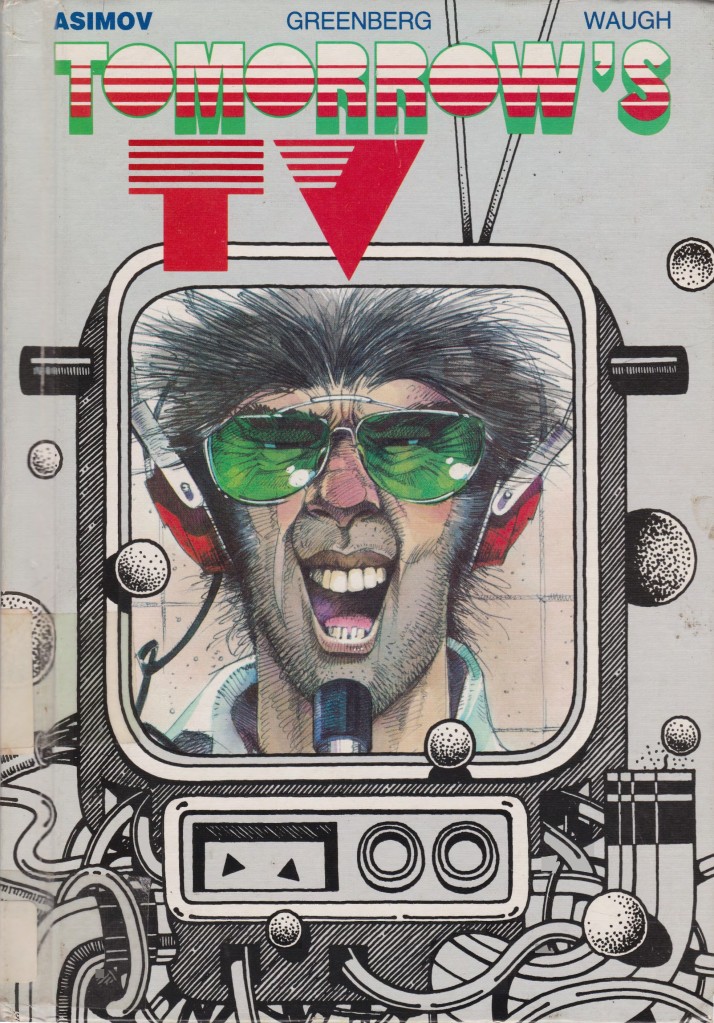
The seventh, eighth, ninth, and tenth stories in my series on the science fictional media landscape of the future appear in the anthology Tomorrow’s TV, ed. Isaac Asimov, Martin Harry Greenberg, and Charles Waugh (1982).
Tomorrow’s TV (1982) gathers together five short stories published between 1951 and 1979 on future speculations and disturbing manifestations of the tube of the future. The extensive number of TV-related science fiction from these decades (especially the 50s and early 60s) should not come as a surprise. According to Gary R. Edgerton’s magisterial monograph The Columbia History of American Television (2007), no “technology before TV every integrated faster into American life” (xi). Isaac Asimov speculates on the nature of education and the role of the “teacher” if every kid goes to school on their TV. Ray Bradbury imagines a frosty world where everyone turns inward towards the hypnotic glow of their TV sets. Robert Bloch explores the intersection of programming as escape and its collision with the real world. Ray Nelson narrates a hyperviolent expose of the alien entities behind subliminal messaging. And Jack Haldeman II imagines what will happen when the human mind reaches a moment of information overload.
The fifth and sixth story in my series on the science fictional media landscape of the future. Fritz Leiber imagines a sinister conjuration of the Girl behind the advertisement and a robot who wanders a post-nuclear landscape selling soda to the charred victims.
Previously: Brian W. Aldiss’ “Panel Game” (December 1955).
Next Up: Tomorrow’s TV (1982). Stories by Isaac Asimov, Jack C. Haldeman II, Ray Bradbury, Robert Bloch, and Ray Nelson.
Tony Roberts’ cover for the 1975 edition of The Secret Songs (1968)
4.5/5 (Very Good)
Fritz Leiber’s “The Girl with the Hungry Eyes” (1949) first appeared in The Girl with the Hungry Eyes, and Other Stories (1949). I read it in his collection The Secret Songs (1968). You can read it online here.
“The Girl with the Hungry Eyes” explores the post-WWII economic boom as television and rapidly growing suburbs expanded the reach and power of advertising. Cold War rhetoric promoted consumerism as a key component of the American Way of Life (source).
A tale of erotic obsession and terror, “The Girl with the Hungry Eyes” imagines a fantastical conjuration of the archetypal advertising Girl selling every conceivable product. Her face appears on billboards across the urban expanse. Her torso or limb holds the object to be marveled at. And her eyes, “the hungriest eyes in the world” (131), tear into the soul and take something away with their gaze. Fritz Leiber’s terrified narrator, the “poor damned photographer” (129)who unleashed her on the world and fell for her spell, confesses “there are vampires and vampires, and not all of them suck blood” (128).





 Science Fiction and Other Suspect Ruminations