Updates: Recent Science Fiction Acquisitions No. CCXXXIX (Jack Dann, Judith Merril, Anne McCaffrey, John Shirley)

1. I have yet to read any of Jack Dann’s SF — this surreal (?) post-apocalyptical novel looks promising! And a strange Jim Burns cover to boot…

2. I recently reviewed Judith Merril’s “Wish Upon a Star” (1958) for my generation ship short story read-through (i’ll have a new installment soon). I decided to track down another one of her short fiction collections….

I’ve reviewed the following collections so far:

3. The title of Anne McCaffrey’s collection Get Off the Unicorn (1977) was derived from a humorous misprint. According to the collection’s introduction: “The title was derived by accident: McCaffrey’s working title had been “Get of the Unicorn” but this was misprinted as “Get Off the Unicorn” in Ballantine’s roster of unfilled contracts. After McCaffrey’s editor, Judy-Lynn del Rey, was repeatedly asked what “Get Off the Unicorn” was, del Rey asked McCaffrey what she could do about that theme.”

The collection itself contains a wide-range of her short fictions—from the Pern sequence (a childhood favorite) to the earliest story in the Catteni Sequence. I DEVOURED Freedom’s Landing (1995), Freedom’s Choice (1997), Freedom’s Challenge (1998), and Freedom’s Randsom (2002) as a kid! How to survive and thrive on an alien planet was my “go-to” SF device.

4. I’ve only read a handful of John Shirley’s short stories. It’s time for a novel. Eclipse (1985), set in a future a cyberpunk dystopia, tells the tale of anti-fascist resistance. We shall see!

Let me know what you think of the books and covers in the comments!

1. The Man Who Melted, Jack Dann (1984)

(Jim Burns’ cover for the 1986 edition) Continue reading

Updates: Recent Science Fiction Acquisitions No. CCXXXVII (Rex Gordon, Craig Strete, Graham Dunstan Martin, and an Anthology of European SF)

Clifford D. Simak, Tanith Lee, and M. A. Foster reviews are incoming. The first few weeks of every semester hit with a vengeance—teaching is an exhausting profession.

In the meantime get inspired to read vintage SF by ogling these gems!

1. In my youth I was obsessed with Victorian/Belle Epoque survivalist novels–Jules Verne’s The Mysterious Island (1874), Perseverance Island Or the Robinson Crusoe Of The Nineteenth Century(1885), et al. I judged them on their “realistic” portrayals of how man (and yes, the characters were always men) moved up the technological tree—from fire to steam engines—in a hostile world. Although I’ve utterly disavowed SF that adheres to such  naive technological triumphalism, occasionally nostalgia calls…. Here’s a SF Robinsonade along similar lines.

2. I adore Craig’s Strete unique brand of SF story. I reviewed, in abbreviated form, his spectacular collection If All Else Fails…. (1980). I’ll read this one soon! The Bleeding Man and Other Science Fiction Stories is also a well-designed volume as elements of the cover art are used at the beginning of each short story.

3. Another unknown commodity—seems to combine SF and fantasy tropes.

4. Back in November I acquired the second in the Terra SF series of anthologies edited by Richard D. Nolane of Western European SF in translation. I pointed out that the first volume online was prohibitively expensive. A follower on twitter discovered that a seller on Amazon incorrectly listed the collection under another title—at a radically reduced price. Now it’s a happy member of my collection.

Let me know what you think of the books and covers in the comments!

~

1. First on Mars (variant title: No Man Friday), Rex Gordon (1956)

(Kelly Freas’ cover for the 1976 edition) Continue reading

Updates: My 2019 in Review (Best SF Novels, Best SF Short Fiction, and Bonus Categories)

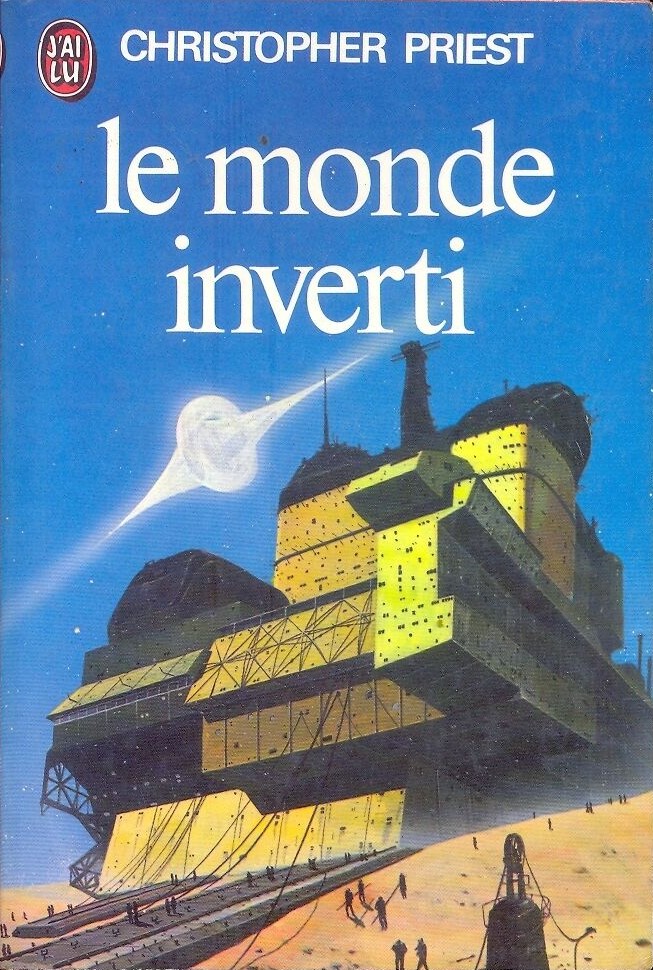
(Chis Foss’ cover for the 1976 French edition of The Inverted World (1974), Christopher Priest)

2019, the tenth year of my site, proved to be a renaissance of sorts. While I managed to read a lot in 2018, I wrote few posts—mostly acquisition and art posts (which take the least effort and time). I have returned, almost, to my earlier levels of productivity and I hope that continues into 2020. Thank you all for reading and commenting be it on the site or on twitter.  It’s greatly appreciated.

And here are my favorite novels and short stories I read in 2019 Continue reading

Updates: Recent Science Fiction Acquisitions No. CCXXXIV (Anne McCaffrey, Lester del Rey, Poul Anderson, and Philip Wylie)

1. In my youth Anne McCaffrey’s Pern novels received a privileged place on my shelf. I have yet to explore her other SF in any great detail. The Ship Who Sang (1969) is a fix-up novel of six earlier short fictions from the 60s. I’ve put this one near the top of my to-read list!

2. Another epic series of tales of space exploration from Poul Anderson! I hope it’s better than Tau Zero (1970).

3. A post-apocalyptical novel from Philip Wylie—14 survivors in the bomb shelter of a millionaire. Thoughts on this one?

4. I’ve never cared for Lester del Rey, The only work of his I’ve somewhat enjoyed was The Eleventh Commandment (1962, rev. 1970) as I’m a sucker for overpopulation-themed SF.

Let me know what you think of the books and covers in the comments!

~

1. The Ship Who Sang, Anne McCaffrey (1969) (MY REVIEW)

(Greg and Tim Hildebrandt’s cover for the 1976 edition) Continue reading

Book Review: The Space-Born, E. C. Tubb (1955)

(Ed Valigursky’s cover for the 1956 edition)

2.5/5 (Bad)

Almost the surprise of the year! E. C. Tubb’s The Space-Born (variant title: Star Ship) (1955) first appeared as a serial in New Worlds (April, May, and June 1955 issues). For American audiences, Tubb’s novel was paired with Philip K. Dick’s The Man Who Japed (1956) as an Ace Double. My only previous exposure to the prolific British author’s SF was “The Seekers” (1965), a paranoid vision of spacemen possessed by delusions of grandeur after their captain’s death. The Space-Born is a fascinating generation ship novel with a catastrophic Continue reading

Generation Ship Short Story Review: Judith Merril’s “Wish Upon A Star” (1958)

Preliminary note: This is the third post in a series of vintage generation ship short fiction reviews. All of the stories I’ll review are available online. You are welcome to read and discuss along with me as I explore humanity’s visions of generational voyage. And thanks go out to all who have joined already!

Previously: Clifford D. Simak’s “Spacebred Generations” (variant title: “Target Generation”) (1953).

Next up: John Brunner’s “Lungfish” (1957)

I’ve compiled a helpful list on the theme.

(Ed Emshwiller’s cover for the December 1958 issue of The Magazine of Fantasy and Science Fiction, ed. Robert P. Mills)

4.25/5 (Good)

In Judith Merril’s “Daughters of Earth” (1952), she refashions the classic pulp SF tale of male exploration of the galaxy by tracing, in biblical fashion, one family of female explorers. In “Wish Upon A Star” (1958), Merril reworks another trope—the male hero on a generation ship who discovers the true Continue reading

Generation Ship Short Story Review: Clifford D. Simak’s “Spacebred Generations” (variant title: “Target Generation”) (1953)

Preliminary note: This is the second post in a series of vintage generation ship short fiction reviews. You are welcome to read and discuss along with me–all of the stories I’ll review will be available online–as I explore humanity’s visions of generational voyage!

Previously: Chad Oliver’s fantastic “The Wind Blows Free” (1957).

Next up: Judith Merril’s “Wish Upon a Star” (1958).

I’ve compiled a helpful list on the theme.

(Tom O’Reilly’s interior art for the Science-Fiction Plus, August 1953)

3.5/5 (Good)

Clifford D. Simak’s “Spacebred Generations” (variant title: “Target Generation”) appeared in the August 1953 issue of Science-Fiction Plus, ed. Hugo Gernsback (Internet Archive link). The story is lavishly illustrated with evocative art by Tom O’Reilly. The story itself posits that religion is required to satiate the Continue reading

Generation Spaceship Short Story Review: Chad Oliver’s “The Wind Blows Free” (1957)

Initial note: This is the inaugural post in a series of vintage generation ship short fiction reviews. You are welcome to read and discuss along with me–all of the stories I’ll review will be available online–as I explore humanity’s visions of generational voyage!

Next up: Clifford D. Simak’s “Spacebred Generations” (variant title: “Target Generation”) (1953).

I’ve compiled a helpful list on the theme.

(Bob Layzell’s cover for the 1980 edition of A Sea of Space (1970), ed. William F. Nolan)

4.5/5 (Very Good)

Chad Oliver’s “The Wind Blows Free” (1957) first appeared in the July 1957 issue of The Magazine of Fantasy and Science Fiction, ed. Anthony Boucher (Internet Archive link). Despite the simple premise, Oliver’s powerful delivery and imagery reaffirmed my love for generation ship stories and their common tropes: generational change, the science of survival, the architecture of arks Continue reading

Updates: Recent Science Fiction Acquisitions No. CCXXXI (Sheri S. Tepper + Paul H. Cook + Robert Merle + Anthology)

1. I bought this themeless hodgepodge anthology for two reasons–the UK 1980 edition has a cool spaceship! And second, it contains Chad Oliver’s generation ship short story “The Wind Blows Free” (1957). MPorcius calls it one of Oliver’s best. As I’ve not been enamored with his brand of SF, I’m eager to try a short story on a favorite theme far outside of his normal anthropological-focused oeuvre.

I’ve previously reviewed Oliver’s The Shores of Another Sea (1971).

2. Sheri S. Tepper is a glaring hole in my SF knowledge. I often explore the back catalog before plunging into the best known novels of an author—The Revenants, her first published novel, is “a long, complex work of SF” according to SF Encyclopedia. I wish it would be a tad more descriptive…. the novel has a fun map which I’ll feature in a Monday Maps and Diagrams post.

3. French post-apocalyptic SF in translation! With an awful cover…

4. Paul Cook is another unknown author to me. His first novel, Tintangel (1981) has a bizarre premise (see blurb below). This might be my next SF read.

Let me know what books/covers intrigue you. Which have you read? Disliked? Enjoyed?

~

1. A Sea of Space, ed. William F. Nolan (1970)

(Bob Layzell’s cover for the 1980 edition) Continue reading