Short Story Review: Mari Wolf’s “The Statue” (1953)

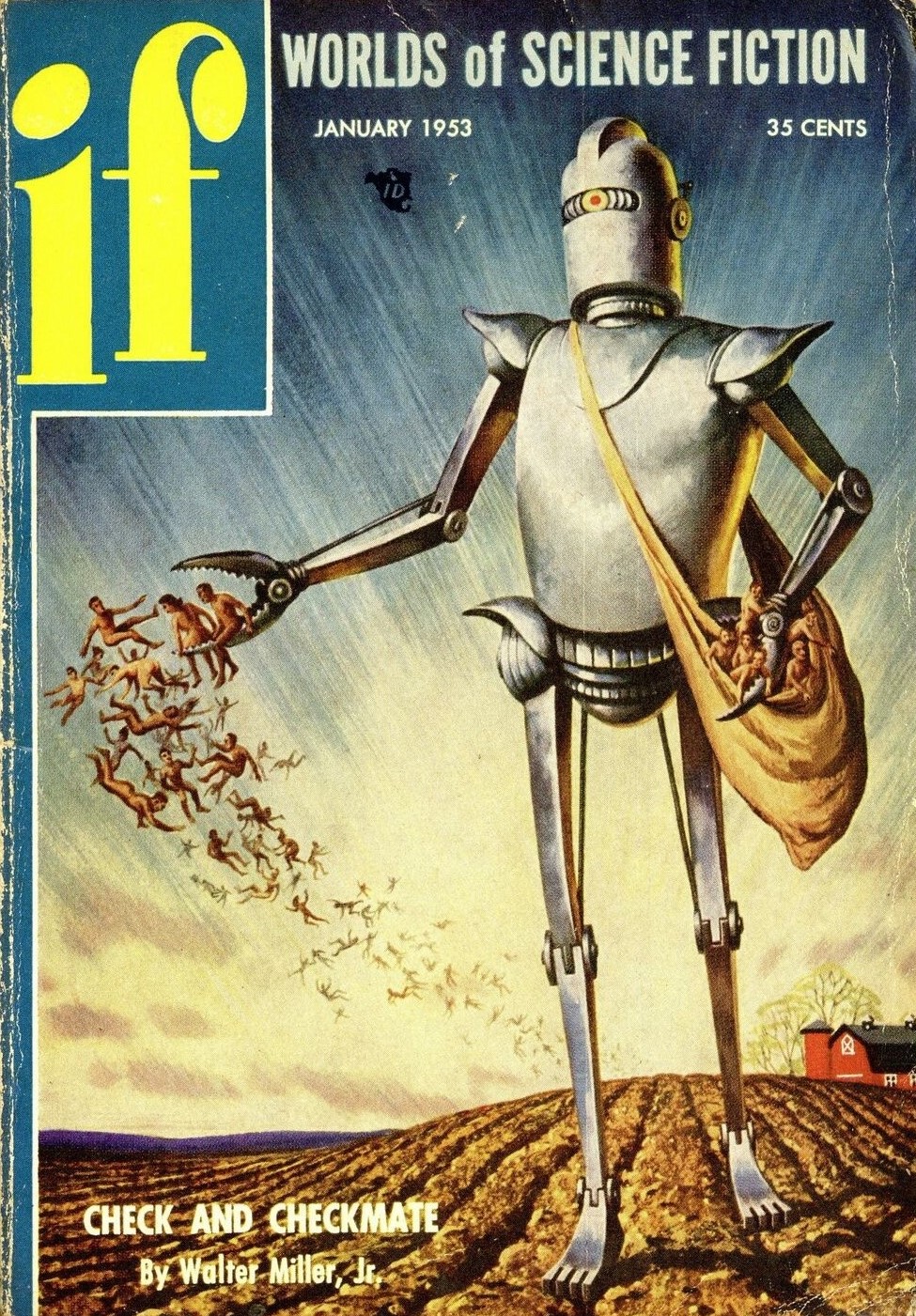
Anton Kurka’s cover for the January 1953 issue

I thought Mari Wolf’s “The Statue” (1953), a rumination on mortality, might find a home in my series on SF stories that are critical in some capacity of space agencies, astronauts, and the culture which produced them. However, due to its overall positivism–despite the blue-collar grit and focus on death–it didn’t fit. I would like to thank “Friend of the Site” Mark Louis Baumgart (see comments) for pointing me towards a new author!


Mari Wolf (1927-), best known for her contributions to fandom including the Fandora’s Box column (1951-1956) in Imagination, published seven short stories between 1952 and 1954, six of which appeared in If. Unfortunately, after her divorce in 1955 from fellow SF author Rog Phillips (1909-1966), she stopped publishing SF. Here is a brief bibliographic blurb on her life, career, and SF endeavors. Ted White Continue reading

Short Story Review: Walter M. Miller, Jr.’s “Death of a Spaceman” (variant title: “Memento Homo”) (1954)

This is the first post in a loose series on SF short stories I’ll be reviewing that are critical in some capacity of space agencies, astronauts, and the culture which produced them.

If you know any stories that might fall into this category published before 1980, let me know in the comments! I have compiled an extensive list (from Barry N. Malzberg to John Sladek) but my encyclopedic tendencies are mere delusions of completeness…

Up next: Edmond Hamilton’s “What’s It Like Out There?” (1952).


Amazing Stories, March 1954

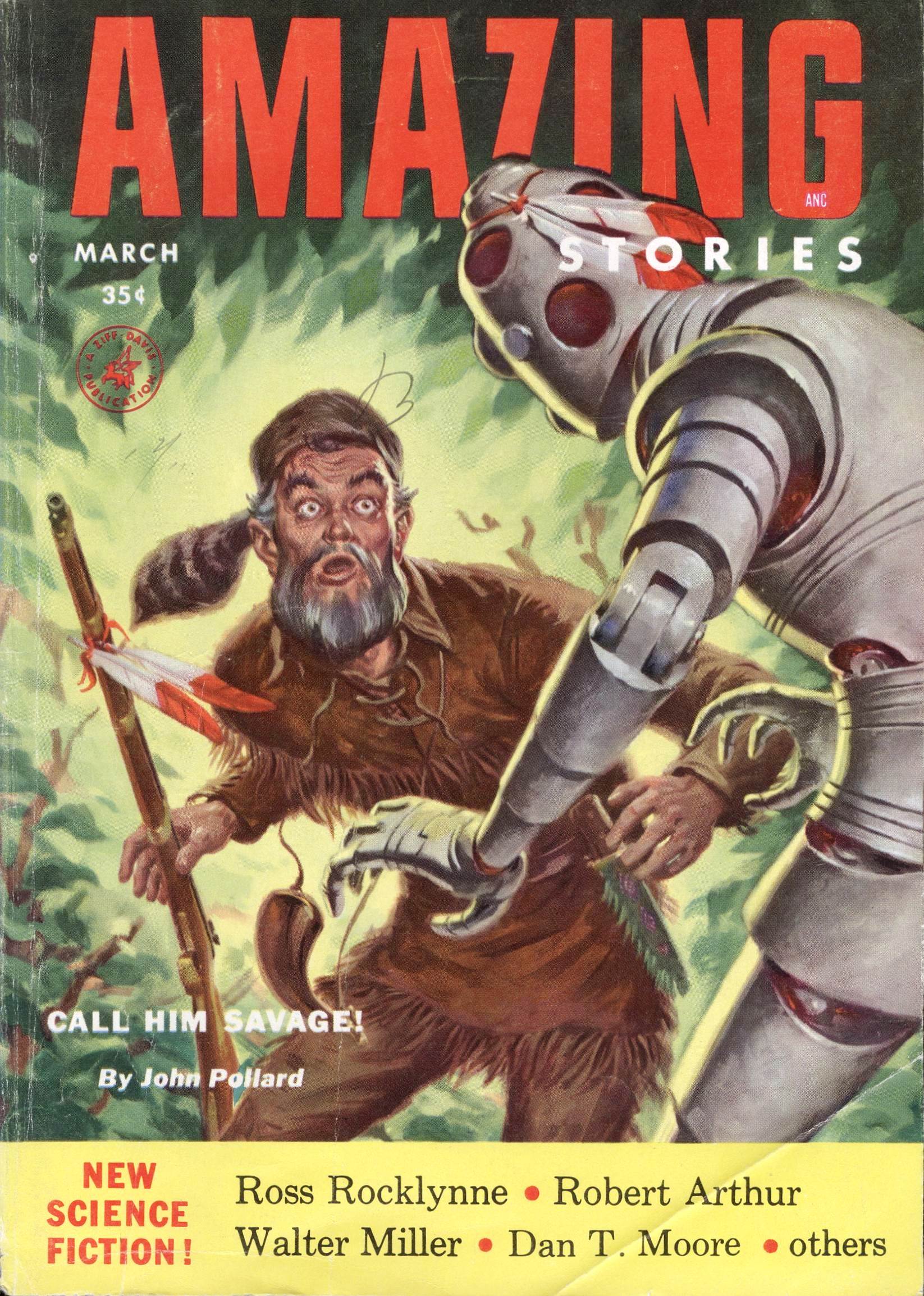
Clarence Doore’s cover for the March 1954 issue

5/5 (Masterpiece)

Walter M. Miller, Jr. (1923-1996), best known for his Hugo-winning fix-up novel A Canticle for Leibowitz (1959), wrote a fascinating range of short fictions between 1951-1957. I’ve previously reviewed a handful in The View From the Stars (1965). However, “Death of a Spaceman” (1954), a complex exploration of death and the delusions we tell ourselves and ones we love, might be the best of his I’ve Continue reading

Updates: Recent Science Fiction Purchases No. CCLXIII (Elizabeth A. Lynn, Romanian SF Anthology, Eastern European SF Anthology, and Barry N. Malzberg)

As always which books/covers/authors intrigue you? Which have you read? Disliked? Enjoyed?

1. Other Worlds, Other Seas, ed. Darko Suvin (1970)

Paul Lehr’s cover for the 1972 edition

From the back cover: “Darko Suvin was born in Zagreb, Yugoslavia in 1930. An internationally known critic of literature and theater, he is the author of seven books of criticism including POSSIBLE WORLDS—An outline of Science-Fiction and Utopias.

Stanislaw Lem of Poland, author of SOLARIS, is only the most famous of a burgeoning group of Eastern European writers. His contribution to OTHER WORLDS, OTHER SEAS—four brilliant stories—is a treat to his hundreds of thousands of American admirers. But a whole body of first rate s-f is now being produced in the socialist countries by equally gifted writers such as Josef Nesvadba, Anatoliy Dneprov, and Anton Continue reading

Book Review: S.O.S. From Three Worlds, Murray Leinster (1967)

Jack Gaughan’s cover for the 1st edition

4/5 (collated rating: Good)

In times of stress, positivist stories about spacemen devoted to selfless service solving medical crises with their friendly tormals (think furry mobile petri dishes) bring a bit of warmth to my bitter heart. While a medical mystery to be solved with logic and resolve forms the core of each story, Murray Leinster hints at the future history of this decentralized spacescape–a product of chaotic often business-driven expansion.  As limited contact exists between distant colonies, The Interstellar Continue reading

Updates: Recent Science Fiction Purchases No. CCLXI (Algis Budrys, Gwyneth Jones, Russell M. Griffin, Dino Buzzati)

As always, which books/covers/authors intrigue you? Which have you read? Disliked? Enjoyed?

1. Some Will Not Die, Algis Budrys (1961, rev. 1978)

Frank Kelly Freas’ cover for the 1978 edition

My 1978 revised edition contains no inside flap or back cover blurb. Instead, here’s the brief description of the novel and its complex publication history from SF Encyclopedia: “Budrys’ first novel has a complex history. As False Night (March 1954 Galaxy as “Ironclad”; much exp. 1954) it was published in a form abridged from the manuscript version; this manuscript served as the basis for a reinstated text which, with additional new material, was published as Some Will Not Die (1961; rev 1978). In both versions a Post-Holocaust story is set in a plague-decimated Continue reading

Updates: Recent Science Fiction Purchases No. CCLIV (Melissa Scott, Murray Leinster, Ian MacMillan, Dick Morland)

As always which books/covers/authors intrigue you? Which have you read? Disliked? Enjoyed?

1. Blakely’s Ark, Ian MacMillan (1981)

Tom Hallman’s cover for the 1st edition

From the back cover: THE CEPH… A parasitic virus. Invariably lethal. In two generations, it had reduced the population of America to 10 million people.

New Jersey is populated by roving gangs of children, savage and insane. New York City is a sealed-off Dome.

America is a wasteland. And Dave Blakely just may be the last whole man in the world.”

Initial Thoughts: I’ve been in a post-apocalyptic mood for the last year or more. I’ve started (and much to my surprise, enjoyed) my watch through of Survivors (1975-1977). And devoured Leigh Brackett’s The Long Tomorrow (1955).

This is Ian MacMillan’s only SF novel. And SF Encyclopedia describes rather than appraises it… As I often Continue reading

Book Review: Doctor to the Stars, Murray Leinster (1964)

John Schoenherr’s cover for the 1964 edition

3.25/5 (Collated rating: Vaguely Good)

I am fascinated by medical-themed science fiction. While my tendencies gravitate towards  the more meta-fictional/experimental takes of this theme, for example William Kotzwinkle’s Doctor Rat (1976) and Elizabeth Baines’ The Birth Machine (1983), I wanted expand my horizons by reading earlier incarnations of the subgenre.

Murray Leinster’s Doctor to the Stars (1964) gathers three stories published in the late 50s and early 60s in the Med Series sequence. As a whole, the stories are positivist, pro-peace, anti-big business, pro-science, and pro-service. Our hero Calhoun, Continue reading

Updates: Recent Science Fiction Purchases No. CCLII (James White, Patricia A. McKillip, John Maddox Roberts, and an Original Anthology)

As always which books/covers intrigue you? Which have you read? Disliked? Enjoyed?

1. Fool’s Run, Patricia A. McKillip (1987)

Michael Whelan’s cover for the 1988 edition

From the back cover: “Terra Viridian is a young woman who obeyed a vision, took a laser assault rifle, and turned fifteen hundred innocents into light. She was captured, convicted, and sentences to the orbital prison called the Underworld. Forever.

Seven years later: a bar-band pianists Continue reading

Book Review: The Long Tomorrow, Leigh Brackett (1955)

(Darrell K. Sweet’s cover for the 1974 edition)

4.5/5 (Very Good)

“No city, no town, no community of more than one thousand people or two hundred buildings to the square mile shall be built or permitted to exist anywhere in the United States of America” (Thirtieth Amendment of the United States Constitution) (1)

Nominated for the 1956 Hugo Award for Best Novel. Leigh Brackett’s The Long Tomorrow (1955) not only clocks in as the best of her work I’ve read so far but also joins my pantheon of favorite 50s SF visions (*).  At first glance Brackett’s novel appears to traverse standard SF juvenile territory where a teenage boy, in a religiously and socially oppressive society, encounters an object  and memories of the past that opens up a path to self-discovery. But memories are memories. And dreams are Continue reading