Updates: Recent Science Fiction Acquisitions No. LXXXV (Fowler + Bishop + Brunner + Blish)

Dallas Part V (and some older finds) (Part IV, Part III, Part II, Part I)!

Love Brunner, want his short stories, enough said….

Also, I have a love hate relationship with Blish (love his “hard” SF and dislike his juveniles of which he wrote a many and often in a “hard” SF series)—The Frozen Year (1957) supposedly is his attempt at a “realistic” SF novel.  I’ll just have to see…  I feel weirdly compelled to read it.

As for the Karen Joy Fowler collection—yes, she wrote in the 80s!—the book sorters at the Half Price Books failed to realized that it was a signed copy!  So for a mere dollar I now have only my second signed SF work after D. G. Compton’s Scudder’s Game (1988).  As people have probably realized, I completely eschew conventions and have little connection with fandom and thus do not go out of my way to procure signed editions…

Michael Bishp=one of my new favorite authors (after reading Beneath the Shattered Moons and A Funeral for the Eyes of Fire).  Hence, Catacomb Years (1979) is a welcome addition to my collection.

Thoughts?

1. No Future in It, John Brunner (1962)

(Uncredited cover for the 1965 edition) Continue reading

Updates: Year in Review (Top Ten SF Novels + Top Ten Short Stories/Novelettes/Novellas + other categories)

Everyone likes lists!  And I do too….  This is an opportunity to collate some of my favorite (and least favorite) novels and shorter SF works I read this year.  Last year I discovered Barry N. Malzberg and this year I was seduced by…. Well, read and find out.


Top Ten Novels

1. We Who Are About To…, Joanna Russ (1976): A scathing, and underread, literary SF novel by one of the more important feminist SF writers of the 70s (of The Female Man fame).

2. A Funeral for the Eyes of Fire, Michael Bishop (1975): A well-written anthropological clash of cultures novel.  Slow, gorgeous, emotionally engaging….

3. Level 7, Mordecai Roshwald (1959): A strange satire of the bomb shelter…  Everyday surrealism. Continue reading

Updates: Recent Science Fiction Acquisitions No. LXXXI (Vinge + Gerrold + Zelazny + White)

Part 1 of many: Half Price Books in Dallas, TX (the second best bookstore, after Dawn Treader Books in Ann Arbor, MI for SF I have ever come across).  Gift card courtesy of fiancé’s mother = LOTS OF SCIENCE FICTION.  There could not be a better gift….

Everyone reads Robert Zelazny’s This Immortal (1966) and Lord of Light (1967), but who has read Isle of the Dead (1969)?  Thematically it seems similar to Lord of Light…  I have high hopes.  James White’s SF is always above average — and a fund cover from Dean Ellis makes that an auto-buy.  Although I disliked David Gerrold’s Space Skimmer (1972) my father swears Yesterday’s Children (1972) is somewhat readable.

I enjoyed Joan D. Vinge’s The Summer Queen (1980), tolerated her first novel The Outcasts of Heaven Belt (1978), so I suspect her two novella collection Fireship (1978) will be worthwhile…

Thoughts?

1. Isle of the Dead, Robert Zelazny (1969)

(Leo and Dianne Dillon’s cover for the 1969 edition) Continue reading

Book Review: Immortality, Inc. (variant title: Time Killer), Robert Sheckley (1958)

(Uncredited cover for the 1959 edition)

3.75/5 (Good)

Nominated for the 1959 Hugo Award for Best Novel

Robert Sheckley’s first novel Immortality, Inc. (variant title: Time Killer) (1958) has a somewhat checkered publication history.  It was originally published by Avalon books under the title Immortality Delivered (1958) where it was abridged against Sheckley’s wishes.  Unless you are a collector of the Avalon publication series I recommend procuring the complete 1959 Bantam Book edition with its gorgeous (and alas, uncredited) cover.  Later editions were decked with rather unfortunate covers linking the book to the atrocious film Freejack (1992) (replete with Mick Jagger) which was supposedly influenced by Sheckley’s novel.

Thematically, Immortality, Inc concerns the societal ramifications of the important discovery that death is not the end of existence and nor does the Christian conception of the afterlife Continue reading

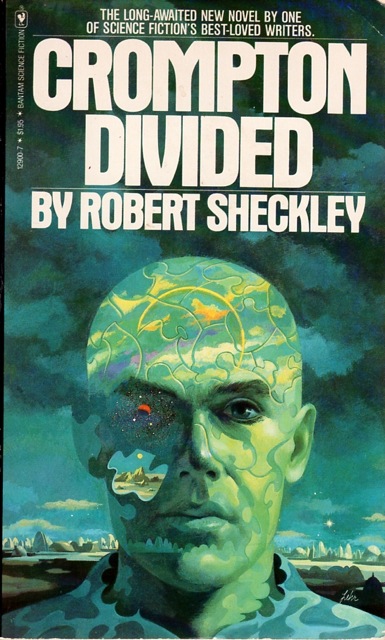
Adventures in Science Fiction Cover Art: Fractured Bodies (unraveling, decaying, [de]constructing)

CRMPTNDVDD1979

(Paul Lehr’s cover for the 1979 edition of Crompton Divided (variant title: The Alchemical Marriage of Alistair Crompton) (1978), Robert Sheckley)

Paul Lehr’s cover for the 1979 edition of Robert Sheckley’s Crompton Divided (1978) was the inspiration for this post.  I found the cover many years ago while looking through Lehr’s entire (mostly brilliant catalogue) and was intrigued.  The man, comprised of puzzle-like pieces that slowly morph into the swirls of his clothes, stares at us with hybridized eyes — a planet, a pupil — while one missing puzzle piece allows the viewer a glimpse of a barren landscape.  His brain, entirely a puzzle, is complete, but are his senses crumbling?

 Dean Ellis’ cover for the 1971 edition of Larry Niven’s collection All the Myriad Ways (1971) is even more fantastic — the puzzle pieces (bones, faces, limbs) dangle in the air Continue reading

Book Review: Xenogenesis, Miriam Allen deFord (1969)

(Richard Powers’ cover for the 1969 edition — there is some speculation that it might be a collaboration with Leo and Diane Dillon)

3.5/5 (Collated rating: Good)

Miriam Allen deFord—one of the more prolific SF short story authors of the 50s-70s whose works appeared in The Magazine of Fantasy and Science Fiction, If, Fantastic Universe, Galaxy, Worlds of Tomorrow, etc—deserves a Gollancz Masterworks volume.  But, as Ian Sales has pointed out so forcefully in his recent article (here), despite the number of prolific women SF authors in the 50s-70s they were rarely republished and are perhaps the least read group of SF authors for modern audiences.  There are some exceptions but few readers can name a women author pre-Ursula Le Guin.  deFord’s shorts were collected in only two volumes, Xenogenesis (1969) and Elsewhere, Elsewhen, Elsehow (1971) and both print runs were limited to the first year of publication.

Informed by her feminist activism (she was an important campaigner for birth control) and her earlier career in the newspapers, deFord’s stories tackle themes such as overpopulation, racism, colonialism, gender issues, sexism, and alienation.  Her works range from deceptively simple allegories to future histories vast in scope and complexity (for short stories).  Her female characters are almost all individualistic, resourceful, and highly educated–they often struggle against increasingly regimented/mechanized/homogenized societies in order to raise families in addition to their careers.  In short, deFord advocates forcefully the right to self-determination Continue reading

Updates (New Resource): List of Immortality Themed SF (a call to contribute!)

This post is a call for readers to submit their favorite immortality themed science fiction NOT included on my list below (and even examples they did not care for so I can make this a more substantial resource).  I’ll make a page with all the information I receive for easy consultation soon (INDEX of similar pages/articles).

A while back I started gathering a list of titles — via SF Encyclopedia, other online resources, and my own shelves — on immortality themed SF.  I have always been intrigued by the social space (one plagued by violence and despair or buoyed by the hope of a better future) that the possibility of immortality might generate.

I would argue that the single best example of social effects that the possibility of immortality might create is Clifford D. Simak’s Why Call Them Back From Heaven? (1967).  In similar fashion, James Gunn’s The Immortals (1962) takes place in a world where immortals do exist, they skirt Continue reading

Book Review: A Way Home, Theodore Sturgeon (1956)

(Mel Hunter’s cover for the 1956 edition)

3/5 (collated rating: Average)

Although Theodore Sturgeon is generally considered a master of the SF short form, his collection A Way Home (1956) contains only two worthwhile stories — “Thunder and Roses” (1947) and “Bulkhead” (1955).  The rest I was either unable to finish or struggled to muddle through over the course of the last two or so weeks.  Fortunately,  the near masterpiece “Bulkhead” was almost worth the pain induced by the intelligent dog related subgenre of SF manifest in “Tiny and the Monster” (1947) or the cute accidentally destructive hurkle kittens of “The Hurkle Is a Happy Beast” (1949).

At this stage in my recent endeavor to brush up on the best of the 50s short story wordsmiths, I place Sturgeon below Robert Sheckley, Brian Aldiss, Philip K. Dick, Fritz Leiber, Miriam Allen deFord, Lester del Rey, Walter M. Miller, Jr., C. M. Kornbluth, and Frederik Pohl. (shocking to some, I know!).

However, before I make a more definitive conclusion I call on my readers to list what you consider his best short work Continue reading

Adventures in Science Fiction Cover Art: Diagrammatic Wonders (alien sand art + planning invasions + and other more mysterious formulations), Part I

1-1957_04_fantasticuniverse_finlay

(Virgil Finlay’s cover for the April 1957 issue of Fantastic Universe, ed. Hans Stefan Santesson)

At first glance this is a miscellaneous collection of covers on diagrammatic wonders — the aliens (or “advanced” humans) on Virgil Finlay’s cover for the April 1957 issue of Fantastic Universe conjure an image of earth with colored sand, generals plot invasions via maps and other diagrams depicting troop movements….

While some of the covers are themselves diagrams (Christopher Zacharow’s cover for the 1985 edition of Ancient of Days (1985), Michael Bishop) others place their characters in opposition to each other as pieces Continue reading