Desperate for something unlike any other New Wave SF experiment, I came across Richard Brautigan’s surreal post-catastrophe novel In Watermelon Sugar (1968). Brautigan, best known as a Counterculture poet and the author of Trout Fishing in America (1967), spins a poetic thread simultaneously elegiac and nightmarish. More a sequence of short linked scenes, In Watermelon Sugar charts the memories of a nameless narrator (N) attempting to write a book about the community and inhabitants of iDEATH. Brautigan juxtaposes the terrifying calamities of N’s past–including his memories of his parents consumed before his eyes by the human-like Tigers and the violent rhetoric and self-immolation of inBOIL–with N’s tender memories of his blossoming love for Pauline.
As always, which books/covers/authors intrigue you? Which have you read? Disliked? Enjoyed?
1. Strength of Stones, Greg Bear (1981)
John Harris’ cover for the 1st edition
From the back cover: “Ages ago this world was named God-Does-Battle. No one remembers wh. It was colonized in the most up-to-date way possible, supplied with the best Cities ever built by Robert Kahn. Huge laboratories labored for decades to produce the right combinations of plant, animal, and machine, and to fit them into the right design. The result was magnificent; living Cities, able to regenerate broken parts, to produce food on demand, and medicine, and clothing. so careful, so advanced was Robert Kahn that he even built into his Cities the ability to protect their inhabitants; to sense the presence of the occasional person whose potential for violence or cruelty made him a threat to society, to remove him from the City, and to erect walls of needle-sharp crystal to be sure he did not return.
It’s time for the fifth post in my series exploring Carol Emshwiller’s science fiction and fantasy–published between 1955-1979 in genre magazines–in chronological order. And if you missed earlier installments, check out Part I, II, III, and IV.
We have a beach vacation in the post-apocalypse, a gorgeous fable of a housewife struggling to chart her path, and the travails of a crashed astronaut and his cat on a planet of religious fanatics. In this installment, I wrap up her stories published in the 1950s and move into the 1960s. Emshwiller published only 12 stories in the 1960s with a publication gap between 1961-1966 while she managed 13 between 1955-1959. In the previous post, Rich Horton and Expendable Mudge speculated that it was due to the birth of her son in 1959.
I’ve listed by rating all of her 50s stories. If you’d like me to write up my thoughts overall on her 50s visions in a more analytical manner (a short essay?), let me know in the comments.
Ed Emshwiller’s cover depicting his wife’s story in The Magazine of Fantasy and Science Fiction (August 1959)
“Day at the Beach” in The Magazine of Fantasy and Science Fiction (August 1959), ed. Robert P. Mills. 4.5/5 (Very Good). You can read it online here. Like “Pelt” (1958), this wonderful story has been frequently anthologized. I read it in The Year’s Best S-F: 5th Annual edition (1960), ed. Judith Merril. At first glance “Day at the Beach” reaffirms the power of family in the face of a cataclysmic event as a mother and father slowly accept changes brought on by atomic mutation. Or, there’s a more sinister reading where the family unit creates a delusional bubble that obfuscates the real horror outside (and inside) their home.
Virgil Finlay’s interior art for Raymond F. Jones’ “The Memory of Mars” in Amazing Stories (December 1961)
3.5/5 (Good)
Before Philip K. Dick’s “We Can Remember It for You Wholesale” (1966), Raymond F. Jones wrote the far lesser known “The Memory of Mars” (1961)–his own paranoid thriller about a vacation to Mars that might not have happened exactly as remembered. This is a plot-driven story. There are multiple twists and delusional layers that unfold at lightning speed–some more satisfying than others. You might want to read the story in the December 1961 issue of Amazing Stories, ed. Cele Goldsmith first.
“The Memory of Mars” has all the pieces of a paranoid masterpiece. A journalist named Mel Hastings, trained to be objective, waits for his wife Alice to be released from surgery. As he waits anxiously for news knowing that something has gone wrong, he recalls his wife’s persistent claim that they had gone on a vacation to Mars the first year of their marriage. The simmering terror of his own phobia of space and recurrent nightmares of being chased across the black void suggest there’s more than he remembers. Mel’s called into the surgery room with disturbing news. His wife is dead and something is terribly wrong with her viscera. Vigil Finlay’s top-notch interior art (above) hints at the terror that unfolds as Alice’s inhuman interior is laid bare….
As always, which books/covers/authors intrigue you? Which have you read? Disliked? Enjoyed?
1. Dawn, Octavia E. Butler (1987)
Enric’s cover for the 1st edition
From the back cover: “XENOGENESIS: The birth of something new—and foreign.
Lilith Iyapo awoke from a centuries-long sleep—and found herself aboard the vast living spaceship of the Oankali. Alien creatures covered in writhing tentacles, the Oankali had saved every surviving human from a dying, ruined Earth. They healed the planet, cured cancer, increased human strength and disease resistance, and were now ready to help Lilith lead her people back to Earth.
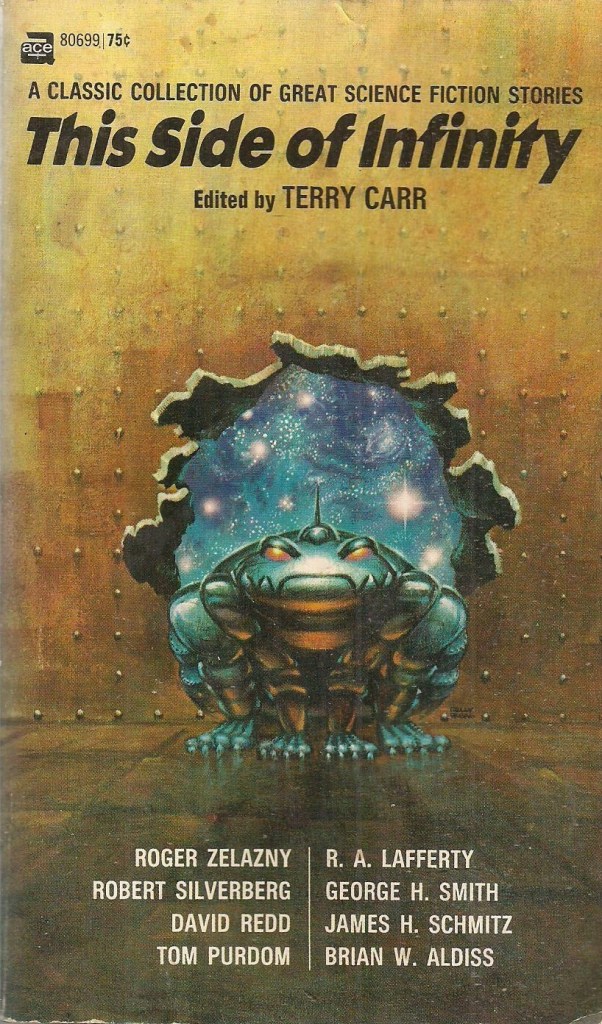
Soldiers in mech armor plagued by existential crisis. Asexual insectoid aliens pretending to be human. Children wielding pet apes as weapons. This Side of Infinity, ed. Terry Carr (1972) gathers eight kaleidoscopic visions from stalwarts (Roger Zelazny and Robert Silverberg) to lesser known authors (David Redd and George H. Smith). As a collated whole, this is a solid collection without a defining standout masterpiece but worth acquiring for the sheer variety and hallucinatory power of it all.
Cover for Galassia #122 (1970). Contains Samuel R. Delany’s The Ballad of Beta-2 (1965) and three short stories by Italian authors (Sergio Ostuni, Ivo Silvestri, and Lorenzo Iacobellis)
Italian artist, author, translator, and comic book critic Ferruccio Alessandri (1935-) created twenty-two covers for the Italian SF magazine Galassia (most of the issues between #109-132) in 1970. Galassia magazine was instrumental in introducing Italian audiences to the New Wave movement. Issues often contained both translations of popular English language authors and original Italian short stories and experimental visions.
As a unit, Alessandri’s covers convey a terrifying hellscape of insectoid visages (#122, #110, #128, #130), encounters with the surreal (#115), the oddly humanoid shapes (#119, #114, #116, #127), etc. Like searing flashes of a planet bathed under neon light, they are micro windows into the wonderscape of science fiction. While his Galassia covers are unconnected to the contents of the issues (to the best of my knowledge), I find their cumulative effect unsettling and alien.
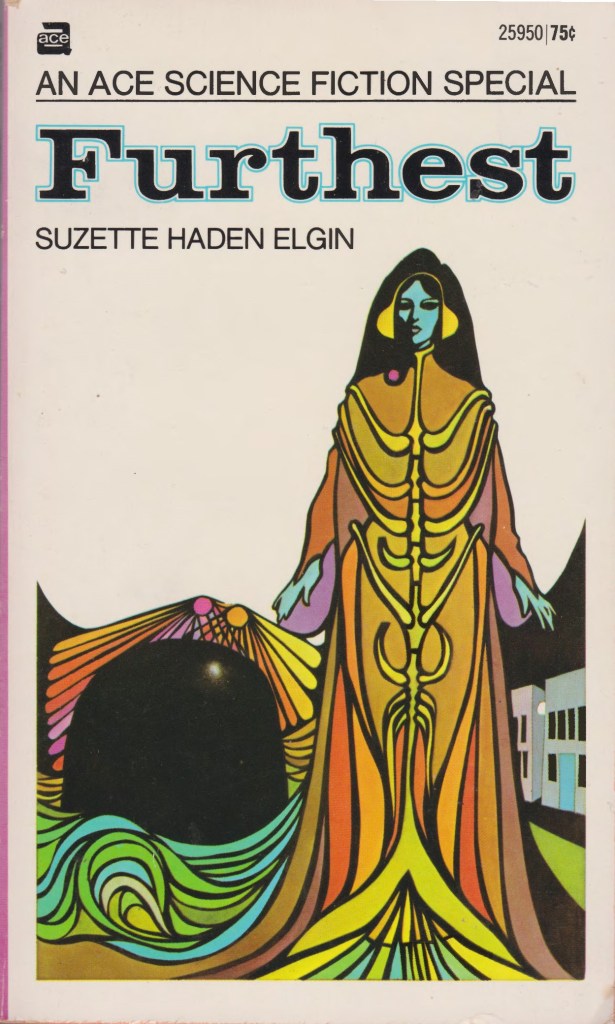
From the back cover: “Coyote Jones, agent for the Tri-Galactic Intelligence Service, had been sent to a planet so unimaginably distant from the rest of the Federation that it bore the descriptive name Furthest. His mission: to find out why the total body of data about Furthest showed the world’s inhabitants to be absolutely average down to the last decimal place. That data had to be false.
Jones was permitted to live on the planet, but the natives were so wary of him that he could uncover nothing—until he chanced into a personal crisis faced by his young Furthest assistant. The boy’s sister had been sentenced to Erasure, and he wanted Coyote Jones to take the fugitive girl in and hide her.
The following review is the 14th installment of my series searching for “SF short stories that are critical in some capacity of space agencies, astronauts, and the culture which produced them.” Some stories I’ll review in this series might not fit. And that is okay. I relish the act of literary archaeology.
Up Next: Walter M. Miller, Jr.’s “The Hoofer” (1955)
Alex Schomburg’s cover for the February 1962 issue of Amazing Stories, ed. Cele Goldsmith
3.5/5 (Good)
Poul Anderson’s “Third Stage” first appeared in the February 1962 issue of Amazing Stories, ed. Cele Goldsmith. You can read it online here.
At first glance Poul Anderson’s “Third Stage” (1962) reads as an archetypal disaster-in-space tale of intrepid spacemen making courageous decisions under great duress. Around that central core, Anderson delves into far more sinister reaches–the media’s role in televising and manipulating grief. Anderson’s astronauts maintain their heroism despite the machinations of nefarious media men in pursuit of ratings.







 Science Fiction and Other Suspect Ruminations