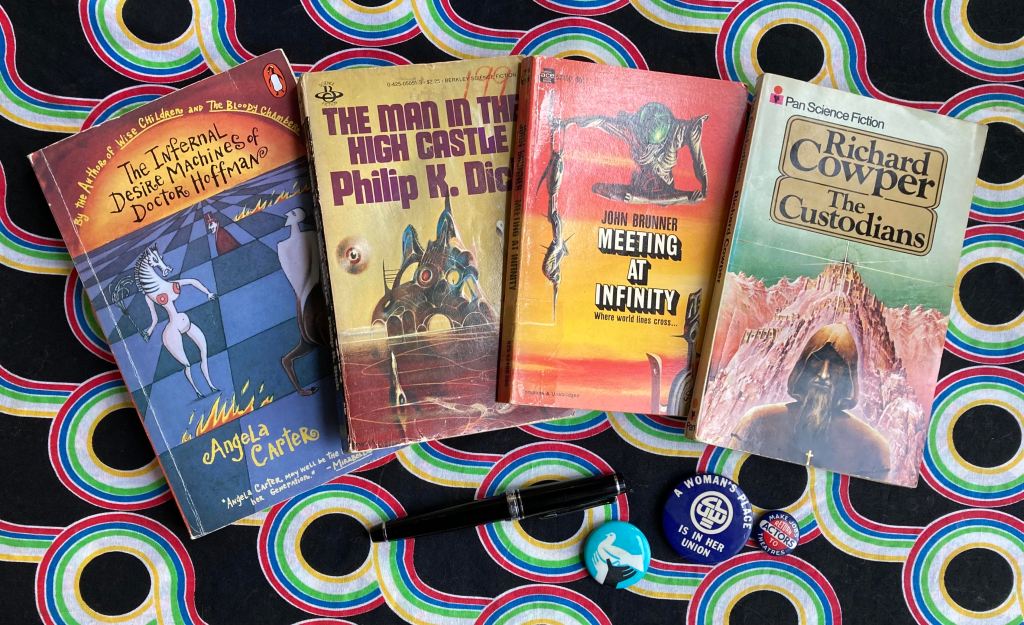
Recent Science Fiction Purchases No. CCCXLIV (Margaret St. Clair, Edgar Pangborn, Keith Laumer, and Edmund Cooper)

Which books/covers/authors intrigue you? Which have you read? Disliked? Enjoyed?

It’s the summer Joachim Boaz. Where are the reviews? I’m currently on a much needed vacation (Iceland). I will be back soon! In the meantime here are four recent purchases.

1. The Dancers of Noyo, Margaret St. Clair (1973)

From the back cover: “Like so many others before him, reluctant Sam MacGregor was sent on a pilgrimage for the Frail Vision by the Dancers: androids grown from the cells of one man, with the powers of hypnotism and illusion–androids who held the tribes of the Republic of California in thrall.

But soon Sam began to doubt his own identity, for he experienced, in close succession, extra-lives in different corridors of time and space.

Continue reading

What pre-1985 science fiction are you reading? + Update No. XXII

What pre-1985 science fiction are you reading or planning to read next month? Here’s the April installment of this column.

As readers of the site know, I am obsessed with the machinations of Cold War nuclear logic—historical and science fictional. In Ira Chernus’ brilliant Apocalypse Management: Eisenhower and the Discourse of National Insecurity (2008), he dives into the Manichean ideoscape that dominated Eisenhower’s thinking. In short, he posits that Eisenhower interpreted the Soviet threat as an apocalyptic struggle in which the traditional outcome, eliminating the treat, is impossible. Instead the best hope is “to contain and manage it forever” (2)–hence “apocalypse management.” This “new linguistic paradigm” profoundly influenced their policymaking process and dominated American public discourse.

According to Chernus, Eisenhower was obsessed with Americans practicing voluntary self-control in their consumption in order shoulder the taxes needed to fund the perpetual struggle. With this paradigm, Eisenhower’s gestures towards peace–for example his “The Chance for Peace” (April 16th, 1953) speech–were acts of calibrated psychological warfare designed to put the burden of action on the Soviets and score points with the American public and American allies. The United States, on the other hand, could wage the conflict with perpetual, safe, and managed inaction in which peace is never the ultimate objective.

Continue reading

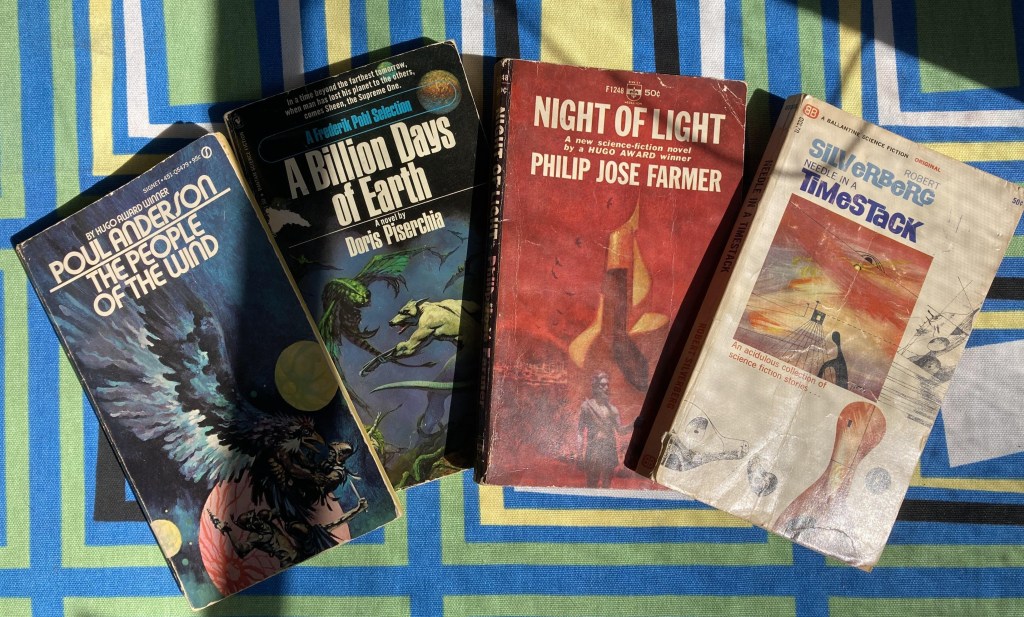
Recent Science Fiction Purchases No. CCCXLIII (Philip K. Dick, Roger Zelazny, Chuck Rothman, Philip José Farmer, and an anthology on Future Love)

Which books/covers/authors intrigue you? Which have you read? Disliked? Enjoyed?

1. Deus Irae, Philip K. Dick and Roger Zelazny (1976)

From the back cover: “One their own, they have written landmarks works that have added whole new dimensions of wonder to the field of science fiction. Now, in Deus Irae, they have created what ALA Booklist calls “the most successful collaboration in years!”–set in in bizarre world where you will encounter…

A bunch of backwoods farmers who happen to be lizards…

Continue reading

What pre-1985 science fiction are you reading? + Update No. XXI

What pre-1985 science fiction are you reading or planning to read this month? Here’s the March installment of this column.

Recently I came across John Boston and Damien Broderick’s three-volume series examining each and every story and non-fiction article in the pre-Michael Moorcock New Worlds and Science Fantasy/SF Impulse magazines in the UK. John Boston is a valued member of my site’s community — frequently stopping by in the comment sections. I thought for this mini-editorial I’d list a handful of active community members with websites, books, and worthwhile SF-related fanzine articles. I, of course, could be missing a few. Community matters more than you might think. I enjoy the discussion. I enjoy reading reviews that others write — even if it’s on science fiction that might not be within my more narrow focus (the historian in me). I always want to learn and share what’s worth reading and/or historically interesting. Thank you one and all.

Continue reading

Updates: Recent Science Fiction Purchases No. CCCXLII (Robert Silverberg, C. L. Moore, Henry Kuttner, Peter Tate, and Thomas Burnett Swann)

Which books/covers/authors intrigue you? Which have you read? Disliked? Enjoyed?

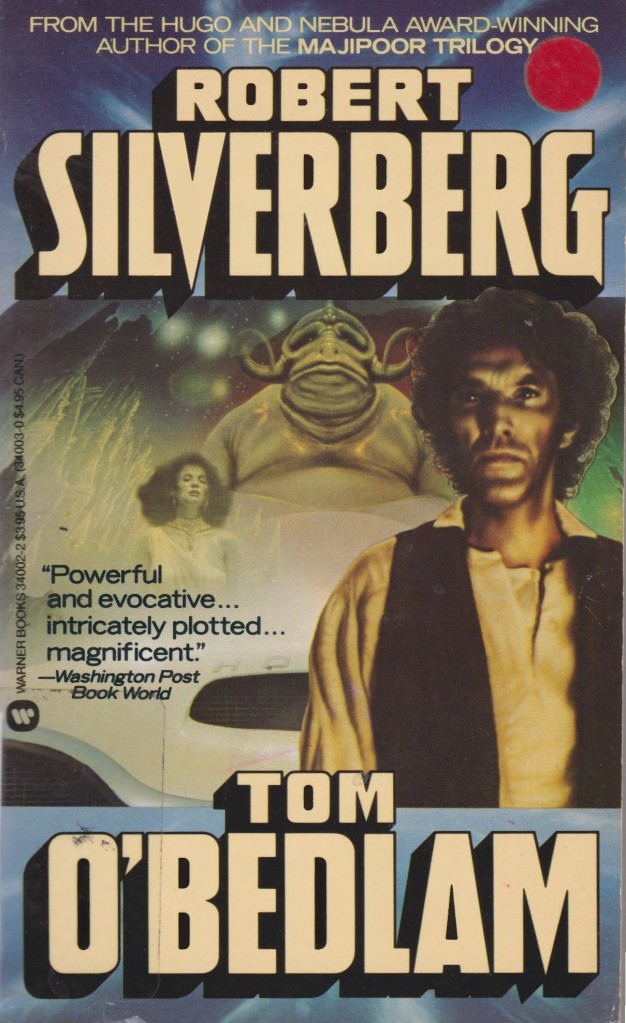
1. Tom O’Bedlam, Robert Silverberg (1985)

From the back cover: “MESSIAH OR MADMAN? It is 2103 and Tom O’Bedlam, madman, prophet, and visionary, wanders through California, dwelling place of the last humans on a continent decimated by radioactive dust. Tom, caught up in a living vision of distant worlds ruled by godlike beings, is the herald of a new age, a herald no one wants to hear until others too begin to dream of salvation beyond the stars. Yet while many dream, only tom has the power to make the wondrous visions real, to give people the ultimate escape they desire. Across the universe they must go… if Tom is humanity’s last hope–and not its final destroyer.”

Continue reading

What pre-1985 science fiction are you reading? + Update No. XX

What pre-1985 science fiction are you reading or planning to read this month? Here’s the January installment of this column (sorry I missed a month).

Before John W. Campbell, Jr. (1910-1971) attempted to raise the “standards and thinking in magazine SF,” David Lasser (1902-1996) attempted his own brief (1929-1933) program to improve science fiction as managing editor of Hugo Gernsback’s Science Wonder Stories, Wonder Stories, and Wonder Stories Quarterly. According to Mike Ashley’s The Time Machine: The Story of the Science-Fiction Pulp Magazine from the Beginning to 1950 (2000), Lasser is a “much neglected revolutionary in science fiction” and through his efforts the genre “started to mature” (66).

Ashley highlights Lasser’s letter of instruction mailed to his regular contributors on the 11th of May, 1931, in which he “exhorted them to bring some realism to their fiction” (72). He also outlawed common tropes like the giant insect story and space opera (73). He emphasized the need to focus on characters that “should really be human” — not everything needs to be a “world-sweeping epic” (73). Stories in this vein, according to Ashley, include Clifford D. Simak’s religiously themed “The Voice in the Void” (1932), P. Schuyler Miller and Walter Dennis’ “The Red Spot on Jupiter” (1931) and “The Duel on the Asteroid” (1974), which featured a grim realism and character development (74).

Continue reading

What pre-1985 science fiction are you reading? + Update No. XIX

What pre-1985 science fiction are you reading or planning to read this month? Here’s the December installment of this column.

Lost texts, and the act of reconstructing the fragments, fascinates. The questions pile up. Would the contents reveal a pattern in an author’s work? Intriguing personal details? A startling modus operandi? At the 11th World Science Fiction Convention (Philcon 2), Philadelphia (September 1953), Philip José Farmer gave a speech titled “SF and the Kinsey Report.” Considering Farmer’s recent publication of “The Lovers” (1952), this is not surprising. Alfred Kinsey, the famous sexologist and founder of the Kinsey Institute for Research in Sex, Gender, and Reproduction on Indiana University’s campus, published his controversial Sexual Behavior in the Human Male in 1948. Sexual Behavior in the Human Female appeared in 1953. Like many of Farmer’s earliest speeches, he did not keep copies.

Deeply intrigued by what the speech might have contained, Sanstone and I (on Bluesky) managed to piece together a few general responses from fanzines and magazine con reports.

Continue reading

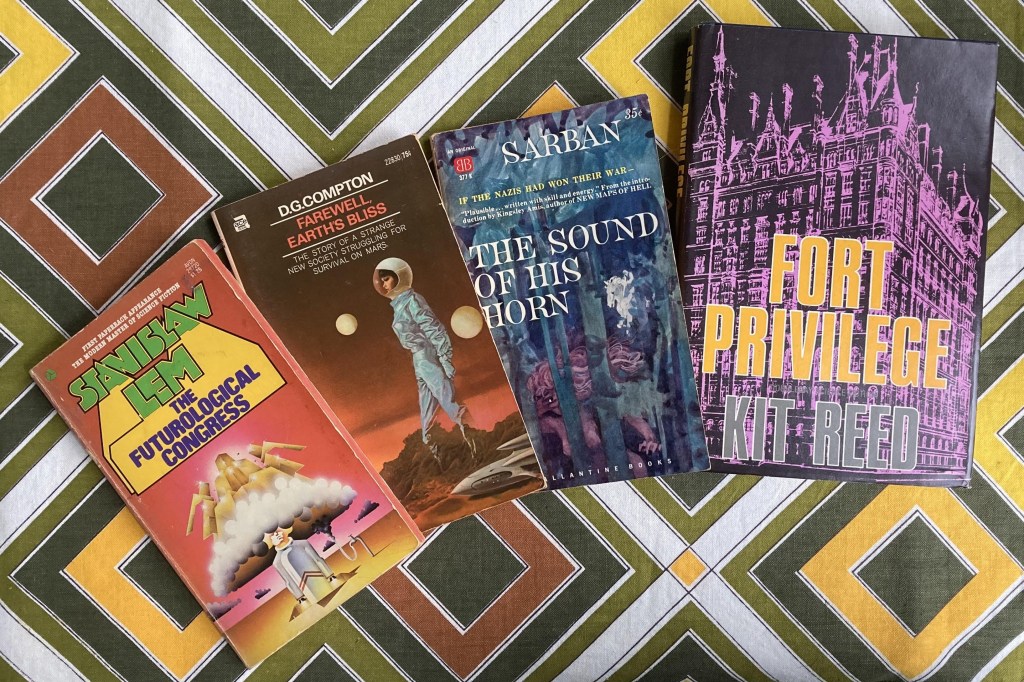
Updates: Recent Science Fiction Purchases No. CCCXL (Philip José Farmer, L. Sprague de Camp, George Alec Effinger, and an Anthology of SF by Women)

A selection of SF volumes acquired over winter break!

Which books/covers/authors intrigue you? Which have you read? Disliked? Enjoyed?

1. Flesh, Philip José Farmer (1960)

From the back cover: “Spaceman by DAY… MONSTER by night!

Peter Stagg was caught in the vilest trap ever devised–his own lust-driven body! For FLESH is the pulse-stirring story of a space explorer’s return from the strangest voyage man had ever made–to the strangest world the universe had ever seen–his own Earth!

Continue reading

Exploration Log 7: Interview with Jordan S. Carroll, author of Speculative Whiteness: Science Fiction and the Alt-Right (2024)

Over the last few years, I have attempted to incorporate a smattering of the vast range of spectacular scholarship on science fiction into my reviews and highlight works with my Exploration Log series that speak to me.1 Today I have an interview with Jordan S. Carroll about his brand-new book, Speculative Whiteness: Science Fiction and the Alt-Right (2024). In the book, he examines the ways the alt-right uses classic science fiction imagery and authors to mainstream fascism and advocate for the overthrow of the state.

You can buy an inexpensive physical copy ($10) directly from the University of Minnesota Press website or an eBook version ($3.79) on Amazon.


Thank you so much for agreeing to this interview. First, can you introduce yourself and research interests?

Continue reading