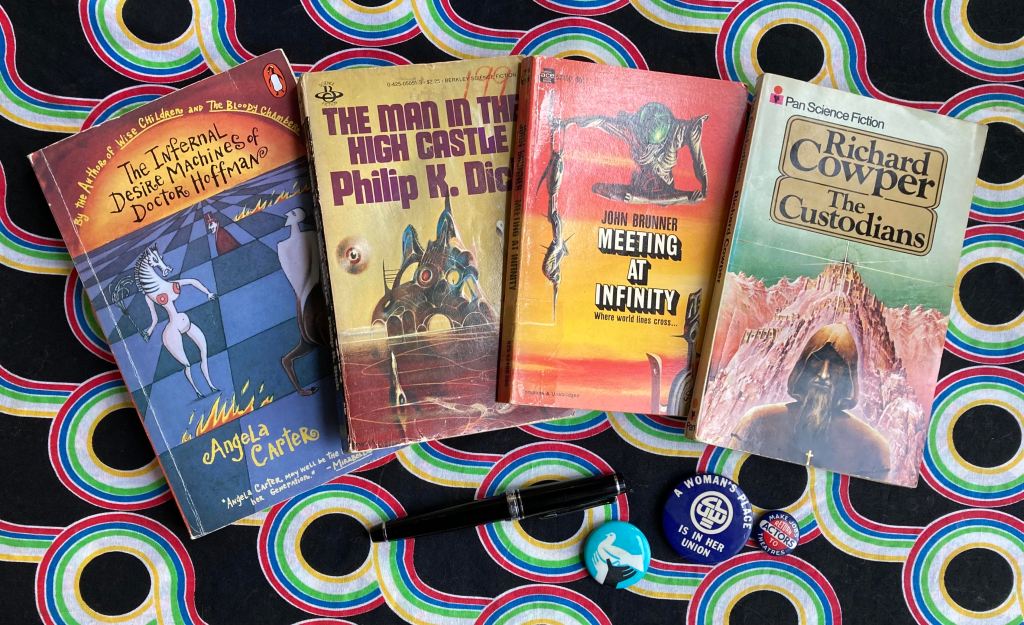
Which books/covers/authors intrigue you? Which have you read? Disliked? Enjoyed?
1. Tom O’Bedlam, Robert Silverberg (1985)
Jim Burns’ cover for the 1986 edition
From the back cover: “MESSIAH OR MADMAN? It is 2103 and Tom O’Bedlam, madman, prophet, and visionary, wanders through California, dwelling place of the last humans on a continent decimated by radioactive dust. Tom, caught up in a living vision of distant worlds ruled by godlike beings, is the herald of a new age, a herald no one wants to hear until others too begin to dream of salvation beyond the stars. Yet while many dream, only tom has the power to make the wondrous visions real, to give people the ultimate escape they desire. Across the universe they must go… if Tom is humanity’s last hope–and not its final destroyer.”
What pre-1985 science fiction are you reading or planning to read this month? Here’s the January installment of this column (sorry I missed a month).
Before John W. Campbell, Jr. (1910-1971) attempted to raise the “standards and thinking in magazine SF,” David Lasser (1902-1996) attempted his own brief (1929-1933) program to improve science fiction as managing editor of Hugo Gernsback’s Science Wonder Stories, Wonder Stories, and Wonder Stories Quarterly. According to Mike Ashley’s The Time Machine: The Story of the Science-Fiction Pulp Magazine from the Beginning to 1950 (2000), Lasser is a “much neglected revolutionary in science fiction” and through his efforts the genre “started to mature” (66).
Ashley highlights Lasser’s letter of instruction mailed to his regular contributors on the 11th of May, 1931, in which he “exhorted them to bring some realism to their fiction” (72). He also outlawed common tropes like the giant insect story and space opera (73). He emphasized the need to focus on characters that “should really be human” — not everything needs to be a “world-sweeping epic” (73). Stories in this vein, according to Ashley, include Clifford D. Simak’s religiously themed “The Voice in the Void” (1932), P. Schuyler Miller and Walter Dennis’ “The Red Spot on Jupiter” (1931) and “The Duel on the Asteroid” (1934), which featured a grim realism and character development (74).
What pre-1985 science fiction are you reading or planning to read this month? Here’s the December installment of this column.
Lost texts, and the act of reconstructing the fragments, fascinates. The questions pile up. Would the contents reveal a pattern in an author’s work? Intriguing personal details? A startling modus operandi? At the 11th World Science Fiction Convention (Philcon 2), Philadelphia (September 1953), Philip José Farmer gave a speech titled “SF and the Kinsey Report.” Considering Farmer’s recent publication of “The Lovers” (1952), this is not surprising. Alfred Kinsey, the famous sexologist and founder of the Kinsey Institute for Research in Sex, Gender, and Reproduction on Indiana University’s campus, published his controversial Sexual Behavior in the Human Male in 1948. Sexual Behavior in the Human Female appeared in 1953. Like many of Farmer’s earliest speeches, he did not keep copies.
Deeply intrigued by what the speech might have contained, Sanstone and I (on Bluesky) managed to piece together a few general responses from fanzines and magazine con reports.
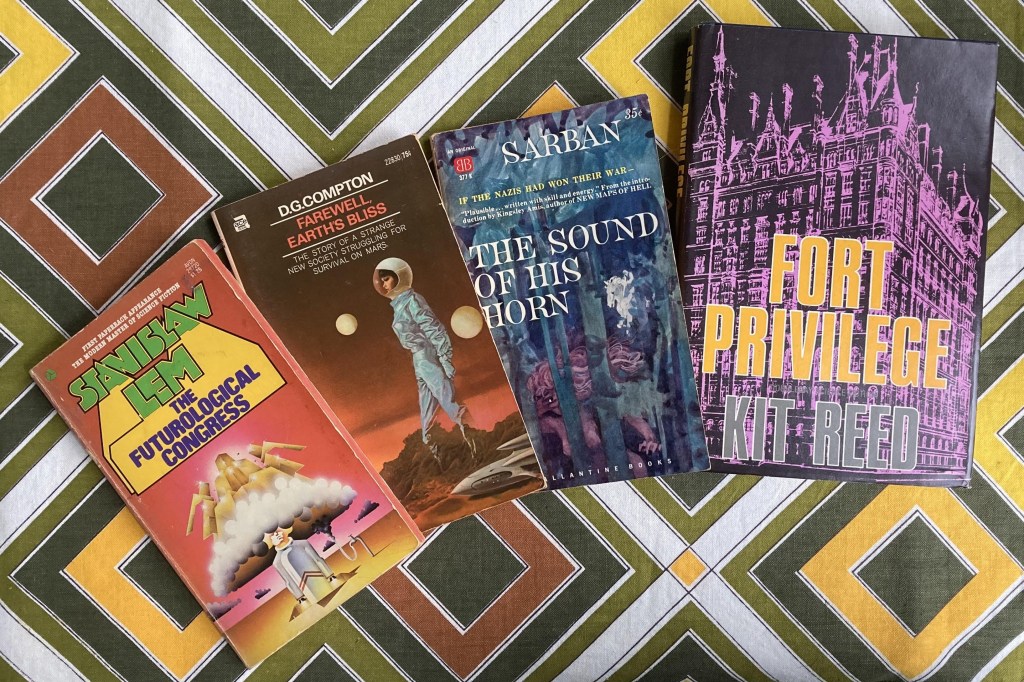
A selection of SF volumes acquired over winter break!
Which books/covers/authors intrigue you? Which have you read? Disliked? Enjoyed?
1. Flesh, Philip José Farmer (1960)
Gerald McConnell’s cover for the 1st edition
From the back cover: “Spaceman by DAY… MONSTER by night!
Peter Stagg was caught in the vilest trap ever devised–his own lust-driven body! For FLESH is the pulse-stirring story of a space explorer’s return from the strangest voyage man had ever made–to the strangest world the universe had ever seen–his own Earth!
Over the last few years, I have attempted to incorporate a smattering of the vast range of spectacular scholarship on science fiction into my reviews and highlight works with my Exploration Log series that speak to me.1 Today I have an interview with Jordan S. Carroll about his brand-new book, Speculative Whiteness: Science Fiction and the Alt-Right (2024). In the book, he examines the ways the alt-right uses classic science fiction imagery and authors to mainstream fascism and advocate for the overthrow of the state.
You can buy an inexpensive physical copy ($10) directly from the University of Minnesota Press website or an eBook version ($3.79) on Amazon.
Thank you so much for agreeing to this interview. First, can you introduce yourself and research interests?
Here’s to a happy reading in 2025! I hope you had a successful reading year. Whether you are a lurker, occasional visitor, a regular commenter, a follower on Bluesky or Mastodon, thank you for your continued support. It’s hard to express how important (and encouraging) the discussions that occur in the comments, social media, and via email are to me. This was the third year running of record-breaking numbers of viewers and views in the 13-year history of my site. What were your favorite vintage SF reads–published pre-1985–of 2024? Let me know in the comments.
What a way to finish 2024! Future Powers, ed. Jack Dann and Gardner Dozois (1976) is a well-crafted thematic anthology with seven original stories and two older classics. Other than R. A. Lafferty’s average contribution, all the tales effectively engage with the theme of the complexities of future control both in everyday and the macropolitical contexts.
A few tantalizing fragments: Ursula K. Le Guin’s “The Diary of the Rose” (1976) explores the operations of dystopic control through the eyes of a neophyte doctor (“scopist”); Damon Knight ruminates on the nature and treatment of the psychopath in “The Country of the Kind” (1956); and A. K. Jorgensson’s “Coming-of-Age-Day” (1965) takes the reader through all the unnerving and confusing moments of a child in a strange future attempting to understand the nature of sex.
What pre-1985 science fiction are you reading or planning to read this month? Here’s the November installment of this column.
Last week I wrote a post about Clifford D. Simak’s delightfully inclusive 1971 speech at the height of the New Wave in which he celebrated science fiction as a “forum of ideas” open to all voices. While reviewing the various snarky comments leveled at the movement by “classic authors” like Asimov, a faint memory of James Blish’s own anti-New Wave sentiments tickled my memory. I randomly opened up a book on my desk to figure out a fascinating SF tidbit to start this post, and voilà, the James Blish story.
Jacqueline Foertsch’s Reckoning Day: Race, Place, and the Atom Bomb in Postwar America (2013) contains a sustained analysis of Samuel R. Delany’s various post-apocalyptic novels. She includes a discussion of the response to Delany’s Nebula-winning The Einstein Intersection (1967). At the 1968 Nebula Awards Banquet, moments after Delany received his prize for Einstein (and where moments later he’d collected another award for “Aye, and Gomorrah”), Blish lambasted the New Wave. Blish complained about the “loosening of the genre’s parameters” and the “re-christening of the genre” as “speculative fiction” (98). I find all of this hilarious as Blish himself wrote fantasy novels like Black Easter (1968) (that would also nab a 1969 Nebula nomination) and far earlier oblique proto-New Wave speculative fictions like “Testament of Andros” (1953). I wonder if Blish aimed such vitriol at a figure like Simak, who took the loosening of the genre’s parameters to extremes during the New Wave–i.e. novels like The Goblin Reservation (1968), Destiny Doll (1971), and Out of Their Minds (1970). Unfortunately, I don’t think it’s surprising that Blish took especial issue with one of the few black SFF authors of the day.
And let me know what pre-1985 science fiction you’ve been reading!
In an August 1967 editorial in Galaxy titled “S.F. as a Stepping Stone”, Isaac Asimov (1920-1992) voiced his extreme disapproval of the New Wave movement as “‘mainstream’ with just enough of a tang of the not-quite-now and the not-quite-here to qualify it for inclusion in the genre” (4). He concludes: “I hope that when the New Wave has deposited its forth and receded, the vast and solid shore of science fiction will appear once more and continue to serve the good of humanity” (6). The implication is clear: there is an Platonic science fiction form that exists (and that he writes) that must be rediscovered.
Fellow “classic” author Clifford D. Simak (1904-1988) offered a different, and far more inclusive, take at his Guest of Honor speech at Norescon 1 (Worldcon 1971). In an environment of “shrill” disagreement between various New Wave and anti-New Wave camps, Simak celebrated science fiction as a “forum of ideas” open to all voices (148).
Preliminary note: I read the speech in Worldcon Guest of Honor Speeches, ed. Mike Resnick and Joe Siclari (2006). You can listen to the speech (at the 28:00 min. mark) here. For a wonderful range of photographs of Simak at the convention, check out this indispensable photo archive.
As I did with six Simak interviews earlier this year, I will paraphrase his main points and offer a few thoughts of my own.
Let’s get to the speech!
Jay Kay Klein’s photograph of Robert Silverberg, Clifford D. Simak, and Isaac Asimov at the 1971 Worldcon