Book Review: Those Who Watch, Robert Silverberg (1967)

3.25/5 (Above Average)

A preliminary note: I’m something of a Robert Silverberg completionist, especially work from his glory years of 1967-1975. I’ve reviewed forty-seven of Silverberg’s short stories and thirteen of his novels–I’ve also read but never reviewed A Time of Changes (1971), The Masks of Time (1968), Tower of Glass (1970), and the stories in Capricorn Games (1976).

While a middling Silverberg novel at best, Those Who Watch (1967) almost succeeds as a revisionist take on UFO panic. The aliens do not seek to experiment on, exterminate, or manipulate humans. Instead, this is a book about the lost and lonely, and how their love and care for the injured interstellar visitors that appear on their doorsteps transform their lives. It’s a problematic work that simultaneously pulses with kindness.

Continue reading

What pre-1985 science fiction are you reading? + Update No. XIII

What pre-1985 science fiction are you reading or planning to read this month?

Here’s May’s installment of this column.

As I am currently exploring the north-of-the-Arctic Circle reaches of Norway, why not segue way into this post by re-ruminating on the only Norwegian SF novel I’ve read: Knut Faldbakken’s spectacular Twilight Country (1974, trans. Joan Tate, 1993). I wish I’d thought to bring the sequel — Sweetwater (1976, trans. Joan Tate, 1994). Twilight Country, my second favorite SF novel read of 2021, contains one of the great depictions of a decaying metropolis. It is a densely metaphoric story of survival within its crumbling edifices. The masterstroke of Faldbakken’s novel is the portrayal of the Dump, a border zone containing the cast off fragments of human existence, as a place of recreation. Our characters run to the Dump to escape, to make their lives anew. They’re deeply flawed figures. There’s a tangible sense of organic transformation within the transients who inhabit this liminal zone. Sweetwater and The Dump act as a closed system. One decays into the other. One creates the other. Not recommended unless you like your SF dark and moody like me!

Continue reading

Updates: Recent Science Fiction Purchases No. CCCXXXIV (Robert Silverberg, Best SF of 1979, C. L. Moore, George Hay)

Spring semester in the books! It’s now time to read (and go on vacation).

Which books/covers/authors in the post intrigue you? Which have you read? Disliked? Enjoyed?

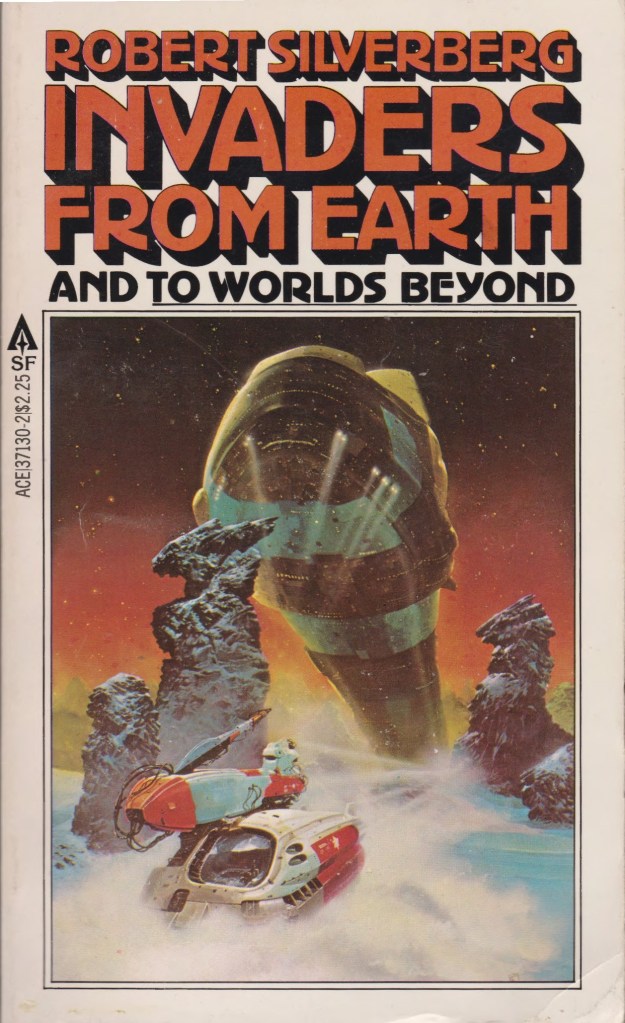
1. Invaders from Earth and To Worlds Beyond, Robert Silverberg (1980)

From the back cover: “The Ganymedians had a rich, peace culture, peaceful culture extending back hundreds of thousands of years in human time. But the soil of their Jovian moon held uncountable riches in the form of the nuclear fuels Earth so desperately needed. It was a pattern that had been repeated many times in humanity’s bloody history; in Asia, in Africa, in the American West–but the nations of mankind were not ready to make the same mistake again. So when the Corporation decided it wanted those fissionables whether the Ganymedians wanted to give them up or not, they knew they had a job of selling of their hands, to swing the weight of public opinion behind them. And that was a job for Ted Kennedy, ad-man supreme. Kennedy’s record showed he could sell the public on just about anything. Even genocide.”

Continue reading

Short Book Reviews: Clifford D. Simak’s They Walked Like Men (1962) and Jacques Sternberg’s Sexualis ’95 (1965, trans. 1967)

Note: My read but “waiting to be reviewed pile” is growing. Short rumination/tangents are a way to get through the stack before my memory and will fades. My website partially serves as a record of what I have read and a memory apparatus for future projects. Stay tuned for more detailed and analytical reviews.


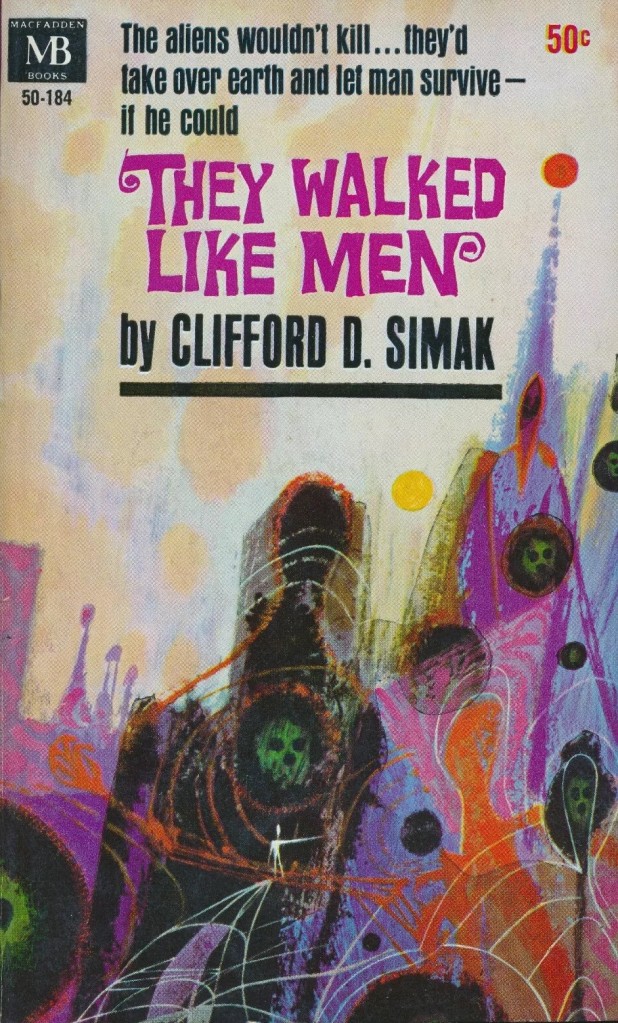
1. They Walked Like Men, Clifford D. Simak (1962)

3/5 (Average)

In a confrontation with maleficent alien land prospectors in Clifford D. Simak’s They Walked Like Men (1962), the main character ruminates that “it was almost if [we] were acting out an old morality play, with the basic sins of mankind enlarged a millionfold to prove a point by exaggeration” (113). Simak’s moment of meta-commentary on his own narrative and tonal choices gives shape to odd conjuration of juvenile comedy and apocalyptic extrapolation of capitalism unleased.

Continue reading

What pre-1985 science fiction are you reading? + Update No. XII

What pre-1985 science fiction are you reading or planning to read this month?

Here’s April’s installment of this column.

First, a bit about Isaac Asimov’s Foundation (1951) from M. Keith Booker’s Monsters, Mushroom Clouds, and the Cold War: American Science Fiction and the Roots of Postmodernism, 1946-1964 (2001), my current history of science fiction read:

Continue reading

Updates: Recent Science Fiction Purchases No. CCCXXXIII (Keith Laumer, Vernor Vinge, Mack Reynolds, Daphne du Maurier)

Which books/covers/authors in the post intrigue you? Which have you read? Disliked? Enjoyed?

1. It’s A Mad, Mad, Mad Galaxy, Keith Laumer (1968)

Back cover: “This frenetic collection of science fiction stories–often disturbing, always entertaining–comes from outstanding and unpredictable SF author Keith Laumer.

Tingle your imagination: In ‘The Planet Wreckers,’ Jack Waverly goes to bed an ordinary mortal and wakes up a movie star. But the trouble is, his life is the price.

Tired of being a 97-pound weakling? “The Body Builders” has the answer for you: Just buy yourself the Body Beautiful.

Exorcise your hostility! A Certain Powers plans to obliterate “the greatest menace in the world today”–coast-to-coast television, better known as ‘The Big Show.'” [I think the last description is not for a story in the collection. Laumer always had a story title “The Big Show” that appeared in 1968. Maybe they were planning on including it in this collection but substitute something else at the last minute?]

Continue reading

What pre-1985 science fiction are you reading? + Update No. XI

What pre-1985 science fiction are you reading or planning to read this month. Here’s March’s installment of this column.

Before we get to books and birthdays and writing plans…

Continue reading

Short Story Review: Vladimir Colin’s “The Contact” (1966, trans. 1970)

Today I’m joined again by Rachel S. Cordasco, the creator of the indispensable website and resource Speculative Fiction in Translation, for the second installment of our series exploring non-English language SF worlds. Last time we covered Kōbō Abe’s allegory of Marxist transformation, “The Flood” (1950, trans. 1989).

This time we journey east of the Iron Curtain to 1960s Romania with Vladimir Colin’s “The Contact.” It first appeared in his collection of short stories Viitorul al doilea (1966). We read it in Other Worlds, Other Seas: Science-Fiction Stories from Socialist Countries, ed. Darko Suvin (1970). The story was translated into English by the author. I cannot find a copy online. Reach out if you want to read it!

Make sure to check out Rachel’s website Speculative Fiction in Translation. Not only does she review the global phenomena of speculative fiction but gathers lists of translated fiction by language. Also check out her reference monograph Out of This World: Speculative Fiction in Translation from the Cold War to the New Millennium (2021).

Now let’s get to our reviews!

Continue reading

Updates: Recent Science Fiction Purchases No. CCCXXXII (Vernor Vinge, Brian Stableford, Joan Cox, and Pierre Boulle)

Which books/covers/authors in the post intrigue you? Which have you read? Disliked? Enjoyed?

1. The Witling, Vernor Vinge (1976)

From the back cover: “Witling: A pretender to wit. (Webster’s Dictionary)

In the eyes of the inhabitants of Giri the scientific explorers from outer space were witlings. In the context of that primitive-seeming planet, they were.

Because on Giri a peculiarity of evolution had given a special talent to all living things–and this talent had made unnecessary most of the inventions associated with intelligent life elsewhere. Roads and planes, engines and doors… these were the products of witlings, not of ‘normal’ people.

So when the little band from Earth’s exploration team fell into Giri hands, their problem was unprecedented. How to demonstrate that science is worthwhile and how to keep the medieval masters of Giri from realizing their potential for cosmic mischief.”

Continue reading