Updates: My 7 Favorite Metafictional Science Fiction Novels

Here are my seven favorite metafictional science fiction novels. By metafiction I’m referring to devices such as breaking the fourth wall (characters addressing the audience), the author addressing the reader, a story about a writer writing a story, a story containing another work of fiction within it, a work where the narrator reveals himself or herself as the author of the story, narrative footnotes, etc….

I’d love to hear your favorites (they don’t have to be novels)!

Obviously, these types of experimental works only appeal to some readers (especially fans of the sci-fi New Wave movement of the late 60s and early 70s) but I personally love seeing experimentation in an often — dare I say — stylistically stale genre.  Often, the metafictional aspects do not prevent authors from deploying traditional narratives.

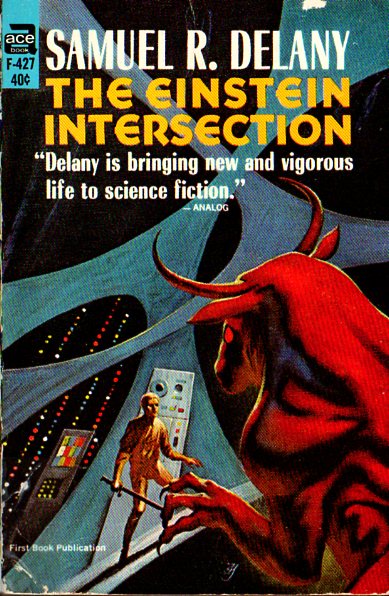
 71nOA-QfpuL NSTNINT1967 RVLTNSXKSK1977

 THIRNDRM1972 MNINTHCST1974

My top seven (and an honorable mention):

1. Beyond Apollo, Brian N. Malzberg (1972) (REVIEW) — what you read is most likely the novel written by the main character. However, he’s most likely insane so attempting to get AT the true nature of his voyage to Venus is purposefully layered… Complicating the matter is how unreliable of a narrator he is and the fact that he’s tells many versions of the same story. Malzberg pokes fun at pulp science fiction throughout — which he clearly enjoyed as a child.

2. Stand on Zanzibar, John Brunner (1968) — the metafictional aspects are rather hidden in this New Wave masterpiece (my single favorite sci-fi novel).  Brunner’s vast (in scope and depth) mosaic of invented book fragments, advertising jingles, and narrative portions are interspersed with news articles taken from his own day — including the school shooting at the University of Texas in 1966.  Of course, as readers we’re geared to imagining that everything Continue reading
Adventures in Science Fiction Cover Art: Nostalgic Visions — Plastic Toy Spacemen

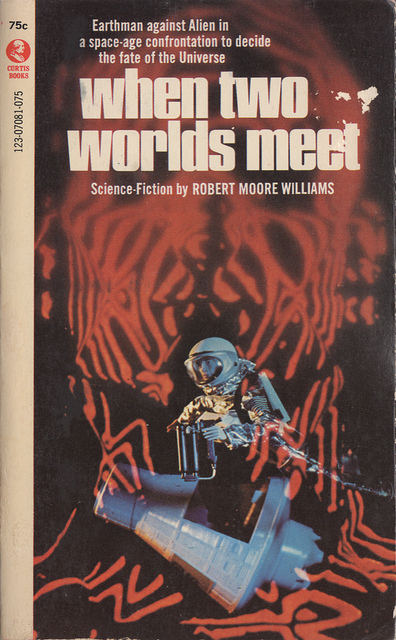
6186728691_d76e9c6c89_z

(Uncredited cover for the 1970 edition of When Two Worlds Meet (1970), Robert Moore Williams)

A while ago I put together a post on the theme of Models, Dolls, and Mannequins in cover art.  Little did I know that Curtis Books (a rather minor publisher of generally minor authors) and Born, a Dutch imprint, used a substantial number of cover compositions comprised of manipulated photographs/collages etc of plastic toy spacemen in unusual alien environments.  Also, a few more major publishers/magazines — Four Square Science Fiction and Analog Science Fiction Science Fact — had their own take on the theme.

I find these covers very charming and fun (sort of like a science fiction B-film from the 50s) — not necessarily artistic masterpieces.  They certainly evoke childhood games with toy figurines — perhaps placed in the lawn or sandbox or amongst the grass. I’ve included a few from my previous post and another can be found in my post Continue reading

Updates: Recent Science Fiction Acquisitions No. LXIV (Herbert + Tenn + Geston + Cummings)

More from my local dirt cheap book store…

By far most interested in William Tenn’s lone novel (he was predominately a short story writer) Of Men and Monsters (1968) — humans living in the walls, like mice, in the homes of the alien invaders of Earth.  Geston’s novelette The Day Star (1972) should be a fast and fun read — hopefully despite the comment by previous owner of the book who inscribed “TEDIOUS” on the back cover with a ballpoint pen…

Some fun covers.

1. Hellstrom’s Hive, Frank Herbert (1972)

HLLSTRMSHV1974

(R. Shore’s cover for the 1975 edition)

Excerpt from the inside flap of the first edition hardback: “In the summer of 1971, Doctor Nils Hellstrom appeared in his own film production, The Hellstrom Chronicle.  The motion picture Continue reading

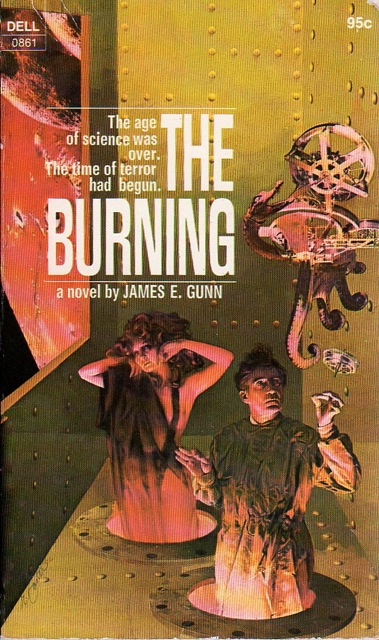
Book Review: The Burning, James E. Gunn (1972)

TBRNNG1972

(Robert Foster’s evocative cover for the 1972 edition)

3.25/5 (collated rating: Above Average)

James E. Gunn’s The Burning (1972) is a fix-up novel containing three previously published but linked novelettes: ‘Witches Must Burn’ (1956), ‘Trial By Fire’ (1969), and ‘Witch Hunt’ (1969).  The first two are contiguous while the third section is more loosely related.  I will rate each separately as I did with the superior The Immortals (1962).

As someone who has lived in areas of the United States plagued by virulent strains of anti-intellectualism, massive higher education funding cuts (especially in the liberal arts), and an increasing emphasis on “practical” fields of study, James E. Gunn’s The Burning (1972) is a profoundly unsettling read.  Of course Gunn’s dystopic future is much more one of doom and gloom: The universities lie in smoldering ruins, the professors (“eggheads”) Continue reading

Updates: Recent Science Fiction Acquisitions No. LXIII (Simak + Tenn + Clement + Frayn)

A new bookstore in my hometown!  Great results! Dirt cheap (between 1-2 $ a book)!  Happy me!

I finally have a copy of Hal Clement’s hard science fiction masterpiece, Mission of Gravity (1953)…  And a collection of William Tenn’s short stories with a downright gorgeous Powers cover — Tenn is supposedly up there with Sheckley in the satirical pantheon of the 50s… Among others…

Has anyone read Michael Frayn’s A Very Private Live (1968)?  I’ve never heard of it before but the Lehr cover was too amazing to pass up…

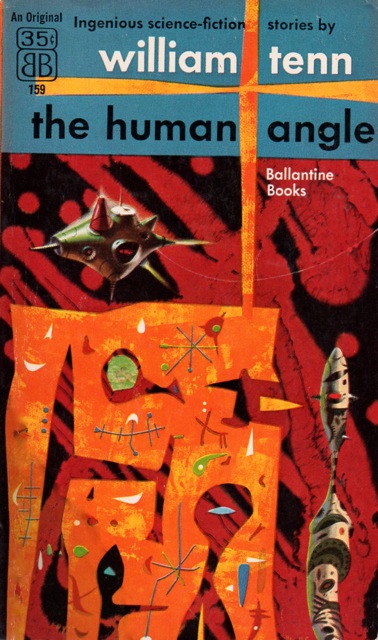
1. The Human Angle, William Tenn (1956) (MY REVIEW)

THHMNNGLVW1956

(Robert Powers’ cover for the 1956 edition)

From the inside flap: “WIT: an extra-terrestrial sells pornographic literature Continue reading

Book Review: The Immortals, James E. Gunn (1962)

THMMRTLSNS1962(Mitchell Hooks’ cover for the 1962 edition)

4.25/5 (collated rating: Good)

James E. Gunn’s The Immortals (1962) is less about the lives and mental state of the eponymous humans “blessed” with immortality (a fascinating topic in itself) and more about the ramifications of their existence on the rest of society not “blessed” with such genetic structures.  Their presence exacerbates the problems of an already dystopically tinged world where medical care is increasingly the domain of the ultra wealthy.  With the knowledge that a random genetic mutation has created a bloodline whose members are immortal, society is all too eager to root them out and (literally) bleed them dry.  Living longer — achieved by whatever means — becomes the single-minded desire of all.  Most of humanity is oblivious to the festering (and carcinogenic) Continue reading

Updates: Recent Science Fiction Acquisitions No. LXII (Amis + Cummings + Van Vogt)

A strange conglomeration of novels….

If there’s any era I’m lacking knowledge in it’s late 20s-early 40s (well, I’ve read some Van Vogt + Edgar Rice Burroughs) pulp science fiction — so I decided to brush up on some of the greats.  With that in mind I acquired five Ray Cummings novels (the rest will be in a later acquisition post) and Van Vogt’s Slan (1940)…..  I don’t have high hopes.  But now I own my first Alex Schomburg cover!

I generally do not accept review copies due to the fact that most offers are for self-published works rather than republished novels from the period I’m most familiar with (and prefer to read) — 1950-1985.  So, when New York Review of Books offered me a copy of Kingsley Amis’ well-known alt-history/sci-fi (depending on whose definition you’re reading) novel The Alteration (1976) I happily agreed….

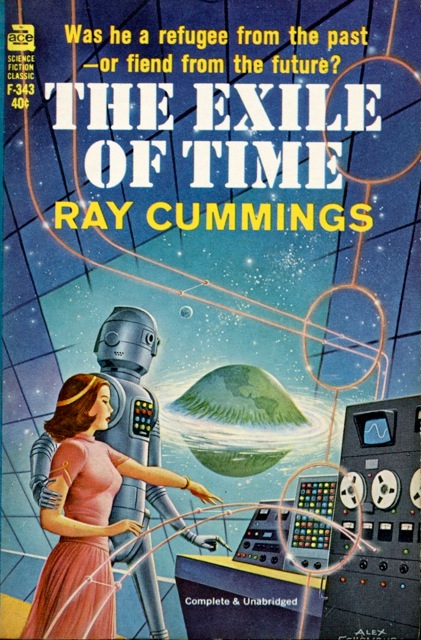
1. The Exile of Time, Ray Cummings (magazine publication 1931)

XLTIME1965

(Alex Schomburg’s cover for the 1964 edition) Continue reading

Adventures in Science Fiction Cover Art: The Space Station, Part II

Screen shot 2013-03-31 at 12.09.55 PM

(Arthur Hawkins’ cover for the 1959 edition of Skyport (1959), Curt Siodmak)

Part II of my series on cover art depicting space stations (Part I).  Here are vast assortment of primarily Alex Schomburg and Vincent Di Fate’s artwork — they did love their space stations.  But, I think my favorite is by far Arthur Hawkins’ cover for the 1959 edition of Curt Siodmak’s Skyport (1959) — the author is of course famous for the novel Donovan’s Brain (1942).  The delightful color scheme, the 50s aesthetic, the vague indication of continents below, the cluster of Continue reading

Book Review: The Status Civilization, Robert Sheckley (1960)

THSTTSCVLZ1960

(Richard Powers (?) cover for the 1960 edition)

4/5 (Good)

Robert Sheckley deftly manipulates — in a mere (but dense) 127 pages — a plot straight from the pulps involving prison planets and gladiatorial fights against terrifying robots into a scathing and artfully constructed work of satire.  Similar skills were apparent in his masterful collection Store of Infinity (1960) where traditional sci-fi situations such as colonization of alien worlds, robot rebellions, post-apocalyptical wastelands, and time-travel (among other tropes) are imbued with witty wordplay and biting social Continue reading