Book Review: Three for Tomorrow, novellas by Robert Silverberg, Roger Zelazny, and James Blish, (1969)

(Uncredited cover for the 1970 edition)

3.5/5 (collated rating: Good)

Three for Tomorrow (1969) contains three novellas written specially for the volume on the following theme selected by Arthur C. Clarke: “with increasing technology goes increasing vulnerability: the more man conquers Nature, the more prone he becomes to artificial catastrophe” (foreword, 8).  In my continuing quest for Robert Silverberg’s work from his Glory Period (proclaimed by me) 1967-1976, I was delighted to come across one of his shorter works paired with two other great authors, James Blish and Roger Zelazny.  If you want to read Silverberg’s novella but not the others, it appeared in many of his later collections — Earth’s Other Shadow (1973) for example.

As with most collections, Three for Tomorrow is uneven.  Silverberg’s installment is the best due to its intriguing social analysis of a city suddenly whose inhabitants are suddenly missing Continue reading

Adventures in Science Fiction Cover Art: Inside the Skull (rats + women + sword fights + robotic circuits + space)

(Ebel’s cover for the 1953 issue of Space Science Fiction)

Previous art explorations which looked at disembodied brains and visualizations of the ultra-intelligent set the stage for this post.  Imagine skulls without brains: sometimes metaphorically, but often, literally hollow skull cavities that hold a vast array of mechanical devies and living captives.  Or, the reader is gifted a voyeuristic peek into the skulls of bodies masquerading as humans but in reality, a mesh of circuits or a metal sheen operates those beautiful limbs and terrifying weapons….

My favorite is by far the pulp goodness of Ebel’s cover (if anyone knows the full name of this artist please let me know) for the 1953 issue of Space Science Fiction.  The gorgeous heroine is held captive in gigantic stone heads with partially glass skulls — a robot that fails to conjure any menace stomps Continue reading

Updates: Recent Science Fiction Acquisitions XXXV (Malzberg + Compton + Silverberg)

Books and short story collections from three of my favorite science fiction authors — Barry N. Malzberg, D. G. Compton, and Robert Silverberg…  A review of Malzberg’s masterpiece Revelations (1972) — almost as good as Beyond Apollo (1972) — is forthcoming.

I’ve recently discovered Marx Books — an online bookstore run by a retired professor (at Texas Tech University) and avid science fiction collector.  His collection is substantial and most importantly, he only bills you for the exact shipping (not sure if he ships internationally).  So, no $3.99 a book as Amazon does!  Instead, $3 shipping total for seven books!  Because Malzberg novels, and his short story collections, are so hard to find in used book stores it’s always nice to know I can pick up a copy quite cheaply online.

Another Richard Powers cover for my collection….

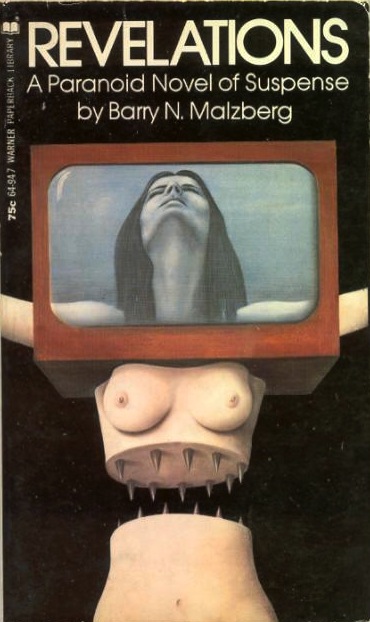
1. Revelations, Barry N. Malzberg (1972) (MY REVIEW)

(Uncredited cover for the 1972 edition)

From the back cover of the 1977 edition: “REVELATIONS is Continue reading

Adventures in Science Fiction Cover Art: Alien Friends

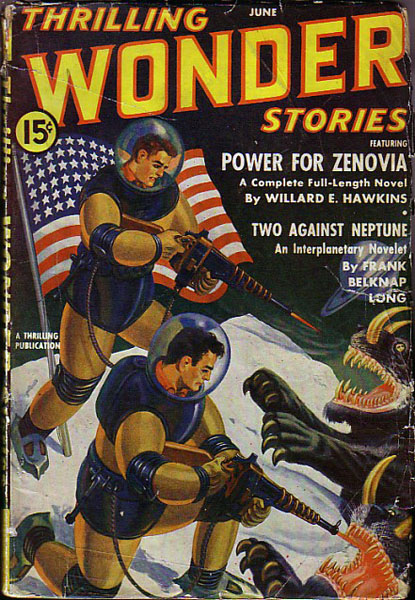
(H. W. Wesso’s June 1941 issue of Thrilling Wonder Stories)

In science fiction aliens are usually evil and generally end up dead — killed by our human heroes via pseudo-videogames (Ender’s Game), guns of endless variety, nuclear weapons detonated on their home worlds, horrific  diseases (Deep Space Nine), tossed into the vacuum of space, tossed into wormholes, etc etc.  They are rarely “humanized” — their families, societies, and history ignored by their human enemies — they are often depicted as “true” evil.  I’ve included the above cover, shooting aliens under the American flag (it is a wartime 40s issue so such overt jingoism is explainable), in order to highlight the attitude towards space fauna which we are all familiar with.

Sometimes “friendship” is feigned.  C. M. Kornbluth’s short story ‘Friend To Man’ (1951) (in this collection) is a disturbing example — the maternal feeling felt by the alien towards our antihero is just a ploy to lure him into her den where she implants him with eggs, which Continue reading

Book Review: Dr. Futurity, Philip K. Dick (1960)

(Ed Valigursky’s cover for the 1960 edition)

2.75/5 (Average)

Over the years I’ve found Philip K. Dick’s early novels hit or miss.  Along with The World Jones Made (1956), Dr. Futurity (1960) (expanded from the 1954 short story “Time Pawn”) is the least satisfying of his novels I’ve read so far.  My total PKD consumption is extensive — around 20 novels and at least 60 short stories.

Time travel is by far my least favorite major science fiction trope.  However, in many of Philip K. Dick’s novels and short stories time travel is transformed into something surreal and often, downright fascinating.  But unlike his later novels, the trope in Dr. Futurity is an endlessly laborious plot device.  Our hero doctor, Jim Parsons, is constantly whisked back and forth in time with hardly a moment of rest or discussion. Continue reading

Adventures in Science Fiction Cover Art: Underwater Expeditions (futuristic submarines + underwater labs + sea monsters + cities), Part II

(Roger Stine’s cover for the 1979 edition of On The Run (variant title: Mankind on the Run) (1955), Gordon R. Dickson)

Part II of my Underwater Expeditions Series (Part I) is a veritable deluge of undersea wonders.  Unusual monsters/aliens proliferate the seascapes — snapping at our aquatic heroes.  A vast array of submersibles and submarines — including a mechanical whale equipped with a harpoon (Jack Coggins’ cover for the April 1957 issue of Galaxy Science Fiction) — trek across the oceanic expanses.  Cities, ruins, hidden scientific facilities are all to be discovered amongst the seaweed and deep water trenches…

There is something so mysterious about the ocean depths — almost as alienating and frightening as space.  Although due to our recent deep sea explorations increasingly less Continue reading

Adventures in Science Fiction Cover Art: Chess/Checkers (with people + planets)

(Ed Valigursky’s cover for the 1962 edition of Cosmic Checkmate (1962), Charles V. DeVet and Katherine MacLean)

Queue Ed Valigursky’s cover for the Cosmic Checkmate (1962): a chessboard arrayed against a background of stars, men stand on different colored squares, as much pawns of some distant player as the pieces nearby.  Spaceships flash across the vast expanse of space — remember, the game has galactic ramifications — with our characters arrayed, the game opens, and the battle (of wits and secret weapons) begins.  Although I have not (yet) read Charles V. DeVet and Katherine MacLean (whose later novel Missing Man (1975) I highly recommend) is explicitly about Chess, or more precisely, a similar alien game, and the ramifications are indeed, galactic in scope.  Other covers are more metaphoric Continue reading

Adventures in Science Fiction Cover Art: Models, Dolls, Mannequins

(David Davies’ cover for the 1968 edition of The Syndic (1953), C. M. Kornbluth)

Occasionally I dabble in the incredibly esoteric and artistically painful.  Apparently in the 60s and the early 70s — heralded by the artist David Davies — there was momentary interest in sci-fi covers constructed from manipulated photographs of store window mannequins, dolls, wire contraptions vaguely suggesting spaceships, toy spacemen, wooden artist mannequins dressed in clothes/wigs, and copyright violating models of the Star Trek: The Original Series Enterprise NCC-1701.

Unfortunately, most of the covers I’ve discovered are uncredited — they might all be the work of David Davies.  Internet Speculative Fiction Database has seventeen of his covers listed but I suspect that he made many many more — I’ve gone ahead and credited a few Continue reading

Updates: Recent Science Fiction Acquisitions No. XXXIV (Brunner + Tucker + Brackett + et al.)

A mixture of a few clearance section novels from Austin bookstores (Chandler and Siodmak) and three recent purchases from a nice used bookstore (for science fiction) in my current town…  I can’t wait to read another Leigh Brackett novel (one of the most renowned pulp sci-fi writers of the 50s) — I’ve only read her novels, The Big Jump (1955) and was pleasantly surprised.

One can never have too many Brunner novels (I have 21 at the moment and I’ve read a majority of them) — even average works from the early 80s….

And Wilson Tucker’s The Year of the Quiet Sun (1970) — yes, I generally dislike time travel, but I’ve yet to read one of his works so I might as well start with what is generally considered his best novel.

(*note: I include images of what I consider the best cover for the novel if it has multiple editions because I enjoy good examples of sci-fi art.  I own perhaps half of the exact editions shown.  A few readers have expressed confusion.)

1. The Long Tomorrow, Leigh Brackett (1955)

(Ed Emshwiller’s cover for Continue reading