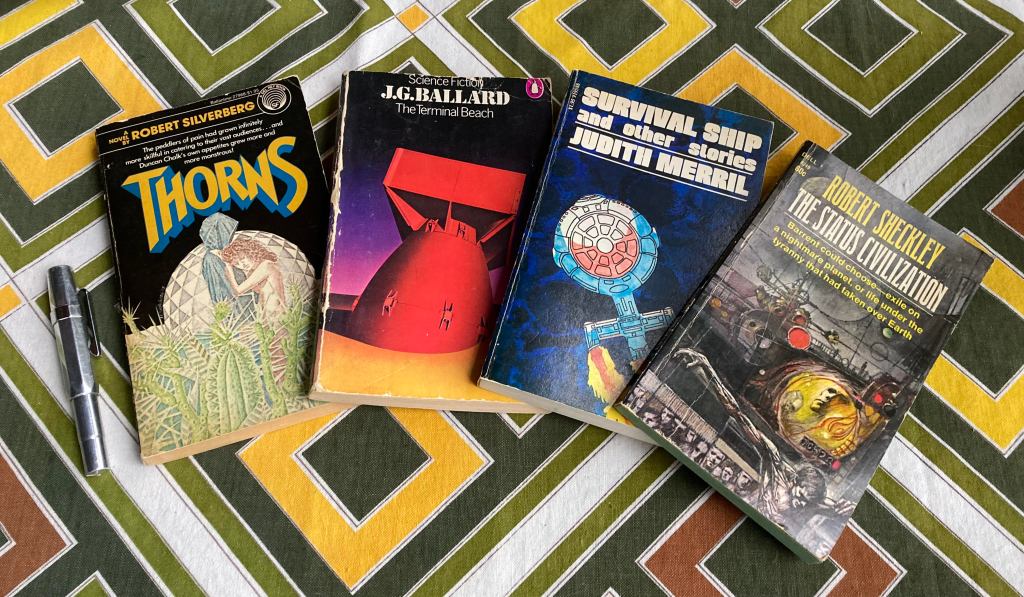
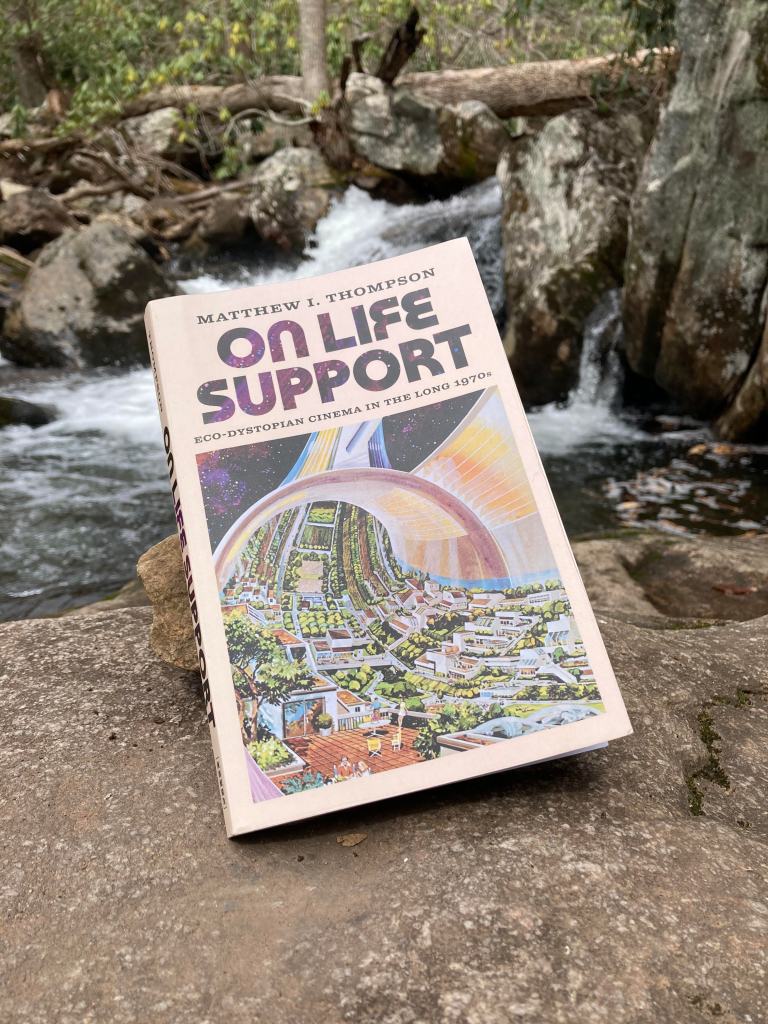
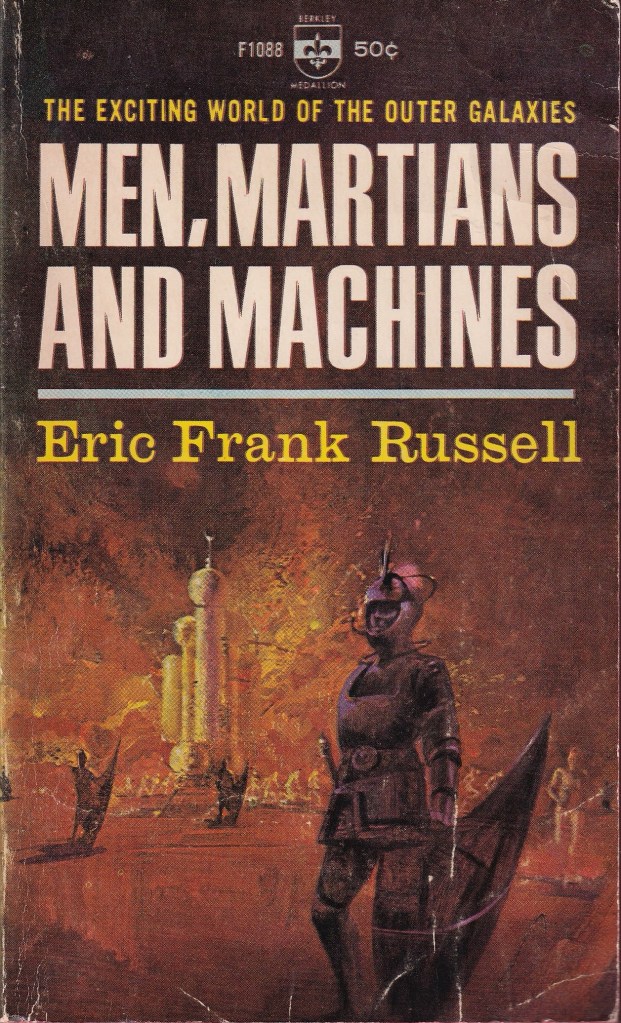
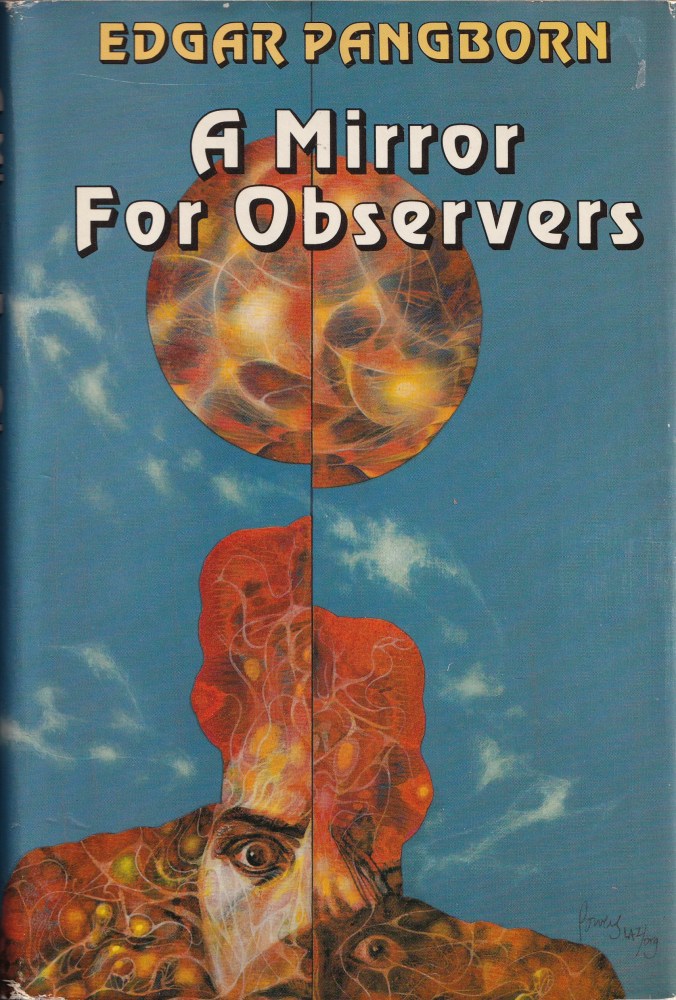
What pre-1985 science fiction are you reading? + Update No. XXVII

What pre-1985 science fiction are you reading or planning to read next month? Here’s the October installment of this column.

If I’m feeling a bit unmotivated to write about science fiction, I always end up on Fanac or another online repository of fanzines/newspapers exploring all the old historical fannish debates. I especially enjoy their reports on various conventions and the community (from accepting to reactionary) that emerges. For example, the details I uncovered about a lost Philip José Farmer speech titled “SF and the Kinsey Report at the 11th World Science Fiction Convention (Philcon 2) in Philadelphia (September 1953) and Pat M. Kuras and Rob Schmieder’s article “When It Changed: Lesbians, Gay Men, and Science Fiction Fandom” (1980) on the first Worldcon panel with an openly LGBTQ topic: “The Closed Open Mind: Homophobia in Science Fiction Fantasy Stories” moderated by Jerry Jacks, one of the “early openly gay fans.” I recently edited a friend’s article for academic publication on the role of conventions in forming feminist and political activism. Conventions sound like fascinating places, at least from my historically-minded vantage point and lens.

Continue reading

Updates: Recent Science Fiction Purchases No. CCCXLVI (Kim Stanley Robinson, Miriam Allen DeFord, Keith Laumer, and Jack Dann)

Which books/covers/authors intrigue you? Which have you read? Disliked? Enjoyed?

Finally acquired a new scanner!

1. The Memory of Whiteness, Kim Stanley Robinson (1985)

From the back cover: “In the 33rd century humanity is scattered among the planets of the Solar System. Millions of lives depend on the revolutionary physics of Arthur Holywelkin; millions of hears are moved by the music created by the strange, eerie instrument he built in the last years of his life: the Orchestra. Johannes Wright is the Ninth–and youngest–Master of the Orchestra. But as he sets out on his first Grand Tour of the Solar System, unseen foes are at his heel, ready to reveal all but the meaning of their enmity. In confronting them, Wright must redefine the Universe–for himself and all humanity.”

Continue reading

What pre-1985 science fiction are you reading? + Update No. XXVI

What pre-1985 science fiction are you reading or planning to read next month? Here’s the August installment of this column.

The Power of the List. I adore lists. I’ve compiled lists of science fiction stories on my site about generation ship stories, immortality (abandoned), overpopulation (abandoned), and sports and games (abandoned). I religiously update my SF Novel and Short Story Review index and the Best SF Novels I’ve reviewed index. In your exploration of genre, I imagine you’ve encountered a “Best Of” list that horrified you — they tend to generate controversy, argument, and all sorts of impulsive takes. Lists can be dangerous. Lists can suggest canon. Lists exclude. Lists can be incomplete. Lists can motivate. Ian Sales, a long-time critic, author, and visitor to my site, created the SF Mistressworks (unfortunately, also abandoned) website in response to an egregious list that demonstrate utter ignorance about the wonderful SF written by women.

Continue reading

Updates: Recent Science Fiction and Fantasy Purchases No. CCCXLV (Ursula K. Le Guin, Alan Garner, Burt Cole, and a Cyberpunk Anthology)

Which books/covers/authors intrigue you? Which have you read? Disliked? Enjoyed?

I apologize for the photos of my copies instead of my normal hi-res scans. My scanner died suddenly. Goodbye Dutiful and Dedicated Recorder of the SF Volumes.

1. Always Coming Home, Ursula K. Le Guin (1985)

From the back cover: “Ursula K. Le Guin’s Always Coming Home is a major work of the imagination from one of America’s most respected writers of science fiction. More than five years in creation, it is a novel unlike any ever written. A rich and complex interweaving of story and fable, poem, artwork and music, it totally immerses the reader in the culture of the Kes, a peaceful people of the far future who inhabit a place called the Valley on the Northern Pacific coast.”

Continue reading

Short Book Reviews: Joe Haldeman’s All My Sins Remembered (1977) and Burt Cole’s Subi: The Volcano (1957)

Note: My read but “waiting to be reviewed pile” is growing. Short rumination/tangents/impressions are a way to get through the stack before my memory and will fades. My website partially serves as a record of what I have read and a memory palace for future projects. Stay tuned for more detailed and analytical reviews.

1. Joe Haldeman’s All My Sins Remembered (1977)

4/5 (Good)

The vast Confederación is comprised of radically distinct worlds ruled by the entire spectrum of political systems with both alien and non-alien inhabitants. There are few rules: don’t take advantage of indigenous populations and don’t wage wars on neighboring planets. At 22, the naive Otto McGavin, an Anglo-Buddhist, joins the Confederación as an agent to “protect the rights of humans and non-humans” (1). But there’s a twist. Under “deep hypnosis” (6) a “construct” of Otto McGavin will be created for each mission. He’ll take on the identity–under a sheath of plasticine flesh–of whatever person he needs to be depending on the task. Otto, and all his training, will only kick in when his life is at risk.

Continue reading

What pre-1985 science fiction are you reading? + Update No. XXV

What pre-1985 science fiction are you reading or planning to read next month? Here’s the July installment of this column.

One of my favorite forms of SF scholarship is careful identification of a intellectual genealogy–tracing what an author read and engaged in dialogue with. Authors are readers. They also can’t escape references and textual traces of what they’ve consumed (or, of course, engagement with the world in which they lived).

I’ve read two interesting examples recently. The first, Carol McGuirk’s “J. G. Ballard and American Science Fiction” in Science Fiction Studies, vol. 49 (2022), is the perfect example of this type of scholarship. She traces Ballard’s engagement with SF, his earliest stories, and the various parallels an interactions between his work and American SF that he read (Galaxy Magazine, Theodore Sturgeon, Fritz Leiber, Robert Heinlein, Frederik Pohl, C. M. Kornbluth, Ray Bradbury, Judith Merril, Federic Brown, Henry Kuttner, C. L. Moore, etc.). She argues that Ballard engaged in “retelling with a twist” (476). She writes that “early Ballard stories rework prior sf in moods ranging from measured homage to barbed repose to parodic photo-bomb” (483).

Continue reading

Book Review: Jack Dann’s Timetipping (1980)

3.75/5 (collated rating: Good)

Alien sex dolls. Carpet stain entities constructing love-nests. Underground retirement community entertainment. Jack Dann’s stories obsessively chart the new rituals of survival in a blasted, irradiated, and decayed future. His characters attempt to identify their place in the world, or, at the very least, stay alive as the world shifts. If you do not care for anti-heroes, a good dose of dystopian perversity, and moments of metaphysical descent, Timetripping (1980) might not be for you. Four of the fourteen stories in the collection were nominated for the Nebula Award.

If you are a fan of the New Wave (and Barry N. Malzberg and Robert Silverberg in particular), and haven’t yet explored Dann’s nightmares, don’t wait as long as I did. Also, go ahead and snag a copy of his later masterpiece The Man Who Melted (1984). I’ve acquired copies of two early fix-up novels Junction (1981) and Starhiker (1976).

My 20 best short story reads of 2025 will undoubtedly include a handful of stories from Timetripping (1980). I found his best works—“The Dybbuk Dolls” (1975), “A Quiet Revolution for Death” (1978), “I’m with You in Rockland” (1972), and “Camps” (1979)—remain cohesive despite moments of metaphysical rumination and deluge of surreal image. Even at his least effective moments of narrative wander, Dann adeptly conjures image and turn of phrase.

Continue reading

What pre-1985 science fiction are you reading? + Update No. XXIV

What pre-1985 science fiction are you reading or planning to read next month? Here’s the June installment of this column.

I adore teaching American History for college credit. Every summer I ponder what to change and improve. And this year, I want to integrate a few science fiction stories!

My 1950s unit in the spring semester could be modified with a few science fiction short stories. Considering my ongoing fascination with media landscapes of the future, I want to integrate one story on fears over television and one on nuclear horror (which would fit nicely with a group of assignments I have using song lyrics about atomic panic). Feel free to suggest a story that you would include or wish was included in your own US college course (or advanced high school course). No novels unfortunately. I have access to a range of syllabi and a TON of ideas but I always love to hear your selections.

Before we get to the photograph above and the curated birthdays, let me know what pre-1985 SF you’re currently reading or planning to read! 

Continue reading

Book Review: Zoë Fairbairns’ Benefits (1979)

3.75/5 (Good)

Zoë Fairbairns’ Benefits (1979) charts the struggles of the British women’s liberation movement in a dystopic near future. An anti-feminist fringe political party called FAMILY comes to power, simultaneously proclaiming family values while systematically dismantling the welfare state. Benefits effectively eviscerates governmental doublespeak and champions the need to organize and educate in order to fight against patriarchal forces and messianic movements that promise to solve all our ills.

The Lay of the Land

The year is 1976. A massive heatwave rocks the UK.1 However, a seemingly innocuous policy will be used to plunge the country into nightmare. The plan? The British government promises to implement “weekly payment to mothers” (5).2 The titular “benefits” would move some earnings from the wallets of fathers into the purses of mothers. The problem? Confronted by a powerful male-dominated trade union movement attempting to protect its male workers, the government “flew in the face of its commitment to women’s rights” and postponed the scheme (5). Mothers decides to go on strike.

Continue reading