Which books/covers/authors intrigue you? Which have you read? Disliked? Enjoyed?
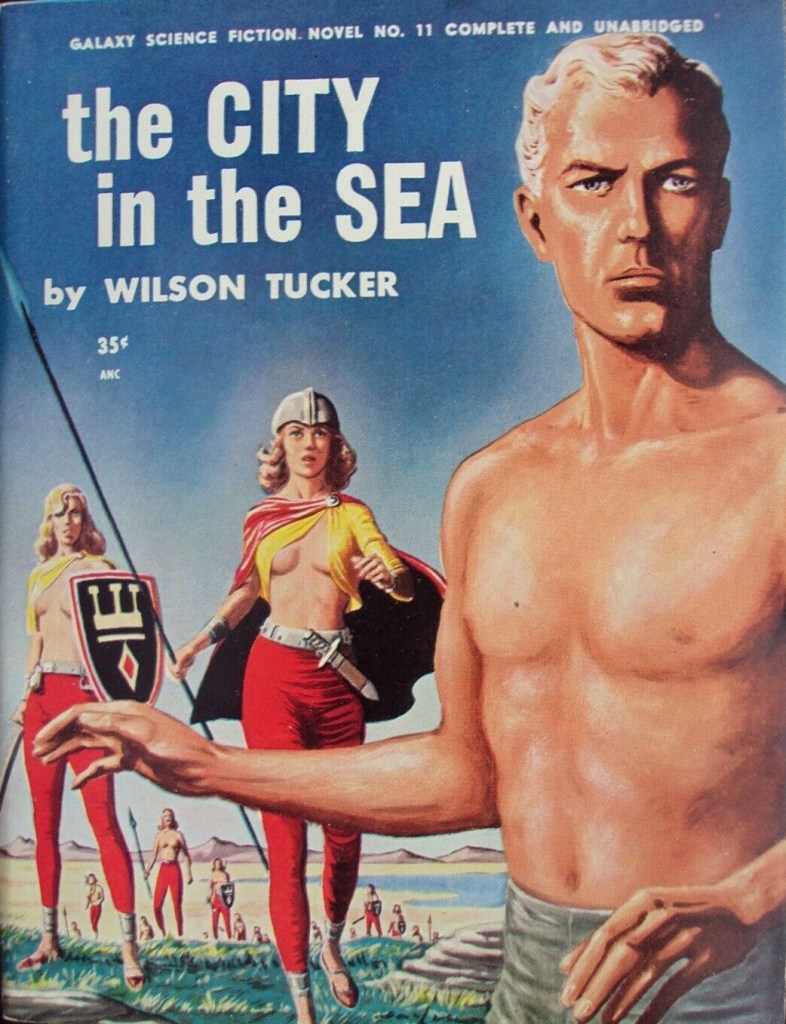
1. The City in the Sea, Wilson Tucker (1951)
Ed Emshwiller’s cover for the 1952 edition
From the inside flap: “Who knows whether the strange events of this story might not one day occur?
This is the story of an expedition—a strange and exciting expedition of one man and an army of women.
He had come into the land of the women suddenly—and without warning. Tall, bronzed, muscular, he stood out among their pale skins and meek spirits. And when they learned of the land from which he had come–the land they hadn’t even known existed—they had to follow him to it.
This is Part I of II in a series covering the short fiction of Russell Bates (1941-2018), one of a handful of Native American science fiction authors active in the 1970s [1]. I first came across his name while investigating all the authors featured in Craig Strete’s Native American fanzine Red Planet Earth (6 issues in 1974) [2]. I’ve managed to piece together the following information about his SF career.
Born in Lawton, Oklahoma (I’ve also seen Anadarko, OK implied as a birthplace), Bates was an enrolled member of the Kiowa tribe. After he finished high school, he entered the U.S. Air Force. While injured after an explosion at a missile assembly building, he was encouraged to take up a hobby. He began writing science fiction stories–including Star Trek fanfiction (discussed in more detail below) [4].
Interested in honing his craft, Bates attended the famous Clarion workshop in 1969, and his first story, “Legion” (1971), hit print two years later [4]. He published six science fiction short stories between 1971-1977. A seventh–“Search Cycle: Beginning and Ending 1. The Last Quest; 2. Fifth and Last Horseman”–was scheduled to appear in Harlan Ellison’s infamous Last Dangerous Visions, originally slated for 1973. It hasn’t been published elsewhere.
Bates decided to try his luck in Hollywood. He joined a Writer’s Guild program for minorities with the assistance of D. C. Fontana. Initially unsuccessful, his rejected Star Trek story attempt later appeared in The New Voyages 2(1978). He kept the American Indian crew member Walking Bear that later appeared in his only co-written Star Trek credit ST: The Animated Series’ “How Sharper Than a Serpent’s Tooth” (1974). It is for this episode that Bates is probably best known as it is the only episode of the two original Star Trek series that won an Emmy Award. Unfortunately, despite quite a few sales to the motion picture industry, few of his stories saw the screen after his early Star Trek credit [5].
Without further tangents, lets turn to his first three science fiction short stories–each a rumination on violence and trauma–to hit print.
Jim Steranko’s cover for Infinity Two, ed. Robert Hoskins (1971)
Today I’ve reviewed the twenty-sixth and twenty-seventh story in my series on the science fictional media landscape of the future. In Kate Wilhelm’s masterpiece of blue-collar drama “Ladies and Gentlemen, This Is Your Crisis” (1976), reality TV serves both as domestic irritant and therapy. Langdon Jones, in “The Empathy Machine” (1965), also speculates on the therapeutic aspects of “viewing” the crisis of another in a media-drenched future.
As always, if you know of other stories connected to this series that I haven’t reviewed, then let me know in the comments!
David Plourde’s cover art detail for the 1978 edition of Best Science Fiction Stories of the Year: Sixth Annual Collection, ed. Gardner Dozois (1977)
5/5 (Masterpiece)
Kate Wilhelm’s “Ladies and Gentlemen, This Is Your Crisis” first appeared in Orbit 18, ed. Damon Knight (1976). You can read it online here if you have an Internet Archive account. I read it in her collection Somerset Dreams and Other Fictions (1979).
Lottie comes home from the factory Friday afternoon with “frozen dinners, bread, sandwich meats, beer” to prepare for the weekend watching reality TV with her husband Butcher (121). As predicted, Butcher comes home mad, “mad at his boss because the warehouse didn’t close down early, mad at traffic, mad at everything” (123). He pulls up his recliner–they’ll sleep in front of the softly flickering screens–Lottie microwaves the dinners and brings her husband beer. The ritual commences.
Which books/covers/authors intrigue you? Which have you read? Disliked? Enjoyed?
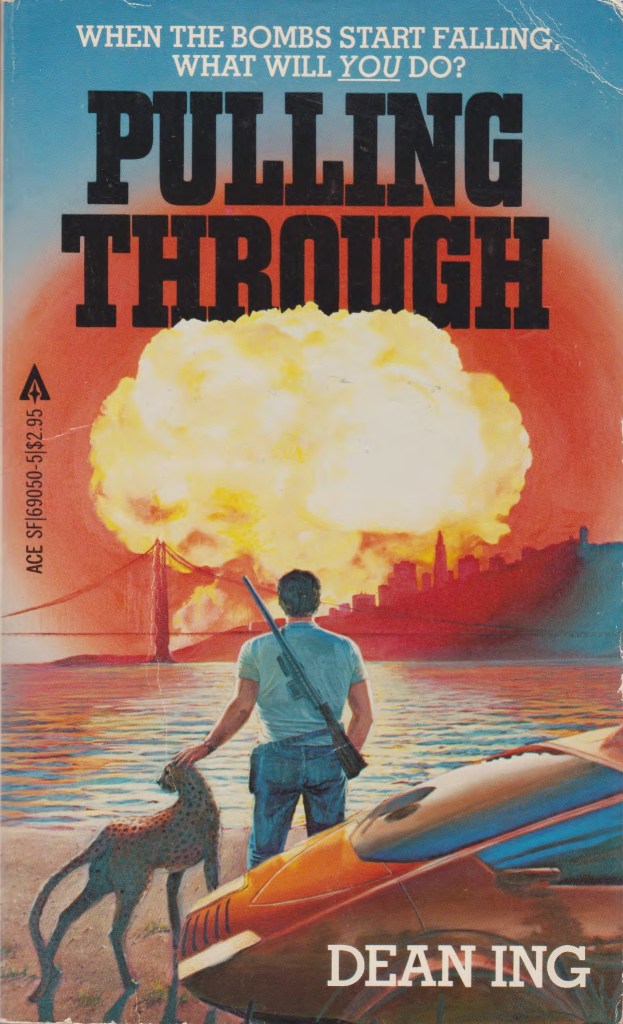
1. Pulling Through, Dean Ing (1983)
Uncredited cover for the 1st edition
From the back cover: “DOOMSDAY. ARE YOU READY?
HARE RACKHAM, bounty hunter, race-car driver. His best friend is a hunting cheetah. Harve has turned his California home into a survival shelter. He intends to pull through.
SHAR MCKAY, Harve’s little sister. Shar’s latest fad is nuclear survival. She intends for her husband and kids to all pull through.
ERNEST MCKAY, engineer. He has the knowledge and skills to save his family. With his help they’ll all pull through.
KATE GALLOW, runaway, forger, a tough street survival. She’s trouble–but when real troubles come down, Kate will always pull through.
Dean Ing has thought a lot about survival, and he wants as many of you as possible to pull through inevitable disaster of nuclear war. That’s why he’s written this more-than-a-novel. Dean Ing lays all the cards on the table in this one. The story tells why. The articles and blue-prints tell how. PULLING THROUGH won’t save your hide all by itself, but it sure will give you a head start on pulling through by yourself.”
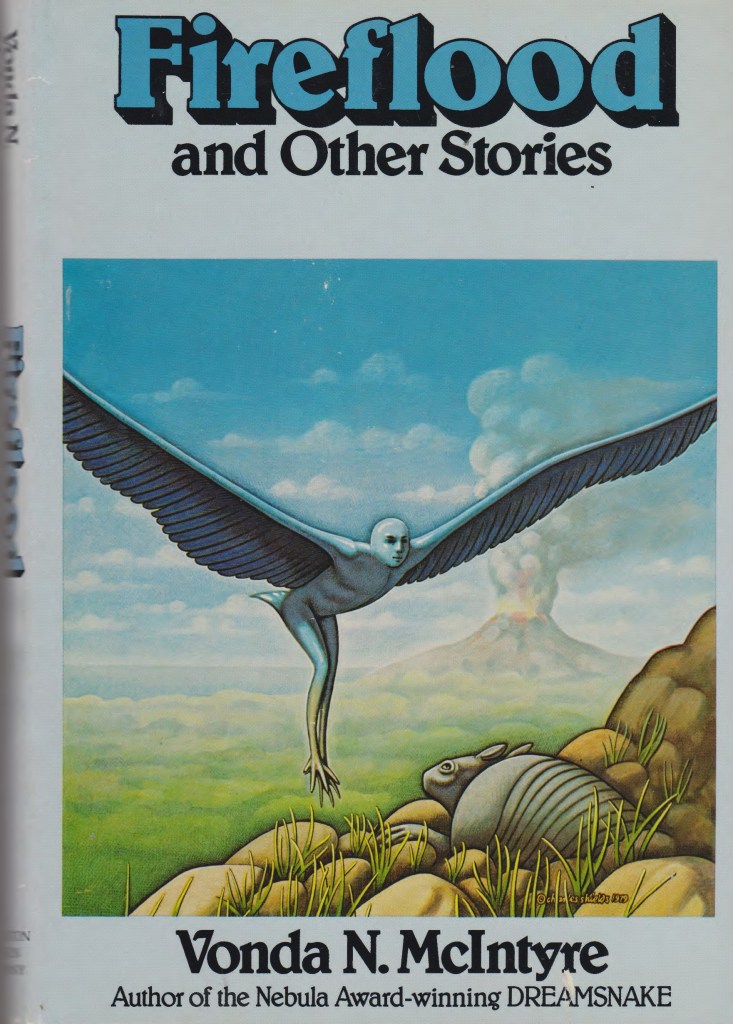
After Vonda N. McIntyre’s passing in 2019, I made a promise to finally tackle her spectacular array of 70s fictions, including her Hugo and Nebula-winning Dreamsnake(1978). Her stories appeal to so many of my sensibilities. Her perceptive eye resides in interior spaces, the moody psychological landscapes of society’s pariahs and traumatized. Her work reflects the best of the New Wave. The prose rarely flashes with excessive experimental exuberance but relies on the poetic moment hinting at internal sadness, decay, and the inability to truly escape.
Despite her often depressed narrators, the stories are not all without hope. In “Of Mist, and Grass, and Sand” (1973), horrific misunderstanding reinforces a healer’s calling. In “Wings” (1973) and “The Mountains of Sunset, the Mountains of Dawn” (1974), the transformed find meaning in interpersonal connection as the unknown spins closer.
There’s a running theme in the collection of technology prematurely and cruelly unleashed. In “Spectra” (1972), a girl is enslaved to a machine that causes others pleasure. In “Aztecs” (1977), the choice–the physical reworking of the body–to become a Pilot servers all possibilities of love. And in “The Genius Freaks” (1973), the mental workings of genetically modified are harvested by cruel overlords unable to confront the lives they have ruined.
Which books/covers/authors intrigue you? Which have you read? Disliked? Enjoyed?
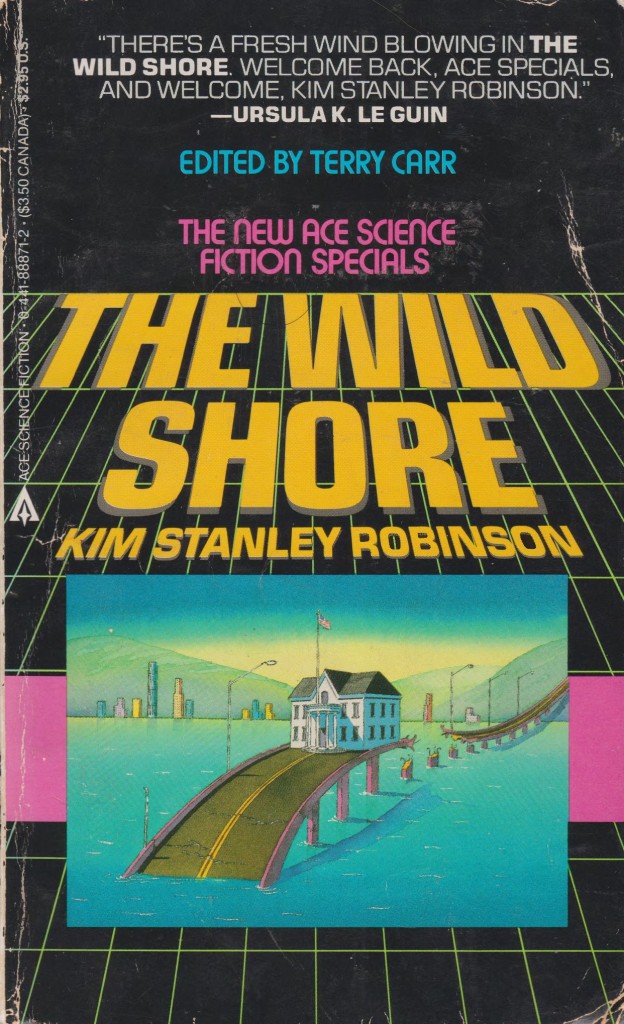
1. The Wild Shore, Kim Stanley Robinson (1984)
Andrea Baruffi’s cover for the 1st edition
From the back cover: “Seventeen-year-old Henry wanted to help make America great again, like it had been sixty years ago, before all the bombs went off. But for the people of Onofre Valley, just surviving was challenge enough. Then one day the world came to Henry, in the shape of two men who said they represented the American Resistance…”
The following reviews are the 21st and 22nd installments of my series searching for SF short stories that are critical in some capacity of space agencies, astronauts, and the culture which produced them. Some stories I’ll review in this series might not fit. Many are far from the best. And that is okay. I relish the act of literary archaeology.
I’ve paired a take by Tom Godwin (1915-1980) and George R. R. Martin (1948-) on the psychiatric impact of isolation in the bleak emptiness of space. Both explore the interior landscape of the mind alone with itself and all its memories, and delusions, and terrors. There are no heroes in these pages.
Kelly Freas’ cover for Analog Science Fiction/Science Fact, ed. Ben Bova (December 1972)
4/5 (Good)
George R. R. Martin’s “The Second Kind of Loneliness” first appeared in Analog Science Fiction/Science Fact, ed. Ben Bova (December 1972). You can read it online here.
At the Edge of the Vortex We Tell So Many Lies
The location: the Cerberus Star Ring, six million miles beyond Pluto (10). The manmade station, “a circle whose diameter is more than a hundred miles” (12), surrounds a nullspace vortex (think wormhole) to an unknown location across the universe. Humanity sends ships through the brightly colored swirling eddies of the portal to establish colonies somewhere beyond. A single man operates the machinery on the ring from a featureless white control room via a holograph helmet (11). The story follows the journal entries of an unreliable narrator ostensibly counting down the days until his relief arrives from Earth: “It will be at least three months before he gets here, of course. But he’s on his way” (10). It’s a mantra he tells himself. Relief is on its way. Relief is on its way. But does he want relief?
I’ve decided to reframe my series on 50s sex and sexuality to include my entire area of SF interest (1945-1985). Thus, I’ve paired Robert Silverberg’s “The Seed of Earth” (1958), a rumination on colonization and human/alien sex, with Doris Piserchia’s “Pale Hands” (1974), a distressing dissection of a future society designed to fixate all sexual desire on masturbation stalls.
If any short stories published between 1945-1985 on sex and sexuality come to mind that I haven’t reviewed yet, let me know in the comments. I have a substantial list waiting to be covered but it’s far from comprehensive.
Ed Emshwiller’s cover for Super-Science Fiction, ed. W. W. Scott (April 1958)
3.5/5 (Good)
Robert Silverberg’s “The Seed of Earth” (variant title: “Journey’s End”) first appeared in Super-Science Fiction, ed. W. W. Scott (April 1958). You can read it online here. It is also available in his collection Dimension Thirteen (1969) that I plan on reviewing in the near future.
A preliminary note about publication: Silverberg reused the title “The Seed of Earth”–chosen by W. W. Scott over “Journey’s End”–for a later unrelated novella and a novel.




 Science Fiction and Other Suspect Ruminations