Updates: Recent Science Fiction Acquisitions No. CCCI (Angela Carter, Keith Roberts, J. L. Hensley, and a Leo Margulies Anthology)

Which books/covers/authors intrigue you? Which have you read? Disliked? Enjoyed?

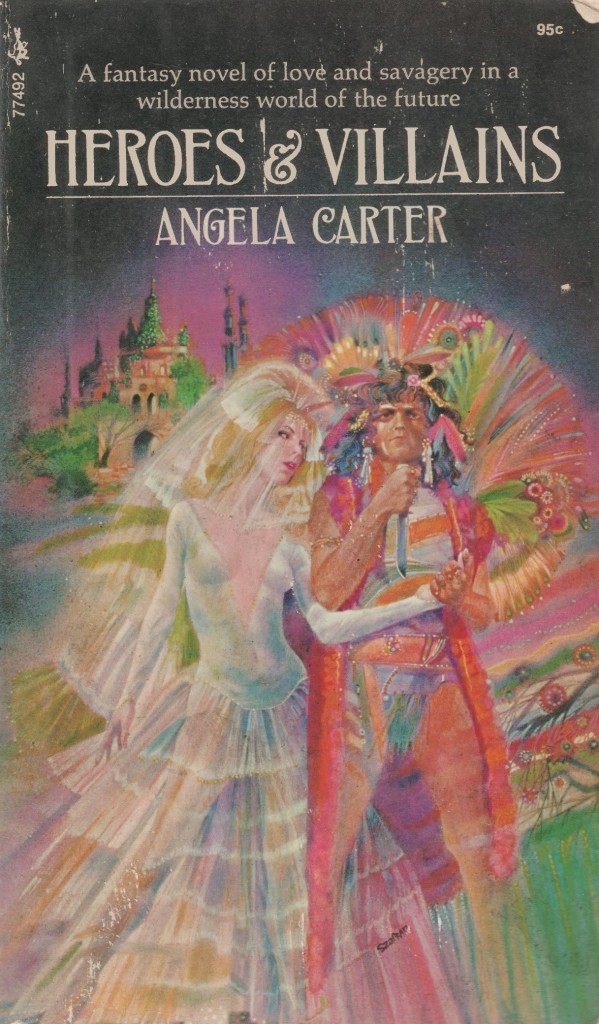
1. Heroes & Villains, Angela Carter (1969)

From the back cover: “The Barbarians had attacked the village, looting and burning. And when they left, Marianne, a daughter of the scientists, went with them. Now she followed Jewel, leader of the barbarians, and lived with him as his captured bride…”

Initial Thoughts: A few years ago I read, and was blown away, by Angela Carter’s The Infernal Desire Machines of Doctor Hoffman (1972). I placed it on my best reads of 2016 list but never managed to write a review. Inspired by the novel, I wrote an article derived from a fascinating 1979 interview on Angela Carter’s views on science fiction–including her inspirations and the state of the British SF scene, Michael Moorcock’s prodigious production and New Worlds editorship, and the unescapable influence of J. G. Ballard.

Continue reading

Updates: Recent Science Fiction Purchases No. CCC (James Blish, Norman Spinrad, R. M. Meluch, Kurt Vonnegut, Jr.)

My 300th purchase post!

Which books/covers/authors intrigue you? Which have you read? Disliked? Enjoyed?

Preliminary Note: As I’m currently on vacation, the images in this post are photographs of my volumes rather than my normal hi-res scans. I’ll replace them when I get home.

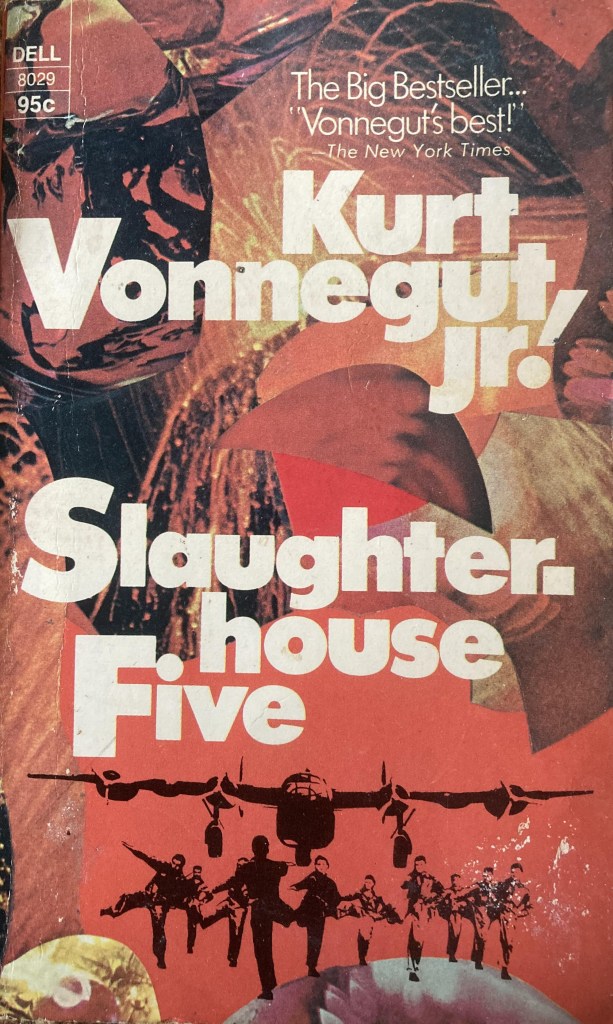
1. Slaughterhouse-Five or The Children’s Crusade: A Duty-Dance with Death, Kurt Vonnegut, Jr. (1969)

From the inside page: “TAKE A TRIP WITH BILLY PILGRIM

-To the cellar of a slaughterhouse in Dresden, a city about to be destroyed by the greatest man-made catastrophe of all time.

-To happy marriage and mating with the sweet and willing daughter of one of the finest citizens of Illium, New York.

-To a luxurious zoo on the planet Tralfamadore for the public exhibition of lovemaking with the famous Earthling blue-moviestar, Montana Wildhack.

All in an amazing novel that could only have been written by Kurt Vonnegut, Jr., a writer whose wildest flights take you straight to the hear and now.

Continue reading

Recent Science Fiction Purchases No. CCXCIX (Henry Kuttner, C. L. Moore, Jack Williamson, Jacob Transure, Star Anthology)

Which books/covers/authors intrigue you? Which have you read? Disliked? Enjoyed?

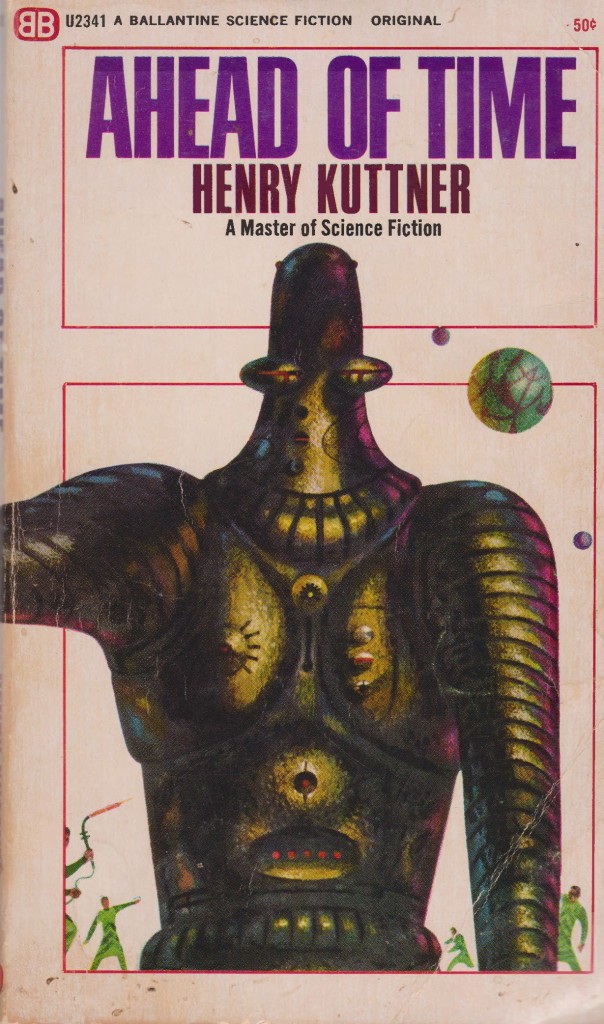
1. Ahead of Time, Henry Kuttner and C. L. Moore (1953)

From the inside page: “A brain in a box fights a criminal plot

A visitor from the future turns out to be peculiar even for his society

An eternal hillbilly family survives the centuries and gets into political trouble

A sick electronic calculator catches a psychosis from its operator

…these are some of the highly original and vividly written stories you will find in this selection of a master’s work.

Science fiction and fantasy grow constantly in popularity. Writing of this quality and imagination is the reason. Henry Kuttner demonstrates again in his book why more and more readers are becoming devotees of that intriguing fiction which is not content to stay in the world as we see it and know it, which takes us to the farthest reaches of space and time, to the farthest reaches of the human mind.”

Continue reading

Updates: Recent Science Fiction Purchases No. CCXCVIII (Harlan Ellison, Edward Bryant, Murray Constantine, Sayko Komatsu, and an automobile-themed anthology)

Which books/covers/authors intrigue you? Which have you read? Disliked? Enjoyed?

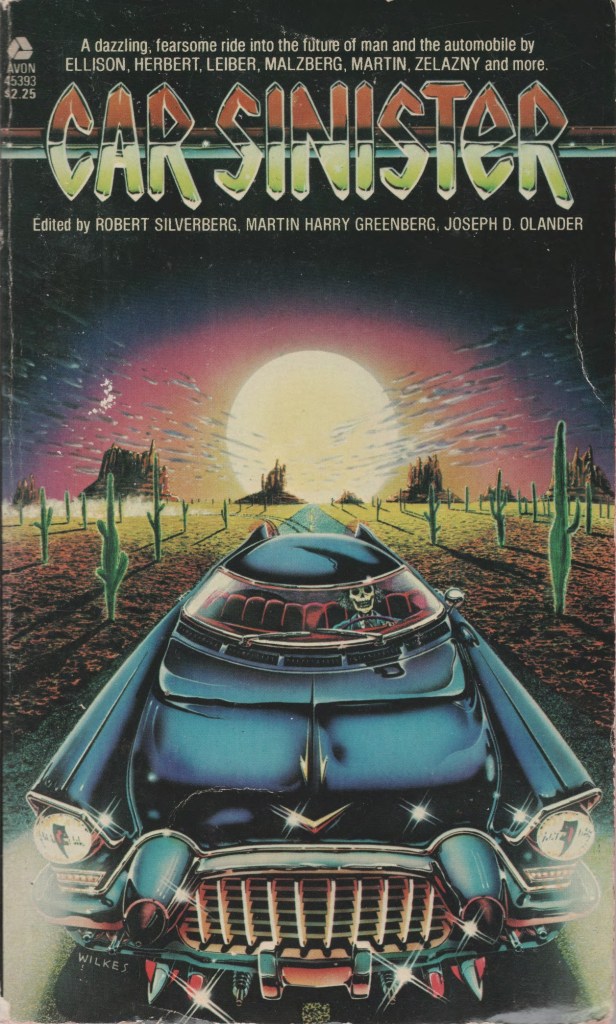
1. Car Sinister, ed. Robert Silverberg, Martin Harry Greenberg, and Joseph D. Olander (1979)

From the back cover: “MAN AND HIS MACHINE. The car is man’s most personalized machine; for teenagers it is a rite of passage and a statement of freedom; for adults it is a reflection of success, taste, and hopes; and for an entire culture it is a great and industrious mode of transportation–driving, perhaps, on the road of destruction. And the automobile–thrilling, honking, speeding, nerve-shattering–haunts us with the dark possibility that when our age of motoring innocence is over, we may no longer be the masters… CAR SINISTER–a splendid, imaginative vision of what lies down the road for all of us.”

Continue reading

Book Review: The Grain Kings, Keith Roberts (1976)

4/5 (collated rating: Good)

Keith Roberts (1935-2000) was an influential, if underread and underappreciated, English author (and cover artist) best known for his alternate history fix-up novel Pavane (1968) and powerful short fictions evocative of the English countryside. He won four BSFA awards in various categories (novel, short story, and artist) yet did not achieve the same critical success in the United States. According to his obituary, his difficult personality, like his common male main characters unable to form steady professional or personal relationships, and propensity to refuse to deal with major publishers impacted his popularity.

Continue reading

Future Media Short Story Review: Barry N. Malzberg’s “The Idea” (1971) (as K. M. O’Donnell)

Today I’ve reviewed the thirteenth story in my series on the science fictional media landscape of the future. Here, I finally return to the nightmarish embrace of Barry N. Malzberg.

Previously: Pat Cadigan’s “Rock On” (1984).

Up Next: Walter F. Moudy’s “The Survivor” (May 1965).

3.5/5 (Good)

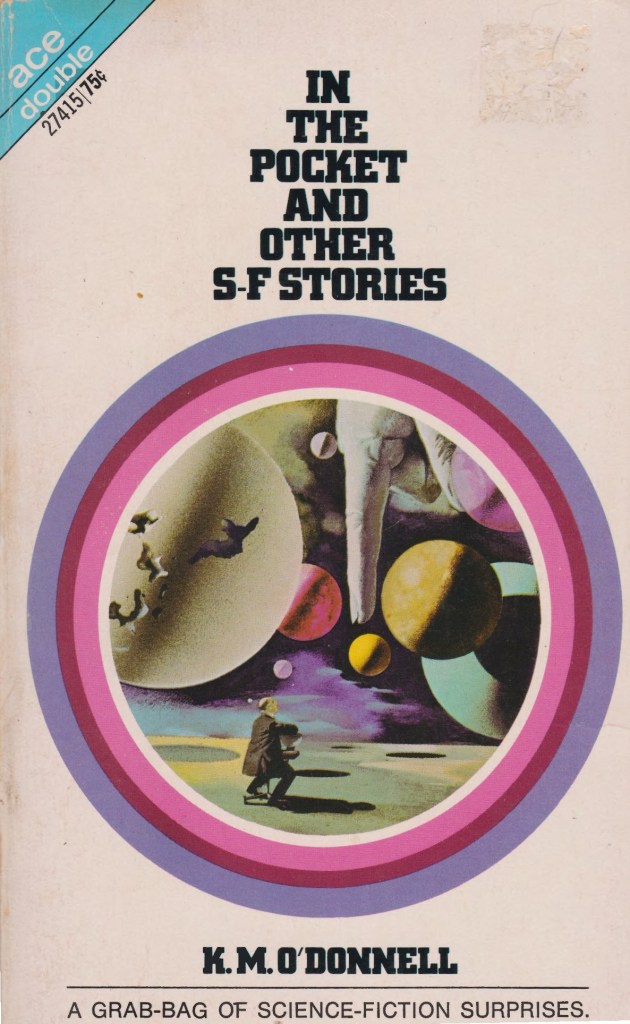
Barry N. Malzberg’s “The Idea” first appeared in In the Pocket and Other S-F Stories (1971) (as K. M. O’Donnell). I cannot find the story online. Please contact me if you do not own a copy and want a PDF of the story. I recommend you procure the fantastic anthology TV: 2000, ed. Isaac Asimov, Martin H. Greenberg, Charles G. Waugh (1982) which “The Idea” also appears in. I’ll be returning to this volume in coming weeks for this series.

Reading a Barry N. Malzberg story is like returning to a familiar embrace–an embrace of the blackest satire conveyed via terrifying existential traps. Ever since I read his masterpiece Beyond Apollo (1972), a metafictional destruction of America’s obsession with space exploration, Malzberg joined the pantheon of my favorite authors.

Continue reading

Short Book Reviews: Michael G. Coney’s Monitor Found in Orbit (1974) and Ron Goulart’s After Things Fell Apart (1970)

Note: My read but “waiting to be reviewed pile” is growing. Short rumination/tangents are a way to get through the stack before my memory and will fades. Stay tuned for more detailed and analytical reviews.


1. Monitor Found in Orbit, Michael G. Coney (1974)

3/5 (collated rating: Average)

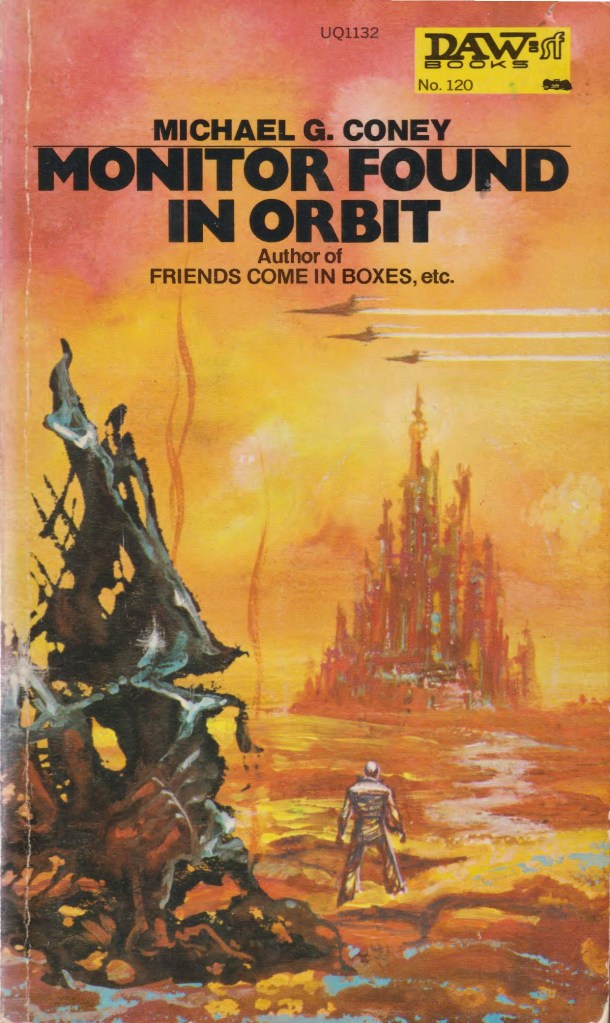
I’ve long enjoyed Michael G. Coney’s science fiction–check out Friends Come in Boxes (1973), Hello Summer, Goodbye (variant title: Rax) (1975), “Those Good Old Days of Liquid Fuel” (1977), and my recent rumination on “The Mind Prison” (1971) (which appears in this collection) for my Generation Ship Short Story Review series. Unfortunately, the majority of the stories in Monitor Found in Orbit (1974), his only published short story collection, are middling at best. I waited far too long to review this one! Despite the presences of some solid to good stories, I can only provide brief summaries at this point without a reread.

Continue reading

Updates: Recent Science Fiction Purchases No. CCXCIII (Theodore Sturgeon, Kevin O’Donnell, Jr., R. M. Meluch, Ian Macpherson)

Which books/covers/authors intrigue you? Which have you read? Disliked? Enjoyed?

1. The Synthetic Man (variant title: The Dream Jewels), Theodore Sturgeon (1950)

From the back cover: “SUPERKIDDO! He ran away from home into the carny world. Noname “Kiddo,” disguised as a little girl in a freak show. What he didn’t know didn’t exist. What he couldn’t do was unimaginable. What he hadn’t asked was obvious: ‘Who am I and where did I come from?'”

Continue reading

Updates: Recent Science Fiction and Fantasy Purchases No. CCXCII (Jack Vance, Craig Strete, Cherry Wilder, Giorgio De Maria)

Which books/covers/authors intrigue you? Which have you read? Disliked? Enjoyed?

1. The Brave Free Men, Jack Vance (magazine 1972)

From the back cover: “The Faceless Man was a prisoner in his own palace and his power over the people of Durdane was in the hands of another–the hands of Gestel Etzwane, a youth whose thirst for vengeance against the dreaded Roguskhoi would slacken only in oceans of their blood.

But to destroy the Roguskhoi, Gastel would have to unite a world that survived by its separateness. To do this was more than dangerous, but Gestel had little choice. He would return to the people control of their lives–and send them to fight to their death…”

Continue reading