Which books/covers/authors intrigue you? Which have you read? Disliked? Enjoyed?
1. The Martian Chronicles, Ray Bradbury (1950)
Ian Miller’s cover for the 1979 edition
From the back cover: “A MAGNIFICANCTLY ILLUSTRATED EDITION OF THE MARTIAN CHRONICLES WHICH MASTERFULLY ENHANCES THE CLASSIC WONDER AND TERROR BY THE WORLD-RENOWNED AUTHOR OF THE ILLUSTRATED MAN RAY BRADBURY.
Note: My read but “waiting to be reviewed pile” is growing. Short rumination/tangents are a way to get through the stack before my memory and will fades. Stay tuned for more detailed and analytical reviews.
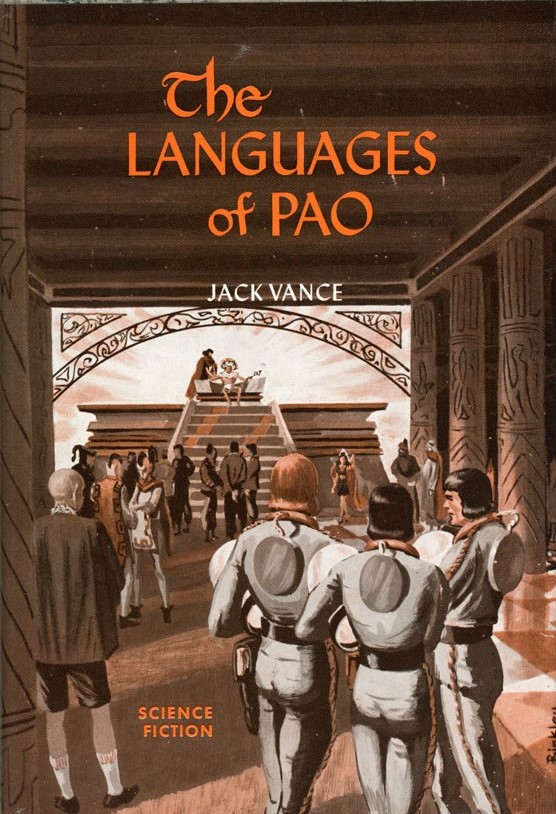
1. The Languages of Pao, Jack Vance (1958)
Ric Binkley’s cover for the 1958 1st edition
3.25/5 (Vaguely Good)
Since I started my site in 2011, I’ve soured a bit on Jack Vance’s brand of planetary adventure in richly realized and exotic worlds. I doubt I’d currently rate novels like Showboat World(1975) or The Blue World (1966) as highly as I did back then. One of more appealing elements of having a single project for so long is my ability to track my evolving views on genre. That said, I’d classify Wyst: Alastor 1716(1978) and The Languages of Pao (1958) amongst his most conceptually ambitious novels I’ve read so far and worth tracking down. For a full list consult my index. Note: I read but never reviewed Dying Earth (1950).
Every morning for the last few years, I post on Twitter the birthdays (pre-1955) of artists, authors, and editors involved in some way with science fiction. In the last year, a singular compulsion has hit and I’ve started to include even more obscure figures like Gabriel Jan (1946-) and Daniel Drode (1932-1984). On May 31st, while perusing the indispensable list on The Internet Speculative Fiction Database, I came across an author unknown to me–Melisa Michaels (1946-2019) (bibliography). She’s best known for the five-volume Skyrider sequence (1985-1988) of space operas “depicting the growth into maturity of its eponymous female Starship-pilot protagonist” (SF Encyclopedia).
As I’m always willing to explore the work of authors new to me, I decided to review the first three of her six published SF short stories. Two of the three stories deal with my favorite SF topics–trauma and memory.
Karl Kofoed’s interior art illustrating Melisa Michaels’ “In the Country of Blind, No One Can See” in Isaac Asimov’s Science Fiction Magazine (January 1979)
“In the Country of the Blind, No One Can See” (1979), 3.5/5 (Good): First appeared in Isaac Asimov’s Marvels of Science Fiction (1979). It was reprinted in Isaac Asimov’s Science Fiction Magazine (January 1979). You can read it online here.
On a terraformed Mars, Allyson Hunter and her two clone sisters, Rebecca and Kim, are societal outcasts. They spent their lives trying to be “real people” yet were “reminded, every day in a dozen little ways, that they weren’t real people” (87). Clones retain their first usage as replacement body parts. Permitted to live only due to indications of telepathic potential (needed to guide spaceships), the sisters attempt to live meaningful lives and develop useful skills. The sisters charter two identical twins, Frank and Todd, to convey them across the Martian landscape. A horrific crash kills Kim and forces the survivors to work together and move past the deep resentment and hatred the brothers hold.
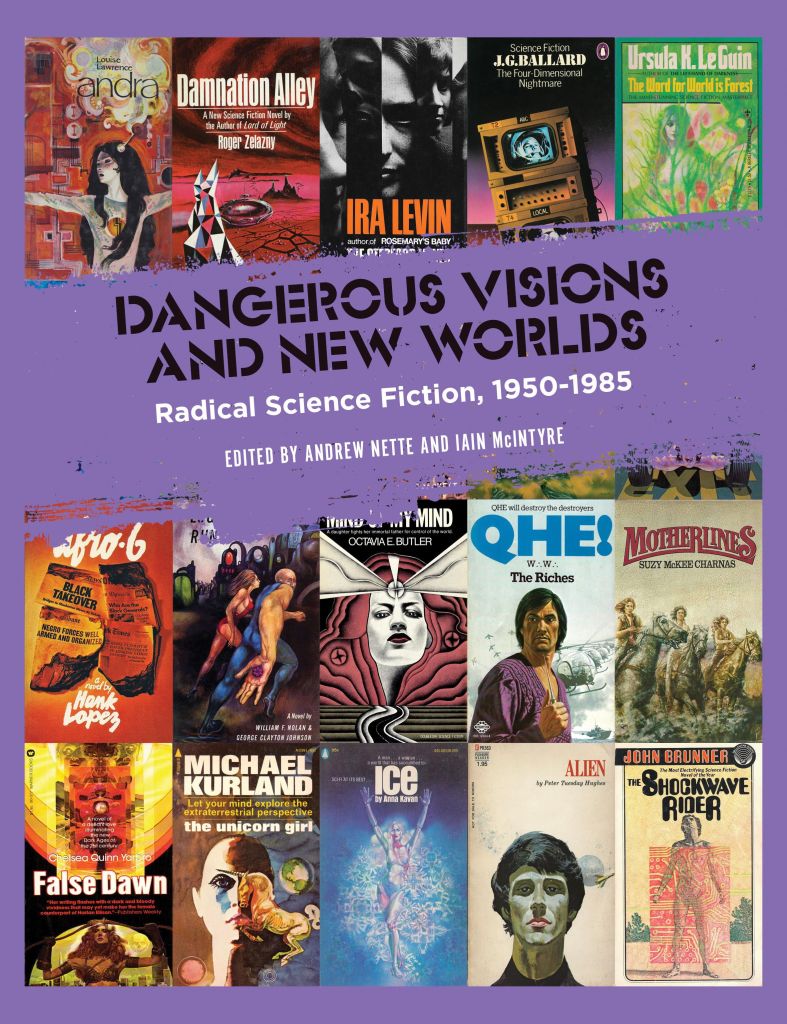
I’ve recently conducted a binge read of my ARC of Dangerous Visions and New Worlds: Radical Science Fiction, 1950-1985, ed. Andrew Nette and Iain McIntyre (2021). It is a must buy for any SF fan of the era interested in exploring the larger world behind the texts. Considering the focus of my website and most of my reading adventures over the last decade, I can unabashedly proclaim myself a fan of the New Wave SF movement–and this edited volume is the perfect compliment to my collection and interests.
The editors and PM Press have graciously provided me with the introduction to the volume. Perhaps it’ll convince you to purchase your own copy!
The “long sixties,” an era which began in the late 1950s and extended into the 1970s, has become shorthand for a period of trenchant social change, most explicitly demonstrated through a host of liberatory and resistance movements focused on class, racial, gender, sexual, and other inequalities. These were as much about cultural expression and social recognition as economic redistribution and formal politics. While the degree to which often youthful insurgents achieved their goals varied greatly, the global challenge they presented was a major shock to the status quo.
Along with Octavia E. Butler (1947-2005), Samuel R. Delany (1942-), John M. Faucette (1943-2003), John A. Williams (1925-2015), and Steven Barnes (1952-), Jesse Miller (1945-) was one of a handful of African American science fiction authors active in the 1970s (note). I have confirmed with Jesse Miller’s relatives that he is still alive. I initially, before confirmation, extrapolated his birthday from a quote in his author blurb in Orbit 16, ed. Damon Knight (1975): “I am black. I am twenty-nine, and I have a good sweet woman, whose name is Jean, and I am slowly going blind.”
Soon after his honorable discharge from the United States Airforce at 21 (after service in Vietnam?), he published four short stories between 1972 and 1979 and then left science fiction altogether. One of a legion of authors first published by the late Ben Bova, he was a finalist for the John W. Campbell Award for Best New Writer (renamed the Astounding Award) for his first published science fiction story “Pigeon City” (1972). He lost to Spider Robinson and Lisa Tuttle. He wrote his first story (published later in 1975) while in a VA hospital bed. For a bit about his life, his brief experience at SF conferences, reflections on losing the Campbell Award, and various humorous and serious interactions with other authors (he smoked a pernicious strain of weed with Joe Haldeman), check out his article “Obnoxia” (c. 2001). I’ve also included George R. R. Martin’s recollections, as recorded in his intro to “Twilight Lives” (1979), in the review of the story below.
Theodore Sturgeon penned the following about Miller in his intro to New Voices II, ed. George R. R. Martin (1979): “[Miller] has that rather rare gift of writing “there,” of giving the reader the feeling that the writer is on location and not operating on a built-up set. Jesse Miller will go flap-jappering up to a high place or he will disappear.” It’s a loss to the field that the latter happened. Three of the four short stories are worth the read! And “Pigeon City” is a near masterpiece that should be anthologized more widely.
If you happen to know any more about him, please let me know!
Note: I think this is complete but I could be missing someone. Steven Barnes published his first three short stories in the 70s. I know Charles R. Saunders’ early work appeared in 70s genre fanzines. Did he write any SF or was it all sword and sorcery? I considered leaving John A. Williams off this list as he’s known as a mainstream author. His wonderful novel Captain Blackman (1972) could be classified as a speculative fiction involving time-travel (whether or not its entirely metaphorical). Williams’ Sons of Darkness, Sons of Light (1969), which I purchased recently, tells of near-future race violence in New York City. I think he qualifies.
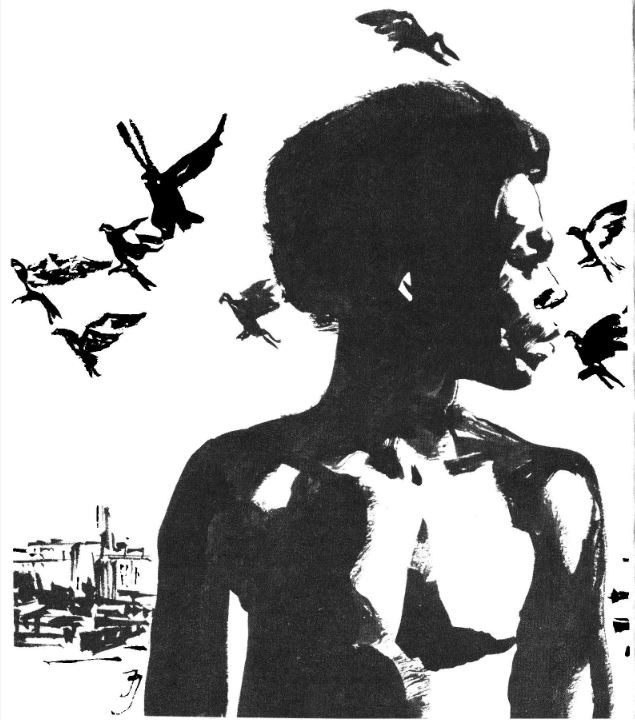
Jack Gaughan’s interior art for Jesse Miller’s “Pigeon City” in Analog Science Fiction (November 1972)
“Pigeon City” (1972), 4.5/5 (Very Good): First appeared in Analog Science Fiction (November 1972), ed. Ben Bova. You can read it online here.
In the 1950s and 1960s, white Americans propelled by racism and economic reasons fled the urban centers for the suburbs. According to Leah Boustan, for every “black arrival, two whites left the central city” in Northern and Western metropolitan areas. An insidious cultural iconography of middle-class white suburbia, replete with lawn and single-family houses, perpetuated inequality and excluded others from the American Dream. In this period, major race riots broke out across the United States–New York City (Harlem Riots, 1964), Los Angeles (Watts Riot, 1965), Newark (1967), and Detroit (1967)–in protest of poverty, racism, and unemployment exacerbated by the departure of businesses from the city centers.
This is the 12th post in my newly resurrected series of vintage generation ship short fiction reviews. Today I have something a bit different — a 1970s commentary on the subgenre. While the story itself is not a generation ship tale as it takes place on Earth, it fits and critiques the theme from within a similar enclosed environment.
As a reminder for anyone stopping by, all of the stories I’ll review in the series are available online via the link below in the review.
You are welcome to read and discuss along with me as I explore humanity’s visions of generational voyage. And thanks go out to all who have joined already. I also have compiled an extensive index of generation ship SF if you wish to track down my earlier reviews on the topic and any that you might want to read on your own.
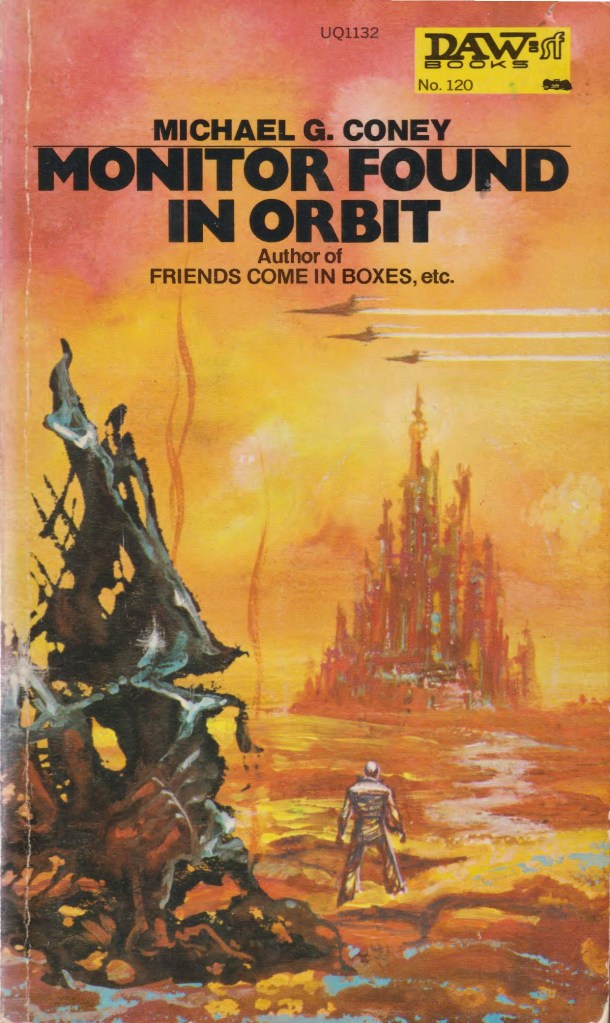
Frank Kelly Freas’ cover for the 1st edition of Monitor Found in Orbit (1974)
Michael G. Coney’s “The Mind Prison” first appeared in New Writings in SF 19, ed. John Carnell (1971). 3.5/5 (Good). You can read it online here. I read it Coney’s collection Monitor Found in Orbit (1974).
Coney positions “The Mind Prison”, in the introduction to his collection Monitor Found in Orbit, as a commentary on generation ship stories–in particular Robert A. Heinlein’s Orphans of the Sky(serialized 1941) and Brian W. Aldiss’ Non-Stop(variant title: Starship) (1959) which he read and reread over the years. He writes: “I cannot explain why I find the closed environment story so fascinating [..] Why should an adventure story be more exciting, merely because the people therein are not subject to external influences?” (114). Coney emphasizes the centrality of male heroism in many of these stories: “I would rather think that these stories emphasize identification, since the hero is invariably the only normal person around, surrounded by nonsensical religions, illogical facts, widely held misconception, which only he [emphasis Coney’s] can see the stupidity of” (114). “The Mind Prison” explores an enclosed environment remarkably similar to a generation ship, with a female heroine.
Which books/covers/authors intrigue you? Which have you read? Disliked? Enjoyed?
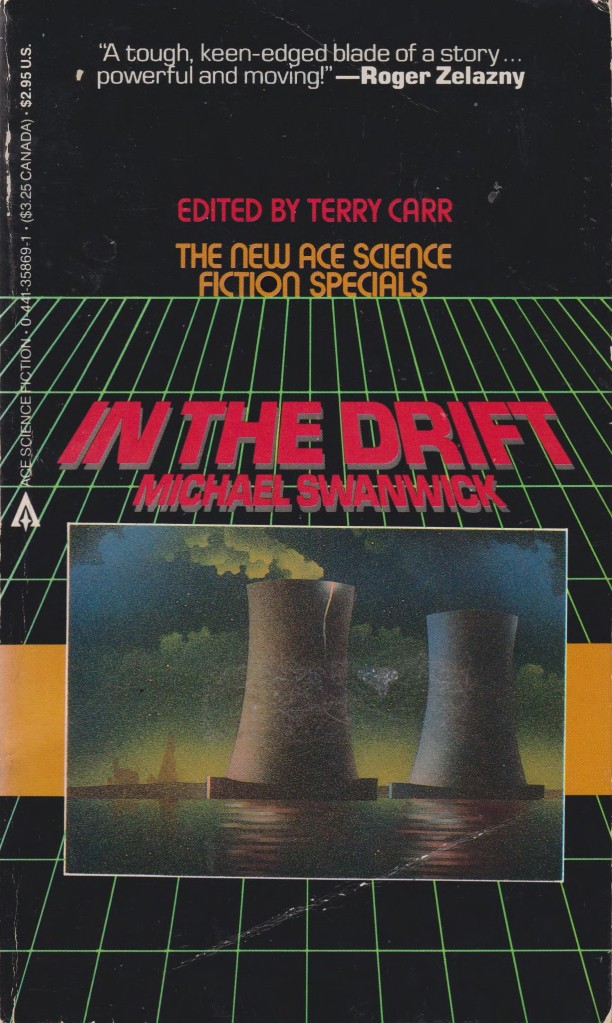
1. In the Drift, Michael Swanwick (1985)
Ron Lieberman’s cover for the 1st edition
From the back cover: “The meltdown at Three Mile Island created the death zone known as the Drift, where the sky burned dark blue and pink and where boneseekers destroyed bodies within.
Terry Carr’s anthology Fellowship of the Stars (1974) collects nine original short stories by luminaries of the genre, Ursula K. Le Guin and Fritz Leiber, to lesser known authors such as Alan Brennert and Mildred Downey Broxon. As the title suggests, Carr commissions stories on the “theme of friendship between human and alien beings” (vii). In a bit of a twist, in more than one instance “friendship” might be code for something far more sinister.
Which books/covers/authors intrigue you? Which have you read? Disliked? Enjoyed?
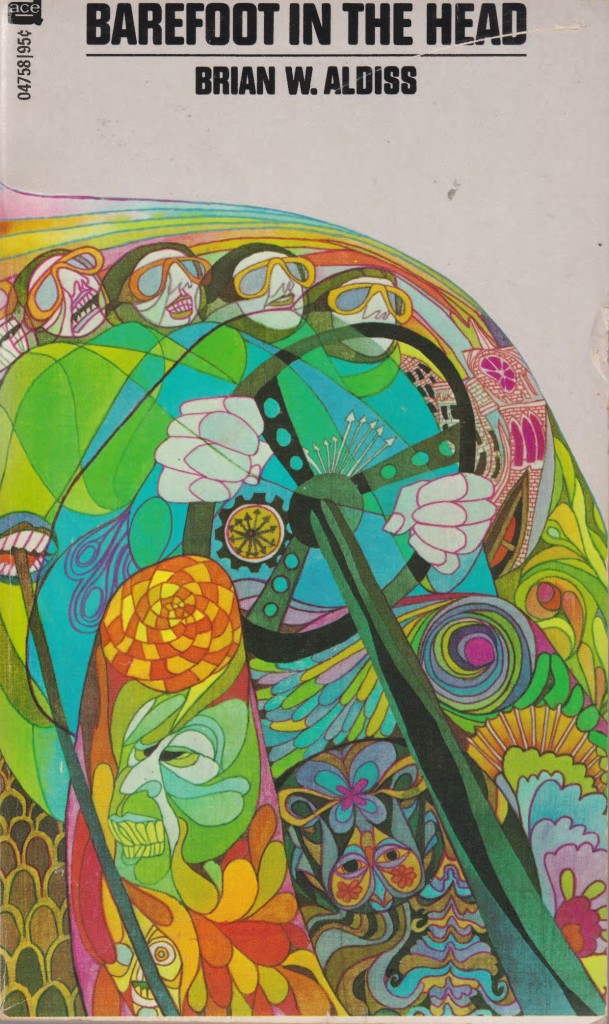
1. Barefoot In the Head, Brian W. Adliss (1969)
Diane and Leo Dillon’s cover for the 1972 edition
From the back cover: “AFTER THE ACID WAR…. Rising from the dust and ashes of a Europe still reeling from the effects of the great Acid War comes Colin Charteris, a futuristic Don Quixote riding the mechanized brontosaurus of the times.
Charteris tries desperately to make sense of the drugged, chaotic world he lives in, and finds himself hailed as the new Messiah. Stranger still, Charteris himself comes to believe this.
His adventures as he tries to save the world from its insanity are brilliantly told, a satiric science fiction comment on the future of mankind.”



 Science Fiction and Other Suspect Ruminations