Which books/covers/authors in the post intrigue you? Which have you read? Disliked? Enjoyed?
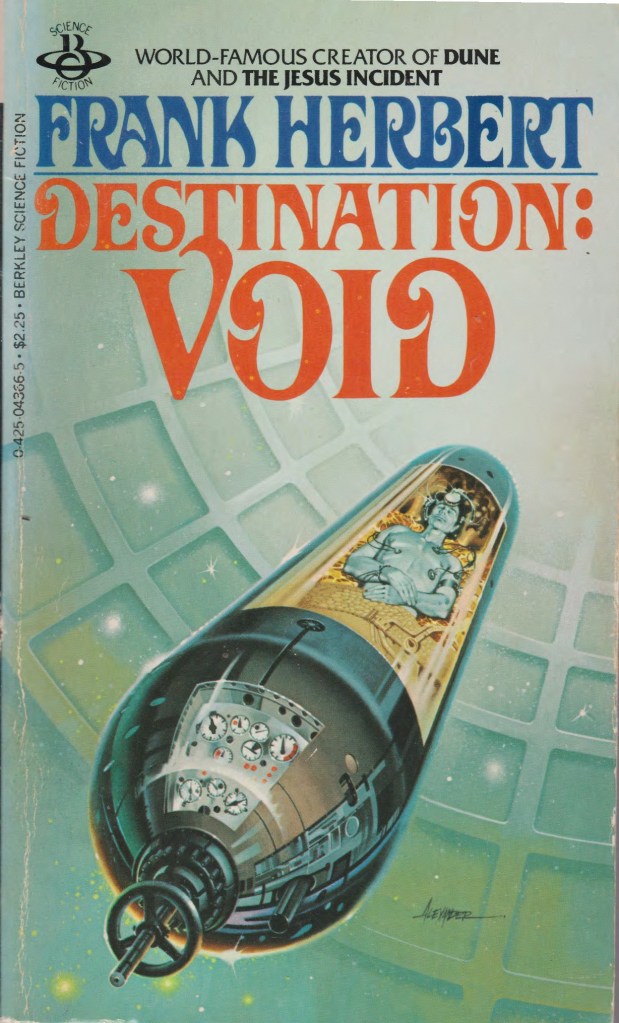
1. Frank Herbert’s Destination: Void (1966, rev. 1978)
Paul Alexander’s cover for the 1978 edition
From the back cover: “DESTINATION: VOID
THE COMPLETELY REVISED AUTHOR’S EDITION OF THE CLASSIC DEEP-SPACE ADVENTURE!
‘When the publishers announced that they were going to bring out a new edition of DESTINATION: VOID, they offered me the opportunity to make any changes I felt were necessary. Because of the tightly interwoven scientific premises behind this story and rapid development in the fields related to these premises, it would be extraordinary if discoveries across thirteen years did not dictate certain revisions.
What pre-1985 science fiction are you reading or planning to read this month? Here’s the September installment of this column. I am a few days late with this post. We’ll pretend it appeared in October!
I’ve been reading the little scholarship on H. Beam Piper (1904-1964) in order to more adeptly understand his political views when I tackle his various union-related stories for my series. I was struck by the extreme poverty, impact of a memorable cover, and dependence on a responsive agent that he found himself mired in after he lost his railroad guard job and had to rely on writing. He kept himself alive by selling off his gun collection that he had accumulated over the years and eating pigeons his shot on his porch. While he doesn’t seem to have been the best with the little money that came his way, often blowing the majority of a paycheck from Campbell, Jr. on expensive suits, it’s shocking what he had to do to survive between story acceptances. Piper seems to have committed suicide in part due to his financial hardships.
Despite the fact that I can’t wholeheartedly recommend John F. Carr’s H. Beam Piper: A Biography (2008) or Typrewriter Killer (2015) as large sections take the form of haphazardly strung together journal entries with little larger historical analysis, I found Carr’s often unnervingly voyeuristic look into his life lay bare the financial realities of publishing SF, even in a moment when magazines paid well. Unfortunately, Carr leaves comments like Piper’s 1961 letter in which he states “John [Cambell, Jr.] is almost as big a fascist sonofabitch as I am — but he wants a couple of points hammered home a bit harder” un-analyzed.
And let me know what pre-1985 science fiction you’ve been reading!
What pre-1985 science fiction are you reading or planning to read this month? Here’s the August installment of this column.
I often think back to how I got hooked on science fiction. As I have mentioned many times before, I primarily read fantasy–in particular every bloated Tolkein ripoff I could get my hands on–before I moved to science fiction in my late teens. Tad Williams’ fantasy trilogy Memory, Sorrow & Thorn (1988-1998) holds special significance. While looking for other fantasy titles by Williams at the local used book store, I stumbled across his equally bloated four-volume SF sequence Otherland (1996-2001). And so the slow shift began… I had read other science fiction but nothing hooked me quite like Otherland. It’s one of those works that I plan on never rereading—the spell would break.
While perusing Eric Garber and Lyn Paleo’s indispensable resource Uranian Worlds: A Reader’s Guide to Alternative Sexuality in Science Fiction and Fantasy (1983, second ed. 1990), my eyes fell on stories by Lisa Tuttle and Grania Davis.1 I’ve never read the work of Lisa Tuttle and I know little to nothing about Grania Davis beyond “My Head’s in a Different Place, Now” (1972), which I tersely dismissed as “zany and forgettable.” I’m glad I decided to pair the stories. Both tackle the inability of 60s radicalism to create a lasting ideological movement. Both stories come with caveats.
Preliminary Note: In the future, I might cover problematic stories on this theme or others with a strong heterosexual bias. They too reveal how people thought about queer topics through the lens of science-fictional extrapolation at different points in history.
Let’s get to the stories!
Tom Barber’s cover for Amazing Stories, ed. Ted White (March 1976)
4.25/5 (Very Good)
Lisa Tuttle’s “Stone Circle” first appeared in Amazing Stories, ed. Ted White (March 1976). You can read it online here. It was nominated for the 1977 Nebula Award for Best Short Story.
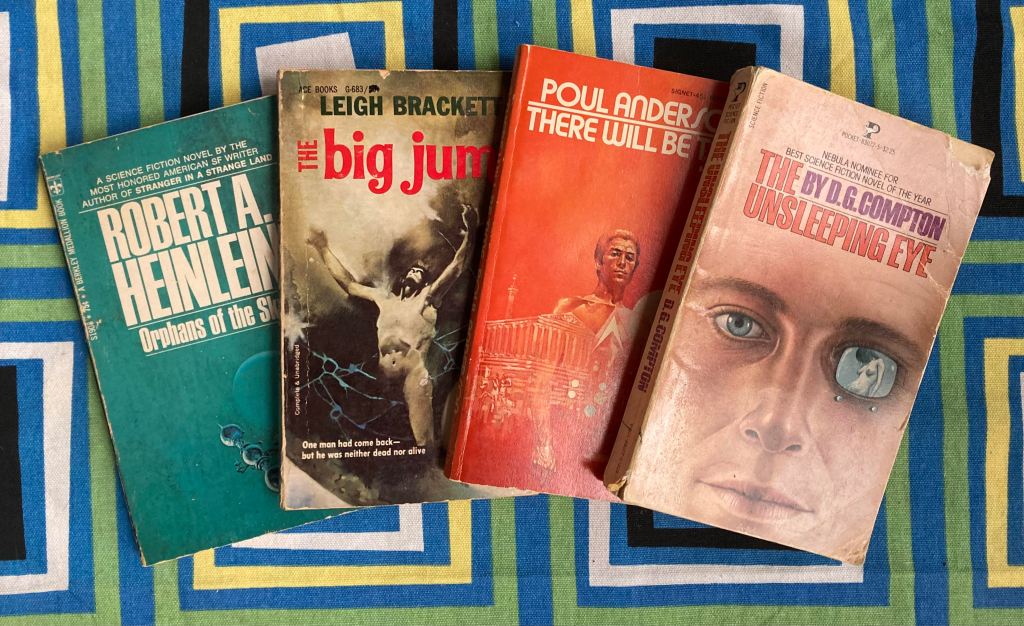
A selection of previously read novels from my shelf
What pre-1985 science fiction are you reading or planning to read this month? Here’s July’s installment of this column.
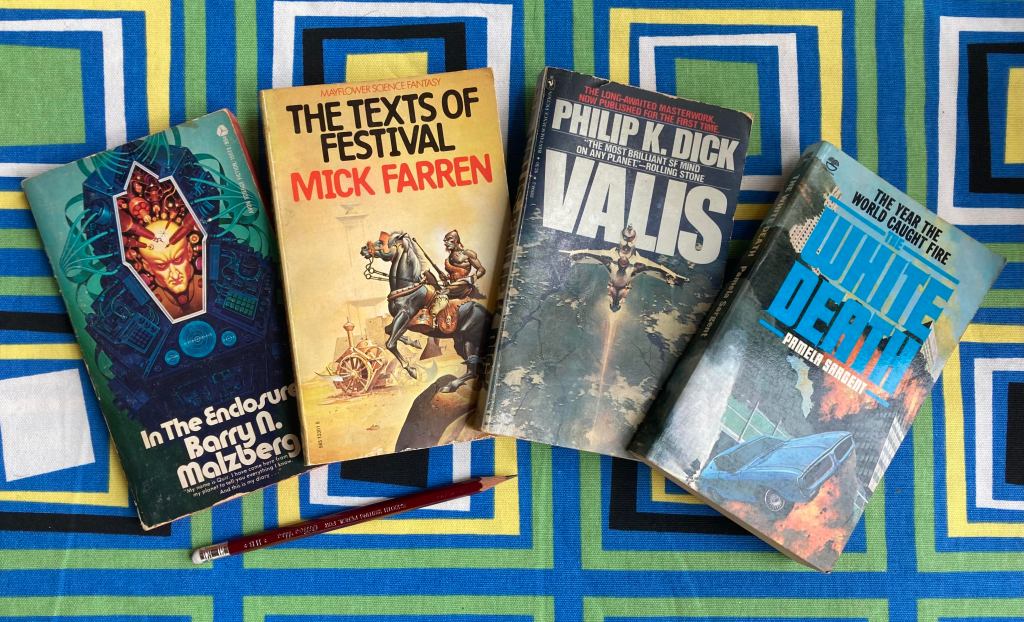
Last month I waxed rhapsodic about a powerful interaction with a professor in graduate school… this month I’ll show you a recent obsessive territory I’ve been reading and ruminating about: 1940s and 1950s (and a few from the 60s) social commentary on American affluence, technology, and media. It all started with my media landscapes of the future series–I could not write on the topic unless I read some Marshall McLuhan. And then I had to read about C. Wright Mills to write about Clifford D. Simak and organized labor. And then I needed to track down other popular authors of social commentary published in era. It should not be surprising so much 50s SF revolved around social commentary — it was in the air. You get the idea. This pile represents some of what I now own:
Which books/covers/authors in the post intrigue you? Which have you read? Disliked? Enjoyed?
1. Away From the Here and Now, Clare Winger Harris (1947)
Uncredited–JM initials but no known name–cover for the 1st edition
From the inside flap: “In this age of atomic bombs and radar to the moon, Mrs. Harris’ stories may prove closer to the “here and now” than the title would indicate. Mrs. Harris Proudly claims the distinction of being the first woman science-fiction writer in the country. Each of her stories is based upon a sound scientific fact, carried so plausibly to the nth degree that at no time does it overstain credulity. The stories possess the qualities of dealing with ideas of big importance to the human race, of presenting those ideas in a plausible form, and of appealing to emotions that exist deep within the heart of every human being whether he be scientific or not.
I’m periodically plagued by the virulent Esoterica virus, the relentless desire to catalogue and write about the less known, and even better, the completely unknown. While attending a Medieval English literature graduate class, I remember a conversation I had with the professor, Robert D. Fulk, during office hours about the sheer quantity of scholarship on Beowulf (here’s his edition of the iconic text). I pointed out the panic I experience if I’m unable to read ALL the scholarship on a popular text.
Clifford D. Simak (1904-1988) published science fiction steadily between 1931 and his death in the late 80s. His work–from City (1952) to the Hugo-winning Way Station (1963)–often demonstrates a fascination with the rural environment and the lives of “ordinary” people confronted with the alien. As I am currently working on a mini-project related to Simak,1 I thought I’d give a rundown of six of the seven interviews I’ve found reference to. I’ll also provide quotes of interesting passages, and a scanned version of one that isn’t available online. In the interviews, Simak comes across as an author deeply suspicious of rigorous generic distinctions, passionate about all life, and open to science fiction as an ever-changing and evolving entity.
The Internet Speculative Fiction Database lists five interviews on science fiction conducted with Clifford D. Simak–all published between 1975-1980. Muriel R. Becker’s indispensable Clifford D. Simak: A Primary and Secondary Bibliography (1980) includes two more: a video interview from 1971 and another from 1976 in the Minneapolis Tribune.2 I cannot find a copy of the latter. I provide links to the others in the post.
Obviously, which interview you want to read depends on your interests or questions you have about Simak. That said, I found Paul Walker’s the most fascinating (and frequently references in the little scholarship on the grandmaster).



 Science Fiction and Other Suspect Ruminations