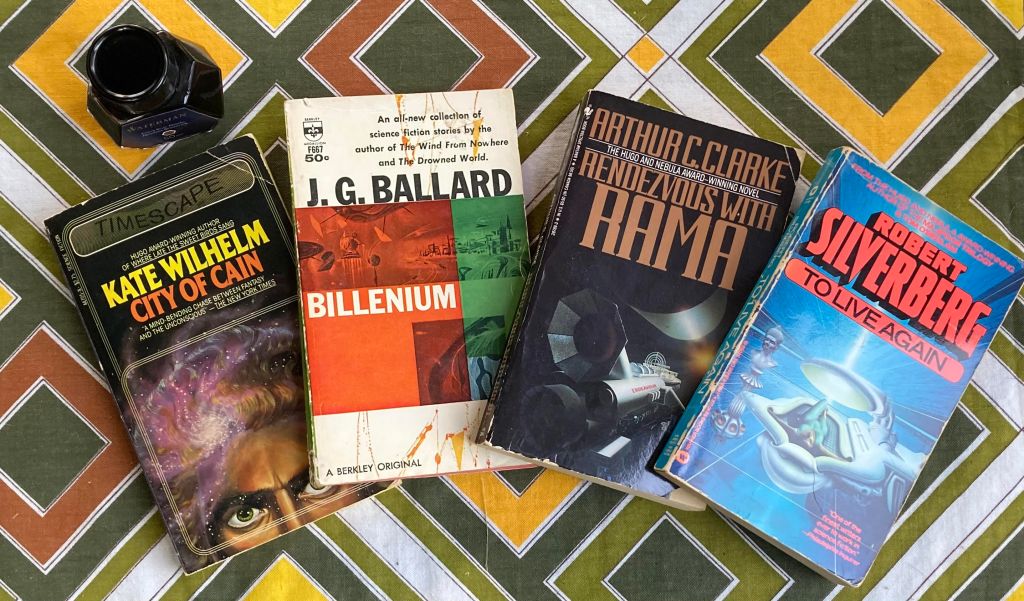
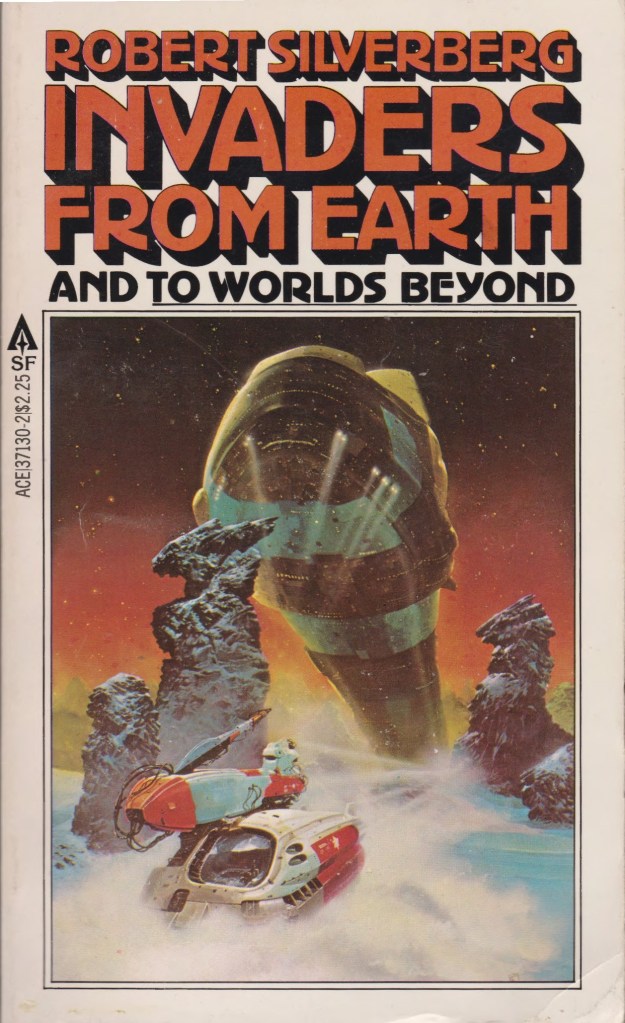
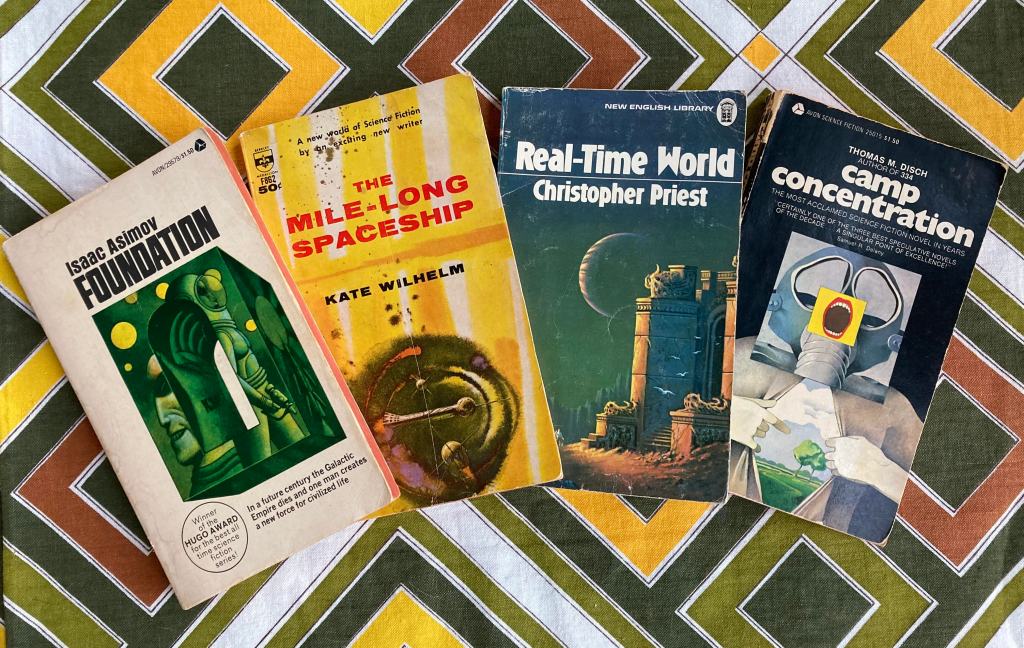
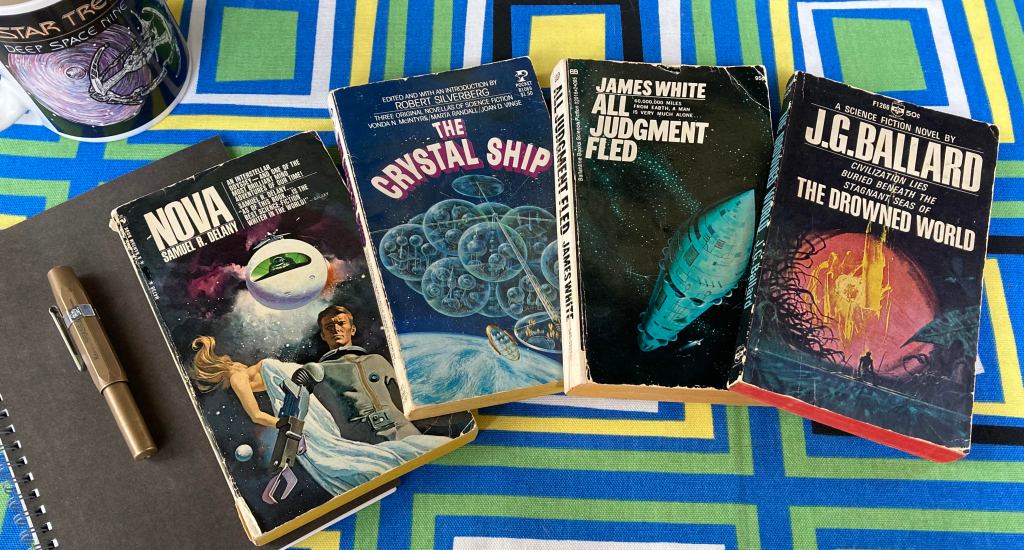
Which books/covers/authors in the post intrigue you? Which have you read? Disliked? Enjoyed?
1. The Witling, Vernor Vinge (1976)
George Barr’s cover for the 1976 edition
From the back cover: “Witling: A pretender to wit. (Webster’s Dictionary)
In the eyes of the inhabitants of Giri the scientific explorers from outer space were witlings. In the context of that primitive-seeming planet, they were.
Because on Giri a peculiarity of evolution had given a special talent to all living things–and this talent had made unnecessary most of the inventions associated with intelligent life elsewhere. Roads and planes, engines and doors… these were the products of witlings, not of ‘normal’ people.
So when the little band from Earth’s exploration team fell into Giri hands, their problem was unprecedented. How to demonstrate that science is worthwhile and how to keep the medieval masters of Giri from realizing their potential for cosmic mischief.”
What pre-1985 science fiction are you reading or planning to read this month? Here’s February’s installment of this column.
Before we get to books and birthdays and writing plans…
Do you have the inner strength to survive the panic of a nuclear attack? Take a test in the August 21st 1953 issue of Collier’s and find out! Sample question: “HOW DO YOU FEEL WHEN: […] You are alone in an automatic elevator when it stalls between floors?” Possible answers: “I’m not bothered,” “I become tense,” “It jars me badly,” and “I blow up.”
What pre-1985 science fiction are you reading or planning to read this month? Here’s January’s installment of this column.
When I’m not reading science fiction, I’m more often than not devouring history that touches on my decades of focus: 1945-1985. Recently that’s meant lots and lots of monographs on Cold War culture: from fallout shelters, suburbia, to analysis of the drama of morality and terror that characterized nuclear deterrence. And in Guy Oakes’ transfixing The Imaginary War: Civil Defense and American Cold War Culture(1994), I came across a fascinating collision of science fictional thought and public policy.
A few months into Dwight D. Eisenhower’s presidency, the Public Affairs Office of the Federal Civil Defense Administration released a short pamphlet that analyzed the “relation between national will and nuclear terror” under the ridiculous title “Civil Defense Implications of the Psychological Impact and Morale Effect of Attacks on the People of the United States” (April 1953). In this pamphlet, the authors imagine the effects of nuclear war. They suggest that some survivors would “isolate themselves from the terrifying consequences of nuclear war by effecting a pseudo-escape into an interior psychological reality.” I thought immediately of Richard Matheson’s brilliant “Pattern for Survival” (1955), in which a SF author reenacts the process of writing and publishing a story to escape the reality in which he lives. The pamphleteers further imagine a political reality dominated by “mystical sects and cults, enthralled by the vision of an immeasurably happier future in an inner fantasy life of an extramundane kingdom of bliss that transcended the brutal empirical reality of nuclear destruction” (41). Early Cold War policy makers and consultants as science fiction authors!
50s paranoid future visions aside, let’s turn to the books in the photo and what I’ve been reading and writing about.
Which books/covers/authors intrigue you? Which have you read? Disliked? Enjoyed?
1. Dinner at Deviant’s Palace, Tim Powers (1985)
Ron Walotsky’s cover for the 1985 edition
From the inside flap: “The civilized world had come to an end more than a century earlier, but in California life and society went on… taking strange, often horrifying forms.
Gregorio Rivas was a survivor–a proud, resourceful man who had, most recently, made his way from the corrupt, crumbling city of Venice to carve out a successful career as a musician within the walls of Ellay. He played his pelican with raw energy and flashy style, and people came from all over to hear him. But Greg’s real claim to fame had nothing to do with music. It was a part of his past he wanted to forget. And it had come back to haunt him…
Please note that I have not read enough to identify their best work and a negative review is not intended to be a statement about their entire oeuvre and impact on the genre. If you have any fond memories, recommendations for stories, or other tangents related to the three authors, let me know in the comments.
Terry Bisson (1942-2014) also passed away this year but did not publish any short fiction until the 90s. I’ll make sure to review one of his 80s novels—Wyrldmaker (1981) or Talking Man (1986)–this year instead. I’ve also procured novels by Purdom and Skal to feature later this year.
Now let’s get to the stories!
David Plourde’s cover art detail for the 1978 edition of Best Science Fiction Stories of the Year: Sixth Annual Collection, ed. Gardner Dozois (1977)
4.5/5 (Very Good)
Howard Waldrop’s “Mary Margaret Road-Grader” first appeared in Orbit 18, ed. Damon Knight (1976). If you have an Internet Archive account, you can read it online here.
Nominated for the 1977 Nebula Award for Best Short Story. Lost to Charles L. Grant’s “A Crowd of Shadows” (1976).
A selection of science fiction novels from my shelves
I hope you’ve gotten off to a great reading start to 2024! What pre-1985 science fiction are you reading this month?
If you’re new and curious about my rationale for the perimeters of my site, check out this recent interview and podcast. And follow me on Mastodon if you don’t already as I no longer post on my Twitter account. Also make sure to check out the previous installment of this monthly column
And, most importantly, let me know what pre-1985 SF you’ve been reading!
The Photograph (with links to reviews and brief thoughts)
Adrian Mitchell’s The Bodyguard (1970) might be one of the oddest dystopias ever written.
Kate Wilhelm’s Where Late the Sweet Birds Sang (1976) is a fascinating peek into her vast oeuvre of disquieting visions. While I read it before I started my site, a friend reviewed it for my guest post series on Wilhelm’s fiction. As I recently covered Wilhelm’s far lesser known anti-Vietnam War novel The Killing Thing (1967), her work was on my mind.
M. John Harrison is rightly famous for his Viriconium Nights sequence: The Pastel City(1971), A Storm of Wings(1980), and In Viriconium (1982). If you enjoyed them, I highly recommend tracking down his first novel — The Committed Men(1971). From my review: “Possessed by destructive melancholy, the inhabitants of a post-apocalyptical UK–where political powers have sunk into oblivion–attempt to recreate a semblance of normalcy. Clement St John Wendover, teeth long since rotted, still administers to the skin diseases and ailments of his one-time patients although he cannot cure them. […] Gathering together a troop of “committed men” (and a woman!), Wendover sets off across the corroded landscape with a newborn mutant child: a new species for an altered Earth or an accidental abnormality….”
I recently covered a Barrington J. Bayley short story in my cities of the future series and it reminded me of his most extreme moments of off-the-wall invention — The Garments of Caean (1976) immediately came to mind.
Which books/covers/authors intrigue you? Which have you read? Disliked? Enjoyed?
1. When Gravity Fails, George Alec Effinger (1986)
Jim Burns’ cover for the 1988 edition
From the back cover: “In a decadent world of cheap pleasures and easy death, Marîd Audran has kept his independence and his identity the hard way. Still, like everything else in the Budayeen, he is available …for a price.