Adventures in Science Fiction Cover Art: Domed Cities (and Outposts) of the Future, Part IV

Screen shot 2013-01-25 at 9.47.21 PM

(Ley Kenyon’s cover for the 1953 edition of Adventures in Tomorrow (1951), ed. Kendell F. Crossen)

Since the release of the TV series Under the Dome (2013-), based on Stephen King’s 2009 novel by the same name, there has been a resurgence of interest in domed cities.  And for good reason — the trope is one of the most popular of science fiction artists and authors since the 30s (and probably earlier).  Not only do the societal implications and visual allure of the trope of a domed outpost on a harsh planet or a domed city amidst the ruins of Earth arouse the creative authorial juices but also generate some fantastically Continue reading

Adventures in Science Fiction Cover Art: The Space Station, Part III

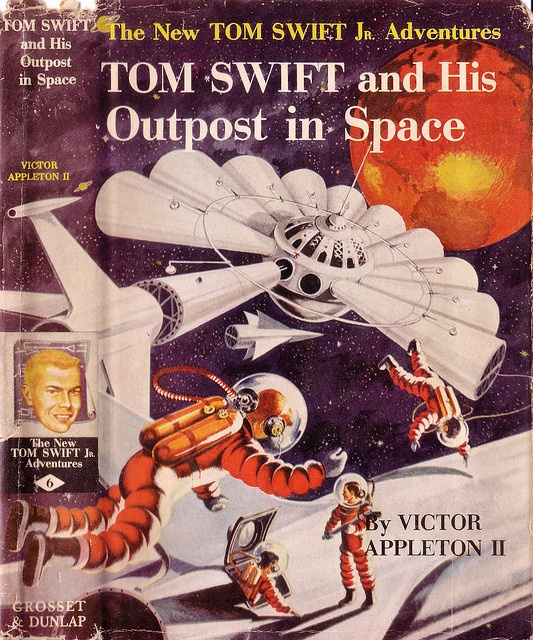
8fb71adc43d8c6f43977b5522a534504(Graham Kaye’s cover for the 1955 edition of Tom Swift and his Outpost in Space (1955), Victor Appleton II)

This is Part III of my series on space stations (Part I + Part II).  Ever since I watched 2001: A Space Odyssey (1968) as a teen I’ve been fascinated by space stations — platforms for further space exploration!  I can only imagine how exciting it was for fans of science fiction who read about stations before they existed to see them finally constructed. The fact that they became reality — well, perhaps not (yet) as a launching point for space going exploration vessels — almost vindicates the scientific extrapolation of some of these early visions.  Also, Arthur C. Clarke’s Islands in the Sky (1952) happened to be one of my first science fiction novels…..  And C. J. Cherryh’s Downbelow Station (1981) Continue reading

Updates: Recent Science Fiction Acquisitions No. LXVII (Simak, Clement, Bradley, White)

I just came back from more than a month in Paris where I was rather sci-fi deprived so I headed immediately (well, not literally) to the local used bookstore.  A nice collection of novels from some of the genre’s greats — Hal Clement, James White, Clifford D. Simak, and Marion Zimmer Bradley.  I’ve not read any of Bradley’s novels and I’ve heard that Darkover Landfall (1972) is probably the place to start.

And I’ve enjoyed James White’s work so far.  Clement isn’t exactly my cup of tea but it might be good to read another one of his novels before I come to a conclusion.

And some fun Paul Lehr covers…

1. Lifeboat (variant title: Inferno), James White (1972)

(John Berkey’s cover for the 1972 edition) Continue reading

Adventures in Science Fiction Cover Art: The Hand of God?

194-1

(William Timmins’ cover for the January 1947 issue of Astounding Science Fiction)

A hand from a body off canvas enters the fray….  An alien’s hands wrap around the Earth, amused or disturbed by its creations?  A hand rises from a variety of desolate landscapes…  Is it the remnant of a robotic construct or a relics from some age old creator?

This particular theme — a powerful force depicted via an often disembodied hand — has yielded some fantastic covers.  Brian Lewis’ cover for the 1958 issue of Science Fantasy is one of my favorites.  I find the scene — a group of people discovering a robotic hand reaching from the f Continue reading

Updates: Recent Science Fiction Acquisitions No. LXVI (Anderson + Simak + Ballard)

Gifts!  From my fiancé!

Four more wonderful books…  I can’t wait to read J. G. Ballard’s The Burning World (1964) and Poul Anderson’s short story collection Time and Stars (1964)…  Ballard is a genius and Anderson is a solid writer who always produced fun plot-driven works (I suspect his Hugo nominated There Will Be Time (1973) will be similar).  Also, despite my general frustration with Clifford D. Simak’s ouvre, I’m intrigued by Why Call Them Back From Heaven? (1967)….

Enjoy the two Powers covers!

1. The Burning World, J. G. Ballard (1964)

THBRNNGWR1964

(Richard Powers’ cover for the 1964 first edition) Continue reading

Book Review: Profundis, Richard Cowper (1979)

PRFNDS1981

(Don Maitz’s cover for the 1981 edition)

3.75/5 (Good)

Richard Cowper’s science fiction (and fantasy) was recommended to me by 2theD over at Potpourri of Science Fiction Literature (be sure to follow him!).  But ever since I procured a copy of Profundis (1979) more than a year ago, I’ve passed over it when searching for my next read — perhaps due to the silly “Three Kinky Kittens, talented sexboats with uninhibiting charms” blurb on the back cover (“uninhibiting” isn’t even a word) in addition to Don Maitz’s uninteresting 80s cover art…  Tangent: Maitz drew the pirate for the Captain Morgan Rum brand.

However, Profundis proved to be a highly involving science fiction parable set in a post-apocalyptical Continue reading

Updates: Recent Acquisitions No. LXV (Spinrad + Coney + Cummings + an anthology containing short stories by Pohl, Knight, Aldiss, et al.)

My first book from the 80s in many a year!  But, I’m on a Norman Spinrad kick so when I saw it for one dollar at the store I had to snatch it up his post-apocalyptical vision Songs from the Stars (180)….  The premise is rather hokey but perhaps a quality writer like Spinrad can imbue it with some vigor.

I’m most excited about The Ninth Galaxy Reader, ed. Frederik Pohl (1966) (twelve short stories from the Galaxy Magazine) due the top-quality author line-up — Brian W. Aldiss, John Brunner, Richard Wilson, Damon Knight, Philip Kose farmer, Harry Harrison, Frederik Pohl, Lester Del Rey, Roger Zelazny, C. C. MacApp, Larry Niven, and R. A. Lafferty….

1.  Songs from the Stars, Norman Spinrad (1980)

SNGSFRMTHS1982

(Uncredited cover for the 1982 Continue reading

Updates: My 7 Favorite Metafictional Science Fiction Novels

Here are my seven favorite metafictional science fiction novels. By metafiction I’m referring to devices such as breaking the fourth wall (characters addressing the audience), the author addressing the reader, a story about a writer writing a story, a story containing another work of fiction within it, a work where the narrator reveals himself or herself as the author of the story, narrative footnotes, etc….

I’d love to hear your favorites (they don’t have to be novels)!

Obviously, these types of experimental works only appeal to some readers (especially fans of the sci-fi New Wave movement of the late 60s and early 70s) but I personally love seeing experimentation in an often — dare I say — stylistically stale genre.  Often, the metafictional aspects do not prevent authors from deploying traditional narratives.

 71nOA-QfpuL NSTNINT1967 RVLTNSXKSK1977

 THIRNDRM1972 MNINTHCST1974

My top seven (and an honorable mention):

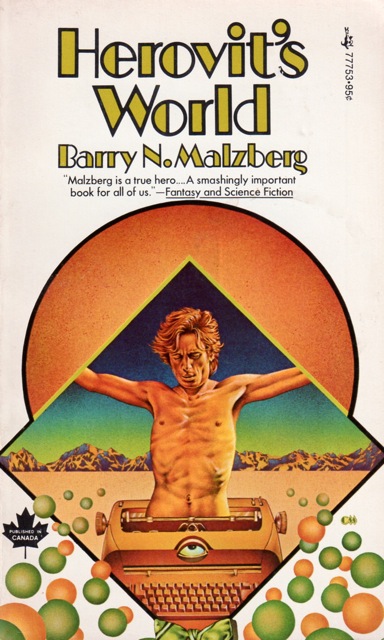
1. Beyond Apollo, Brian N. Malzberg (1972) (REVIEW) — what you read is most likely the novel written by the main character. However, he’s most likely insane so attempting to get AT the true nature of his voyage to Venus is purposefully layered… Complicating the matter is how unreliable of a narrator he is and the fact that he’s tells many versions of the same story. Malzberg pokes fun at pulp science fiction throughout — which he clearly enjoyed as a child.

2. Stand on Zanzibar, John Brunner (1968) — the metafictional aspects are rather hidden in this New Wave masterpiece (my single favorite sci-fi novel).  Brunner’s vast (in scope and depth) mosaic of invented book fragments, advertising jingles, and narrative portions are interspersed with news articles taken from his own day — including the school shooting at the University of Texas in 1966.  Of course, as readers we’re geared to imagining that everything Continue reading

Book Review: The Iron Dream, Norman Spinrad (1972)

(Uncredited cover for the 1972 edition)

4.75/5 (Very Good)

Nominated for the 1973 Nebula Award

Simply put, Norman Spinrad’s The Iron Dream (1972) is a fantastic alternate history novel.  However, unlike a standard “what if this happened instead and now let’s write a traditional narrative” alternate history, The Iron Dream is organized around a powerful metafictional conceit which explicitly serves to satirize pulp science fiction and fantasy and condemn its lurid nature and Spinrad would argue, racist inclinations.

The premise is straightforward: after the Great War (WWI) Hitler comes to the United States (and thus WWII never happens) and becomes a science fiction illustrator.  Eventually he starts writing science fiction and articles in fanzines.  However, he’s considered by the establishment to be little more than a hack writer and lives the rest of his life in squalor.  It is only after he dies (from symptoms related to syphilis) that he receives any critical success. What you read is Hitler’s 1954 posthumous Hugo-winning novel (which he wrote in six weeks), The Lord of the Swastika,  along with a short pseudo-scholarly “afterward to the Continue reading