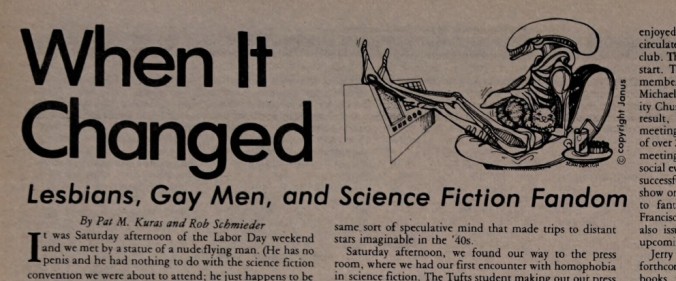
Exploration Log 8: Pat M. Kuras and Rob Schmieder’s “When It Changed: Lesbians, Gay Men, and Science Fiction Fandom” (1980)

“We also encountered many gay people, feminists and progressives of every stripe. These people were at the convention because present day science fiction has much to offer them. Science fiction is the fiction of ideas, and the ideas coming from the minds of the new writers more and more concern progressive analyses of social issues.”

— Pat M. Kuras and Rob Schmieder (1980)

At the 38th World Science Fiction Convention (29th August–1st September, 1980) held in Boston, MA, organizers scheduled the first Worldcon panel with an openly LGBTQ topic: “The Closed Open Mind: Homophobia in Science Fiction Fantasy Stories” moderated by Jerry Jacks, one of the “early openly gay fans.”1 Around 200 fans attended to hear Elizabeth A. Lynn (SFF author), Samuel R. Delany (SFF author), Frank M. Robinson (SF author and activist), and Norman Spinrad (SFWA President and SF author) (“the token straight”) discuss issues of representation.

Continue reading

Exploration Log 7: Interview with Jordan S. Carroll, author of Speculative Whiteness: Science Fiction and the Alt-Right (2024)

Over the last few years, I have attempted to incorporate a smattering of the vast range of spectacular scholarship on science fiction into my reviews and highlight works with my Exploration Log series that speak to me.1 Today I have an interview with Jordan S. Carroll about his brand-new book, Speculative Whiteness: Science Fiction and the Alt-Right (2024). In the book, he examines the ways the alt-right uses classic science fiction imagery and authors to mainstream fascism and advocate for the overthrow of the state.

You can buy an inexpensive physical copy ($10) directly from the University of Minnesota Press website or an eBook version ($3.79) on Amazon.


Thank you so much for agreeing to this interview. First, can you introduce yourself and research interests?

Continue reading

My 2024 in Review (Best Science Fiction Novels and Short Fiction, Articles/Podcasts, Reading Initiatives, and Bonus Categories)

Here’s to a happy reading in 2025! I hope you had a successful reading year. Whether you are a lurker, occasional visitor, a regular commenter, a follower on Bluesky or Mastodon, thank you for your continued support. It’s hard to express how important (and encouraging) the discussions that occur in the comments, social media, and via email are to me. This was the third year running of record-breaking numbers of viewers and views in the 13-year history of my site. What were your favorite vintage SF reads–published pre-1985–of 2024? Let me know in the comments.

Clifford D. Simak defined my 2024. Starting with a February review of his collection Worlds Without End (1964), I embarked on a fiction and non-fiction reading extravaganza that culminated in my article for Journey Planet, which I spent most of the summer writing, titled “‘We Must Start Over Again and Find Some Other Way of Life’”’: The Role of Organized Labor in the 1940s and ’50s Science Fiction of Clifford D. Simak.” Despite his Grand Master status, there’s little scholarship on Simak’s work and so much more to be done. As expected, there was little response to the article outside of my website. I also wrote two Exploration Logs on six of his interviews and his 1971 Worldcon speech and contributed to a podcast on “The Huddling Place” (1944) (the second City story). Sometimes you find a little niche that you never expected to inhabit which you feel there’s so much more to explore and say. I hope my Simak focus continues into 2025.

Continue reading

Book Review: In the Drift, Michael Swanwick (1985)

3.25/5 (Above Average)

In The Drift (1985), a fix-up novel comprised of two Nebula-nominated short works–“Mummer Kiss” (1981) and “Marrow Death” (1984), maps a new way forward in an ecologically and genetically ravaged post-apocalyptic age. The entire concoction decays with a sense of grim unease and cavorts around piles of dead that would make a triumvir from the Late Roman Republic proud. It’s a violent, erotic, and disquieting experience that can’t entirely hide its flaws behind the decadent panache.

Continue reading

Short Fiction Reviews: Leigh Kennedy’s “Salamander” (1977), “Whale Song” (1978), “Detailed Silence” (1980), and “Speaking10 to Others2; Speaking3 to Others20” (1981)

In the past few years, I’ve put together a series on the first three published short fictions by female authors who are completely new to me or whose most famous SF novels fall mostly outside the post-WWII to mid-1980s focus of my reading adventures.

Today I’ve selected the first four stories by an author I’ve only recently started to read–Leigh Kennedy (1951-). I’d previously reviewed “Helen, Whose Face Launched Twenty-Eight Conestoga Hovercraft” (1982) and placed her on the list for this series. According to SF Encyclopedia, Kennedy’s “writing is succinct, polished, lucent, and her stories are emotionally penetrating; it is unfortunate that she has fallen from the world of novel publishing, though continuing to work as a professional indexer.” And I can’t agree more! Her first four stories show great promise and moments of refined vision. I can’t help but think the backlash to her Nebula-nominated (and best-known work) “Her Furry Face” (1983) might have had some effect on her trajectory.

So far I’ve featured Alice Eleanor Jones (1916-1981), Phyllis Gotlieb (1926-2009), Sydney J. Van Scyoc (1939-2023), Josephine Saxton (1935-), Carol Emshwiller (1921-2019), Wilmar H. Shiras (1908-1990), Nancy Kress (1948-), Melisa Michaels (1946-2019), Lee Killough (1942-), Betsy Curtis (1917-2002), and Eleanor Arnason (1942-). To be clear, I do not expect transformative or brilliant things from first stories. Rather, it’s a way to get a sense of subject matter and concerns that first motivated authors to put pen to paper.

Let’s get to the stories!


Continue reading

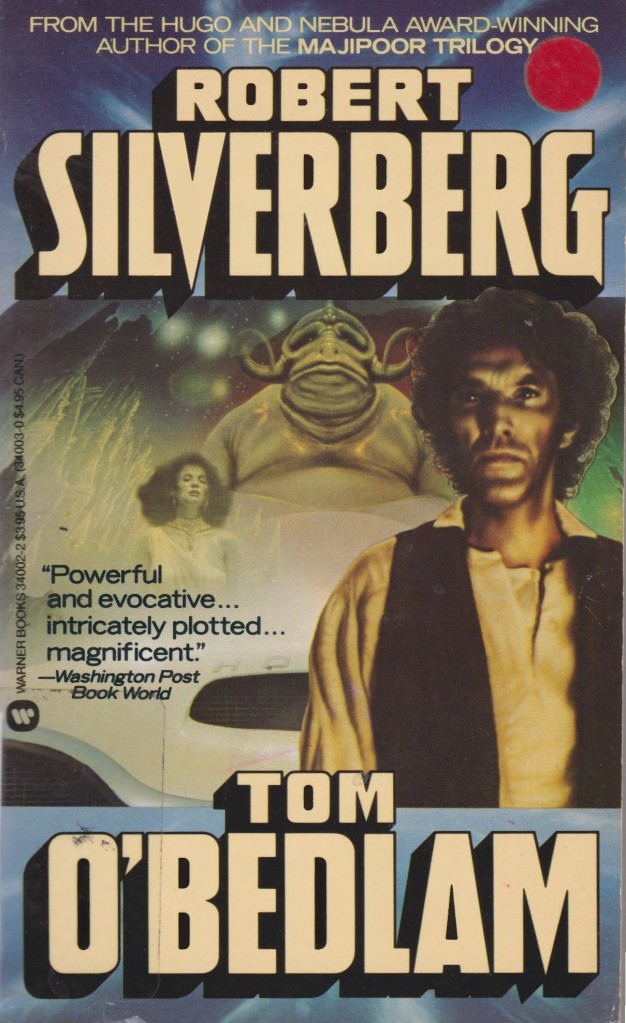
Updates: Recent Science Fiction Purchases No. CCCXXXVIII (Gregory Benford, Dean McLaughlin, Warren Norwood, and Aileen La Tourette)

Which books/covers/authors in the post intrigue you? Which have you read? Disliked? Enjoyed?

1. In Alien Flesh, Gregory Benford (1986)

From the back cover: “A journey into the depts of space and time by Gregory Benford, winner of the Nebula Award.”

Contents: “In Alien Flesh” (1978), “Time Shards” (1979), “Redeemer” (1979), “Snatching the Bot” (1977), “Relativistic Effects” (1982), “Nooncoming” (1978), “To the Storming Gulf” (1985), “White Creatures” (1975), “Me/Days” (1984), “Of Space/Time and the River” (1985), “Exposures” (1981), “Time’s Rub” (1984), “Doing Lennon” (1975).

Continue reading

Updates: Recent Science Fiction Purchases No. CCCXXXVII (Paul Cook, Poul Anderson, Jack Wodhams, and Penelope Gilliatt)

Which books/covers/authors in the post intrigue you? Which have you read? Disliked? Enjoyed?

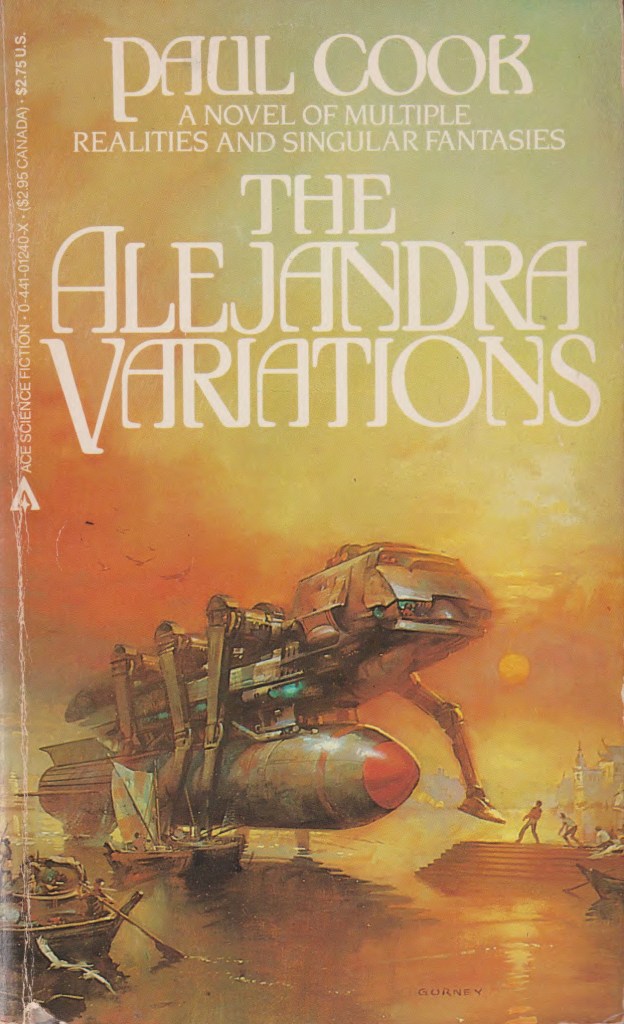
1. The Alejandra Variations, Paul Cook (1984)

From the back cover: “FIRST VARIATION

Nuclear Strategist Nicholas Tejada sees the end of the world.

SECOND VARIATION

One thousand years later, Nicholas wakes up in an underground civilization that lives only for drugs, sex, and thrills.

THIRD VARIATION

Continue reading

Book Review: The Shadow Hunter, Pat Murphy (1982)

3.75/5 (Good)

Pat Murphy’s first novel The Shadow Hunter (1982) is an achingly beautiful tale of displacement. In the distant past, a young Neanderthal boy embarks on a hunt to claim his name and to learn the nature of the world. In the near future, a mogul named Roy Morgan wants to create a Pleistocene oasis (The Project) ensconced in a valley in an increasingly urban world. Morgan employs two damaged souls, Amanda and Cynthia, to aim his machines–that reach backward and forward into time.

Continue reading

What pre-1985 science fiction are you reading? + Update No. XIV

What pre-1985 science fiction are you reading or planning to read this month?

Here’s June’s installment of this column.

I’m periodically plagued by the virulent Esoterica virus, the relentless desire to catalogue and write about the less known, and even better, the completely unknown. While attending a Medieval English literature graduate class, I remember a conversation I had with the professor, Robert D. Fulk, during office hours about the sheer quantity of scholarship on Beowulf (here’s his edition of the iconic text). I pointed out the panic I experience if I’m unable to read ALL the scholarship on a popular text.

Continue reading