Adventures in Science Fiction Cover Art: Underwater Expeditions (futuristic submarines + underwater labs + sea monsters + cities), Part II

(Roger Stine’s cover for the 1979 edition of On The Run (variant title: Mankind on the Run) (1955), Gordon R. Dickson)

Part II of my Underwater Expeditions Series (Part I) is a veritable deluge of undersea wonders.  Unusual monsters/aliens proliferate the seascapes — snapping at our aquatic heroes.  A vast array of submersibles and submarines — including a mechanical whale equipped with a harpoon (Jack Coggins’ cover for the April 1957 issue of Galaxy Science Fiction) — trek across the oceanic expanses.  Cities, ruins, hidden scientific facilities are all to be discovered amongst the seaweed and deep water trenches…

There is something so mysterious about the ocean depths — almost as alienating and frightening as space.  Although due to our recent deep sea explorations increasingly less Continue reading

Book Review: Sargasso of Space, Andre Norton (1955)

(Ed Emshwiller’s cover for the 1964 edition)

4/5 (Good)

Andre Norton’s Sargasso of Space (1955), the first installment of her Solar Queen sequence of novels, delivers everything a 1950s juvenile science fiction adventure should.  Sargasso of Space is not only blessed with genuine tension, intriguing situations, heroic young adults, but also a multi-racial cast (an African-American apprentice engineer and two crew members of Asian descent).  This is my first of Andre Norton’s massive body of work I’ve read — Secret of the Lost Race, Star Born, Daybreak-2250 A. D., and Witch World are all on my shelf waiting to be devoured — and I will be looking to add more to my collection.  There’s something so appealing in the classic archetypal trope of the young hero–with the help of loyal friends–solving an intriguing (and dangerous) puzzle.

Brief Plot Summary

Our young/intrepid hero Dane Thornson is an apprentice Cargo-Master Continue reading

Adventures in Science Fiction Cover Art: Crashed Spaceships

(Gaylord Welker’s cover for the December 1952 issue of Astounding Science Fiction)

Gaylord Welker’s cover for the December 1952 issue of Astounding Science Fiction appeared in my best sci-fi cover post a while back.  Although I rarely recycle images, whenever I see his masterful cover I’m impressed with the sheer desolation and desperation of the scene.  Inspired by the image I set off to find more covers depicting crashed spaceships (alien or human on Earth, the moon, distant planets….).

Hannes Bok’s cover for Campbell’s The Moon is Hell (1951), Hubert Roger’s cover for the February 1939 issue of Astounding, Earle Bergey’s cover for the November 1952 issue of Fantastic Story, and Walker Brook’s cover for the 1953 edition of Simak’s First He Died (variant title: Time and Again) are thematically similar but less successful.  The others include one of my personal favorites (not one of the best by a long shot) — Earle Bergey’s cover the June 1952 issue of Startling Stories — where a man and a woman rescue two green tentacled Continue reading

Book Review: Ossian’s Ride, Fred Hoyle (1959)

SSNSRDSLDK1959.jpg

(Hoffman’s cover for the 1959 edition)

2.5/5 (Bad)

Fred Hoyle’s Ossian’s Ride (1959) is a disappointing sci-fi thriller which fails to live up to its intriguing premise: why is unusual technology flowing from unknown sources from far Western Ireland (a handy map is provided) beyond the Erin Curtain?  Get it, Ireland’s IRON CURTAIN…  This wobbly little thriller conjures but little thrill, the grand mystery is all too obvious/abrupt/giggle-inducing, and, most damaging, intended or not the political message is an endorsement of a police state as long as it encourages technological advancement.

The first edition cover proclaims Ossian’s Ride Continue reading

Book Review: Bright New Universe, Jack Williamson (1967)

(John Schoenherr’s cover for the 1967 edition)

3.25/5 (Average)

Jack Williamson’s Bright New Universe (1967) is one part juvenile (young man trekking into space against the wishes of his family), one part 1960s social commentary on race, and one part 30s/40s pulp (look at that beehive alien!  Look at that sexy Asian girl alien!).  The hybridity is jarring and unsuccessful but shows Williamson’s valiant attempt to modify his earlier writing styles to the increasingly prevalent social science fiction of the 60s.

Brief Plot Summary (limited spoilers)

In the middle of a gathering with his family and the family of his wealthy fiancée Kayren, Adam Cave (early 20s) calls off his wedding and declares that he will follow his father’s footsteps and Continue reading

Book Review: Planet of the Voles, Charles Platt (1971)

(Paul Lehr’s cover for the 1972 edition)

1/5 (Terrible)

Charles Platt’s Planet of the Voles (1971) has a similar feel to one of the more atrocious episodes of Stargate SG-1.  In place of all the horridly butchered Egyptian mythology is a weird pseudo-mythology about the inevitability of a battle between the sexes uneasily pasted on an archetypal military sci-fi plot.  The work is filled with alien landscapes which look like Earth, soldier/scientists who can do anything and everything with anything anywhere, random bits of hokey technology appear as if by magic to facilitate the pedestrian plot (this black box will make alien birds carry us into the fortress!) etc.

Platt’s prose is lacking all ability to convey human emotions.  After our Continue reading

Book Review: Traitor to the Living, Philip José Farmer (1973)

(Hans Ulrich Osterwalder and Ute Osterwalder’s cover for the 1973 edition)

2.5/5 (Bad)

In disappointing fashion, Traitor to the Living (1973) follows a similar pattern to Philip José Farmer’s famous Hugo winning To Your Scattered Bodies Go (1971) — the fascinating premise is bogged down by blank characters and repetitive action.  Despite my fervent conviction that To Your Scattered Bodies Go is one of the worst Best Novel Hugo winners (and I’ve read a majority of them) and that the endlessly laborious sequels are a complete waste of ink, paper, and time, I gave Farmer a second chance — albeit with one of his lesser known works.  Because some of the pieces are in place in Traitor to the Living for a worthwhile novel, I hold out hope that he produced a readable work that I might be compelled to acquire (queue question: what is your favorite novel/short story/novella by Farmer?).

If you’re a Farmer completest, Traitor to the Living might be Continue reading

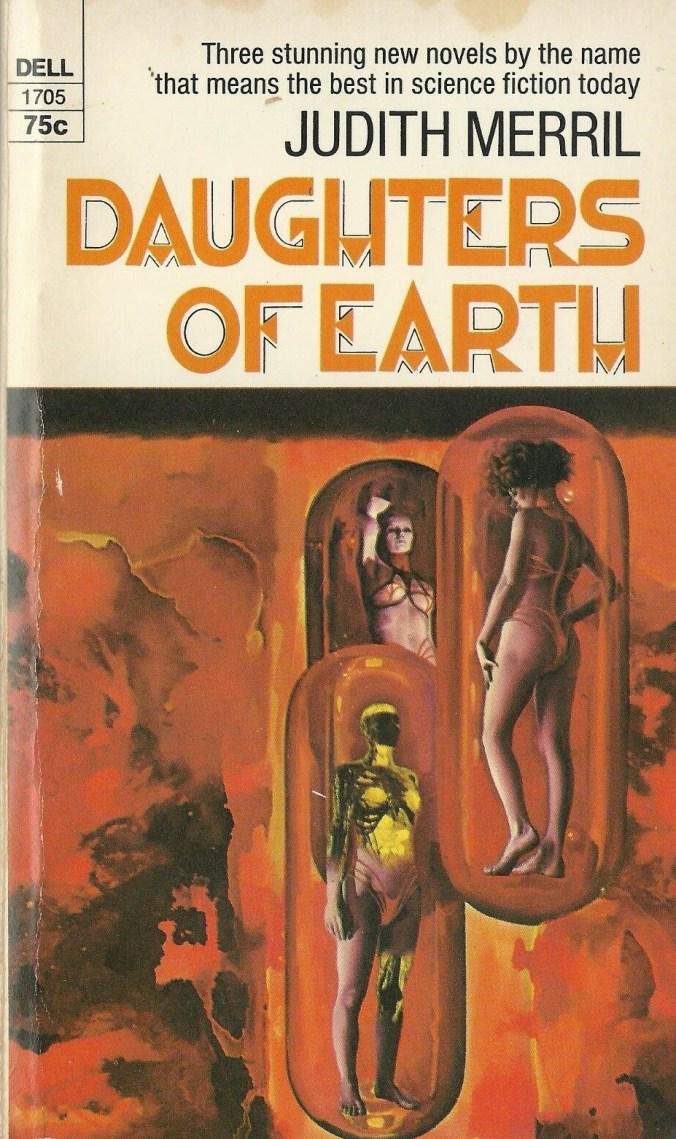
Book Review: Daughters of Earth, Judith Merril (1968)

daughters of earth

(Robert Foster’s cover for the 1970 edition)

4/5 (Good)

Judith Merril was not only an important early science fiction author of novels and short stories but a political activist and a member of the influential 1940s sci-fi group known as the Futurians (members included her husband Frederik Pohl, James Blish, Damon Knight, David A. Wollheim, C. M. Kornbluth, et al.).  Her fascinating collection, Daughters of Earth (1968), contains three novellas from the 1950s: ‘Project Nursemaid’ (1955), the highlight of the collection — ‘Daughters of Earth’ (1952), and the underwhelming ‘Homecalling’ (1956).  

All three contain a plethora of female characters Continue reading

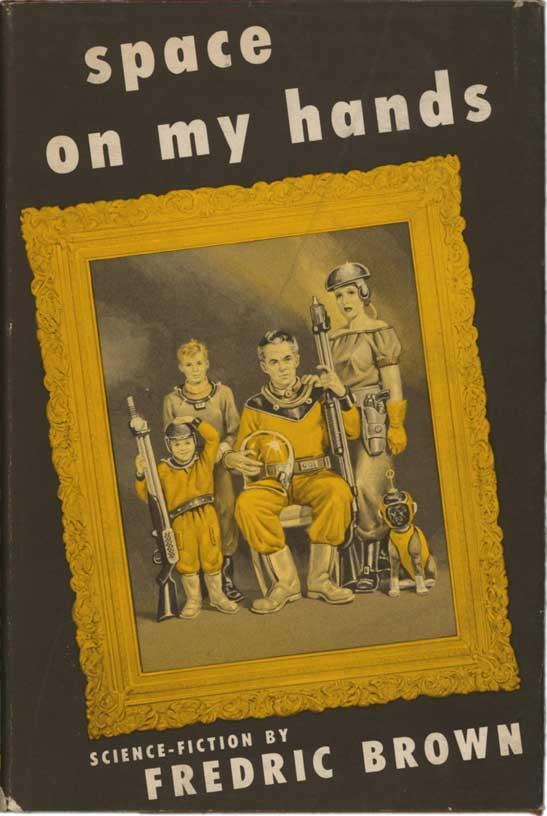
Adventures in Science Fiction Cover Art: The Space Age Family

(Malcolm Smith’s cover for the 1951 edition of Space on My Hands (1951), Frederic Brown)

I’ve scrounged through my collection of cover images over and over again trying to find families — and not alien families being slaughtered by intrepid earthmen à la The Red Planet (below).  Simply put, sci-fi generally revolves around characters who set off on their own, occasionally (at the end) finding a spouse (alien or not) and starting a family.  Heinlein’s juveniles are a great example — boy from broken family (dead mother, abandoned orphan…) learns all the math necessary for navigating in space from a book, sets off (or stows away) in the nearest possible spaceship and goes on grand adventures — perhaps killing some alien families along the way…..

I’ve still managed to find a few.  The best Continue reading