Updates: Recent Acquisitions No. LXV (Spinrad + Coney + Cummings + an anthology containing short stories by Pohl, Knight, Aldiss, et al.)

My first book from the 80s in many a year!  But, I’m on a Norman Spinrad kick so when I saw it for one dollar at the store I had to snatch it up his post-apocalyptical vision Songs from the Stars (180)….  The premise is rather hokey but perhaps a quality writer like Spinrad can imbue it with some vigor.

I’m most excited about The Ninth Galaxy Reader, ed. Frederik Pohl (1966) (twelve short stories from the Galaxy Magazine) due the top-quality author line-up — Brian W. Aldiss, John Brunner, Richard Wilson, Damon Knight, Philip Kose farmer, Harry Harrison, Frederik Pohl, Lester Del Rey, Roger Zelazny, C. C. MacApp, Larry Niven, and R. A. Lafferty….

1.  Songs from the Stars, Norman Spinrad (1980)

SNGSFRMTHS1982

(Uncredited cover for the 1982 Continue reading

Book Review: A Scourge of Screamers (variant title: The Lost Perception), Daniel F. Galouye (1966)

SCRGSCRM1968

(Paul Lehr’s cover for the 1968 edition)

2.75/5 (Vaguely Average)

Recently I procured a handful of Daniel F. Galouye’s novels (here) for a few dollars on ebay because I enjoyed his first novel Dark Universe (1961), which is an underread/underrated classic of the early 60s.  In an effort to rekindle public interest in Galouye’s small ouvre (he died at 54 due to war injuries and was unable to write much in the last ten years of his life), he received the Cordwainer Smith Rediscovery Award in 2007.  Unfortunately, Galouye’s fast-paced sci-fi thriller A Scourge of Screamers (variant title: The Lost Perception) does not measure up to the claustrophobic and well-plotted social rumination (with a good dose of action) that is Dark Universe.

The most redeeming feature is Paul Lehr’s harrowing depiction of mental anguish Continue reading

Book Review: The Immortals, James E. Gunn (1962)

THMMRTLSNS1962(Mitchell Hooks’ cover for the 1962 edition)

4.25/5 (collated rating: Good)

James E. Gunn’s The Immortals (1962) is less about the lives and mental state of the eponymous humans “blessed” with immortality (a fascinating topic in itself) and more about the ramifications of their existence on the rest of society not “blessed” with such genetic structures.  Their presence exacerbates the problems of an already dystopically tinged world where medical care is increasingly the domain of the ultra wealthy.  With the knowledge that a random genetic mutation has created a bloodline whose members are immortal, society is all too eager to root them out and (literally) bleed them dry.  Living longer — achieved by whatever means — becomes the single-minded desire of all.  Most of humanity is oblivious to the festering (and carcinogenic) Continue reading

Book Review: The Status Civilization, Robert Sheckley (1960)

THSTTSCVLZ1960

(Richard Powers (?) cover for the 1960 edition)

4/5 (Good)

Robert Sheckley deftly manipulates — in a mere (but dense) 127 pages — a plot straight from the pulps involving prison planets and gladiatorial fights against terrifying robots into a scathing and artfully constructed work of satire.  Similar skills were apparent in his masterful collection Store of Infinity (1960) where traditional sci-fi situations such as colonization of alien worlds, robot rebellions, post-apocalyptical wastelands, and time-travel (among other tropes) are imbued with witty wordplay and biting social Continue reading

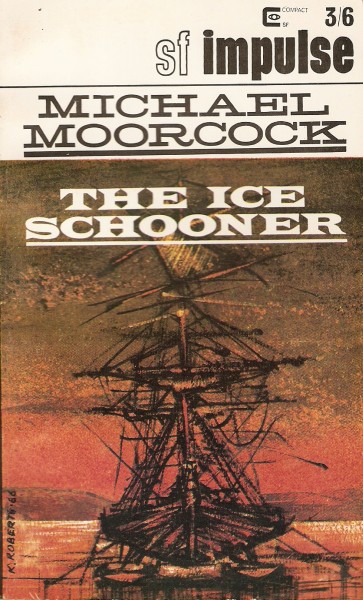
Book Review: The Ice Schooner, Michael Moorcock (1969)

IMPULSENOV1966

(Keith Robert’s cover for the 1966 edition)

3.25/5 (Average)

The Ice Schooner (1969) is the second of Michael Moorcock’s novels I’ve read — the first was the equally unremarkable adventure The Warlord of the Air (1971).  The Ice Schooner, an homage to seafaring  works of Joseph Conrad, functions as a standalone novel without the trappings of Moorcock’s multi-verse mythology.  Despite the lack of explicit connection between this novel’s hero and the “eternal champion” character archetype that features in so many of his works, one could argue that Konrad Arflane displays many of the same Continue reading

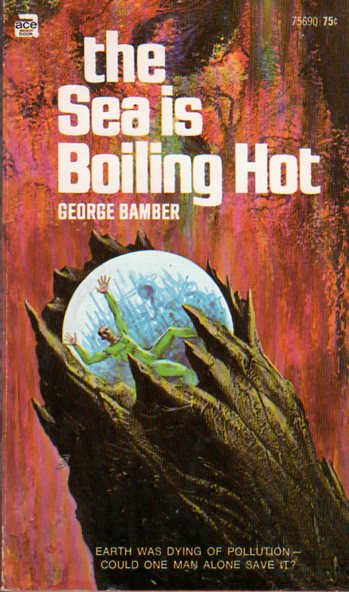
Book Review: The Sea is Boiling Hot, George Bamber (1971)

(Jack Gaughan’s cover for the 1971 edition)

2/5 (Bad)

The Sea is Boiling Hot (1971), George Bamber’s sole novel length contribution to the genre (thankfully), is the unabashedly pornographic version of the ecological disaster, humanity cooped-up in massive domed cities, let’s all get lobotomies to escape the horrors of the world science fiction.  As in, large portions of the narrative are endless sex scenes all gussied up with the accouterments of ecological “message” science fiction.

Unfortunately the sex scenes are there, in all their endless variation, simply to titillate to the reader rather than a necessary part of world building/character analysis — I’m thinking of Silverberg’s Continue reading

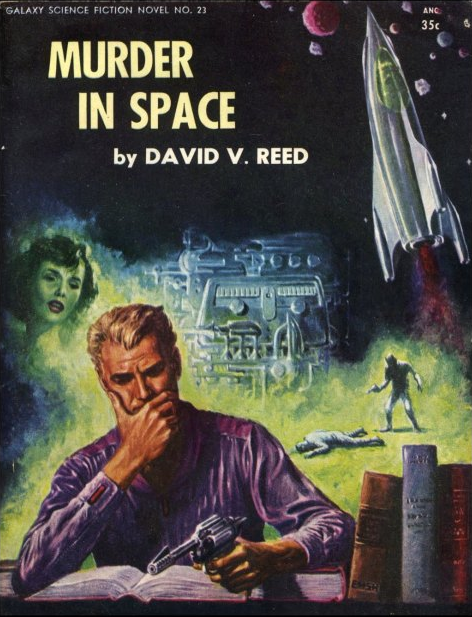
Adventures in Science Fiction Cover Art: The Composite Cover (illustrating a multiplicity of scenes, stories, thematic elements)

Screen shot 2013-01-27 at 5.27.06 PM

(Ed Emshwiller’s cover for the 1954 edition of Murder in Space (1944), David V. Reed)

Ed Emshwiller’s cover for the 1954 edition of Murder in Space (1944) perfectly embodies the composite cover comprised of sequences from the narrative.  Our hero (or villain) plots the murder in the foreground (guns, books, furrowed brow), commits the murder in the background, his love interest looks over his left shoulder (she’s constantly on his mind), and some random astroids/planets (let’s call them space rocks), a spaceship, and a strange piece of technology alert us to the science fiction aspect of the narrative…  The uncredited cover for the 1955 edition of The Altered Continue reading

Book Review: Lords of the Starship, Mark S. Geston (1967)

(John Shoenherr’s cover for the 1967 edition)

3.75/5 (Good)

Mark S. Geston’s first novel Lords of the Starship (1967), written at the age of 21 while he was an undergraduate history student, revolves around a fascinating premise: The construction of a massive (fake) spaceship intended to lift a society out of a crippling malaise.  The narrative covers hundreds of years and seemingly innumerable characters.  The lack of distinct characters is the most frustrating aspect of the work.  However, the extremely dark tone and satirical underpinnings lift the novel above the endless morass of earlier pulp sci-fi.

For fans of 50s/60s space opera and more traditionalist 60s Continue reading

Updates: Recent Science Fiction Acquisitions N. XLVI (Reed + Pratt + Brown + anthology)

Finally getting near the end of the pile of science fiction novels procured during my latest journey to Texas (a few were in clearance dollar bins) + gifts from 2theD.  I know very little about any of the authors (any info would be read with relish) — and I even bought a book from the early 1980s!  I know, shocker, but it has to do with drowned cities…. one of my favorite themes…. although it’ll never equal the uterine joys of Ballard’s magisterial The Drowned World (1962).

1. Under the City of Angels, Jerry Earl Brown (1981)

(Lou Feck’s cover for the 1981 edition) Continue reading