Book Review: The Wall Around the World, Theodore R. Cogswell (1962)

(John Schoenherr’s cover for the 1962 edition)

collated rating: 2.25/5 (Bad)

In my quest to bring to light the esoteric, the worthwhile yet forgotten, and to re-examine unjustly maligned works of science fiction I’m unfortunately more likely find incredibly average works than if I were to stick to the more well-trod path.  Theodore Cogswell’s short stories attempt unsuccessfully to wed clichéd fantasy + horror elements — à la vampires, werewolves, broomsticks and all that drek — with science fiction staples, including alien invasions and alien visitations.  I suspect there was, and still is, a market for such hybridity.  I don’t have to mention the conveyor belt chunking out vampire/zombie excreta all over our modern bookstore shelves… (I apologize to anyone who’s offended or implicated by that statement).  Almost all of Cogswell’s stories are lighthearted (besides ‘The Burning’), replete with heavy doses of whimsy, and in the few readable stories, some vibrancy.

Not my type of science fiction or fantasy.
Continue reading

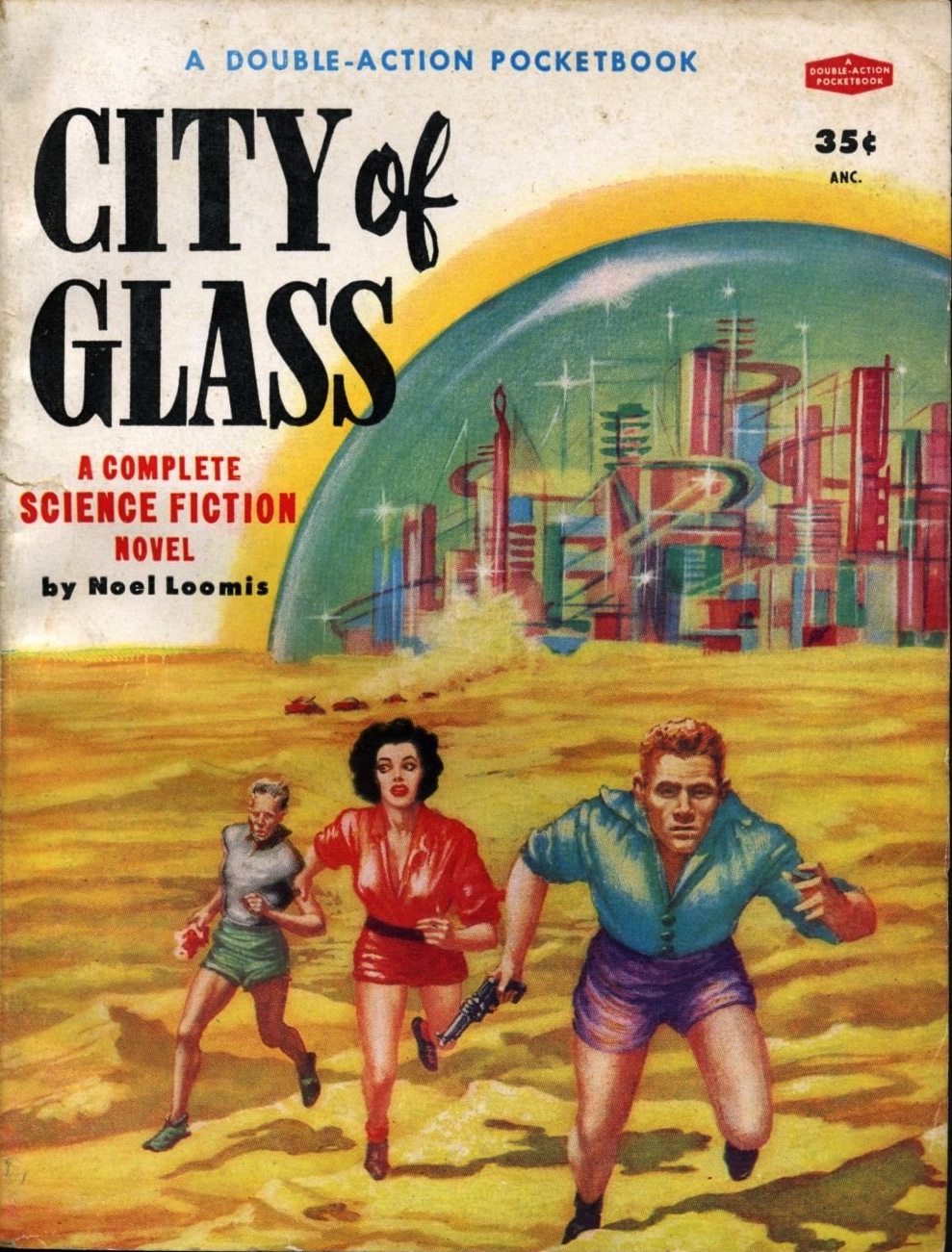
Adventures in Science Fiction Cover Art: Domed Cities of the Future, Part III

(Kelly Freas’ cover for the 1955 edition of City of Glass (1942 magazine), Noel Loomis)

Part I, Part II of my series on domed cities of the future.

Bob Watkin’s cover for the 1955 issue of If Magazine depicts an old man regaling stories of futuristic domed cities.  His fantastic visions are reduced to their key elements in sketch form — a translucent dome, buildings.  I’ve selected a variety of images from pulp 50s works until the late 70s depicting more fantastic/futuristic domed cities than the old man’s imagination conjures.  Ed Emshwiller’s cover for the  1953 edition of City at World’s End (1950) depicts two futuristic metropoli — a trend in future city development?  The first is a planned circular city spreading horizontally across the plain.  The other, an incredibly stylized “futuristic complex” Continue reading

Adventures in Science Fiction Cover Art: Nuclear Explosions + Mushroom Clouds, Part II

(Pattee’s cover for the November 1950 issue of Astounding Science Fiction)

In case you missed Part I.

Pattee’s cover for the Astounding Science Fiction November 1950 issue is visually stunning.  A transparent man (his arteries + brain showing) holds the atomic symbol aloft.  On the horizon a gigantic mushroom cloud is transposed with a spaceship.  Does man use atomic power for science and the good of mankind or evil and the destruction of mankind?  The message is made even more abundantly clear by the title of the piece of art — “Choice.”  Although this rhetoric might seem somewhat ham-fisted to modern post-Cold War readers, it produced some remarkable works of science fiction and science fiction art.  (If anyone knows the full name of the artist, I’d be grateful).

As with Part I, I’ve included some covers from the notorious hackwork spewing conveyor belt publisher Badger Books for giggles and Continue reading

Updates: Recent Science Fiction Acquisitions N. XLII (Malzberg + Roshwald + Clement + Moorcock)

A nice selection of books from my fellow book reviewer at Potpourri of Science Fiction Literature and a few from a recent trip to Indianapolis — the fried chicken and waffles at Maxine’s were far superior to their used book stores….

My trilogy of dark/brilliant/disturbed Malzberg novels dealing with the space program, The Falling Astronauts (1971), Revelations (1972), and Beyond Apollo (1972) is now complete!  When I get around to reading The Falling Astronauts I will put together a special post with a series of intriguing space program documents given to me by my fiancé — including a hilarious 1965 publication, The Astronauts & Their Families, where real life astronauts pose with their happy families, play with puppies, teach their children to shoot rifles, pose with their cars, pretend to play at the piano, etc — i.e. the oposite of Malzberg’s vision of the “manliest” of American heroes…

The Moorcock novel, The Ice Schooner (1969) was a rather impulsive buy — I’ve yet to read any of his works, but voyagers to cities wreathed in ice is always a fun trope.

Level 7 (1959) is generally considered a Cold War masterpiece…

Clement’s Through the Eye of the Needle (1978) is the sequel to Needle (magazine 1949) — I’ll probably want to find a copy of the first in the series before I give the sequel a shot….

1. The Falling Astronauts, Barry N. Malzberg (1971) (MY REVIEW)

(Davis Meltzer’s cover Continue reading

Book Review: The Eleventh Commandment, Lester del Rey (1962, revised: 1970)

(Dean Ellis’ cover for the 1970 edition)

3.5/5 (Good)

Lester del Rey’s The Eleventh Commandment, originally published in 1962, was revised by the author in 1970. I’ve reviewed the 1970 edition — I do not know to what extent the original was changed.

My first exposure to Lester del Rey’s sci-fi bucks the impression of general averageness conveyed by my fellow reviewers.  This work strikes me as a product of the more mature side of del Rey, a move away from his normal space opera YA fare.  In The Eleventh Commandment del Rey explores the religious ramification of overpopulation (see list) concerns of the 50s/60s.  Due to the fact that overpopulation fears gained a lot of currency after the publication of the 1968 bestselling non-fiction work The Population Bomb,  I suspect it provided the impulse for del Rey to rewrite the novel.  Despite the involving premise, the plot is often a Continue reading

Updates: Recent Science Fiction Acquisitions N. XXXVIII (Spinrad + Harrison + Kavan + Effinger)

Ah, when I have access to a massive inexpensive catalogue (Marx Books) the quality of my finds goes up and up…..  Finally a copy of Norman Spinrad’s metafictional The Iron Dream (1972) (if Hitler lived in America and wrote a sci-fi novel AND a commentary on said piece of science fiction).  Unfortunately, I own a later edition (with a hideous cover) than the one below.  Geo. Alec Effinger’s bizarre What Entropy Means to Me (1972) — again, about writing, and interpreting writing, and inventing interpretation…  Anna Kavan’s drug inspired underrated and underread sci-fi parable Ice (1976).  AND, a futuristic fantasy of the highest caliber, M. John Harrison’s The Pastel City (1971) — yes, I could have purchased the multi-novel sequence (and related short stories) in one volume but I like having the original paperbacks.

1. The Iron Dream, Norman Spinrad (1972)

(Uncredited cover for the 1972 edition) Continue reading

Book Review: Three for Tomorrow, novellas by Robert Silverberg, Roger Zelazny, and James Blish, (1969)

(Uncredited cover for the 1970 edition)

3.5/5 (collated rating: Good)

Three for Tomorrow (1969) contains three novellas written specially for the volume on the following theme selected by Arthur C. Clarke: “with increasing technology goes increasing vulnerability: the more man conquers Nature, the more prone he becomes to artificial catastrophe” (foreword, 8).  In my continuing quest for Robert Silverberg’s work from his Glory Period (proclaimed by me) 1967-1976, I was delighted to come across one of his shorter works paired with two other great authors, James Blish and Roger Zelazny.  If you want to read Silverberg’s novella but not the others, it appeared in many of his later collections — Earth’s Other Shadow (1973) for example.

As with most collections, Three for Tomorrow is uneven.  Silverberg’s installment is the best due to its intriguing social analysis of a city suddenly whose inhabitants are suddenly missing Continue reading

Book Review: Seed of Light, Edmund Cooper (1959)

(Uncredited cover for the 1959 edition — I suspect it might be David Davies)

3.25/5 (Average)

Edmund Cooper’s Seed of Light (1959) is less of a traditional narrative of the voyage of a generation ship as are its fellow generation ship novels of the 40s/50s. The best examples are Brian Aldiss’ Non-Stop (1958) and Robert Heinlein’s Orphans of the Sky (1941).  Seed of Light is more like a piece of pseudo-history interlaced with fragments of narrative of varying effectiveness.  The work is best described as a thematically-linked series of novellas tracking the future development of man in broad strokes à la Brian Aldiss’ Galaxies Like Grains of Sand (1960).  Unfortunately, Cooper’s original splicing of the generation ship theme onto a Future History template (made popular but Olaf Stapleton and Isaac Asimov among others) is extremely uneven.  Some portions are involving while others are plagued by laborious epoch-spanning pseudo-historical lectures.

Because each part is a separate novella (the last two are more closely Continue reading

Adventures in Science Fiction Cover Art: Nuclear Explosions + Mushroom Clouds

(Ed Valigursky’s cover for the 1957 edition of Doomsday Eve (1957). Robert Moore Williams)

The nuclear scare produced some of the best dystopic visions ever put to paper — the devastation would be utter, complete, and the radiation, oh what fun science fiction authors and filmakers had with the effects of radiation.  A red spectrum! Mutations! Hybrid bug people!  Godzilla!  Women with two heads!  An endless assortments of monsters…  I’ve selected a wide range of covers depicting the actual nuclear explosion — not the after effects.  Families gaze from caves in dispair, watching the bomb incinerate their world.  People run helter-skelter away from the explosion.  Or, artists take a more stylized approach to the explosion — figures are cast upward amongst the wreckage of buildings. Continue reading