Magazine Review: Galaxy Science Fiction, ed. H. L. Gold (November 1950) (Brown, Asimov, Boucher, Leiber, Knight, Simak)

Preliminary Note: I plan on reading all 116 issues of the influential, and iconic, SF magazine Galaxy under H. L. Gold’s editorship (October 1950-October 1961) in chronological order. How long this project will take or how seriously/systematically I will take it remain complete unknowns.

See my inaugural post in this series for my reasoning behind selecting Galaxy under H. L. Gold.

Previously: the October 1950 issue.

Up Next: the December 1950 issue.

Let’s get to the stories. We have the first Galaxy masterpiece!


You can read the entire issue here.

Fredric Brown’s “Honeymoon in Hell” (1950), 3/5 (Average): The year is 1962. The Cold War heats up. The race for a permanent presence on the Moon takes center stage. Each side “had landed a few men” and claimed it as their own (4). Each side races to construct a space station in orbit to facilitate the construction of a permanent base on the moon. But there’s another worrying world-wide trend–a massive gender imbalance in new births! Not enough boys! Riots. Cults. What’s the plan?

Continue reading

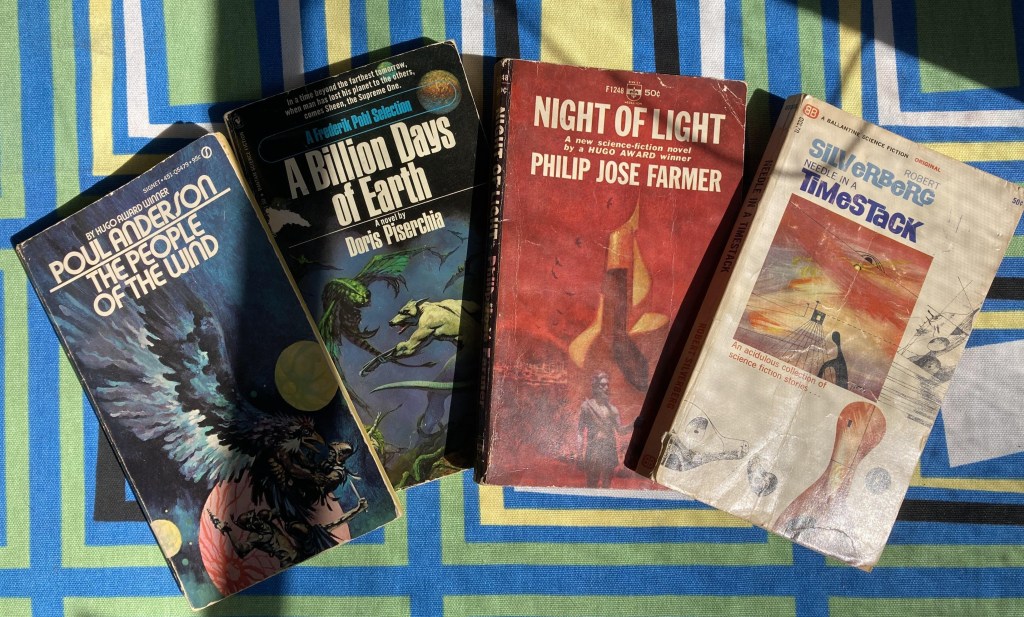
Recent Science Fiction Purchases No. CCCXLIV (Margaret St. Clair, Edgar Pangborn, Keith Laumer, and Edmund Cooper)

Which books/covers/authors intrigue you? Which have you read? Disliked? Enjoyed?

It’s the summer Joachim Boaz. Where are the reviews? I’m currently on a much needed vacation (Iceland). I will be back soon! In the meantime here are four recent purchases.

1. The Dancers of Noyo, Margaret St. Clair (1973)

From the back cover: “Like so many others before him, reluctant Sam MacGregor was sent on a pilgrimage for the Frail Vision by the Dancers: androids grown from the cells of one man, with the powers of hypnotism and illusion–androids who held the tribes of the Republic of California in thrall.

But soon Sam began to doubt his own identity, for he experienced, in close succession, extra-lives in different corridors of time and space.

Continue reading

Magazine Review: Galaxy Science Fiction, ed. H. L. Gold (October 1950) (Simak, Sturgeon, MacLean, Matheson, Leiber, Brown, Asimov)

Preliminary Note: I plan on reading all 116 issues of the influential, and iconic, SF magazine Galaxy under H. L. Gold’s editorship (October 1950-October 1961) in chronological order. How long this project will take or how seriously/systematically I will take it are complete unknowns. I am a reader of whim. I will choose whether to reread certain stories that I’ve previously covered. Serialized novels will only be reviewed after I complete the entire work and posted as separate reviews. Why Galaxy, you might ask?

First, I can’t escape the pull of 1950s science fiction focused on social commentary and soft science. Second, I am obsessed with 50s American politics during a time of affluence, the rise of TV and mass culture, and the looming terror of the Cold War. Third, there are a legion of well-known 50s authors I’ve yet to address in any substantial manner on the site who appeared behinds its illustrious covers. Fourth, H. L. Gold was interested in all different types of stories.

As SF Encyclopedia explains, Galaxy was an “immediate success” in part because “Astounding was at this time following John W Campbell Jr’s new-found obsession with Dianetics and was otherwise more oriented towards technology.” Gold’s interests, on the other hand, “were comparatively free-ranging: he was interested in psychology, sociology and satire and other humor, and the magazine reflected this.”

I hope you enjoy this series! Feel free to join.

Up Next: the November 1950 issue.


You can read the entire issue here.

Clifford D. Simak’s Time Quarry (variant title: Time and Again) (1950). Serialized over three issues. I will post an individual review after I complete the serialization.

Continue reading

Short Book Reviews: Edgar Pangborn’s The Company of Glory (1974, novelized 1975) and Harold Mead’s Mary’s Country (1957)

Note: My read but “waiting to be reviewed pile” is growing. Short rumination/tangents/impressions are a way to get through the stack before my memory and will fades. My website partially serves as a record of what I have read and a memory palace for future projects. Stay tuned for more detailed and analytical reviews.

1. Edgar Pangborn’s The Company of Glory (1975)

3.5/5 (Good)

Edgar Pangborn is an unsung SF hero in my book. At his best, he’s a deeply humanistic writer interested in moments of effective metafictional play on the nature of narrative. The Company of Glory (serialized 1974, 1975) is the third novel in the Tales of Darkening World sequence. It forms a prequel to Pangborn’s masterpiece Davy (1964). As with Davy, The Company of Glory attempts to create multiple interlocking layers of narrative, stories within the stories, quotations from various diaries, and the interjections of the overarching narrator of the entire collection of texts who remains anonymous until the final pages.

Continue reading

What pre-1985 science fiction are you reading? + Update No. XXII

What pre-1985 science fiction are you reading or planning to read next month? Here’s the April installment of this column.

As readers of the site know, I am obsessed with the machinations of Cold War nuclear logic—historical and science fictional. In Ira Chernus’ brilliant Apocalypse Management: Eisenhower and the Discourse of National Insecurity (2008), he dives into the Manichean ideoscape that dominated Eisenhower’s thinking. In short, he posits that Eisenhower interpreted the Soviet threat as an apocalyptic struggle in which the traditional outcome, eliminating the treat, is impossible. Instead the best hope is “to contain and manage it forever” (2)–hence “apocalypse management.” This “new linguistic paradigm” profoundly influenced their policymaking process and dominated American public discourse.

According to Chernus, Eisenhower was obsessed with Americans practicing voluntary self-control in their consumption in order shoulder the taxes needed to fund the perpetual struggle. With this paradigm, Eisenhower’s gestures towards peace–for example his “The Chance for Peace” (April 16th, 1953) speech–were acts of calibrated psychological warfare designed to put the burden of action on the Soviets and score points with the American public and American allies. The United States, on the other hand, could wage the conflict with perpetual, safe, and managed inaction in which peace is never the ultimate objective.

Continue reading

Recent Science Fiction Purchases No. CCCXLIII (Philip K. Dick, Roger Zelazny, Chuck Rothman, Philip José Farmer, and an anthology on Future Love)

Which books/covers/authors intrigue you? Which have you read? Disliked? Enjoyed?

1. Deus Irae, Philip K. Dick and Roger Zelazny (1976)

From the back cover: “One their own, they have written landmarks works that have added whole new dimensions of wonder to the field of science fiction. Now, in Deus Irae, they have created what ALA Booklist calls “the most successful collaboration in years!”–set in in bizarre world where you will encounter…

A bunch of backwoods farmers who happen to be lizards…

Continue reading

What pre-1985 science fiction are you reading? + Update No. XX

What pre-1985 science fiction are you reading or planning to read this month? Here’s the January installment of this column (sorry I missed a month).

Before John W. Campbell, Jr. (1910-1971) attempted to raise the “standards and thinking in magazine SF,” David Lasser (1902-1996) attempted his own brief (1929-1933) program to improve science fiction as managing editor of Hugo Gernsback’s Science Wonder Stories, Wonder Stories, and Wonder Stories Quarterly. According to Mike Ashley’s The Time Machine: The Story of the Science-Fiction Pulp Magazine from the Beginning to 1950 (2000), Lasser is a “much neglected revolutionary in science fiction” and through his efforts the genre “started to mature” (66).

Ashley highlights Lasser’s letter of instruction mailed to his regular contributors on the 11th of May, 1931, in which he “exhorted them to bring some realism to their fiction” (72). He also outlawed common tropes like the giant insect story and space opera (73). He emphasized the need to focus on characters that “should really be human” — not everything needs to be a “world-sweeping epic” (73). Stories in this vein, according to Ashley, include Clifford D. Simak’s religiously themed “The Voice in the Void” (1932), P. Schuyler Miller and Walter Dennis’ “The Red Spot on Jupiter” (1931) and “The Duel on the Asteroid” (1974), which featured a grim realism and character development (74).

Continue reading

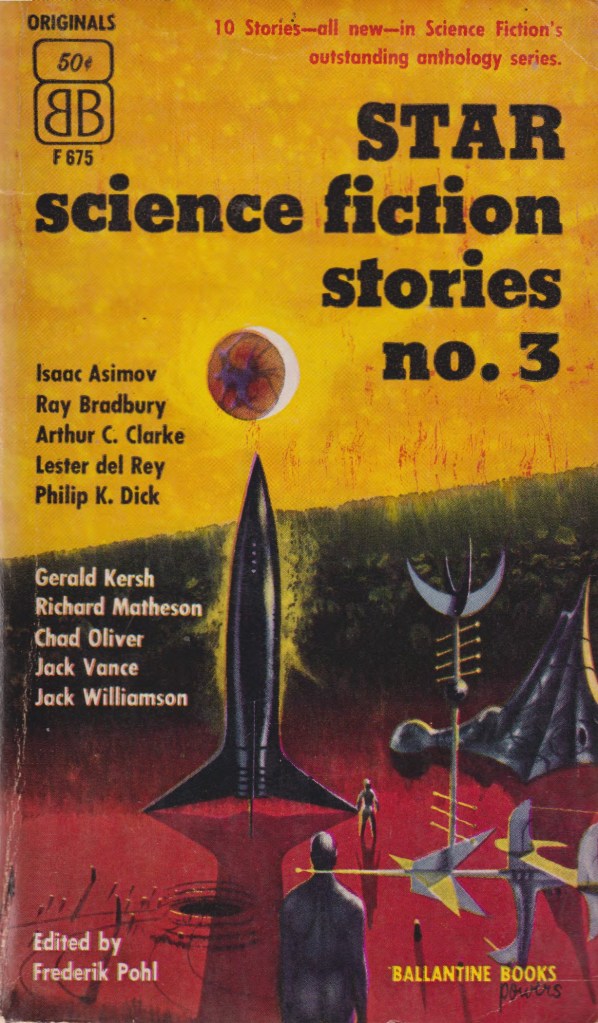
Book Review: Star Science Fiction Stories No. 3, ed. Frederik Pohl (1955)

3.5/5 (collated rating: Good)

Ballantine Books’ illustrious science fictional program started with a bang–Star Science Fiction Stories. According to Mike Ashley’s Transformations: The Story of Science-Fiction Magazines from 1950 to 1970 Frederik Pohl’s anthology series of original (mostly) stories was “intended as both a showcase of Ballantine’s authors and a lure to new writers.” Paying better rates than magazines, the Star series foreshadowed the explosion of original anthologies that would provide a sustained challenge to the eminence held in the 50s by the magazine.

I’ve selected the third volume of the six-volume series.1 It contains an illustrative cross-section of 50s science fiction. Philip K. Dick’s “Foster, You’re Dead” (1955), Richard Matheson’s “Dance of the Dead” (1955), and Jack Williamson’s “Guinevere for Everybody” (1955) are not to be missed.

Continue reading

Book Review: Future Power, ed. Jack Dann and Gardner Dozois (1976) (Ursula K. Le Guin, Damon Knight, James Tiptree, Jr., Gene Wolfe, etc.)

4/5 (collated rating: Good)

What a way to finish 2024! Future Powers, ed. Jack Dann and Gardner Dozois (1976) is a well-crafted thematic anthology with seven original stories and two older classics. Other than R. A. Lafferty’s average contribution, all the tales effectively engage with the theme of the complexities of future control both in everyday and the macropolitical contexts.

A few tantalizing fragments: Ursula K. Le Guin’s “The Diary of the Rose” (1976) explores the operations of dystopic control through the eyes of a neophyte doctor (“scopist”); Damon Knight ruminates on the nature and treatment of the psychopath in “The Country of the Kind” (1956); and A. K. Jorgensson’s “Coming-of-Age-Day” (1965) takes the reader through all the unnerving and confusing moments of a child in a strange future attempting to understand the nature of sex.

Continue reading