Book Review: Future Power, ed. Jack Dann and Gardner Dozois (1976) (Ursula K. Le Guin, Damon Knight, James Tiptree, Jr., Gene Wolfe, etc.)

4/5 (collated rating: Good)

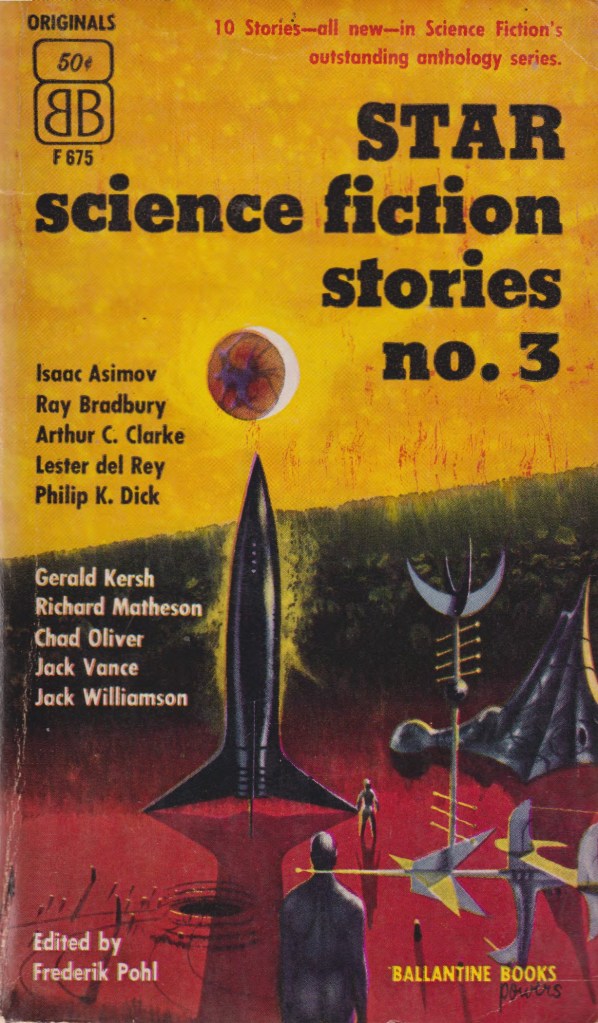
What a way to finish 2024! Future Powers, ed. Jack Dann and Gardner Dozois (1976) is a well-crafted thematic anthology with seven original stories and two older classics. Other than R. A. Lafferty’s average contribution, all the tales effectively engage with the theme of the complexities of future control both in everyday and the macropolitical contexts.

A few tantalizing fragments: Ursula K. Le Guin’s “The Diary of the Rose” (1976) explores the operations of dystopic control through the eyes of a neophyte doctor (“scopist”); Damon Knight ruminates on the nature and treatment of the psychopath in “The Country of the Kind” (1956); and A. K. Jorgensson’s “Coming-of-Age-Day” (1965) takes the reader through all the unnerving and confusing moments of a child in a strange future attempting to understand the nature of sex.

Continue reading

What pre-1985 science fiction are you reading? + Update No. XVII

What pre-1985 science fiction are you reading or planning to read this month? Here’s the September installment of this column. I am a few days late with this post. We’ll pretend it appeared in October!

I’ve been reading the little scholarship on H. Beam Piper (1904-1964) in order to more adeptly understand his political views when I tackle his various union-related stories for my series. I was struck by the extreme poverty, impact of a memorable cover, and dependence on a responsive agent that he found himself mired in after he lost his railroad guard job and had to rely on writing. He kept himself alive by selling off his gun collection that he had accumulated over the years and eating pigeons his shot on his porch. While he doesn’t seem to have been the best with the little money that came his way, often blowing the majority of a paycheck from Campbell, Jr. on expensive suits, it’s shocking what he had to do to survive between story acceptances. Piper seems to have committed suicide in part due to his financial hardships.

Despite the fact that I can’t wholeheartedly recommend John F. Carr’s H. Beam Piper: A Biography (2008) or Typrewriter Killer (2015) as large sections take the form of haphazardly strung together journal entries with little larger historical analysis, I found Carr’s often unnervingly voyeuristic look into his life lay bare the financial realities of publishing SF, even in a moment when magazines paid well. Unfortunately, Carr leaves comments like Piper’s 1961 letter in which he states “John [Cambell, Jr.] is almost as big a fascist sonofabitch as I am — but he wants a couple of points hammered home a bit harder” un-analyzed.

And let me know what pre-1985 science fiction you’ve been reading!

Continue reading

Short Story Reviews: Lisa Tuttle’s “Stone Circle” (1976) and Grania Davis’ “New-Way-Groovers Stew” (1976)

While perusing Eric Garber and Lyn Paleo’s indispensable resource Uranian Worlds: A Reader’s Guide to Alternative Sexuality in Science Fiction and Fantasy (1983, second ed. 1990), my eyes fell on stories by Lisa Tuttle and Grania Davis.1 I’ve never read the work of Lisa Tuttle and I know little to nothing about Grania Davis beyond “My Head’s in a Different Place, Now” (1972), which I tersely dismissed as “zany and forgettable.” I’m glad I decided to pair the stories. Both tackle the inability of 60s radicalism to create a lasting ideological movement. Both stories come with caveats.

Preliminary Note: In the future, I might cover problematic stories on this theme or others with a strong heterosexual bias. They too reveal how people thought about queer topics through the lens of science-fictional extrapolation at different points in history.

Let’s get to the stories!


4.25/5 (Very Good)

Lisa Tuttle’s “Stone Circle” first appeared in Amazing Stories, ed. Ted White (March 1976). You can read it online here. It was nominated for the 1977 Nebula Award for Best Short Story.

Continue reading

Short Story Review: Robert Abernathy’s “Single Combat” (1955)

In January, I inaugurated a new review series on the urban landscape in science fiction. I finally present the second post! And it’s a good one. I am joined by Anthony Hayes, a frequent contributor and creator of wonderful conversations over the last few years on the site (as antyphayes). I recommend you check out his website The Sinister Science. In addition to ruminations on science fiction–often through the lens of his academic PhD research in the Situationist International, “as well as other related left-communist and post-situationist writings,” he creates fascinating collages that interweave comic books, textual play, and historical images.

We chose Robert Abernathy’s deceptively complex parable of urban alienation “Single Combat” (1955) as our inaugural story. It first appeared in The Magazine of Fantasy and Science Fiction, ed. Anthony Boucher (January 1955). You can read it online here.

Previously: Michael Bishop’s “The Windows in Dante’s Hell” (1973), Barrington J. Bayley’s “Exit from City 5” (1971), and A. J. Deutsch’s “A Subway Named Mobius” (1950).

Up Next: TBD


Anthony Paul Hayes’ Rumination

Urban alienation writ large: Robert Abernathy’s “Single Combat”’ (1955)

Having planted an explosive device in a forgotten corner of an unnamed, North American city, the similarly unnamed protagonist flees. However, in fleeing the protagonist comes to realise what they had hitherto only suspected: that the city has become a living, conscious thing, and like all such things is willing to fight for its survival.my

Continue reading

What pre-1985 science fiction are you reading? + Update No. XII

What pre-1985 science fiction are you reading or planning to read this month?

Here’s April’s installment of this column.

First, a bit about Isaac Asimov’s Foundation (1951) from M. Keith Booker’s Monsters, Mushroom Clouds, and the Cold War: American Science Fiction and the Roots of Postmodernism, 1946-1964 (2001), my current history of science fiction read:

Continue reading

Short Story Review: Kōbō Abe’s “The Flood” (1950, trans. 1989)

Today I’m joined by Rachel S. Cordasco, the creator of the indispensable website and resource Speculative Fiction in Translation, for something a bit different!

We will both offer our reviews of one of Kōbō Abe’s first published speculative short stories, “The Flood” (1950). Over the next few months, we’ll post reviews of speculative fiction in translation from Romania, Chile, Austria, Poland, France, and the Netherlands. Depending on the story and our thoughts, I might also include our responses to each other’s review.

Also if you haven’t checked out Rachel’s website, you must. Not only does she review the global phenomena of speculative fiction but gathers lists of translated fiction by language. Also check out her reference monograph Out of This World: Speculative Fiction in Translation from the Cold War to the New Millennium (2021). In 2016, she contributed to my site reviews of three French SF stories in translation.

We read Kōbō Abe’s “The Flood” (1950) in The Best Japanese Science Fiction Stories, ed. John L. Apostolou and Martin H. Greenberg (1989). Translated by Lane Dunlop. You can read it online here.

Now let’s get to our reviews!

Continue reading

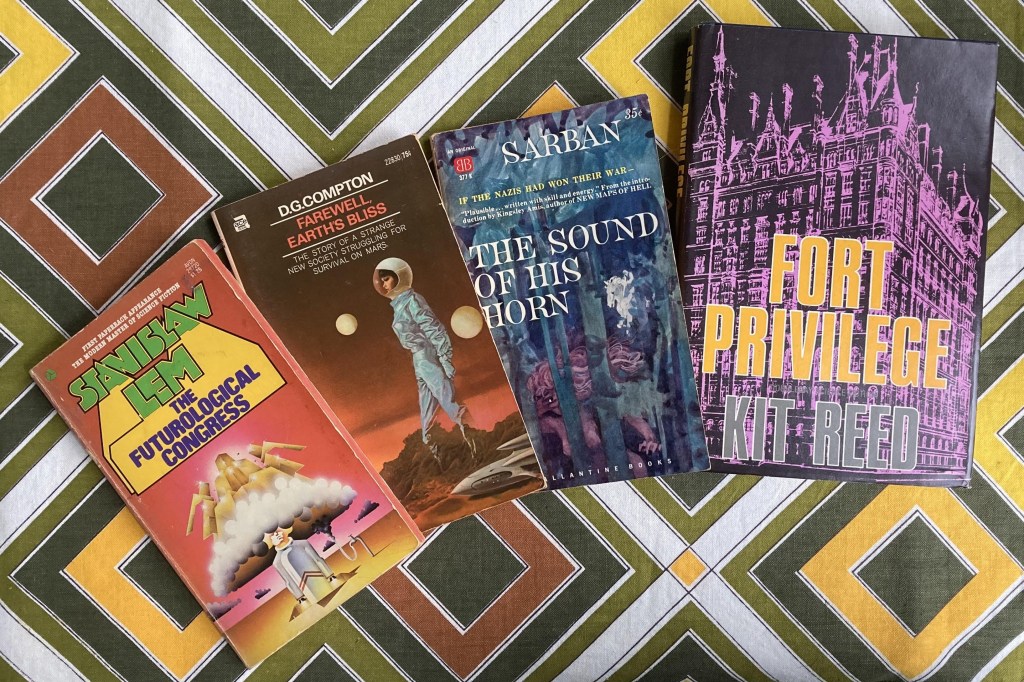
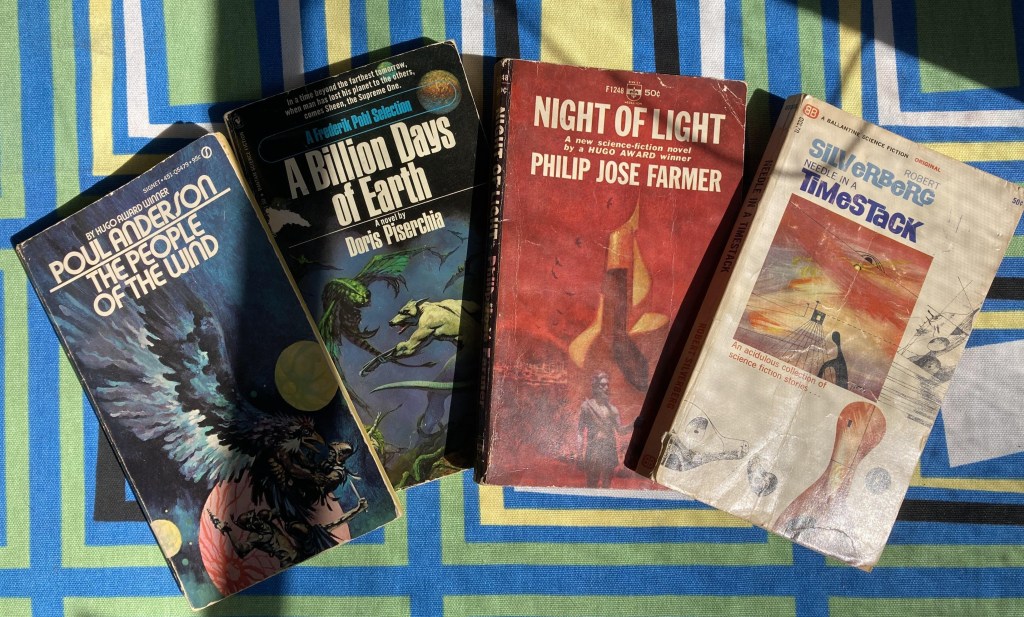
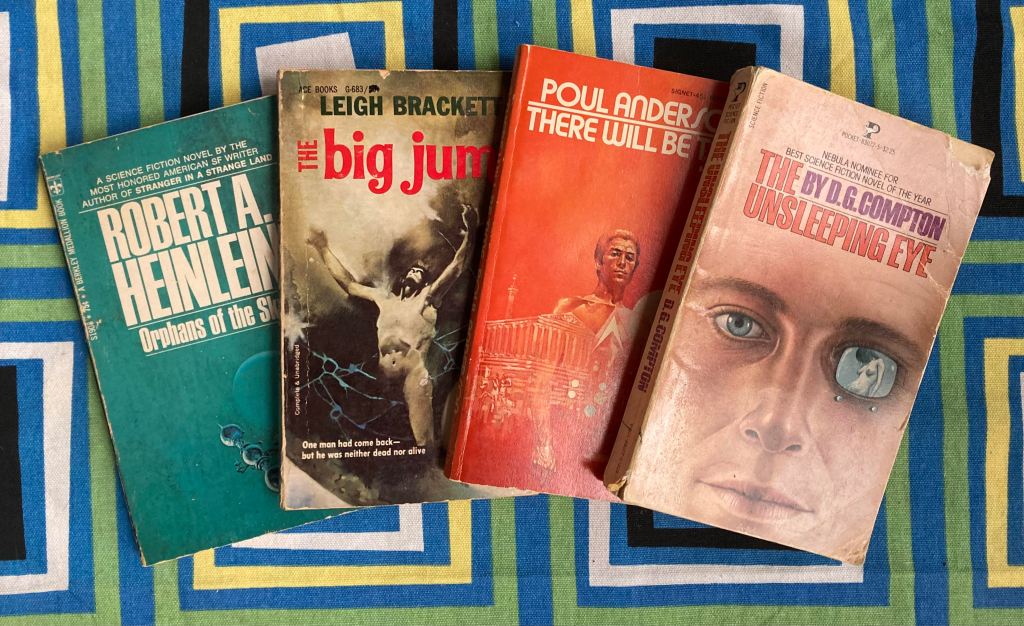
Updates: Recent Science Fiction Purchases No. CCCXXX (Tim Powers, Octavia E. Butler, George Alec Effinger, and Tom Purdom)

Which books/covers/authors intrigue you? Which have you read? Disliked? Enjoyed?

1. Dinner at Deviant’s Palace, Tim Powers (1985)

From the inside flap: “The civilized world had come to an end more than a century earlier, but in California life and society went on… taking strange, often horrifying forms.

Gregorio Rivas was a survivor–a proud, resourceful man who had, most recently, made his way from the corrupt, crumbling city of Venice to carve out a successful career as a musician within the walls of Ellay. He played his pelican with raw energy and flashy style, and people came from all over to hear him. But Greg’s real claim to fame had nothing to do with music. It was a part of his past he wanted to forget. And it had come back to haunt him…

Continue reading

Short Story Reviews: Howard Waldrop’s “Mary Margaret Road-Grader” (1976), David J. Skal’s “Chains” (1971), and Tom Purdom’s “Courting Time” (1966)

Howard Waldrop (1946-2024), David J. Skal (1952-2024), and Tom Purdom (1936-2024) all passed away since the beginning of the year. As I’ve only read Howard Waldrop’s “God’s Hooks!” (1982), “My Sweet Lady Jo” (1974), and “The Ugly Chickens” (1980) and Tom Purdom’s “Toys” (1967), I impulsively thought I’d stich together a post featuring a tale by each.

Please note that I have not read enough to identify their best work and a negative review is not intended to be a statement about their entire oeuvre and impact on the genre. If you have any fond memories, recommendations for stories, or other tangents related to the three authors, let me know in the comments.

Terry Bisson (1942-2014) also passed away this year but did not publish any short fiction until the 90s. I’ll make sure to review one of his 80s novels—Wyrldmaker (1981) or Talking Man (1986)–this year instead. I’ve also procured novels by Purdom and Skal to feature later this year.

Now let’s get to the stories!


4.5/5 (Very Good)

Howard Waldrop’s “Mary Margaret Road-Grader” first appeared in Orbit 18, ed. Damon Knight (1976). If you have an Internet Archive account, you can read it online here.

Nominated for the 1977 Nebula Award for Best Short Story. Lost to Charles L. Grant’s “A Crowd of Shadows” (1976).

Continue reading

Updates: Holiday Purchases! No. CCCXXVIII (Robert Silverberg, S. P. Somtow, Janet Asimov, and a World’s Best Anthology)

Happy holidays. I hope you’ve been able to squeeze in a bit of science fiction reading.

Which books/covers/authors intrigue you? Which have you read? Disliked? Enjoyed?

1. Those Who Watch, Robert Silverberg (1967)

From the back cover: “CRASH LANDING FROM THE STARS.

Only three humans would ever know that the blinding flash in the sky on that night in 1982 was an exploding flying saucer. Only they would learn the truth about THOSE WHO WATCH–about the alien beings who came into this world in a crash landing from the stars. THOSE WHO WATCH is the strange, seductive novel of three accidental colonists from outer space whose chance encounter with Earth triggers interplanetary conflict. It is also the most unusual love story ever written.”

Continue reading