Which books/covers/authors intrigue you? Which have you read? Disliked? Enjoyed?
1. Dinner at Deviant’s Palace, Tim Powers (1985)
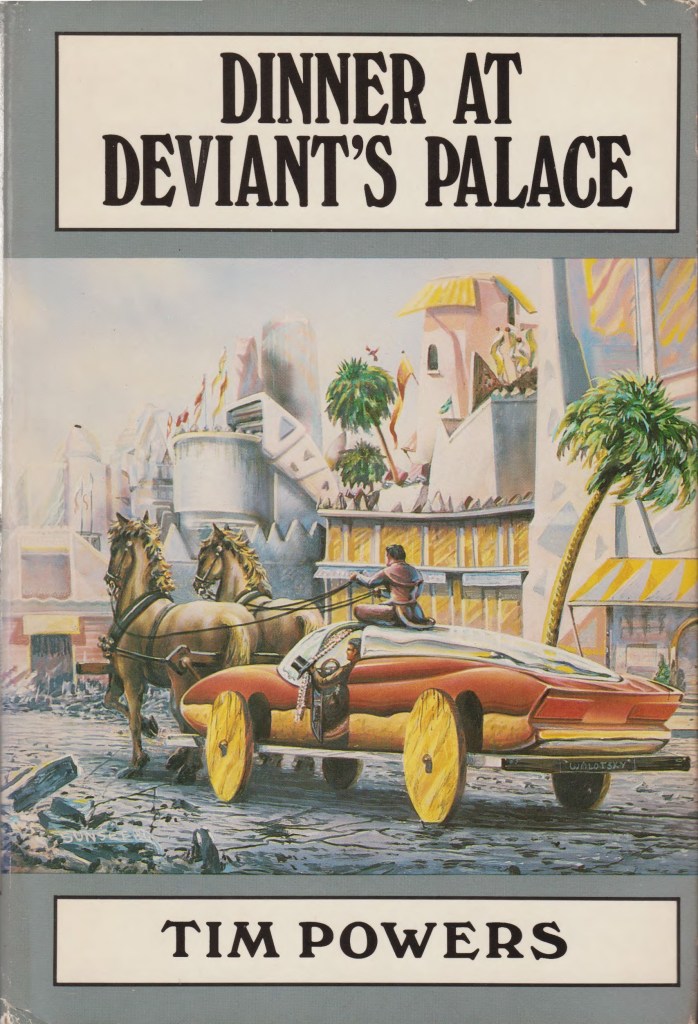
Ron Walotsky’s cover for the 1985 edition
From the inside flap: “The civilized world had come to an end more than a century earlier, but in California life and society went on… taking strange, often horrifying forms.
Gregorio Rivas was a survivor–a proud, resourceful man who had, most recently, made his way from the corrupt, crumbling city of Venice to carve out a successful career as a musician within the walls of Ellay. He played his pelican with raw energy and flashy style, and people came from all over to hear him. But Greg’s real claim to fame had nothing to do with music. It was a part of his past he wanted to forget. And it had come back to haunt him…
A well-dressed old man stood at the bar watching the band play, and it took a few moments between the time that Rivas first noticed him and the unpleasant spark of recognition. It was Barrows, father of the girl Greg had loved some 13 years ago, and longed for ever since. Urania.
Barrows hadn’t been at all pleased at the relationship between his only child and a tenant farmer’s son, and he’d put an abrupt end to the romance–to the boy’s everlasting humiliation. Yet Greg managed to remain outwardly cool as he wandered over to join the man, well aware that there was only one possible reason for Irwin Barrows to seek him out.
It was Greg Rivas, redeemer, the old man wanted. For Urania had been recruited by the followers of self-proclaimed messiah Norton Jaybrush. Outsiders knew very little about the cult–just stories of Jaybrush’s “miracles” and incredible powers of mind control… and the disturbing fact that once a convert entered the Holy City of Irvine, he or she never returned. Grief-stricken families who could pay the price hired redeemers–contract kidnappers who would, with luck, bring lost sons and daughters home again before the cult’s mysterious sacrament burned out their minds. And of all the redeemers, Greg Ricas was the best. Because Greg had once been a Jaybird himself […].”
Initial Thoughts: Nominated for the 1986 Nebula Award for Best Novel. I have not read anything by Tim Powers — yet. Post-apocalyptic California cults? Count me in.
2. Clay’s Ark, Octavia E. Butler (1984)
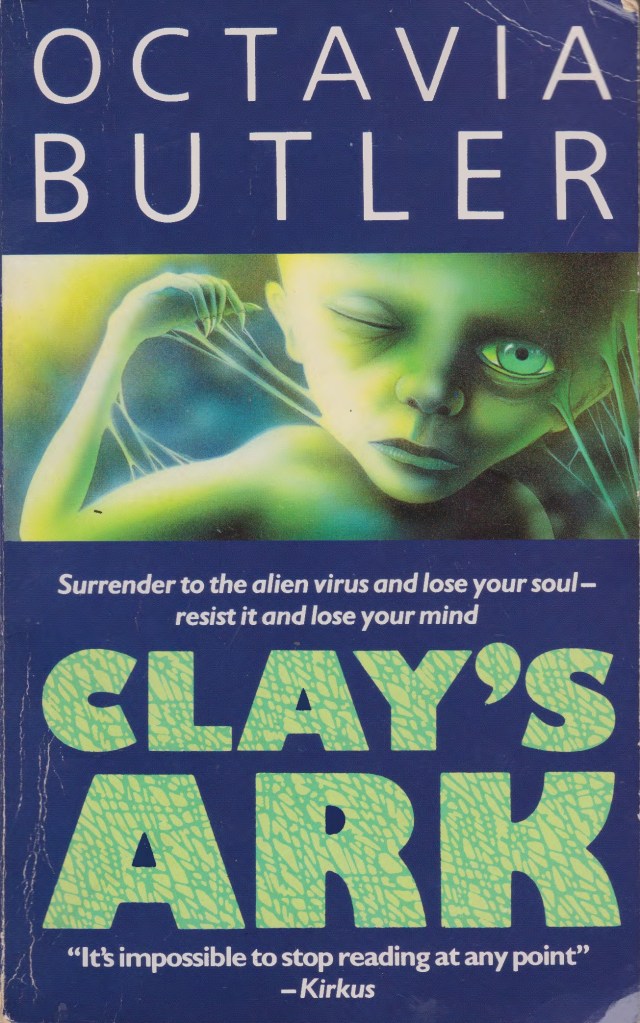
Danny Flynn’s cover for the 1991 edition
From the back flap: “In the future where casual barbarism and criminality are rife, the kidnapping of his doctor and his two daughters in the desert seems hardly exceptional–except that the kidnappers seem hardly human.
Victims of a ‘close encounter’, the desperate abductors have become infected with an alien virus so insidious and deadly that they have become exiled from their own race. The compulsion to spread the infection is fierce–to resist it is sheer mental torment–but to submit means to surrender ones humanity, and be ruled by an insatiable physical hunger, unhindered by morality or restraint.
The tension between the kidnappers and the kidnapped is stretched to breaking point as the virus threatens to overwhelm not only them, but the whole of humanity, body and soul.”
Initial Thoughts: Last year I read, and mostly enjoyed, Butler’s Mind of My Mind (1977) in the Patternist sequence. I now own all the volumes but the impossibly expensive (and disowned) Survivor (1978).
3. The Wolves of Memory, George Alec Effinger (1981)
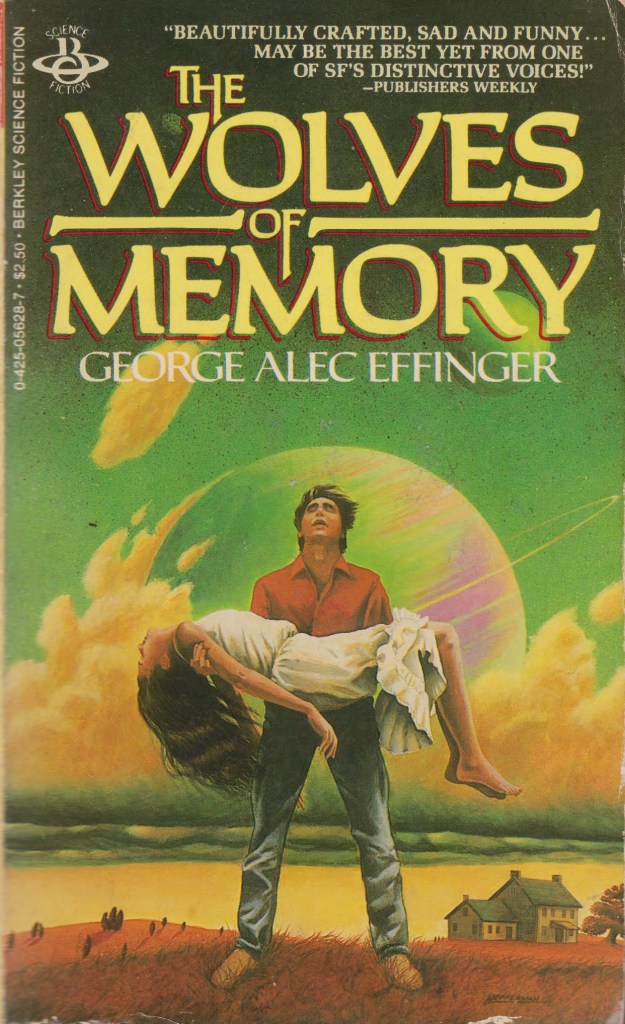
David Heffernan’s cover for the 1982 edition
From the back flap: “NO ONE EVER RETURNS FROM THE FARAWAY PLANET CALLED HOME.
When the bumbling idiots of the human race turned over their cares and woes to the infinitely superior mechanisms of TECT, they clearly made a wise choice.
Take the case of Sandor Courane. TECT offered to make him a college basketball star. When it turned out he could barely dribble, TECT gave him a second chance as a science-fiction writer. And when no one bought his book, TECT offered him a comfortable job on the assembly line of a Japanese auto plant.
When Courane had the effrontery to flunk as a screw-turned, TECT was even kind enough to send him to a rehabilitation program on a lovely pastoral planet.
The end-of-the-line world called Home.”
Initial Thoughts: Acquired on suggestion of Mark Pontin, Friend of the Site. For some reason, this one had escaped my knowledge of Effinger… Mostly likely the next Effinger I read.
4. The Barons of Behavior, Tom Purdom (1972)
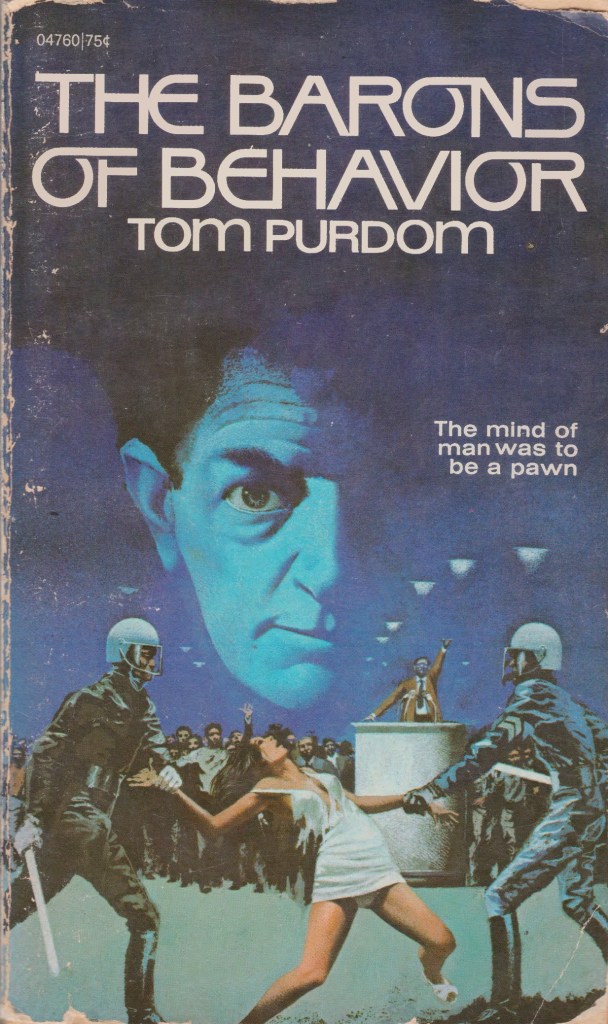
Karel Thole’s cover for the 1st edition
From the back flap: “Ralph Nicholson, psychotherapist to the psyched-out world, had discovered a terrible secret. Martin Boyd and his political machine were controlling all of Windham County by playing upon every psych technique in existence. Nicholson had only one way to combat Boyd’s machine and, incidentally, save his own life. Ralph Nicholson must built a better psycho-political machine to make the world safe for mankind’s collective mind.
But Nicholson face an established monster, and his only weapons consisted of his brain, his computer, his wife and finding the right dark horse candidate to be the puppet on his psychological strings. And while Nicholson searched and computer, Boyd’s machine was grinding ever closer to a final printout of mankind’s destiny.”
Initial Thoughts: Tom Purdom (1936-2024) earlier this year. I thought I should go ahead and read a some more of his work. Check out my recent review of his odd story of group marriage: “Courting Time” (1966).
For book reviews consult the INDEX
For cover art posts consult the INDEX
For TV and film reviews consult the INDEX


“Dinner” is somewhat unusual amongst Powers’ novels in that it’s set in the future; most of his work is set either in contemporary California or the past, frequently falling into the category of “secret histories” featuring real historical figures as secondary characters. I’d particularly recommend “The Anubis Gates”, “On Stranger Tides” and “Last Call”, but any of his novels, and occasional shorter works, are worth trying.
The fact that it was SF vs some of his better known works is why I tracked it down. I am even perversely interested in reading his first two SF novels from the infamously bad Laser Books press: The Skies Discrowned (1976) and Epitaph in Rust (1976).
Last Call and On Stranger Tides are published outside the range of my site.
The Anubis Gates is terrific fun.
So I’ve heard!
I found a copy of Crowley’s Beasts, and a certain other white whale of mine whose title I will conceal until I reveal my latest project.
I’m a big fan of Beasts. My review: https://sciencefictionruminations.com/2013/05/06/book-review-beasts-john-crowley-1976/
I keep thinking I should buy the shiny 15th anniversary of the 25th anniversary edition of Little, Big and then I rediscover it’s hard to get hold of and also 135 USD.
I’m fine with my old paperback. Ain’t no collector 😉
I bought the ceremonial edition (in 2006!) out of reverence for the work and the author. Sure is nice, but looks awfully cumbersome to actually read.
And the paperback still wins!
Speaking of which, I really should squeeze in another Crowley novel this year. It’s been too long since I’ve read him. Maybe Engine Summer…
Is there a canonical edition?
Joachim: ENGINE SUMMER would be a good next Crowley, the best of his three pre-LITTLE, BIG SF novels.
James: The ceremonial edition and the canonical edition of LITTLE, BIG are one–though there are degrees of ceremony, and I bought the lowest, the one for the groundlings.
As I’ve already read and reviewed The Deep and Beasts, I only have two choices within my area of focus 😉
Little Big or Engine Summer. And, I guess, a handful of early short stories…
His novella, The Great Work of Time is v good, but I think it’s a little late for your purposes. I don’t recall offhand which of his early stories would count as science fiction rather than fantasy.
I’m sure I read an interview back when Little, Big was published saying that he had written it and Engine Summer alternately, depending on which of them he was happiest working on. I guess he still had a lot of LB to write after he had finished Engine Summer though!
I too bought the anniversary edition of Little, Big back when it was launched. In fact Ron Drummond was visiting Edinburgh before he had decided to definitely do it and came into my shop. We chatted and I remember encouraging him to do it.
In retrospect, given its painful, rocky path to publication, this may have been a mistake, but it is a lovely edition!
Yeah, some of his earliest stories appear to be fantasy. That said, there seem to be a few SF ones. I know “Snow” (1985) is SF — it got a Hugo nod for best short story. And it looks like “The Green Child” (1981) and “Novelty” (1983) are as well.
Re LITTLE, BIG an d ENGINE SUMMER: Here’s a data point. Crowley says: “Even before [ENGINE SUMMER] was entirely finished, I had begun thinking of another book, a fairy tale that was actually a long novel in the realist tradition. . . .” LITTLE, BIG of course. This is from his essay “Practicing the Arts of Peace,” which I am reading in TWO TALKS ON WRITING, just issued as part of the “Conway Miscellany” (Crowley’s rummage sale) published by Ninepin Press. But I’ve read it before somewhere and it’s probably on the web. Anyway, it suggests that he was not actually writing the two books simultaneously even in part. (For whatever difference it makes–close to none, I’d say.)
Ah, fair enough. It’s an aging memory of mine and I’m not sure where I thought I had read that he was, at least in part, writing them simultaneously. Thinking about his next book while while finishing the current one isn’t too far away!
No doubt I’ll read the same essay fairly soon as my Conway Miscellany just arrived this morning!
The Wolves of Memory was a good one.
I plan on reading it soon. I’ve been, as you can probably tell, mostly reading short fiction as of late. Due to my incredibly stressful job, I find myself able to write about short stories at a more regular rate but I hope to integrate more novel reviews — including the Effinger — this year.
Short review posted!
CLAY’S ARK is Butler’s most unrelievedly grim book, and that’s against pretty stiff competition.
I thought Mind of My Mind was unrelievedly dark. Although that one tricks you into deeply caring for Mary until she becomes the new dictator… and the new elite over a legion of pawns.
Review of the Butler finally posted!
The blurb for The Barons of Behaviour is pretty intriguing. I love to see old SF that makes incorrect (but interesting) predictions about the future efficacy of such-and-such a technology. This sounds like it’s doing that for psychology?
I assume so. I haven’t read it yet.
I’m a sucker for SF that covers psychiatry and psychology — especially if they intersect with dreams.
For example, Roger Zelazny’s The Dream Master (1966) https://sciencefictionruminations.com/2014/04/19/book-review-the-dream-master-roger-zelazny-1966/
I was looking at that Tim Powers book on the shelf yesterday wondering whether I had enjoyed it. My memory of it was vague. Your post reminded me it was as an enjoyable read.
I’d seen it a few times at my local used book store and always assumed it was one of his fantasy novels. This time I actually picked it up and read the blurb.
I read Dinner at Deviant’s Palace in high school back in the 20th century. I have not read it since though which suggests it did not resonate with me. I do like Tim Powers though. I have read the Anubis Gates and On Stranger Tides more than once.
I was drawn to it as it’s SF vs. his normal fantasy topics. As a fan of SF about the post-apocalyptic wasteland and creepy cults, I am intrigued…
The edition I read had cover art by John Berkey which was an immediate draw for me as well his previous work. I might track it down and give it another read.
Let me know what you think. You’ll probably get to it long before me. Have so many plans at the moment that, unfortunately, don’t involve this book.
Well, bother. Christopher Priest died.
Yup. I saw the post from Nina Allen this morning. I plan on reviewing one of his early Dream Archipelago stories that I haven’t read yet. He’s a favorite of mine.
Powers established himself with The Anubis Gates. I enjoyed it enough to read a few more of his books, including this one. However, that was back in ’85. Think I enjoyed it? (McCannon is absolutely right in saying it’s not representative). I re-read Crowley’s Aegypt last year and enjoyed it every bit as much as I did the first time, maybe even more so.
I’ve read and reviewed Crowley’s first two SF novels — The Deep and Beasts. I enjoyed both.
That Powers’ does sound interesting, always up for a post-apocalyptic yarn. I’ve just started ‘Bug Jack Barron’ by Spinrad. It’s been a while since I went for a new wave type novel, trying to get myself back into the mindset of dealing with the style of prose that was more common then. I think it will end up being finished on holiday over the weekend when I have a bit more time to decide to it. After that I’ve got an old selection of short stories edited by Asimov ‘Machines That Think’ to begin and then maybe ‘Cure for Cancer’ by Michael Moorcock.
Bug Jack Barron is one of the few New Wave classics that I haven’t yet read. I’ve heard very mixed things about it (none of which prevent me from reading the novel, at least for my historically obsessive personal reasons).