Book Review: An Alien Heat, Michael Moorcock (1972)

nlnhtcpfnk1974

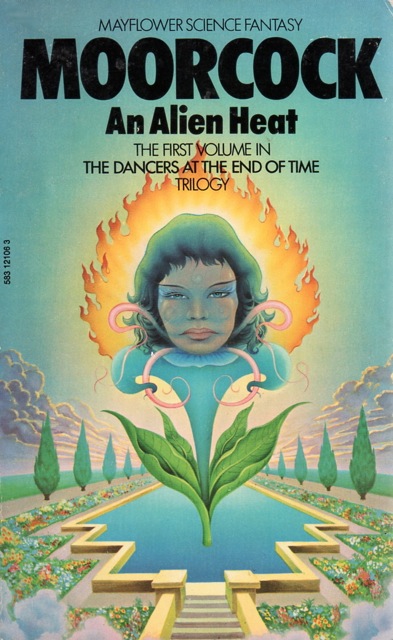
(Bob Haberfield’s cover for the 1974 edition)

3.25/5 (Vaguely Good)

Decay and the end of the world. There are so many ways to write about decadence and decay. M. John Harrison spins haunting tales of crumbling bodies paralleling crumbling landscapes—The Pastel City (1971) and The Committed Men (1971). Mark S. Geston in Lords of the Starship (1967) postulates some retreat into the “medieval” where the masses can be harnessed and manipulated. Michael Moorcock’s An Alien Heat (1972)—the first in The Dancers at the End of Time sequence—unfolds with comedy and wit in a far future where an “inherited millennia of scientific and technological knowledge” allows the remaining inhabitants to “play immense Continue reading

Updates: Recent Science Fiction Acquisitions No. CLXVII (Smith + Harrison + French SF Anthology + New Writings in SF Anthology)

Goodies!

Including a Richard Powers’ cover that might be among my favorites as it has a delightful architectural feel…. Do you have a favorite Powers?

I must fill the hole that is my lack of knowledge about Cordwainer Smith.  A source of many arguments!

Rachel S. Cordasco recently reviewed three stories by French women SF authors pre-1969 and I decided to track down the same collection.  And yes, the back cover is filled with purple prose… Plus hilarious back cover font which I will feature in a SF cover art post in the near future.

And another John Carnell anthology in his New Writings in SF series.  I featured the artist a few months ago here.

All the covers are scans of my own copies — if you click on the images you can see them in high resolution.

Enjoy!

1. Bill, The Galactic Hero, Harry Harrison (1964)harrison-bill-the-galactic-hero

(Richard Powers’ cover for the 1966 edition) Continue reading

Updates: Recent Science Fiction Acquisitions No. CLXVI (Saxton + Harrison + Whiteley + New Worlds Anthology)

Procuring SF paperbacks never gets old! I have started scanning in the covers (two of the four below) in order to provide higher quality images (click to zoom)— especially if they are hard to find images online and/or I find them aesthetically pleasing (Powers + Lehr in this post).

Let me know if the change is worth it!

Book rundown:

Josephine Saxton: Despite reading The Hieros Gamos of Sam and An Smith (1969) years ago, my mind still traces the imprint of its strange ritualistic beauty . Her short fiction was published in a range of SF magazines and collections from 1965 to 1992.  I have tracked down a copy of her first collection. Despite its 1985 publication date, eight of the fourteen stories were published in the 60s/70s.

Harry Harrison: A “classic” author whose work I need to explore more: I’ve read Deathworld (1960), attempted to read Make Room! Make Room! (1966) and A Transatlantic Tunnel, Hurrah (1972) at least three times, and Lifeship (1976), which he co-wrote with Gordon R. Dickson. I’ve encountered his short fiction here and there and found “By The Falls” (1970) a satisfying New Wave endeavor. Time for more short fiction!

New Worlds Anthology: I want all of them, end of story.

And finally, the selection bound to surprise and confuse my regular readers…. Aliya Whiteley: Despite my various protestations, I have not stopped reading new SF entirely.  And I couldn’t resist finding a copy of Whiteley’s well-received  fungal nightmare…. If you’re curious see Jesse’s review over at Speculiction.

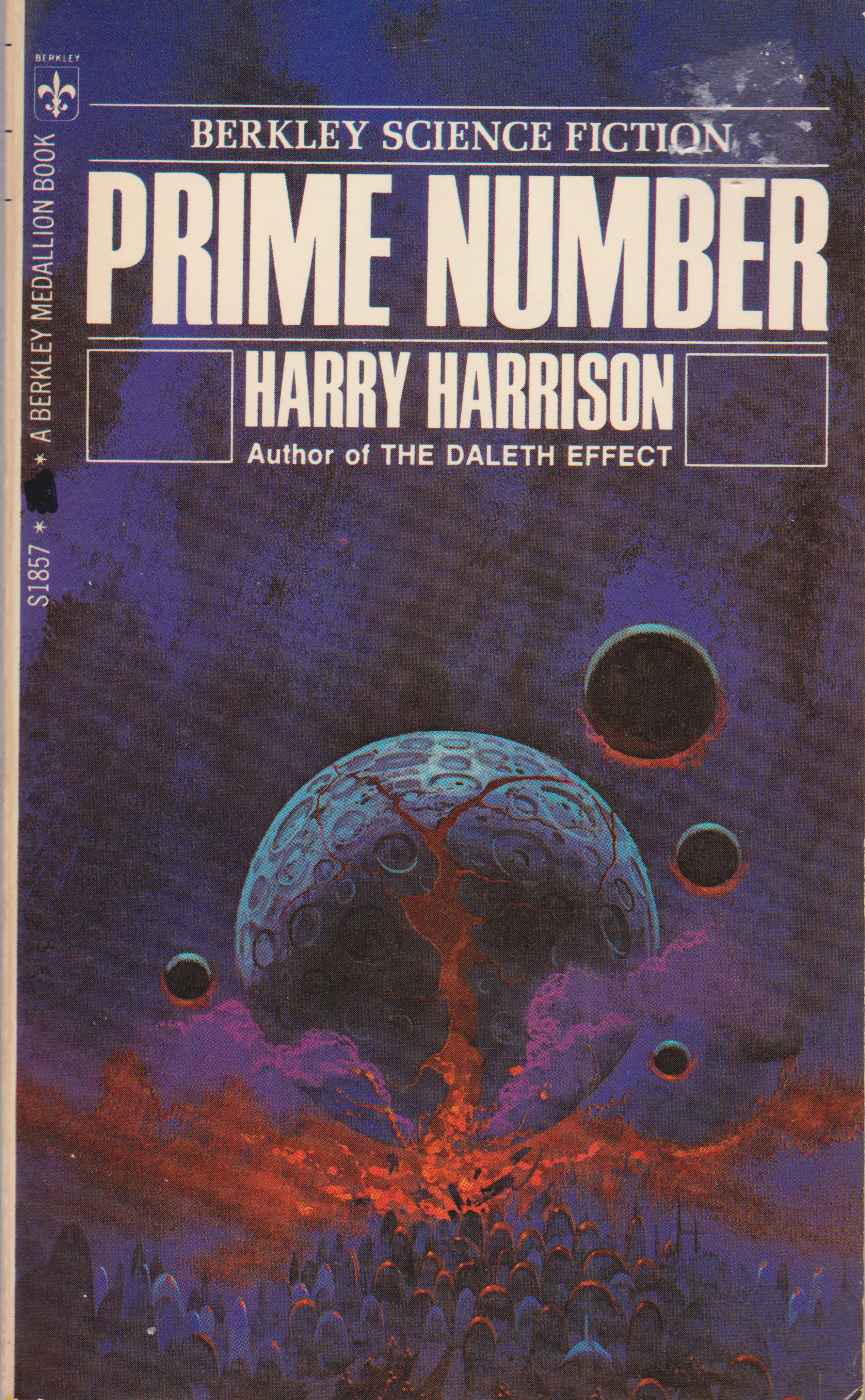
1. Prime Number, Harry Harrison (1970)

lehr-prime-numbers-harrison

(Paul Lehr’s cover for the 1970 edition) Continue reading

Book Review: Real-Time World, Christopher Priest (1974)

real-time-world

(Bruce Pennington’s cover for the 1976 edition)

3.75/5 (collated rating: Good)

Christopher Priest’s An Infinite Summer (1979) clocks in as my second highest rated single-author collection, behind Michael Bishop’s Catacomb Years (1979), so far in the life of my site.  I find Priest’s fiction intense and hypnotic.

As Real-Time World (1974) contains a range of Priest’s earliest published short stories, one cannot escape the feel that he is still trying to find his way as an author.  Similar indecision characterized his first novel Indoctrinaire (1970). The best stories in the collection revolve around the themes—the complex nature of perception and reality, psychologically unsettled environments and characters, voyeurism and performance—that his later Continue reading

Guest Post Series Announcement: SF Short Stories by Women Writers pre-1969

146532

(Richard Powers’ cover for the 1963 edition of A Handful of Time (1963), Rosel George Brown)

The time has come for a new Guest Post series on SF Short Stories by Women Writers pre-1969. My reasons are two-fold: 1) to showcase a deserving and fascinating topic in line with my goal to feature lesser known SF from a range of viewpoints and traditions 2) to feature posts from reviewers in the vintage SF blogsphere and beyond (in any combination of the following) that attempt to move past standard lists and grand narratives of canon, tackle fiction from evidence-based analytical and academic perspectives, or are simply darn good writers whose sites I cannot help but return to compulsively.

Why pre-1969? Although most endpoints are arbitrary in nature, 1969 saw the publication of Ursula Le Guin’s magisterial The Left Hand of Darkness. Considered a watershed moment in the history of women writers as it was the first to win a Hugo Award for best novel, Le Guin among many others were part of a rich (albeit oft suppressed and ignored) genealogy of women SF authors reaching back to Mary Shelly. My focus on short stories will allow exploration of many authors who did not write novels, whose novels overshadow their short fiction, and those whose rich body of early work focused predominately on the short form.

Thus I have rounded up my normal suspects along with new voices. The first guest post series covered the work of Michael Bishop and the second Kate Wilhelm.

Topics in the queue: Robot therapists, French and Soviet SF, a range of speculative fictions from the 19th Continue reading

Updates: Recent Science Fiction Acquisitions No. CLXV (Leiber + Haiblum + Scholz and Harcourt + Orbit Anthology)

Recently reminded of Fritz Leiber’s beautiful story “A Pail of Air” (1951) which I reviewed a few years ago in the eponymous collection, I was delighted to come across another one of his short story collections.  Thankfully, no Fafhrd and the Gray Mouser stories are in sight.  And of course, another Richard Powers cover…

On twitter I mentioned my ignorance regarding the work of Isidore Haiblum, the author of the “the first Yiddish SF novel” according to the blurb on The Tsaddik of the Seven Wonders (1971).  I have not come across a copy of that particular novel yet, but, another even lesser known quantity joins the books arrayed in piles across my library.

My dalliance with the 1980s continues in fits and starts: I wrote a short review of Christopher Priest’s masterpiece The Affirmation (1981) and recently reviewed Terry Carr’s edited volume Universe 10 (1980)…  As Carter Scholz’s short story “The Johann Sebastian Bach Memorial Barbecue and Nervous Breakdown” (1980) made such a positive impression on me, I decided to find a copy of his collaborative novel.

And I love Damon Knight’s Orbit series of original anthologies.  For reviews: Orbit 1 (1966), Orbit 3 (1968), and Orbit 8 (1970).

As always, thoughts/comments are welcome!

1. Fritz Leiber, The Night of the Wolf (1966)

thnghwlf111966

(Richard Powers’ cover for the 1966 edition)  Continue reading

Book Review: The Pastel City, M. John Harrison (1971)

screen-shot-2016-11-04-at-10-30-36-am

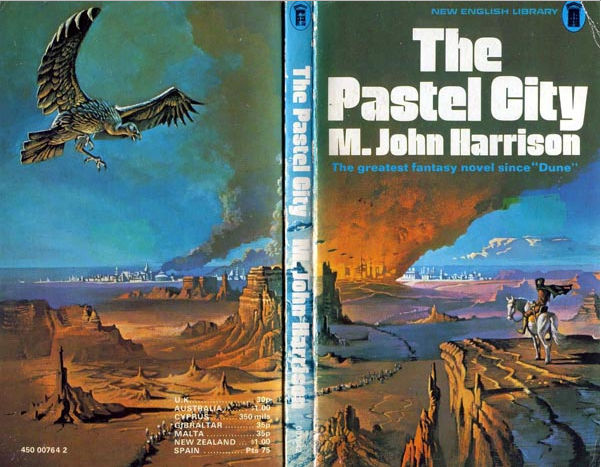
(Bruce Pennington’s cover for the 1971 edition)

4.25/5 (Very Good)

One of the previous owners of my copy of M. John Harrison’s The Pastel City (1971) must have harbored a pernicious grudge against corroded landscapes and nebulous morals.  So much in fact that they propped up the first volume of the Viriconium sequence against a tree and used it for BB gun target practice. I am still trying to identify the cause of the book’s other wounds… [pictorial evidence below].

As one can expect from Harrison, decadence and decay seeps from the quires of The Pastel City as characters try to create meaning, or grasp hold of half-formed Continue reading

Adventures in Science Fiction Cover Art: The Artists Behind the 1st ed. Cover of John Brunner’s The Sheep Look Up (1972)

thshplkpff1972

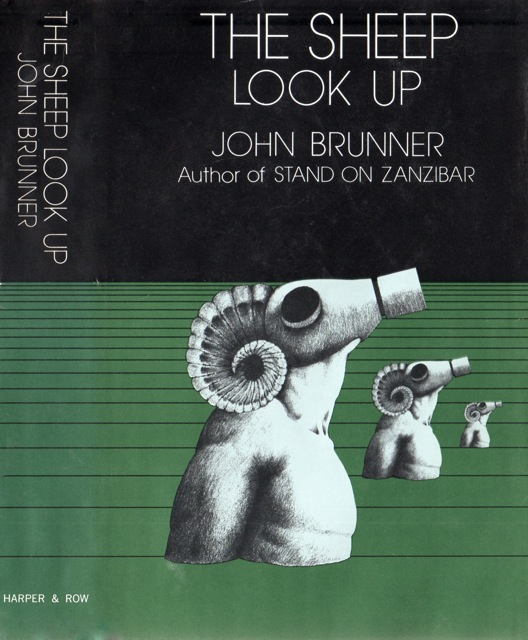
(Irving Freeman and Mark Rubin’s cover for the 1st ed. of The Sheep Look Up (1972), John Brunner)

John Brunner’s The Sheep Look Up (1972) would easily make my top fifteen SF novels of the 1970s—it’s far better than anything else he produced in the decade, although some might argue that The Shockwave Rider (1975) comes close.  Other than the novel’s unforgettable power, the first edition cover by Irving Freeman and Mark Rubio for Harper & Row remains seared in my memory.  The  1973 Ballantine first edition paperback also used the same art.

The harrowing nature of the story, decaying bodies/pollution, matches perfectly the ram-horned figures on human torsos, gas masks upturned… The distance to the horizon line, rendered via black horizontal lines, results in Continue reading

Book Review: Universe 10, ed. Terry Carr (1980) (Lafferty + Bishop + Tiptree, Jr., Waldrop, et al.)

screen-shot-2016-10-30-at-10-36-06-am

(Uncredited cover for the 1982 edition)

3.5/5 (collated rating: Good)

Fresh off Terry Carr’s novel Cirque (1977), I decided to return to his original Universe series of anthologies.  I’ve previously reviewed Universe (1971) and Universe 2 (1972).  As with the majority of SF anthologies, Universe 10 (1980) is sprinkled with both good and bad.  I selected it from the veritable sea of anthologies on my shelves due to the presence of authors I wish to explore further and those who are foreign to me: Michael Bishop and James Tiptree, Jr. in the former category; Lee Killough, Howard Waldrop, Carter Scholz, and F. M. Busby in the latter.

Michael Bishop’s “Saving Face”, James Tiptree, Jr.’s “A Source of Innocent Merriment,” and Carter Continue reading