Book Review: A Funeral for the Eyes of Fire, Michael Bishop (1975*)

funeral

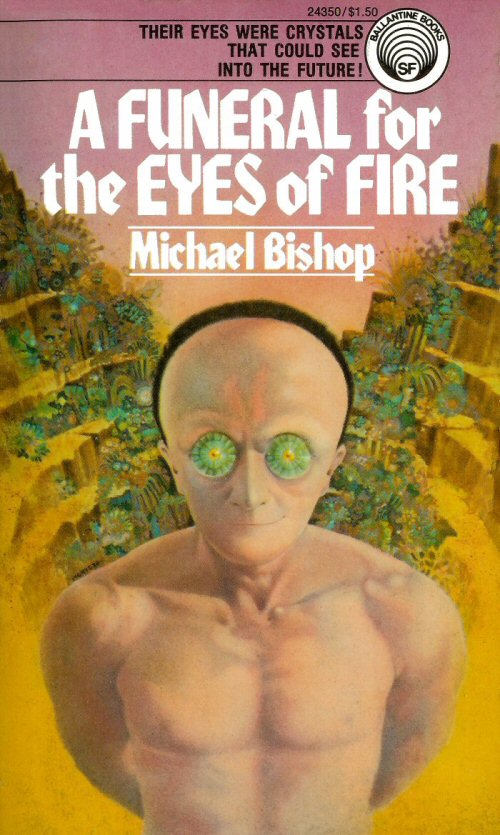
(Gene Szafran’s cover for the 1975 edition)

Nominated for the 1976 Nebula Award for Best Novel

5/5  (Masterpiece)

*First, a preliminary note on the publication history:  I read the original, unabridged 1975 edition.  However, Michael Bishop “completely rewrote” the novel in 1980 (according to ISFDB and his introduction to the later edition).  The 1980 rewrite—initially titled Eyes of Fire but later confusingly released under the original title, A Funeral For the Eyes of Fire-–was the one republished and recently available as an eBook through SF Gateway according to Bishop’s wishes.  I would prefer my readers, if they are interested in the volume, to not hesitate in snatching up the original.  I suspect both are worth reading.


Fresh off Michael Bishop’s strangely wonderful And Strange at Ecbatan the Trees (variant title: Beneath the Shattered Moons) (1976) I eagerly devoured his first published novel, A Funeral for the Eyes of Fire (1975)—and with this work, bluntly put, he enters my pantheon of favorite SF authors.  Bishop, completely in command of his narrative, weaves together a literary and anthropological tapestry filled with stories within stories and delicate interplay between these layers.

The deceptively simple premise unfurls into a complex and moving meditation on culture clash and the power of ritual, threatening at every moment to explode into violence.  This is perhaps the most sophisticated rumination I  Continue reading

Updates: Year in Review (Top Ten SF Novels + Top Ten Short Stories/Novelettes/Novellas + other categories)

Everyone likes lists!  And I do too….  This is an opportunity to collate some of my favorite (and least favorite) novels and shorter SF works I read this year.  Last year I discovered Barry N. Malzberg and this year I was seduced by…. Well, read and find out.


Top Ten Novels

1. We Who Are About To…, Joanna Russ (1976): A scathing, and underread, literary SF novel by one of the more important feminist SF writers of the 70s (of The Female Man fame).

2. A Funeral for the Eyes of Fire, Michael Bishop (1975): A well-written anthropological clash of cultures novel.  Slow, gorgeous, emotionally engaging….

3. Level 7, Mordecai Roshwald (1959): A strange satire of the bomb shelter…  Everyday surrealism. Continue reading

Book Review: The Men Inside, Barry N. Malzberg (1973)

(Ron Walotsky’s cover for the 1973 edition)

4.5/5 (Very Good)

Caveat: If a perverse (and Freudian) metafictional (and literary) retelling of Otto Klement and Jerome Bixby’s Fantastic Voyage replete with filmic flashbacks does not intrigue you then stay away….

There are few SF authors who utilize metafictional elements as gleefully and effectively as Barry N. Malzberg.  Beyond Apollo (1972), his masterpiece, is a labyrinthine sequence of 67 short chapters of a novel written by the main character who may or may not be recounting real (imagined?) events.  While in In the Enclosure (1973) the excruciating paranoia that permeates the pages and the impossible escapes that transpire, recounted as if they were entries in a diary, could indeed be generated by an external force—the exact nature of which is unknowable—implanting memories.  Revelations (1972) was entirely comprised of a sequence of documents (interview transcripts, diary fragments, epistolary fragments) Continue reading

Book Review: The Downstairs Room and Other Speculative Fiction, Kate Wilhelm (1968)

(Ron Walotsky’s cover for the 1968 edition)

4/5 (collated rating: Good)

By the late 60s Kate Wilhelm’s SF moved from generally uninspiring pulp (à la the collection The Mile-Long Spaceship) to psychologically taught and emotive mood pieces exploring the almost existential malaise of daily existence and the disturbing effects of “programmed” lives (especially the housewife).  The fourteen short-stories in The Downstairs Room and Other Speculative Fiction (1968) (the term “speculative fiction” was coined by Judith Merril in the 60s) comprise a snapshot of Wilhelm’s best New Wave work.  It should be noted that not all are SF.

Although some are less engaging than others, her harrowing portrayal of starlets subjected to endless psychological torments at the whims of their viewers in “Baby, You Were Great” (1967) (Nebula nominated) and the evocative tapestry of daydreams Continue reading

Adventures in Science Fiction Cover Art: Fractured Bodies (unraveling, decaying, [de]constructing)

CRMPTNDVDD1979

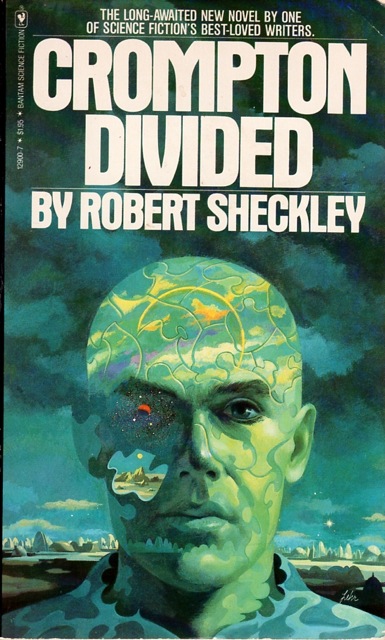
(Paul Lehr’s cover for the 1979 edition of Crompton Divided (variant title: The Alchemical Marriage of Alistair Crompton) (1978), Robert Sheckley)

Paul Lehr’s cover for the 1979 edition of Robert Sheckley’s Crompton Divided (1978) was the inspiration for this post.  I found the cover many years ago while looking through Lehr’s entire (mostly brilliant catalogue) and was intrigued.  The man, comprised of puzzle-like pieces that slowly morph into the swirls of his clothes, stares at us with hybridized eyes — a planet, a pupil — while one missing puzzle piece allows the viewer a glimpse of a barren landscape.  His brain, entirely a puzzle, is complete, but are his senses crumbling?

 Dean Ellis’ cover for the 1971 edition of Larry Niven’s collection All the Myriad Ways (1971) is even more fantastic — the puzzle pieces (bones, faces, limbs) dangle in the air Continue reading

Updates: Recent Science Fiction Acquisitions No. LXXIX (Haldeman + Chalker + Oliver + Anderson)

Some Chicago finds from Powell Books (Hyde Park)…  I own too many SF novels in my to read pile (I have close to 300 waiting to be read so I am going to try to put a stop on rampant — yes, they are cheap — purchases).

Last one of these for a while?  Should I take bets?

Some titles definitely not my normal fare — I’ve read Haldeman’s The Forever War (1975), Forever Peace (1999), and Forever Free (1999) but not a single one of his short stories so Infinite Dreams (1978) is a welcome addition to my collection.

Chad Oliver is one of the “second-tier” greats whom I’ve not read…. And Chalker falls in that category as well.  Poul Anderson’s The Byworlder (1971) is generally not considered one of his best but it did snag a Nebula award nomination.

Thoughts?

1. Infinite Dreams, Joe Haldeman (1978)

(Clyde Caldwell’s cover for the 1979 edition) Continue reading

Updates (New Resource): List of Immortality Themed SF (a call to contribute!)

This post is a call for readers to submit their favorite immortality themed science fiction NOT included on my list below (and even examples they did not care for so I can make this a more substantial resource).  I’ll make a page with all the information I receive for easy consultation soon (INDEX of similar pages/articles).

A while back I started gathering a list of titles — via SF Encyclopedia, other online resources, and my own shelves — on immortality themed SF.  I have always been intrigued by the social space (one plagued by violence and despair or buoyed by the hope of a better future) that the possibility of immortality might generate.

I would argue that the single best example of social effects that the possibility of immortality might create is Clifford D. Simak’s Why Call Them Back From Heaven? (1967).  In similar fashion, James Gunn’s The Immortals (1962) takes place in a world where immortals do exist, they skirt Continue reading

Book Review: A Way Home, Theodore Sturgeon (1956)

(Mel Hunter’s cover for the 1956 edition)

3/5 (collated rating: Average)

Although Theodore Sturgeon is generally considered a master of the SF short form, his collection A Way Home (1956) contains only two worthwhile stories — “Thunder and Roses” (1947) and “Bulkhead” (1955).  The rest I was either unable to finish or struggled to muddle through over the course of the last two or so weeks.  Fortunately,  the near masterpiece “Bulkhead” was almost worth the pain induced by the intelligent dog related subgenre of SF manifest in “Tiny and the Monster” (1947) or the cute accidentally destructive hurkle kittens of “The Hurkle Is a Happy Beast” (1949).

At this stage in my recent endeavor to brush up on the best of the 50s short story wordsmiths, I place Sturgeon below Robert Sheckley, Brian Aldiss, Philip K. Dick, Fritz Leiber, Miriam Allen deFord, Lester del Rey, Walter M. Miller, Jr., C. M. Kornbluth, and Frederik Pohl. (shocking to some, I know!).

However, before I make a more definitive conclusion I call on my readers to list what you consider his best short work Continue reading

Adventures in Science Fiction Cover Art: Diagrammatic Wonders (alien sand art + planning invasions + and other more mysterious formulations), Part I

1-1957_04_fantasticuniverse_finlay

(Virgil Finlay’s cover for the April 1957 issue of Fantastic Universe, ed. Hans Stefan Santesson)

At first glance this is a miscellaneous collection of covers on diagrammatic wonders — the aliens (or “advanced” humans) on Virgil Finlay’s cover for the April 1957 issue of Fantastic Universe conjure an image of earth with colored sand, generals plot invasions via maps and other diagrams depicting troop movements….

While some of the covers are themselves diagrams (Christopher Zacharow’s cover for the 1985 edition of Ancient of Days (1985), Michael Bishop) others place their characters in opposition to each other as pieces Continue reading