In The Drift (1985), a fix-up novel comprised of two Nebula-nominated short works–“Mummer Kiss” (1981) and “Marrow Death” (1984), maps a new way forward in an ecologically and genetically ravaged post-apocalyptic age. The entire concoction decays with a sense of grim unease and cavorts around piles of dead that would make a triumvir from the Late Roman Republic proud. It’s a violent, erotic, and disquieting experience that can’t entirely hide its flaws behind the decadent panache.
What pre-1985 science fiction are you reading or planning to read this month? Here’s the November installment of this column.
Last week I wrote a post about Clifford D. Simak’s delightfully inclusive 1971 speech at the height of the New Wave in which he celebrated science fiction as a “forum of ideas” open to all voices. While reviewing the various snarky comments leveled at the movement by “classic authors” like Asimov, a faint memory of James Blish’s own anti-New Wave sentiments tickled my memory. I randomly opened up a book on my desk to figure out a fascinating SF tidbit to start this post, and voilà, the James Blish story.
Jacqueline Foertsch’s Reckoning Day: Race, Place, and the Atom Bomb in Postwar America (2013) contains a sustained analysis of Samuel R. Delany’s various post-apocalyptic novels. She includes a discussion of the response to Delany’s Nebula-winning The Einstein Intersection (1967). At the 1968 Nebula Awards Banquet, moments after Delany received his prize for Einstein (and where moments later he’d collected another award for “Aye, and Gomorrah”), Blish lambasted the New Wave. Blish complained about the “loosening of the genre’s parameters” and the “re-christening of the genre” as “speculative fiction” (98). I find all of this hilarious as Blish himself wrote fantasy novels like Black Easter (1968) (that would also nab a 1969 Nebula nomination) and far earlier oblique proto-New Wave speculative fictions like “Testament of Andros” (1953). I wonder if Blish aimed such vitriol at a figure like Simak, who took the loosening of the genre’s parameters to extremes during the New Wave–i.e. novels like The Goblin Reservation (1968), Destiny Doll (1971), and Out of Their Minds (1970). Unfortunately, I don’t think it’s surprising that Blish took especial issue with one of the few black SFF authors of the day.
And let me know what pre-1985 science fiction you’ve been reading!
In the past few years, I’ve put together a series on the first three published short fictions by female authors who are completely new to me or whose most famous SF novels fall mostly outside the post-WWII to mid-1980s focus of my reading adventures.
Today I’ve selected the first four stories by an author I’ve only recently started to read–Leigh Kennedy (1951-). I’d previously reviewed “Helen, Whose Face Launched Twenty-Eight Conestoga Hovercraft” (1982) and placed her on the list for this series. According to SF Encyclopedia, Kennedy’s “writing is succinct, polished, lucent, and her stories are emotionally penetrating; it is unfortunate that she has fallen from the world of novel publishing, though continuing to work as a professional indexer.” And I can’t agree more! Her first four stories show great promise and moments of refined vision. I can’t help but think the backlash to her Nebula-nominated (and best-known work) “Her Furry Face” (1983) might have had some effect on her trajectory.
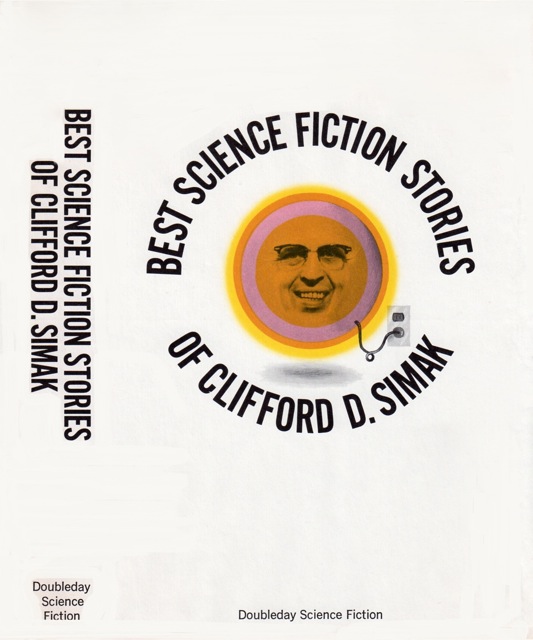
I can’t get off my Clifford D. Simak (1904-1988) kick–the author that’s defined, directly and indirectly, my 2024 reading and writing adventure. Rather than hunt for more stories on the theme of organized labor, I fished out a collection languishing in a dusty corner of my shelves instead. Best Science of Science Fiction Stories of Clifford D. Simak (1967), not to be mixed up with the later collection The Best of Clifford Simak (1975), contains seven short stories published between 1954-1963. Of the bunch, “Founding Father” (1957) ranks amongst the best of Simak I’ve read. Only one, “Lulu” (1957), should be avoided.
While I still recommend City (novelized 1952) for readers new to Simak, this collection contains a nice representative group of stories from those nine years.
Short Summaries/Analysis
“Founding Father” (1957), 4.75/5 (Very Good). First appeared in Galaxy Magazine, H. L. Gold (May 1957). You can read it online here.
Ted White (1938-) took over as editor of Amazing Science Fiction and Fantastic from Barry N. Malzberg in October, 1968. As the magazines were bi-monthly and Malzberg had already acquired stories for multiple later issues, White’s first issues appeared in 1969. He’d accepted the position on the condition that he phase out the reprints (not acquired by White) slowly over multiple years.1 Apparently while White was not a fan of the New Wave movement, he “was all for more daring fiction exploring adult themes and saw no reason why these stories could not co-exist alongside more traditional stories.”2 Thus, his two magazines attempted to appeal to a wide-range of readers.
By the early 1970s, White demonstrated growing interest in even “greater liberalization of science fiction, in line with what was happening to youth nationwide.” He saw SF as “a vehicle to push back on the barriers of the ‘establishment’, with no suppression of soft drugs, ‘healthy sex,’ or free expression.”3 His magazines included stories emphasizing future sex in all its forms” far more frequently than its competitors.4 As the pay rates of both magazines were low–White could only pay 1 cent a word vs. 3 cents for the bigger magazines of the day–he attempted to appeal to writers who did not mesh well with the “establishment.”5
White did not earn a living wage as the editor despite the magazines consuming much of his time. In order to cobble together a meager living he also served as art director (which included cutting and pasting each issue) and wrote stories to publish in his own magazines!6 White’s first professional stories appeared in 1962 after a decade of fan writing.
This post includes three of White’s own violent and bleak visions of future society that appeared in Amazing and Fantastic. While he might not have been a fan of the experimental tendencies of the movement, his obsession with violating taboos, scenes of urban decay, and general miasmic gloom are certainly on display.
I am increasingly fascinated by the more radical, bleak, and grimy stories within White’s magazines–both from his pen and others–and plan on exploring more. See my earlier reviews of Lisa Tuttle’s “Stone Circle” (1976) and Grania Davis’ “New-Way-Groovers Stew” (1976).
Let’s get to the stories!
Jeff Jones’ cover for Amazing Science Fiction, ed. Ted White (May 1971)




 Science Fiction and Other Suspect Ruminations