Short Story Review: Izumi Suzuki’s “Terminal Boredom” (1984, trans. by Daniel Joseph 2021)

Today I’m joined again by Rachel S. Cordasco, the creator of the indispensable website and resource Speculative Fiction in Translation, for the sixth installment of our series exploring non-English language SF worlds. Last time we covered Arkady and Boris Strugatsky’s ruminative “Wanderers and Travellers” in International Science Fiction, ed. Frederik Pohl (November 1967).

Please note that Rachel and I are interested in learning about a large range of authors and works vs. only tracking down the best. That means we’ll encounter some stinkers. Thankfully, not this time! We got a powerful one.

Unfortunately, Izumi Suzuki’s “Terminal Boredom” (1984, trans. by Daniel Joseph 2021) does not exist online. A large range of her SF stories were translated and published in two volumes by Verso books with various translators. You can acquire Terminal Boredom (2021) and Hit Parade of Tears (2023) at relatively inexpensive prices online. Despite my substantial qualms with the editions (see my review below), I recommend acquiring them.

“Terminal Boredom” (1984) does double duty as the 35th installment of my review series on media landscapes of the future.

Previously:  George H. Smith’s “In the Imagicon” (1966).

Up Next: TBD

Enjoy!


Rachel S. Cordasco’s Review

In an article on the “iconoclast” Japanese sf writer Izumi Suzuki, Andrew Ridker distills her stories down to three words: “Ambivalence, disappointment, resignation: Suzuki’s stories speak so eloquently to our burnt-out moment that it’s easy to forget the importance of her cultural context” (LitHub, 5/7/21). We are indeed burnt out, more burnt out even than when Ridker was writing just four years ago. It’s now 2025 and time to face the fact that Facebook and YouTube have been around for over twenty years. The iPhone has been around for nearly that long, and for an entire year, the world was turned upside down during a pandemic, during which time we were even more closely connected to our devices. We’re burnt out by phones, by the rapidly-developing world of AI, by the streaming services that offer us so many choices that it’s nearly impossible to pick something to watch.

Continue reading

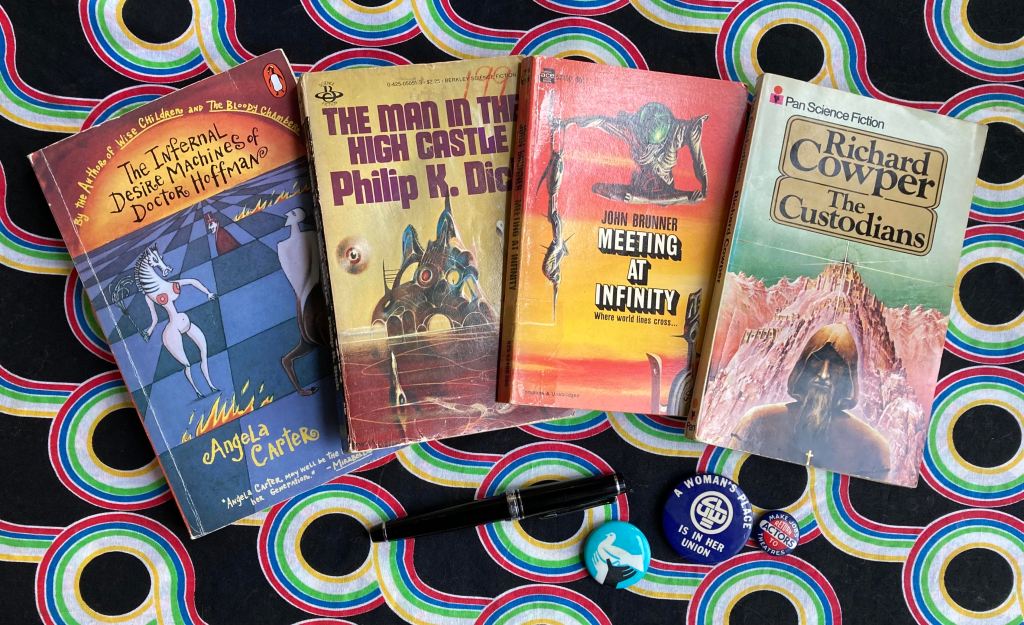
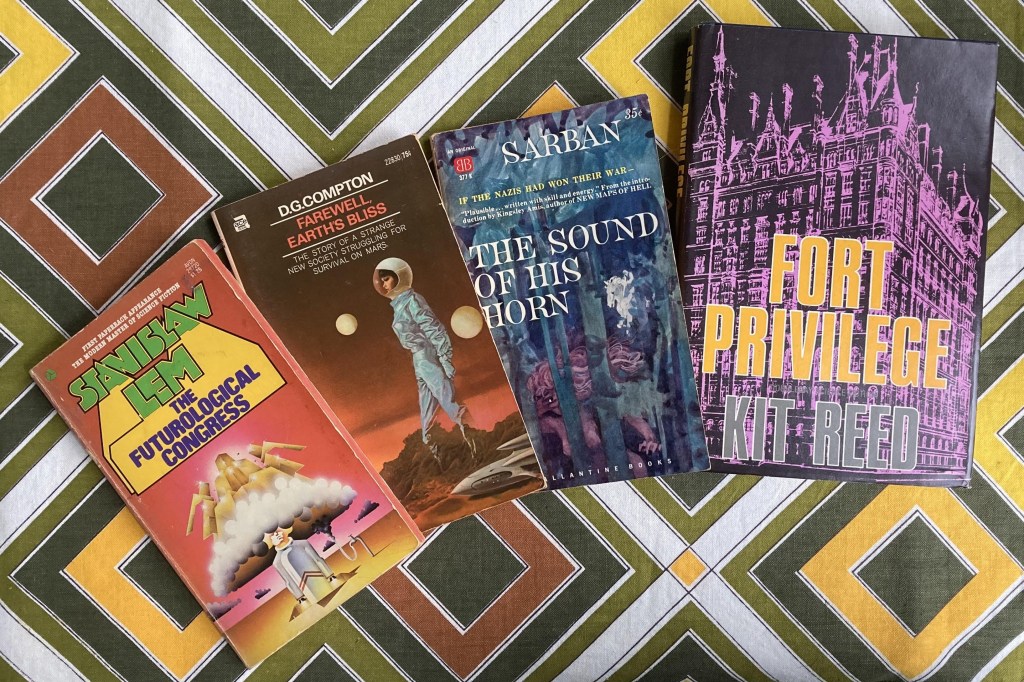
Updates: Recent Science Fiction Purchases No. CCCXLVI (Kim Stanley Robinson, Miriam Allen DeFord, Keith Laumer, and Jack Dann)

Which books/covers/authors intrigue you? Which have you read? Disliked? Enjoyed?

Finally acquired a new scanner!

1. The Memory of Whiteness, Kim Stanley Robinson (1985)

From the back cover: “In the 33rd century humanity is scattered among the planets of the Solar System. Millions of lives depend on the revolutionary physics of Arthur Holywelkin; millions of hears are moved by the music created by the strange, eerie instrument he built in the last years of his life: the Orchestra. Johannes Wright is the Ninth–and youngest–Master of the Orchestra. But as he sets out on his first Grand Tour of the Solar System, unseen foes are at his heel, ready to reveal all but the meaning of their enmity. In confronting them, Wright must redefine the Universe–for himself and all humanity.”

Continue reading

Book Review: Octavia E. Butler’s Clay’s Ark (1984)

4.5/5 (Very Good)

Octavia E. Butler’s Clay’s Ark (1984) is the final published volume of her Patternist sequence (1976-1984).1 It is the third novel according to the internal chronology of the series. Clay’s Ark is, without doubt, the most horrifyingly bleak science fiction novel I have ever read.2 It’s stark. It’s sinister. It’s at turns deeply affective before descending into extreme violence and displaced morality. The moral conundrum that underpins the central problem, the spread of an extraterrestrial disease, unfurls with an unnerving alien logic. Butler’s characters are trapped by the demands of the alien microbes, scarred by the pervasive sense that their humanity is slipping away, and consumed by the fear of starting an epidemic. A true confrontation of the moment cannot lead to anything other than suicide or the first steps towards an apocalyptic transformation.

Continue reading

What pre-1985 science fiction are you reading? + Update No. XXVI

What pre-1985 science fiction are you reading or planning to read next month? Here’s the August installment of this column.

The Power of the List. I adore lists. I’ve compiled lists of science fiction stories on my site about generation ship stories, immortality (abandoned), overpopulation (abandoned), and sports and games (abandoned). I religiously update my SF Novel and Short Story Review index and the Best SF Novels I’ve reviewed index. In your exploration of genre, I imagine you’ve encountered a “Best Of” list that horrified you — they tend to generate controversy, argument, and all sorts of impulsive takes. Lists can be dangerous. Lists can suggest canon. Lists exclude. Lists can be incomplete. Lists can motivate. Ian Sales, a long-time critic, author, and visitor to my site, created the SF Mistressworks (unfortunately, also abandoned) website in response to an egregious list that demonstrate utter ignorance about the wonderful SF written by women.

Continue reading

Short Fiction Review: John Wyndham’s “The Man From Beyond” (variant title: “The Man from Earth”) (1934)

The following review is the 36th installment of my series searching for “SF short stories that are critical in some capacity of space agencies, astronauts, and the culture which produced them.” Some stories I’ll review in this series might not fit or are poor quality. And that is okay. I relish the act of literary archaeology.

Why John Wyndham? I snagged a copy of David Seed’s new book John Wyndham (2025) out via University of Liverpool Press and realized how little I knew about his pre-War science fiction.1 This story, among a few others, jumped out to me due to its critical stance on human exploration.

Previously: E. C. Tubb’s “Without Bugles” (1952), “Home is the Hero” (1952), and “Pistol Point” (1953)

Up Next: Clifford D. Simak’s “Madness from Mars” (1939)


3.5/5 (Good)

John Wyndham, writing as John Benyon Harris, published “The Man from Beyond” (variant title: “The Man from Earth”) in Wonder Stories, ed. Hugo Gernsback (September 1954). You can read the story online here.

The Contours of Venusian Wonder

Continue reading

What pre-1985 science fiction are you reading? + Update No. XXIII

What pre-1985 science fiction are you reading or planning to read next month? Here’s the May installment of this column.

In my interview with Jaroslav Olša, Jr. about his book Dreaming of Autonomous Vehicles: Miles (Miroslav) J. Breuer: Czech-American Writer and the Birth of Science Fiction (2025), an interesting methodological question jumped out to me: what is the role of more ephemeral publications outside of Hugo Gernsback in the early history of genre? A bit of context: Miles J. Breuer also wrote in Czech. He published stories in Czech-language publications aimed at the immigrant community far earlier than their re-written versions appeared in Gernsback’s Amazing. In addition, he published in various medical journals (that occasionally ran SF) and university publications. As Olša points out in the interview, it obviously depends on the questions asked by the historian — and these publications had small audiences that make it hard to ascertain “influence” or “inspiration” for later authors. Food for thought.

Before we get to the photograph above and the curated birthdays, let me know what pre-1985 SF you’re currently reading or planning to read! 

Continue reading

What pre-1985 science fiction are you reading? + Update No. XXII

What pre-1985 science fiction are you reading or planning to read next month? Here’s the April installment of this column.

As readers of the site know, I am obsessed with the machinations of Cold War nuclear logic—historical and science fictional. In Ira Chernus’ brilliant Apocalypse Management: Eisenhower and the Discourse of National Insecurity (2008), he dives into the Manichean ideoscape that dominated Eisenhower’s thinking. In short, he posits that Eisenhower interpreted the Soviet threat as an apocalyptic struggle in which the traditional outcome, eliminating the treat, is impossible. Instead the best hope is “to contain and manage it forever” (2)–hence “apocalypse management.” This “new linguistic paradigm” profoundly influenced their policymaking process and dominated American public discourse.

According to Chernus, Eisenhower was obsessed with Americans practicing voluntary self-control in their consumption in order shoulder the taxes needed to fund the perpetual struggle. With this paradigm, Eisenhower’s gestures towards peace–for example his “The Chance for Peace” (April 16th, 1953) speech–were acts of calibrated psychological warfare designed to put the burden of action on the Soviets and score points with the American public and American allies. The United States, on the other hand, could wage the conflict with perpetual, safe, and managed inaction in which peace is never the ultimate objective.

Continue reading

What pre-1985 science fiction are you reading? + Update No. XXI

What pre-1985 science fiction are you reading or planning to read this month? Here’s the March installment of this column.

Recently I came across John Boston and Damien Broderick’s three-volume series examining each and every story and non-fiction article in the pre-Michael Moorcock New Worlds and Science Fantasy/SF Impulse magazines in the UK. John Boston is a valued member of my site’s community — frequently stopping by in the comment sections. I thought for this mini-editorial I’d list a handful of active community members with websites, books, and worthwhile SF-related fanzine articles. I, of course, could be missing a few. Community matters more than you might think. I enjoy the discussion. I enjoy reading reviews that others write — even if it’s on science fiction that might not be within my more narrow focus (the historian in me). I always want to learn and share what’s worth reading and/or historically interesting. Thank you one and all.

Continue reading

Science Fiction in Dialogue with The Great Depression: Frank K. Kelly’s “Famine on Mars” (1934)

Sherwood Anderson (1876-1941) confides in the introduction to his travel memoir Puzzled America (1935) that the Great Depression was inescapable: “I was a writer of tales. It might be that I should have remained just that, but there is difficulty. There are, everywhere in America, these people now out of work. There are women and children hungry and others without enough clothes.”1 Edgar Albion Lyons, in the author’s note to his science fiction novel The Chosen Race: A Novel Based on the Depression and Machine Age (1936), echoes this sentiment: “The following chapters were written during the months of 1932 when the words ‘Depression’ and ‘Unemployment’ were on everyone’s lips.”2 Magazine science fiction, with its eye towards the marvelous technological future, likewise could not escape contemporary economic, political, and societal convulsions.3 Science, “in the form of a hypothesized device or theory,” enabled exciting adventures but also the exploration of “diverse and dire social implications.”4

On May 9th, 1934, a massive two-day dust storm caused by severe drought and human-made factors, removed massive amounts of Great Plains topsoil. The Dust Bowl unleashed its fury. The dust clouds reached Chicago and cities in the east, blotted out the Statue of Liberty and the United States Capitol. Red snow fell in New England.5 In the September 1934 issue of Astounding, a twenty-year-old Frank K. Kelly published “Famine on Mars” (1934) about a desperate attempt to assist Martians dying of thirst and starvation after a drought. In Kelly’s vision, The Combine, Earth’s government, deliberately caused the genocide and refuses to provide assistance.6

Continue reading